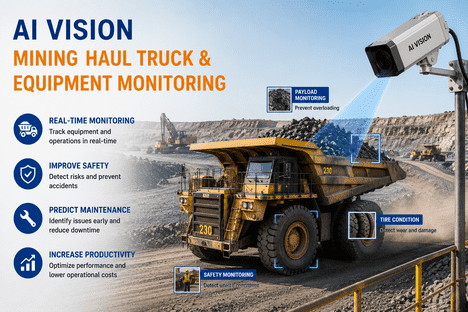
AI vision for mining haul truck and equipment monitoring is rapidly becoming the operational standard for surface and underground mines that can no longer accept the cost of unplanned downtime, overloaded trucks, compromised tires, or equipment failures discovered too late for planned intervention. Haul trucks in open-pit mining operations account for up to 50% of total operating costs, and a single unscheduled breakdown on a CAT 793 or Komatsu 930E can cost more than $15,000 per hour in lost production before a single repair dollar is spent. Traditional condition monitoring methods — periodic oil analysis, manual visual inspections, and vibration sensors — provide snapshots of equipment health but consistently fail to catch progressive defects between inspection intervals, and they cannot monitor load levels, tire conditions, fragmentation quality, or shovel GET wear in real time at production speed. iFactory's AI vision platform addresses each of these gaps with deep learning-based object detection deployed at the edge — operating without connectivity constraints in the harsh, dust-laden, high-vibration environments where mining equipment works hardest.
Why Conventional Monitoring Fails in Mining Environments
The operating environment of a surface mining haul fleet is among the most demanding for any monitoring technology. Dust concentrations that blind standard cameras, vibration levels that destroy conventional sensor mountings, extreme temperature swings from freezing overnight lows to desert daytime highs, and the sheer scale of open-pit operations — where a single haul route can span several kilometers — collectively defeat the monitoring architectures designed for controlled industrial environments. Mining operations deploying standard industrial vision systems discover quickly that camera fouling, network latency on remote sites, and model performance degradation under variable lighting conditions make those systems unreliable precisely where reliability matters most. The consequence is that most mining fleets still rely on operator judgment for load assessment, manual shift inspections for tire condition, and calendar-based maintenance intervals for equipment health — approaches that consistently miss early-stage defects and allow avoidable failures to develop into full breakdowns during production shifts. iFactory's AI vision platform is engineered specifically for these constraints: ruggedized edge AI units that process vision data locally without cloud connectivity, deep learning models trained on mining-specific defect and condition datasets, and sensor configurations designed to maintain imaging performance in high-dust, high-vibration installations on haul trucks, excavators, and fixed crushing stations.
Five Core AI Vision Monitoring Capabilities for Mining Operations
iFactory's AI vision object detection platform delivers five distinct monitoring capabilities across the mining haul and equipment workflow — from pit floor loading through haul road operation to dump and crusher delivery. Each capability operates independently or as part of an integrated monitoring architecture that connects to the mine's fleet management system and CMMS via REST API. Mining operations ready to see all five capabilities demonstrated on their specific equipment and site conditions can Book a Demo with iFactory's mining vision specialists.
| AI Vision Capability | What It Detects | Equipment Covered | Operational Benefit |
|---|---|---|---|
| Load Level Detection | Truck fill level (0–100%), overload, underload, uneven distribution | Haul trucks at loading point | Eliminates overloading, optimizes payload per cycle |
| Tire Condition Monitoring | Sidewall cuts, tread wear, bulging, debris embedment, flat detection | All mining haul trucks | 35–40% tire life extension, blowout prevention |
| Fragmentation Analysis | Particle size distribution, boulder detection, P80 measurement | Shovel bucket, blast muck pile | Optimizes blasting, improves shovel bucket fill factor |
| Shovel GET Monitoring | Tooth wear, missing teeth, lip shroud condition, adapter damage | Electric and hydraulic shovels | Prevents crusher jams, reduces GET replacement cost |
| Equipment Structural Health | Body cracks, frame deformation, hydraulic leaks, undercarriage wear | Haul trucks, excavators, dozers | Converts unplanned failures to scheduled maintenance events |
Each capability is powered by convolutional neural networks trained on mining-specific image datasets covering the full range of conditions encountered in open-pit and underground operations — variable lighting, dust haze, mud accumulation, and equipment age variation. Detection confidence scores are generated for every inference event and logged with timestamp, equipment ID, and GPS coordinates for integration into fleet management and maintenance scheduling systems.
Haul Truck Load Level Detection: Eliminating the Most Costly Payload Errors
Payload management is one of the highest-leverage optimization opportunities in open-pit mining. Chronic overloading of haul trucks — even by 5–10% above rated capacity — accelerates tire degradation, increases frame fatigue, and shortens powertrain service life at a rate that compounds across every cycle of every shift. Chronic underloading wastes truck capacity, increases fuel cost per tonne moved, and requires additional truck cycles to move the same volume of material. Shovel operators relying on visual judgment and experience consistently produce payload variance of 15–25% between loads, generating both overload and underload events throughout every production shift. iFactory's AI vision object detection system installs a camera unit at the loading point — either mounted on the shovel structure or at a fixed position overlooking the loading zone — and processes real-time overhead images of the truck body to classify fill level in five gradations from empty to fully loaded. The system provides immediate visual feedback to the shovel operator via a cab-mounted display, enabling load adjustment before the truck departs. Each load detection event is logged with the measured fill level, truck identity, shovel identifier, and timestamp — creating a complete payload record for every truck cycle that feeds directly into the mine's fleet management reporting system and highlights loading patterns that require operator coaching or shovel positioning adjustment.
Tire Condition Monitoring: The Highest-Cost Consumable in Mining Fleet Operations
Ultra-class mining truck tires are among the single most expensive consumable components in surface mining operations, with individual tires on large haul trucks representing significant capital expenditure and tire-related unplanned downtime among the leading causes of production interruption in open-pit fleets. Conventional tire monitoring programs rely on shift-change visual inspections that take place once per 8–12 hours — an interval during which a developing sidewall cut, an embedded sharp rock fragment, or progressive tread separation can progress from a manageable condition to a blowout that destroys the tire, damages the truck body, and creates a serious safety event. iFactory's AI vision tire condition monitoring deploys camera units at strategic fixed positions on the haul road — typically at the pit ramp exit, at the dump approach, and at the workshop entry — where every truck passes at low speed under consistent lighting conditions. The deep learning model inspects each tire on every pass, classifying sidewall condition, detecting embedded debris, measuring tread depth changes over successive passes, and flagging bulges or deformations that indicate structural compromise. When the system detects a tire condition requiring attention, it generates an automatic alert to the dispatch system and, when integrated with the mine's CMMS, creates a maintenance work order with the tire image, condition classification, truck identity, and detection timestamp attached — giving the maintenance team the complete context needed to prioritize the response without performing a manual inspection first.
Fragmentation Analysis and Shovel GET Monitoring: Vision AI at the Working Face
Rock fragmentation quality from blasting directly determines shovel productivity, haul truck fill factors, crusher throughput, and energy consumption through the entire ore processing chain. Poorly fragmented rock — with oversized boulders or bimodal particle size distribution — reduces bucket fill factors to as low as 60% of rated capacity on the same shovel that achieves 90%+ fill with optimally fragmented material. Research on Hitachi hydraulic shovels demonstrated that maintaining particle sizes in the 15–25 cm range produced fill factors consistently above 90%, while fragmentation passing 32 cm reduced fill to approximately 60% of bucket capacity. iFactory's AI vision fragmentation analysis deploys a camera on the shovel boom or at a fixed muck pile monitoring position to capture continuous images of the blasted rock face. The deep learning model segments individual rock particles, measures their projected areas, and computes the full particle size distribution in real time — providing the blast engineering team with objective P80 data for each blast without manual sieve sampling or estimation. The same camera system monitors shovel Ground Engaging Tools continuously, classifying tooth wear state, detecting missing teeth within seconds of loss, and flagging adapter and shroud condition before GET failures lead to bucket material passing downstream and jamming the primary crusher. GET monitoring via AI vision converts what was previously a reactive problem — discovering a missing tooth only when the crusher jams — into a proactive maintenance signal that allows planned GET replacement during the next scheduled maintenance window. Mining engineers interested in integrating fragmentation analysis with their drill and blast planning workflow can Book a Demo to see iFactory's vision system operating on shovel and muck pile applications.
AI Vision vs. Conventional Mining Equipment Inspection: Performance Comparison
The following comparison reflects operational performance data across mining fleets operating under conventional shift-inspection programs versus AI vision monitoring architectures. The performance gap is most pronounced in tire condition detection and load management, where the frequency and objectivity of AI-based monitoring produce outcomes that manual inspection programs structurally cannot match.
| Monitoring Metric | Manual Shift Inspection | Sensor-Only Monitoring | AI Vision (iFactory) | Vision Advantage |
|---|---|---|---|---|
| Tire Inspection Frequency | Once per 8–12 hr shift | Pressure/temp only — continuous | Every truck pass — continuous visual | 100% pass coverage |
| Load Level Accuracy | Operator estimation ±15–25% | Payload meter ±5–8% | AI vision classification ±2–3% | Highest payload accuracy |
| GET Missing Tooth Detection | Post-crusher jam discovery | Not detectable by sensors | Seconds after tooth loss | Prevents crusher jams |
| Fragmentation Assessment | Manual sieve sampling — delayed | Not applicable | Real-time per-bucket P80 data | Immediate blast feedback |
| Structural Defect Detection | Inspector-dependent, inconsistent | Vibration signature only | Visual crack and leak detection | Objective visual evidence |
| Maintenance Record Generation | Manual — paper or spreadsheet | Automated sensor log only | Auto image + classification record | Complete audit trail |
| CMMS Integration | Manual work order entry | Alert only — no work order | Auto work order with image attached | Zero manual data entry |
Mining Safety AI: Collision Avoidance and Personnel Protection Through Vision Object Detection
Mining fatalities from vehicle interactions remain among the most frequent categories of serious incidents at surface mining operations. Large haul trucks have significant blind zones around the cab, particularly at the front and sides where the truck body blocks the operator's view of the ground level — exactly where light vehicles, personnel on foot, and maintenance equipment operate during shift changes, fueling stops, and roadway crossings. iFactory's AI vision object detection system extends the safety monitoring capability beyond equipment health into proximity detection, using the same edge-deployed camera infrastructure to perform real-time object classification in the truck's operational field of view. The system detects and classifies people, light vehicles, and stationary objects within defined proximity zones, generating immediate cab alerts when a detected object enters the operator's blind zone while the truck is moving or maneuvering. Detection events are logged with timestamps and GPS coordinates, creating a complete record of proximity incidents that safety managers use to identify persistent hazard locations on the mine site and adjust traffic management plans. When iFactory's AI vision platform is connected to the mine's CMMS and fleet management system, proximity events can trigger automated speed restriction notifications for the affected haul segment — converting a reactive near-miss record into a proactive operational control. Mining safety managers who want to see the full scope of iFactory's proximity detection capability integrated with equipment health monitoring can Book a Demo for a site-specific capability walkthrough.
Remote open-pit mines frequently operate with limited or intermittent network connectivity across haul roads and pit floors — conditions that make cloud-dependent AI vision systems unreliable for safety-critical and production-critical monitoring applications. iFactory's AI vision platform processes all inference computation at the edge unit mounted on the vehicle or at the fixed monitoring station, generating detection results and alerts in under 50 milliseconds without requiring a network connection to a central server. Vision data, detection classifications, and equipment health records are stored locally and synchronized to the fleet management system and CMMS when connectivity is available — ensuring that no monitoring event is lost and no safety alert is delayed by network latency or coverage gaps. This edge-first architecture is the foundational design requirement for reliable AI vision deployment in mining environments, and it distinguishes iFactory's platform from analytics systems originally designed for manufacturing environments that assume continuous high-bandwidth network availability. Mining operations that have attempted cloud-dependent vision AI and experienced reliability failures in remote site conditions can Book a Demo to see iFactory's edge architecture operating under equivalent connectivity constraints.
Implementing AI Vision Monitoring Across a Mining Haul Fleet: Phased Deployment
Deploying AI vision monitoring across a full haul fleet is most effectively executed in three phases that build integration depth progressively while delivering measurable ROI at each stage. iFactory's mining deployment approach is structured around this phased model, with each phase producing a production-validated configuration that scales without additional engineering effort to the full fleet size.
Select the five to ten haul trucks with the highest unplanned downtime history and install iFactory's edge AI vision units. Activate load level detection and tire condition monitoring as the initial capability set — these two applications together typically generate the fastest and most measurable ROI through payload optimization and tire life extension. Validate detection accuracy against manual inspection records during a four-week parallel operation period before removing manual inspection from the pilot units. Document baseline and post-activation KPIs for payload variance, tire replacement rate, and downtime hours for the ROI measurement that justifies full fleet rollout.
Expand AI vision monitoring to the shovel fleet with GET monitoring and fragmentation analysis capability activated at the loading face. Install fixed camera stations at the pit ramp exit and crusher approach for full tire condition monitoring coverage without limiting deployment to on-truck units only. Activate CMMS integration to begin generating automatic work orders from vision detection events — eliminating the manual inspection-to-work-order handoff that accounts for the majority of data entry labor in conventional mining maintenance programs. Configure fleet management system integration to incorporate load level data into dispatch optimization for payload-per-truck-cycle reporting.
Roll out the validated AI vision configuration to the full haul truck and auxiliary equipment fleet using the deployment template established in Phase 1. Activate proximity detection and safety monitoring across all equipped trucks. Connect AI vision data streams to the mine's production reporting, maintenance, and safety management systems for unified operational intelligence. Establish live dashboards for fleet managers, maintenance planners, and safety supervisors showing real-time load levels, tire condition alerts, equipment health scores, and proximity incident logs across all monitored assets. Commission quarterly model performance reviews to incorporate new defect examples and update detection thresholds as equipment age and site conditions evolve.
Frequently Asked Questions: AI Vision for Mining Haul Trucks and Equipment
iFactory's mining vision units use ruggedized camera housings with IP66-rated dust and water protection, vibration-dampened mounting systems, and pressurized air purge systems for lens cleaning in high-dust environments. The deep learning models are trained on image datasets that include degraded-visibility conditions — dust haze, mud-splattered surfaces, low-angle sun glare, and night operation under artificial lighting — so detection accuracy is maintained across the full range of conditions encountered on active mine sites. Edge processing eliminates the network latency that causes reliability issues when cloud-based AI systems encounter intermittent connectivity in remote mining operations.
iFactory's AI vision platform is equipment-agnostic — the object detection models are trained on specific truck body configurations and shovel bucket profiles during the deployment calibration phase, allowing the system to support CAT 793, CAT 797, Komatsu 730E, Komatsu 830E, Komatsu 930E, Liebherr T 282, Hitachi EH5000, and other major ultra-class and large haul truck models. Shovel and excavator support covers both electric rope shovels and hydraulic face shovels across major OEM equipment. The model training process for new equipment types typically completes within two to four weeks using images captured during the pilot installation phase.
iFactory's fragmentation analysis system provides real-time P80, P50, and full particle size distribution data for each shovel bucket or muck pile scan. This data is logged by blast block identifier and exported to the mine's blast performance reporting system, enabling the drill and blast team to correlate specific explosive designs and burden-to-spacing configurations with the fragmentation results they produce. Over multiple blast campaigns, this feedback loop allows blast engineers to calibrate their designs toward the optimal fragmentation range — typically 15–25 cm for large hydraulic shovels — that maximizes bucket fill factors and crusher throughput simultaneously, reducing energy cost per tonne processed across the full value chain.
Yes. iFactory's platform connects to fleet management systems including Wenco, Modular Mining DISPATCH, Komatsu FrontRunner, and Caterpillar MineStar via REST API data connectors. CMMS integration supports SAP PM, IBM Maximo, and other major enterprise maintenance platforms — automatically generating work orders with attached defect images, equipment identifiers, and detection timestamps when the AI vision system detects a condition requiring maintenance response. Integration configuration does not require replacement of existing fleet management or maintenance infrastructure; iFactory operates as a vision intelligence layer that feeds structured detection data into the mine's existing operational systems.
Mining operations deploying AI vision monitoring across haul fleets typically achieve full technology investment payback within six to twelve months through three primary value streams: payload optimization that improves tonnes per cycle and reduces fuel cost per tonne moved, tire life extension of 35–40% that directly reduces the single largest consumable budget item in open-pit fleet operations, and unplanned downtime reduction of 10–20% through early equipment defect detection that converts reactive breakdowns into scheduled maintenance events. At a fleet scale of 30–50 haul trucks, even a 1% improvement in fleet availability generates production value that typically exceeds the total cost of AI vision system deployment. Operations interested in a site-specific ROI projection based on their current fleet size and production rates can discuss their parameters directly when they Book a Demo with iFactory's mining team.