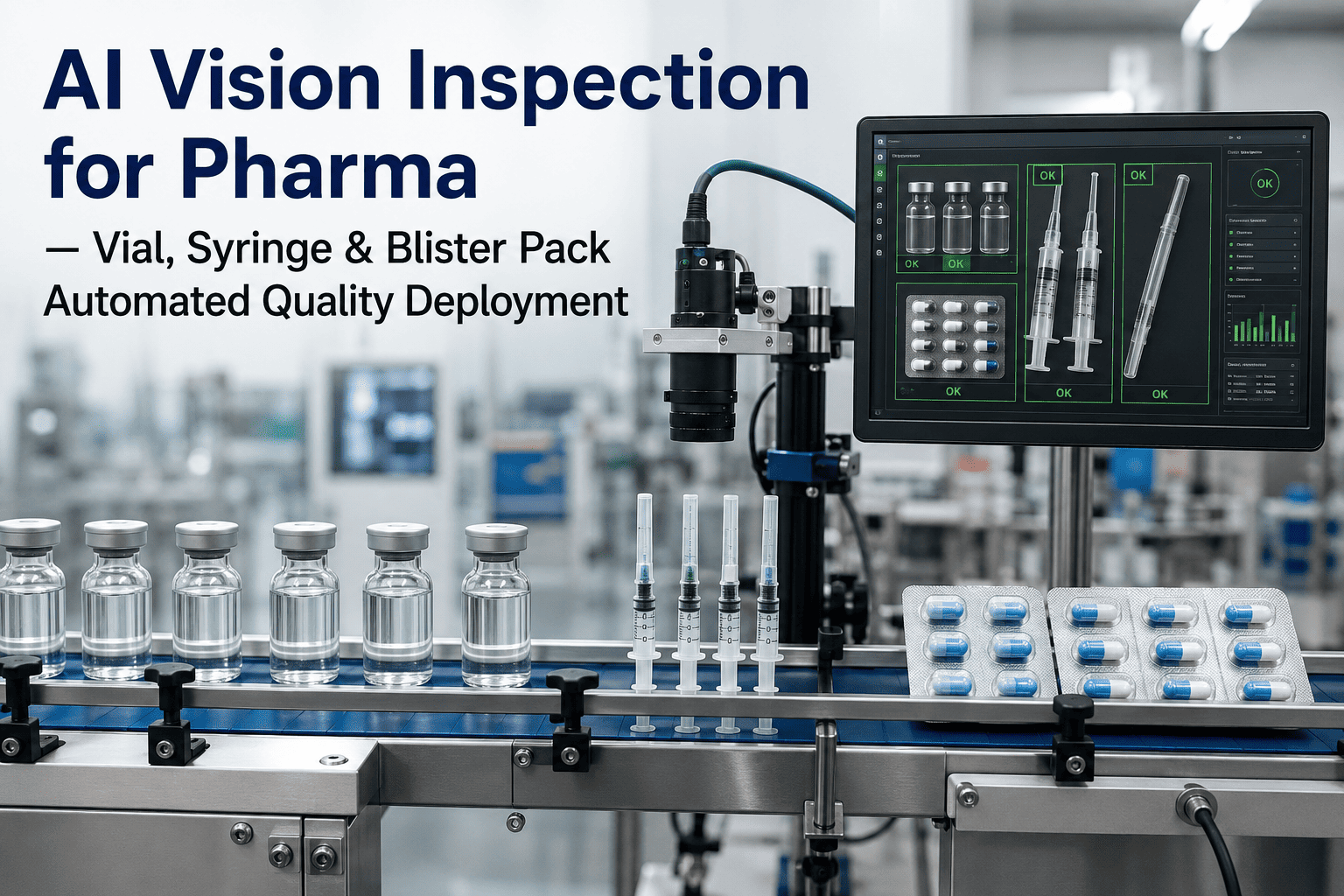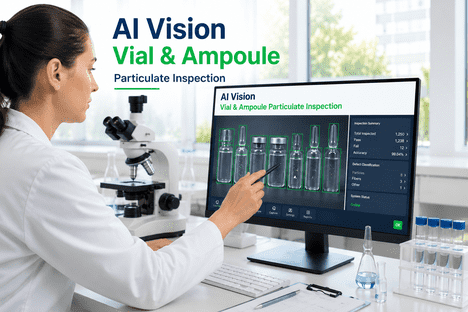
Parenteral drug products — injectables, intravenous solutions, and lyophilised formulations filled into vials and ampoules — carry the highest quality and patient safety stakes of any pharmaceutical product category. A single vial with an undetected glass particle, a cracked ampoule neck, a partially seated stopper, or an underfill reaching a patient can cause severe adverse events up to and including fatality. Regulatory bodies including the FDA, EMA, and PMDA have steadily tightened their expectations for 100% automated visual inspection of parenteral containers — moving the standard from statistical sampling with acceptable quality levels toward validated automated systems that inspect every container with documented, reproducible detection performance. The business cost of inspection failures runs in both directions: missed defects create recall exposure and patient safety risk, while excessive false rejects on high-value injectables waste product worth hundreds of dollars per vial and drive unnecessary batch investigation. iFactory's AI vision camera platform with vision anomaly detection applies deep learning to 100% vial and ampoule inspection — detecting particulate matter, container cracks, stopper seating defects, fill level deviations, and cosmetic defects at line speed with false reject rates that validated manual inspection cannot match. Pharmaceutical quality engineers and AVI system managers evaluating their current inspection architecture regularly choose to Book a Demo with iFactory's engineering team to understand how AI vision anomaly detection maps to their specific container types, product characteristics, and regulatory submission requirements.
100% Vial and Ampoule Inspection — Every Container, Every Defect, Every Batch.
iFactory's AI vision anomaly detection platform inspects parenteral containers for particulates, cracks, stopper seating, and fill level at ±0.3% tolerance and line speed — generating the validated, 21 CFR Part 11-compliant inspection records that FDA, EMA, and PMDA require for AVI system qualification.
Why 100% Automated Visual Inspection Is Now the Regulatory Standard for Parenterals
The regulatory trajectory for parenteral container inspection has shifted decisively toward 100% automated visual inspection as the expected control standard. FDA's guidance on AVI systems, EMA's guidance on parametric release, and USP <1790> Visual Inspection of Injections collectively define a framework that requires pharmaceutical manufacturers to validate their inspection systems — demonstrating that the system detects specified defect types at defined sensitivity levels, maintains detection performance across the production run, and generates the documented inspection records that demonstrate ongoing process control. Manual visual inspection by trained operators — the previous industry standard — is no longer a defensible primary control for high-volume sterile filling operations. It produces variable results influenced by inspector fatigue, ambient lighting, training currency, and the irreducible human limits of detecting sub-visible particulates in moving containers at production line speeds. Regulatory inspection findings related to inadequate visual inspection programs have become one of the most frequent citations in FDA warning letters to sterile drug manufacturers, reflecting both the heightened regulatory expectation and the continued gap between what many facilities operate and what current guidance requires. iFactory's AI vision camera platform is designed from the ground up for the pharmaceutical AVI environment — combining detection performance that exceeds manual inspection with the validation documentation framework that USP <1790> and EU GMP Annex 1 require for a qualification-ready automated inspection system.
FDA Warning Letter Exposure
Inadequate visual inspection programs are among the most frequent citations in FDA warning letters to sterile drug manufacturers. Systems that cannot demonstrate validated detection performance for defined defect categories — or that rely primarily on manual inspection for 100% release — face increasing regulatory risk in the current enforcement environment.
EU GMP Annex 1 (2022 Revision)
The 2022 revision of EU GMP Annex 1 explicitly strengthened requirements for automated detection systems in sterile manufacturing — requiring contamination control strategies that include 100% container integrity testing and visual inspection with validated automated systems for critical product categories.
USP <1790> Validation Requirements
USP <1790> defines the framework for qualifying automated visual inspection systems — including challenge testing with knurled sets, statistical performance validation, and ongoing monitoring requirements. AVI systems must demonstrate detection sensitivity that meets or exceeds validated manual inspection for each defect category in the product's defect library.
Patient Safety Consequence
Particulate contamination in injectable drug products causes granulomatous reactions, pulmonary embolism, and organ damage when administered intravenously. Container defects — cracks, incomplete seals, stopper displacement — compromise sterility assurance. The patient safety consequence of AVI failure is among the highest of any pharmaceutical manufacturing control failure.
False Reject Cost in High-Value Injectables
Biologics and specialty injectables with API costs of $200–$2,000 per vial cannot sustain the 2–5% false reject rates that legacy machine vision systems generate on challenging products. Each unnecessary rejection represents direct product loss and triggers documentation requirements. AI vision anomaly detection reduces false reject rates below 0.5% while maintaining sensitivity to genuine defects.
21 CFR Part 11 Audit Trail
FDA's 21 CFR Part 11 requirements for electronic records in pharmaceutical manufacturing apply directly to automated visual inspection systems — requiring timestamped, immutable inspection records for every container inspected, system access controls, audit trail integrity, and electronic signature workflows for batch record review and release.
Defect Detection Performance: AI Vision vs. Validated Manual Inspection
AVI system qualification requires demonstrating detection performance superior to or equivalent to validated manual inspection for each defect category. iFactory's AI vision platform consistently exceeds manual inspection benchmarks across all primary parenteral container defect classes. Book a Demo to review detection performance data for your specific container type and product.
| Defect Category | Manual Inspection Detection Rate | iFactory AI Vision Detection Rate | Regulatory Reference |
|---|---|---|---|
| Visible Particulates (>100 μm) | 70–80% (fatigue-dependent) | 97–99% | USP <1790> / Ph. Eur. 2.9.20 |
| Sub-Visible Particulates (50–100 μm) | 40–60% (highly variable) | 91–95% | EU GMP Annex 1 (2022) |
| Container Cracks (vial body / ampoule neck) | 75–85% | 98–99.5% | USP <1790> crack knurled set |
| Stopper Seating Defects | 65–75% | 96–98% | 21 CFR 211.94 / Annex 1 |
| Fill Level Deviation (±0.3% tolerance) | 55–70% at ±1% deviation | 99%+ at ±0.3% tolerance | 21 CFR 211.101 / Ph. Eur. |
| False Reject Rate | 0.5–1.5% (trained inspectors) | <0.3% (AI calibrated) | USP <1790> knurled set specificity |
How iFactory's AI Vision Anomaly Detection Works for Parenteral Containers
iFactory's parenteral inspection platform integrates multiple imaging modalities — visible spectrum, near-infrared, and polarised light configurations — with deep learning anomaly detection models to provide simultaneous inspection coverage for all primary defect categories in a single inspection pass. The system architecture follows the physical inspection sequence of a validated AVI station while replacing the limitations of conventional rule-based machine vision with the pattern recognition capability of deep learning — enabling reliable detection of the irregular, non-repeating defect presentations that rule-based systems consistently miss.
Particulate Detection — Rotation and Sedimentation Imaging
Containers are rotated and brought to a stop — liquid continues to rotate and carry particulates into view while the container is stationary, maximising particle visibility during the imaging window. High-speed cameras capture multiple image frames during the sedimentation phase, and deep learning models classify detected moving objects against the liquid background by size, shape, movement trajectory, and contrast characteristics — distinguishing genuine particles from air bubbles, meniscus reflections, and normal product turbidity with specificity that rule-based threshold systems cannot achieve on challenging products such as protein biologics and lipid emulsions.
Container Integrity — Crack and Cosmetic Defect Detection
Polarised and structured light illumination configurations reveal crack signatures on vial bodies, ampoule necks, container bases, and shoulder regions that are invisible under standard visible-spectrum illumination. AI models trained on crack morphology across container glass types — Type I borosilicate in standard and delamination-risk formulations, ampoule glass in pull-seal and tip-seal formats — classify crack detections by location, orientation, and severity. Cosmetic defects including glass inclusions, mould marks, deformation, and contamination on the container exterior are simultaneously classified in the same imaging pass using separate model channels.
Stopper and Closure Inspection
Stopper seating inspection uses high-resolution top and side imaging with AI models trained on the normal stopper position geometry for each closure type and vial format. Defect classes detected include cocked stoppers, partially seated stoppers, missing stoppers, stopper damage, and flip-off cap defects — each classified against a product and container-specific reference model that accounts for the normal dimensional variation in stopper seating geometry. Crimp seal integrity and aluminium overseal defects are inspected simultaneously using lateral illumination that reveals seal deformation patterns associated with incomplete crimping or mechanical damage to the closure assembly.
Fill Level Verification at ±0.3% Tolerance
Fill level is measured using optical level detection models that locate the liquid surface meniscus position in each container image and calculate fill volume against the container geometry model for the specific vial or ampoule format. Measurement precision of ±0.3% is achieved through multi-point meniscus detection and container geometry compensation that accounts for dimensional variation within the container specification — providing compliant fill level verification that satisfies 21 CFR 211.101 and pharmacopoeial fill volume requirements without the sample-based variability of manual fill measurement methods.
AVI System Qualification: USP <1790>, EU GMP Annex 1, and 21 CFR Part 11 Compliance
AVI system qualification is a validation project with documentation requirements that parallel process validation — requiring installation qualification, operational qualification, performance qualification, and ongoing monitoring to demonstrate that the system maintains its validated state across the product lifecycle. iFactory's platform is delivered with a qualification documentation package designed to accelerate the IQ/OQ/PQ sequence for new system deployments and to support requalification following product or container changes. The qualification approach follows the requirements of USP <1790>, EU GMP Annex 1 (2022 revision), and ASTM E2184 for container integrity — providing a scientifically justified, regulatorily defensible qualification framework that satisfies FDA Pre-Approval Inspection expectations and EMA technical assessments for AVI systems described in marketing authorisation applications. The 21 CFR Part 11 compliance architecture includes timestamped, immutable inspection records for every container inspected — with electronic batch record integration, audit trail coverage for all system events, role-based access controls, and electronic signature workflows for batch disposition and system parameter changes. All inspection data is stored in a Part 11-compliant repository that generates audit-ready batch inspection reports in the format required for QP certification in EU markets and batch record review in FDA-regulated facilities. Pharmaceutical quality teams building their AVI system validation strategy and seeking to understand how iFactory's qualification documentation framework maps to their specific regulatory submissions can Book a Demo with iFactory's pharmaceutical validation engineering specialists.
AI Vision Vial and Ampoule Inspection — Common Questions
How does iFactory's AI vision system reduce false rejects compared to conventional machine vision AVI systems?
Conventional rule-based machine vision AVI systems reject containers when detected signals exceed fixed intensity thresholds — a method that generates high false reject rates on products with optical challenges such as protein aggregation, coloured liquids, lyophilised cake fragments, and high-viscosity formulations where the normal product appearance creates signals that threshold-based systems cannot reliably distinguish from genuine defects. iFactory's deep learning models learn the full appearance envelope of each product-container combination from training images captured on the actual production line — including the normal variation in liquid appearance, container glass characteristics, and stopper reflection patterns specific to each product and format. Foreign particles deviate from this learned normal baseline in ways the model classifies with specificity that eliminates the threshold ambiguity that drives false rejects. False reject rates below 0.3% are consistently achieved on product categories where legacy AVI systems generate 2–5% false rejects.
Can the platform inspect lyophilised products where particulate detection inside the vial is complicated by cake appearance?
Lyophilised product inspection presents specific challenges that iFactory's platform addresses through lyophilised-specific imaging configurations and model variants. For particulate detection in lyophilised vials, the inspection strategy focuses on the headspace above the cake and the visible container surfaces rather than attempting to detect particles embedded within or beneath the cake — reflecting the physical reality that sub-surface particles in a dense lyophilised cake are inaccessible to optical inspection regardless of system type. Container integrity inspection — cracks, stopper seating, fill level of the headspace — proceeds on the same basis as liquid-filled vials. Reconstitution particle detection as a separate inspection step after automated reconstitution is supported as an optional configuration for products where reconstituted product particle detection is required by the manufacturing control strategy.
What line speeds and container formats does the platform support?
iFactory's parenteral inspection platform supports inspection throughputs from 100 to 600 containers per minute depending on the inspection sequence configuration, number of imaging stations, and container format. Vial formats from 2 mL to 100 mL and ampoule formats from 1 mL to 20 mL are supported with container-specific handling, imaging geometry, and inspection model configurations. Multi-format lines with frequent product and container changeovers use recipe-based configuration selection — switching the inspection model, illumination parameters, and reject thresholds for each container format and product combination automatically from the centralised recipe management system without manual reconfiguration of inspection hardware or software.
How does the system handle cosmetically challenging biologics with inherent protein aggregates or coloured formulations?
Biologics with inherent protein aggregates, opalescence, or colour — including monoclonal antibodies, fusion proteins, and iron-containing formulations — represent the most challenging product category for AVI systems because the normal product appearance mimics the visual signatures of genuine defects in conventional inspection approaches. iFactory's AI models for biologics inspection are trained specifically on the product's characteristic appearance range — including the full range of normal opalescence, aggregate distribution, and colour variation within the product specification — enabling the model to establish a product-specific normal envelope that distinguishes genuine foreign particles from inherent product characteristics with the specificity required for a qualified inspection system. Validation of this specificity is demonstrated through challenge testing with knurled defect sets spiked into the actual product — not in a clear surrogate — as required by USP <1790> for products with challenging optical properties.
What documentation does iFactory provide to support AVI system qualification and regulatory submissions?
iFactory's qualification documentation package includes: User Requirements Specification (URS) and Design Qualification (DQ) documentation; Installation Qualification (IQ) protocol and report templates aligned to GAMP 5 and USP <1790>; Operational Qualification (OQ) protocols covering system function verification including challenge set detection performance; Performance Qualification (PQ) protocols for product-specific validation including knurled challenge set studies, statistical performance analysis against manual inspection benchmarks, and ongoing monitoring procedure definitions. Regulatory submission support includes AVI system description sections for CTD Module 3 filing, audit trail and 21 CFR Part 11 compliance assessment documentation, and technical reports in the format expected by FDA during Pre-Approval Inspections. Facilities integrating iFactory's AVI system into a new or supplement marketing authorisation application can schedule a qualification documentation review session by booking a Book a Demo consultation with iFactory's pharmaceutical validation engineering team.
Deploy Validated AI Vision Inspection Across Your Parenteral Filling Lines.
iFactory's AI vision anomaly detection platform provides 100% vial and ampoule inspection at ±0.3% fill level tolerance — with USP <1790> qualification documentation, 21 CFR Part 11-compliant audit trails, and detection performance that exceeds validated manual inspection across all primary parenteral defect categories.