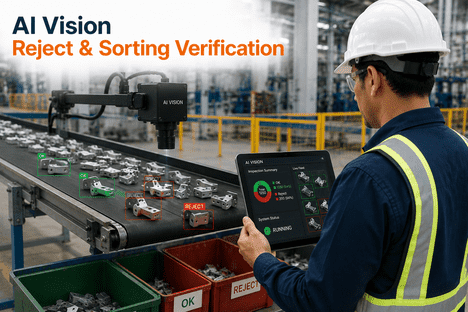
A rejected product that is never actually ejected is more dangerous than one that was never inspected. Quality gates across manufacturing, food processing, pharmaceutical packaging, and consumer goods production rely on rejection systems — pneumatic ejectors, diverter gates, pusher arms — that are assumed to work every time they are triggered. That assumption is wrong often enough to generate significant escape rates, customer returns, and regulatory findings. Actuator timing failures, mechanical wear, air pressure drops, and conveyor speed variations all create conditions where a triggered rejection does not result in a confirmed ejection. On the sorting side, misrouted products — incorrectly sorted by grade, destination, or specification — create fulfillment errors that compound downstream. iFactory's AI Vision Camera applies deep learning object detection to rejection and sorting verification, confirming in real time that every triggered reject is physically removed from the line and every sorted item reaches the correct destination lane. This closed-loop verification layer closes the gap that every inspection system without ejection confirmation leaves open. Quality and production engineering teams evaluating AI vision solutions for reject and sorting verification can Book a Demo with iFactory to assess how ejection confirmation and sorting accuracy verification integrate into their existing quality gate architecture.
Confirm Every Reject Is Ejected. Verify Every Sort Is Correct.
iFactory AI Vision provides closed-loop confirmation that triggered rejects leave the line and sorted products reach the right destination — preventing escapes and misroutes at line speed.
Why Triggered Rejections and Sort Signals Are Not the Same as Confirmed Outcomes
Most production quality systems generate a rejection signal when an inspection device — a vision camera, metal detector, checkweigher, or X-ray unit — detects a non-conforming product. That signal triggers an ejector. But no system in most facilities confirms that the ejector actually removed the product. The inspection system logs a reject event; the line continues; the rejected product may still be on the conveyor heading toward packing. This gap between triggered rejection and confirmed ejection is where escapes are born. iFactory's AI Vision Camera monitors the ejection zone continuously, confirming physical removal of every triggered reject and raising an immediate line-stop alert when a product fails to clear. On sorting lines, the same system verifies that each item arrives at its designated lane — catching misroutes before they become fulfillment errors. Quality teams ready to close the escape gap in their rejection and sorting systems can Book a Demo to see iFactory's verification architecture configured for their line.
Ejection Confirmation
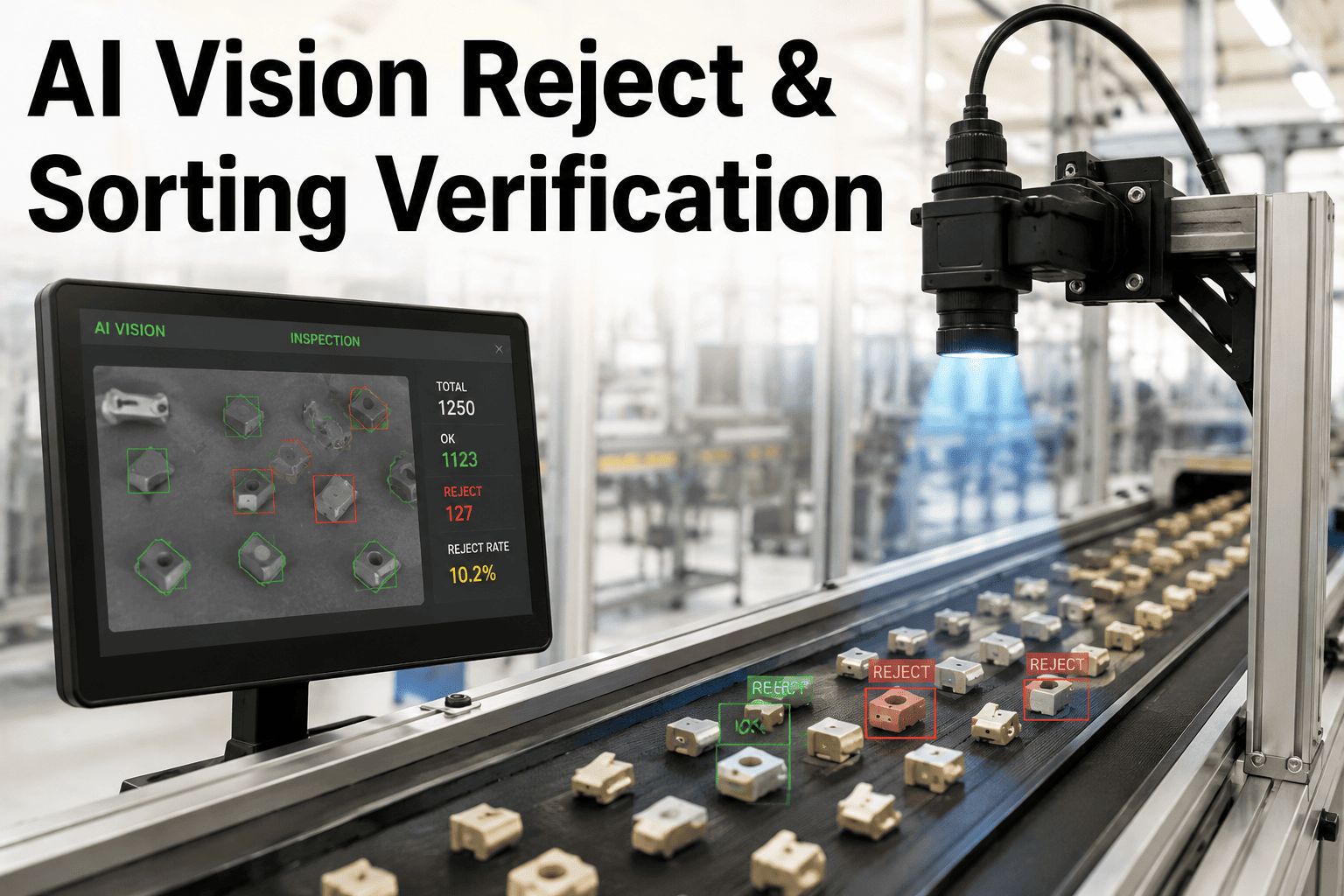
AI vision monitors the rejection zone and confirms physical product removal within milliseconds of each ejection trigger. Failed ejections are detected immediately — triggering a line stop before the non-conforming product reaches downstream stations or packing.
Sorting Lane Verification
On multi-lane sorting systems, AI vision confirms that each item arrives at its designated destination lane — detecting misroutes, lane crossovers, and diverter failures that generate fulfillment errors and mixed-grade shipments.
False Reject Detection
AI vision distinguishes between products correctly rejected for genuine defects and good products incorrectly triggered for ejection. False reject data feeds directly into inspection system calibration, recovering yield without compromising escape prevention.
Reject Bin Monitoring
AI vision monitors reject bins and accumulation zones, confirming that ejected products are contained and flagging conditions where reject accumulation may cause line blockage or where bin content does not match expected reject volume from triggered events.
Six Rejection and Sorting Failures That AI Vision Catches in Real Time
Ejection system failures and sorting errors follow predictable patterns — mechanical wear, timing drift, pressure variation, and conveyor speed changes. Each failure mode has a distinct visual signature that AI vision detects at line speed, providing the closed-loop confirmation that standalone inspection systems cannot deliver.
The rejection signal fires but the ejector does not actuate — due to solenoid failure, air supply drop, or control system fault. AI vision detects the product continuing past the ejection zone and triggers an immediate line-stop alert before the escape reaches downstream packing.
The ejector actuates but does not fully remove the product — due to timing mismatch with conveyor speed or insufficient ejection force from mechanical wear. The product remains on the line in a partially displaced position. AI vision detects incomplete clearance of the ejection zone and flags the event for line review.
Ejector timing errors or product spacing irregularities cause the ejector to remove the product adjacent to the targeted reject, triggering a false removal of conforming product. AI vision tracks individual product positions through the ejection zone, detecting when the wrong item is removed.
On sorting lines, diverter gate timing failures or wear-induced positioning errors cause products to enter incorrect destination lanes. AI vision verifies lane assignment at the sort point, detecting misroutes before sorted product reaches downstream processes or fulfillment staging.
An overflowing reject bin causes ejected products to fall back onto the production conveyor or be carried past the containment zone. AI vision monitors reject accumulation levels and detects overflow conditions before escaped rejects re-enter the conforming product stream.
High consecutive reject rates — from an upstream process excursion — cause ejector jamming as products accumulate faster than the rejection system can clear them. AI vision detects abnormal rejection density and flags the condition for immediate line review before the ejector fails mechanically.
How iFactory AI Vision Closes the Loop Between Rejection Trigger and Confirmed Ejection
iFactory's AI Vision Camera is positioned at the ejection zone exit point and at lane assignment verification points on sorting systems. The edge AI processor analyzes product presence and position in the rejection zone for every triggered event — comparing the expected post-ejection zone state against the actual observed condition within milliseconds of the ejection event. When a product is confirmed removed, the event is logged with a timestamped image. When a product fails to clear, the system fires an immediate alert to the line controller and CMMS simultaneously — stopping the line or triggering a secondary ejection attempt depending on configured response logic. On sorting verification points, the camera tracks individual items through lane transitions and confirms correct lane assignment against sort signals received from the upstream grading or inspection system. Every sort event — correct or incorrect — is logged with product image and lane assignment evidence, creating a complete traceability record for every item that passes through the sort system.
Rejection Trigger Synchronization
iFactory's AI Vision system receives the rejection trigger signal from the upstream inspection device — vision system, metal detector, checkweigher, or X-ray — via digital I/O or OPC-UA integration. The trigger timestamp is synchronized with the camera analysis window, ensuring the AI model evaluates the correct product position in the ejection zone for each triggered event.
Ejection Zone Clearance Verification
The AI vision model analyzes the ejection zone within the configured dwell window after each ejection trigger, confirming that the targeted product has physically cleared the zone. Detection occurs in under 20 milliseconds — within the line cycle time of high-speed production environments — with a binary confirmed or failed result generated for every event.
Failed Ejection Response Execution
When a failed ejection is detected, iFactory's system fires an immediate output signal to the line controller within one conveyor cycle — triggering a line stop, secondary ejection attempt, or divert to a manual inspection station depending on the configured response hierarchy. Simultaneously, a CMMS work order is generated with the event image, timestamp, and asset ID attached.
Sorting Accuracy Confirmation and Traceability Logging
For sorting verification, every item's lane assignment is confirmed against the sort signal and logged with a timestamped image to the production traceability record. Misroute events generate immediate alerts and are flagged in the quality record against the batch or shift — providing auditable evidence of sorting system performance for customer quality reporting and regulatory compliance. Quality teams evaluating AI-based reject and sort verification systems can Book a Demo to see iFactory's verification system integrated with their existing line controller and inspection architecture.
Close the Gap Between Rejection Trigger and Confirmed Ejection
iFactory AI Vision delivers real-time ejection confirmation, sorting lane verification, and false reject detection — integrated with your existing inspection systems and CMMS with zero line modification required.
Inspection Without Ejection Confirmation Is an Incomplete Quality Gate
Every production quality system that detects defects but cannot confirm their physical removal from the line has a structural escape pathway built into its design. Ejection system failures — actuator non-actuation, partial ejection, timing drift — are not rare events; they are predictable mechanical outcomes in high-cycle production environments that operate without closed-loop confirmation. AI vision reject verification closes this gap permanently, converting the rejection trigger from an assumed outcome into a confirmed, documented event. On sorting systems, the same principle applies: a sort signal is not a confirmed sort until AI vision verifies lane assignment. iFactory's AI Vision Camera platform delivers both capabilities — ejection confirmation and sorting accuracy verification — in a single edge-deployed system that integrates with existing inspection devices, line controllers, and CMMS platforms without line modification. Manufacturing, food processing, pharmaceutical, and consumer goods operations running rejection and sorting systems without closed-loop visual confirmation should Book a Demo to see how iFactory closes their specific escape pathway.
AI Vision Reject and Sorting Verification — Common Questions
How does iFactory AI Vision confirm ejection without contact with the product?
iFactory's AI Vision Camera monitors the ejection zone from a fixed overhead or side-mount position. When a rejection trigger is received, the system analyzes the zone image within the configured window after the trigger event, confirming whether the product has physically cleared the zone. This non-contact confirmation works at full line speed for all product formats that the upstream inspection system handles.
Can the system integrate with existing metal detectors, checkweighers, or vision systems?
Yes — iFactory receives rejection triggers from any upstream inspection device via digital I/O signal, OPC-UA, or Ethernet connection. The system does not require replacement of existing inspection equipment; it adds a confirmation layer downstream of the ejector that verifies the outcome of each trigger event generated by the existing quality gate infrastructure.
What happens when a failed ejection is detected?
When AI vision detects a product that has not cleared the ejection zone after a triggered rejection, the system fires an output signal to the line controller within one conveyor cycle. The configured response — line stop, secondary ejection, or manual inspection divert — executes immediately. Simultaneously, a timestamped event record with supporting image is generated and pushed to the CMMS as a prioritized alert for the line supervisor.
How does the system handle high-speed lines where products pass the ejection zone rapidly?
iFactory's edge AI processor delivers ejection zone analysis in under 20 milliseconds per event — well within the cycle time of high-speed packaging and processing lines operating at 300–600 products per minute. Camera frame rate and trigger synchronization are configured at commissioning for the specific line speed and product spacing of each installation.
Does the system generate traceability records for regulatory or customer quality reporting?
Yes — every reject event and sort event is logged with a timestamped image, product identifier where available, triggered outcome, and confirmed outcome. These records are stored in iFactory's platform and exportable for use in customer quality audits, regulatory compliance documentation, and internal quality management system records without additional manual data entry.