When a customer complaint, a regulatory audit, or a recall investigation arrives, the question is rarely whether an inspection happened — it is whether the evidence can be produced. Manual quality records scattered across paper logs, spreadsheets, and individual inspector memory cannot reconstruct what a specific unit looked like, what defect threshold it was measured against, or who reviewed it, at the speed an auditor or a recall response team requires. AI vision inspection audit trail and traceability closes this gap by capturing every inspection image, every defect classification, and every accept-or-reject decision as a timestamped, structured record the moment it happens — turning quality data from something assembled defensively after the fact into something that already exists, complete and retrievable, the instant it is needed.
Why Most Quality Records Fail the Moment They're Actually Needed
The most expensive compliance failures rarely come from missing inspections — they come from inspections that happened but were never properly documented. When a retailer rejects a shipment, an auditor asks for thirty-six months of inspection history, or a recall investigation needs to know exactly which lot a defect affected, the question is not whether quality control was performed. It is whether the record can be produced, in full, on demand. Paper inspection logs, spreadsheet-based quality tracking, and inspector memory all share the same structural weakness: they were never designed to reconstruct a specific unit's history at the speed a real audit or recall requires. A human inspector who checked a thousand units in a shift cannot recall which one had a borderline defect three weeks later. A spreadsheet entry that says "pass" carries no image, no measurement, and no context about what the inspector was actually looking at. AI vision inspection eliminates this gap structurally — every unit that passes through the camera generates its own permanent, timestamped record the moment it is inspected, regardless of whether anyone ever expects to need it again.
What Gets Captured in Every AI Vision Inspection Record
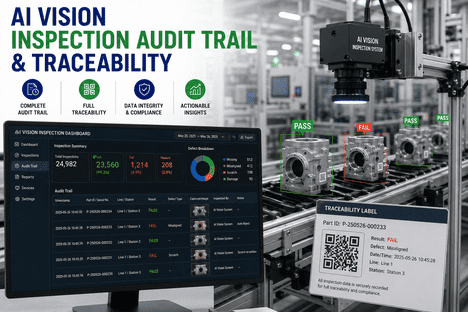
An audit-ready inspection record is only useful if it actually contains the information an auditor, a customer quality team, or a recall investigator would need to reconstruct what happened. iFactory's AI vision platform structures every inspection event around the same complete data set, regardless of which defect type triggered it or which production line generated it. Teams that want to see the structure of these records on their own product lines can Book a Demo to review a sample audit export.
Timestamped Inspection Image
Every inspected unit has its captured image retained as part of its permanent record — not a sample, not a representative shot, but the actual frame the AI model evaluated for that specific unit. This image is timestamped to the millisecond and tied to the exact inspection event, giving any later review the same visual evidence the system used to make its decision in the first place.
Defect Classification and Severity Score
When a unit is flagged, the record includes the specific defect category the model identified, a confidence or severity score, and the bounding box or annotation marking exactly where on the unit the issue was detected. This turns a generic "fail" result into a structured, explainable finding that can be reviewed, disputed, or used as evidence without anyone having to guess what the system actually saw.
Accept/Reject Decision and Disposition Outcome
Every inspection event records the final disposition — accepted, rejected, or routed to manual review — along with the threshold or rule that produced that outcome. If a unit was auto-rejected, the record shows why. If a borderline result was sent to a human for a second look, the record shows that escalation and its eventual resolution, preserving the full decision chain rather than only the final answer.
Batch, Lot, and Asset Context
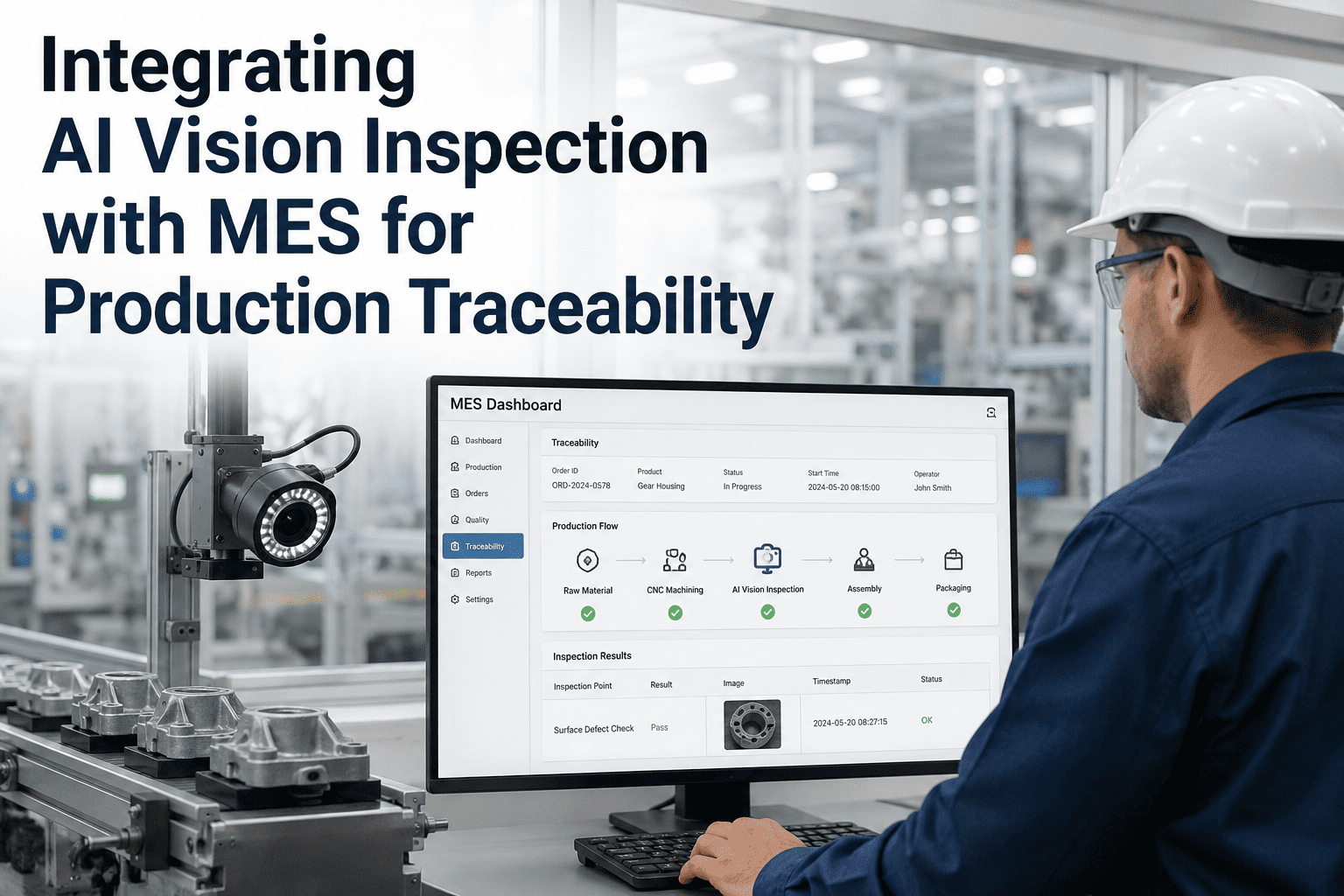
Each inspection record is linked to the lot number, batch ID, production line, and equipment that produced the unit at the time it was inspected. This context is what makes the difference between a generic defect log and a traceability system capable of answering the question every recall response depends on: which specific units, from which specific run, are affected.
Shift, Operator, and System Metadata
Every record also captures the shift, the line configuration, and the model version active at the time of inspection. This matters for regulatory frameworks that require evidence not just of what was inspected, but of who and what system was responsible for the decision — a requirement that grows more important as more inspection decisions move from human judgment to AI models that themselves need to be auditable.
From Manual Logs to AI Vision Audit Trails: What Actually Changes
The practical difference between manual quality documentation and AI vision audit trails is not just speed — it is completeness. A manual system can only document what someone remembered to write down, while an AI vision system documents every inspected unit by default, whether or not anyone anticipated needing that specific record later.
| Capability | Manual / Spreadsheet Records | AI Vision Audit Trail |
|---|---|---|
| Inspection Coverage Documented | Sample-based, often a fraction of total output | 100% of inspected units, automatically |
| Visual Evidence Per Unit | Rarely retained beyond the inspection moment | Timestamped image stored with every record |
| Audit Retrieval Time | Hours to weeks of manual compilation | Minutes, via structured query or export |
| Recall Scope Identification | Approximate, based on date ranges or shift logs | Precise, down to the individual unit and lot |
| Consistency Across Shifts | Varies by inspector and documentation habits | Identical record structure, every shift, every unit |
The retrieval-time difference shown above is not a minor convenience. When a retailer audit or a regulatory inspection arrives with a 24-to-48-hour evidence request window, the gap between minutes and weeks is the gap between a clean audit outcome and a finding that gets logged against the facility regardless of whether the underlying quality work was actually sound.
How AI Vision Traceability Changes the Economics of a Recall
Recall costs scale dramatically with how late a defect is caught and how imprecisely its scope can be defined. A defect caught at the inspection station costs a fraction of what the same defect costs once it reaches a customer, and the same defect discovered only after a field complaint or a regulatory notice can cost orders of magnitude more once retrieval, legal exposure, and brand damage are included. Traceability data determines which of those cost tiers an organization actually lands in. Without unit-level inspection records, a recall investigation has to assume the worst-case scope — every unit from a wide date range or an entire production run — because there is no data precise enough to narrow it. With AI vision audit trails, the same investigation can identify exactly which lots, which units, and which time windows were affected by a specific defect signature, often narrowing a recall from an entire run to a fraction of it. Quality and compliance teams modeling their own recall exposure can Book a Demo to see how iFactory's traceability records would scope a recall against their actual production data.
Built for the Compliance Frameworks That Actually Demand This Evidence
Different industries and regulatory frameworks place different specific demands on quality documentation, but they converge on the same underlying requirement: records must be complete, attributable, and reconstructable after the fact. Food and beverage manufacturers operating under GFSI schemes, SQF, BRC, or FSMA need inspection records, CCP verification logs, and corrective action documentation that hold up under third-party audit without weeks of manual preparation. Pharmaceutical and medical device manufacturers operating under FDA 21 CFR Part 11 and EU GMP Annex 11 need audit trails that are timestamped, attributable to a specific system and decision, and structured so that no change to the underlying record can occur without leaving its own trace. Automotive and industrial manufacturers under ISO and IATF quality systems need every part result, defect image, and corrective action linked and retrievable for customer and certification audits. iFactory's AI vision platform generates the same structured, image-backed inspection record regardless of which of these frameworks a facility operates under — because the underlying requirement in every case is the same: evidence that already exists, rather than evidence assembled defensively once an audit notice arrives.
An audit trail only delivers its full value when the data inside it actually reaches the people who need to act on it. iFactory's AI vision platform runs on-premise edge AI, processing every inspection locally and logging the result with full image and metadata context before the next unit reaches the line. When a defect pattern emerges — a recurring issue traced back to a specific tool, line, or shift — the same structured record that satisfies an audit request also feeds directly into work order generation and root cause analysis, connecting compliance documentation to the operational response instead of leaving it isolated in a separate quality archive that nobody reviews until an auditor asks for it.
Frequently Asked Questions: AI Vision Audit Trail and Traceability
Each record includes the timestamped inspection image, the defect classification and severity score if a defect was found, the final accept-reject-review disposition and the rule that produced it, the lot and batch identifiers linking the unit to its production context, and metadata covering the shift, line, and model version active at the time of inspection. Together these fields let any later review reconstruct exactly what the system saw and why it made the decision it made.
Recall scope is usually set by how precisely a facility can identify which units were affected. Without unit-level inspection data, that scope defaults to a wide date range or an entire production run, because there is no more precise data available. With AI vision records linked to lot and batch IDs, the same investigation can isolate the specific units, time windows, and lines actually affected by a given defect signature — frequently narrowing a recall from an entire run down to a small fraction of it, which directly reduces retrieval costs, regulatory exposure, and the volume of product that has to be pulled from distribution.
No. The value of an audit trail depends entirely on the original record being preserved exactly as it was generated. iFactory's inspection records are written once at the moment of inspection and are not retroactively altered. If a result is later reviewed and overturned — for example, a borderline rejection that a human reviewer determines was a false positive — that review is captured as an additional entry in the record rather than a replacement of the original finding, preserving the full decision history rather than overwriting it.
Structured records can be queried and exported in minutes rather than the hours or weeks that manual compilation across paper logs and spreadsheets typically requires. Because every inspection already generated its own complete record at the time it happened, retrieval is a search-and-export operation against existing data rather than a reconstruction project that pulls information from multiple disconnected systems and people's memory.
Yes — the specific terminology and required fields vary between frameworks like FDA 21 CFR Part 11, EU GMP Annex 11, GFSI schemes, and ISO or IATF quality systems, but the underlying requirement is consistent across all of them: records must be timestamped, attributable, and reconstructable after the fact without gaps. A structured, image-backed inspection record built around those principles satisfies the evidence requirements of multiple frameworks simultaneously rather than requiring a separate documentation process for each one.