Integrating AI Vision Inspection with MES for Production Traceability
By Johnson on August 4, 2026
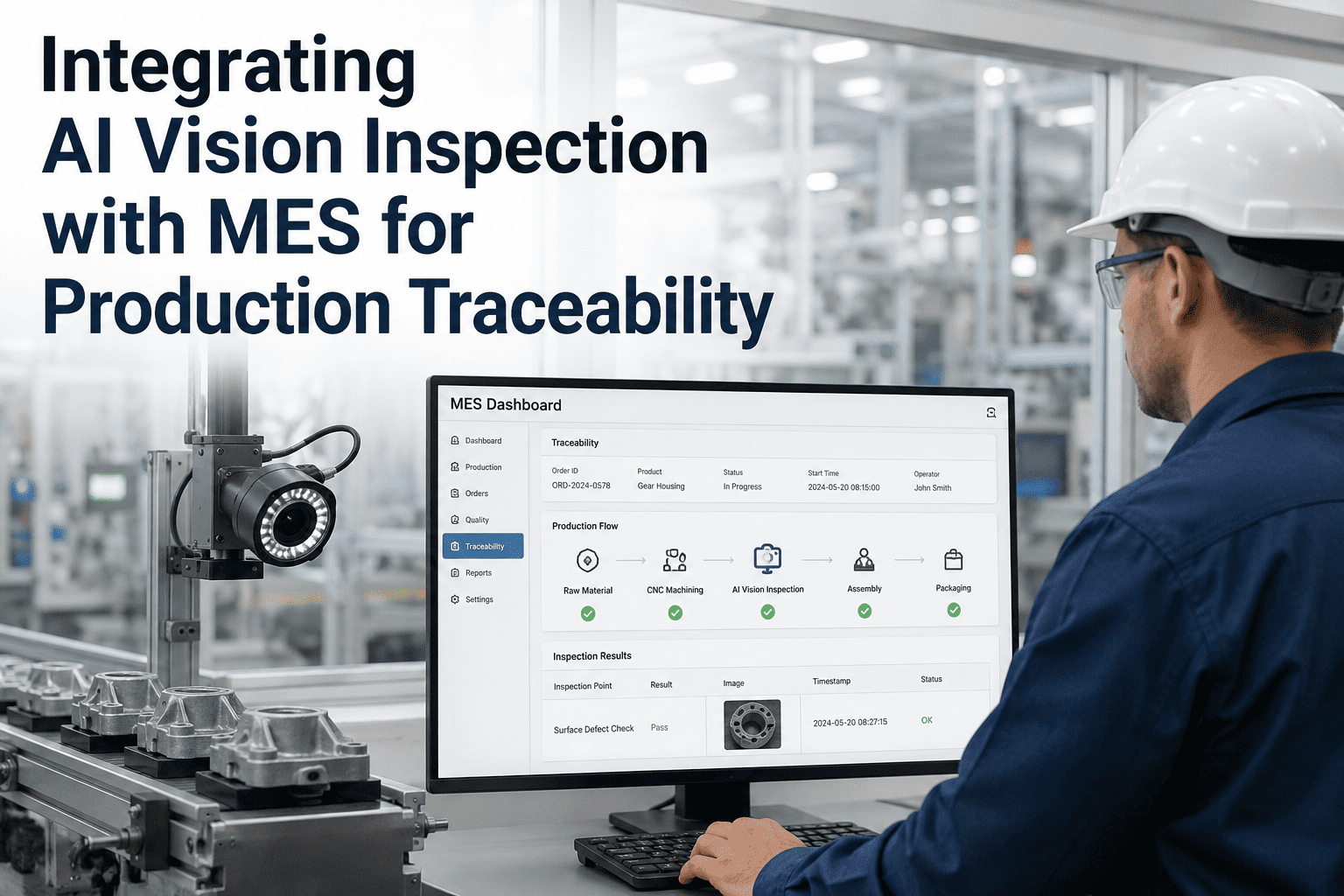
A quality escape rarely fails because of missing cameras or bad inspection logic. It fails because the inspection result existed — and nobody linked it to the production order, the batch record, or the serial number before the pallet shipped. An AI vision system that runs in isolation produces a pass/fail verdict for each part. An AI vision system integrated with your Manufacturing Execution System produces something far more valuable: a complete, timestamped quality record tied to every production variable — operator, machine, material lot, work order, and shift — automatically, without a single manual log entry. When a customer calls with a field complaint, or a regulator arrives for an audit, that record is the difference between a surgical corrective action and a full-line recall. iFactory's MES integration layer closes this gap across every major MES, PLC, SCADA, and ERP platform. Reach out to the iFactory integration team to map a traceability architecture for your line.
AI Vision + MES · Production Traceability
Every Inspection Result Linked to Batch, Lot, and Serial — Automatically, in Real Time
iFactory connects AI vision inspection output directly into your MES production records — so every pass, fail, and defect image is permanently attached to the work order, material lot, and operator that produced it, with zero manual data entry.
When Vision and MES Don't Talk, the Inspection Result Is Worthless After the Shift Ends
Most manufacturers who have invested in AI vision inspection still carry a critical data gap: the vision system knows a part failed, but the MES doesn't know which production order it came from, which material lot it carried, or which machine produced it. The quality event lives in the vision system's own database, disconnected from the production record. When a field complaint arrives three weeks later — or an auditor asks for the complete device history record under FDA 21 CFR Part 820 — the answer requires hours of manual cross-referencing between two systems that were never linked. That manual reconstruction is where errors enter and where liability accumulates.
Without MES Integration
Vision result stored in isolation — no production context attached
Operators manually log defect data into MES — hours late, error-prone
Traceability gap: defect image cannot be matched to batch without manual search
Recall scope unknown — entire production period suspect, not just affected lot
Audit takes days — records reconstructed from paper, memory, shift logs
With iFactory MES Integration
Every result tagged to production order, batch, serial, machine, operator automatically
MES quality record updated in under 3 minutes, no manual entry required
Defect image + metadata permanently linked to lot history record
Recall isolated to specific lots — not entire production window
Full audit trail retrieved in minutes — every inspection, timestamped and indexed
Compliance Requirements
Why Traceability Is No Longer Optional — Regulatory and Customer Requirements by Industry
The mandate for complete production traceability is expanding across every major manufacturing sector. What was once a best practice is now a contractual or legal requirement — and the penalty for non-compliance is no longer a warning letter, but mandatory recall, facility suspension, or OEM contract termination.
Automotive
IATF 16949 Clause 8.5.2
Serial-level traceability required for safety-relevant parts — brake components, airbag assemblies, steering systems. GM, Ford, Stellantis, and BMW customer-specific requirements extend serial traceability obligations to Tier 2 suppliers. A traceability gap during an OEM audit triggers supplier status review.
Non-compliance: OEM contract suspension
Pharmaceutical
FDA 21 CFR Part 820 / EU GMP Annex 11
Device History Records must document every production step, inspection result, and material lot for each finished device. Records must be retrievable within hours during an FDA investigation. Electronic records under 21 CFR Part 11 require time-stamped, unalterable audit trails — paper sign-offs do not qualify.
Non-compliance: Warning letter, facility shutdown
Food & Beverage
FDA FSMA / EU Regulation 178/2002
Key Data Elements at every Critical Tracking Event must be retrievable within 24 hours of an FDA contamination request. Traceability Lot Codes must link the supply chain from ingredient receipt to customer shipment. Non-digitised records cannot meet this response window in practice.
Unique Device Identification requires every Class II and Class III device to be traceable to patient level on demand. Production Identifiers — lot number, serial number, manufacturing date — must accompany every unit from production to end user, with quality evidence attached.
Manual Traceability Cannot Meet a 24-Hour FDA Data Request. Automated MES Integration Can.
iFactory's integration layer links every AI vision inspection result to your existing MES batch and serial records the moment the result is generated — no manual entry, no end-of-shift reconciliation, no reconstruction under audit pressure.
How iFactory Connects AI Vision Results to Your MES — The Data Flow, Layer by Layer
The integration works through a structured handshake: your MES provides the production context to the vision system before each part is inspected, and the vision system returns the result tagged with that context immediately after inspection is complete. No middleware. No proprietary connectors. Standard industrial protocols throughout.
L4
ERP / Quality System
SAP · Oracle · Microsoft Dynamics · QMS — receives aggregated quality data, lot disposition records, and CAPA triggers via REST API
REST API · Webhooks
L3
MES / SCADA
SAP ME · Siemens Opcenter · Rockwell FactoryTalk · custom MES — receives inspection verdict, defect class, image reference, and part ID per inspection event
OPC-UA · MQTT · REST
L2
iFactory Vision Engine
Edge AI server — receives part ID from MES handshake, runs inference, returns: verdict + defect class + confidence score + image hash + timestamp, tagged to part identifier
OPC-UA · Modbus TCP · EtherNet/IP · PROFINET
L1
PLC / Line Control
Existing PLC receives reject signal on confirmed defect — no line redesign required. Barcode / RFID at station entry provides part identifier to trigger the MES handshake
All protocols are native — no proprietary middleware, no gateway hardware, no SDK license required between layers.
What Gets Recorded
Every Inspection Event Creates a Traceable Quality Record With These Seven Data Fields
01
Part / Serial Identifier
Scanned from barcode, DMC, or RFID at the station entry point before inspection begins. This is the primary key that links the vision result to every other production record in the MES.
02
Production Order Reference
The active MES work order number is pushed to the vision system at line start or changeover. All inspection results during that order carry the order reference, enabling complete batch-level quality summaries.
03
Material Lot and Revision
The material lot currently active on the line — including revision level and supplier code — is attached to every inspection result, enabling downstream isolation of quality events to specific incoming material batches.
04
Inspection Verdict and Defect Class
Pass, fail, or review — plus the specific defect classification (scratch, void, dimensional deviation, contamination) and the AI confidence score. Not a binary bit but a structured result with semantic context.
05
Defect Image Reference
A hash-linked reference to the annotated defect image stored on the edge server — retrievable from the MES quality record without searching a separate vision system database. The image is the audit evidence.
06
Station, Machine, and Shift
The inspection station ID, machine tag, and active shift are appended automatically from the MES context — enabling failure pattern analysis by equipment and shift without additional data collection.
07
Timestamp and Operator
UTC timestamp to millisecond precision, plus the operator badge ID active at the station. Under 21 CFR Part 11, this electronic signature creates an unalterable audit record that satisfies FDA inspection requirements.
Real-World Impact
Three Scenarios Where Integrated Traceability Changes the Outcome
Scenario A
Customer Field Complaint — Pharmaceutical
Without Integration
A sterile packaging customer reports a seal integrity failure. Quality team must search the vision system database for inspection images from the suspected date range, then cross-reference against paper shift logs to identify the material lot, then manually check the MES for the production order. Investigation takes 3-4 working days. During that window, the plant quarantines all product from the affected week — not just the affected lot.
With iFactory MES Integration
The customer provides the unit serial number. The MES quality record for that serial immediately surfaces: the inspection image, defect class, material lot, production order, machine, and operator. Affected scope is isolated to 340 units from one lot — not 4,200 units from one week. Investigation closes in under 4 hours. CAPA triggered automatically from the defect record.
Scenario B
Regulatory Audit — Food Manufacturing
Without Integration
An FDA inspector requests complete production records for Lot 2247 within the 24-hour FSMA window. The quality team begins reconstructing records from paper inspection sheets, vision system exports, and MES printouts. By hour 22, the package is incomplete — vision images cannot be matched to specific lot records because the vision system logged by timestamp, not by lot ID.
With iFactory MES Integration
The MES quality module is queried for Lot 2247. Within 8 minutes it returns: every inspection result for every unit in that lot, with timestamped pass/fail records, defect images, material inputs, and operator sign-offs. The complete package is handed to the FDA inspector the same day. Zero manual reconstruction required.
Scenario C
Recurring Defect Pattern — Automotive
Without Integration
A dimensional defect has appeared three times in four weeks on the same component. Each time, the vision system logged the image. But because the vision data was never linked to machine or shift data in the MES, the quality team cannot determine whether the defect correlates with a specific machine, a specific incoming material supplier, or a specific operator. Root cause remains unresolved after four weeks.
With iFactory MES Integration
The iFactory analytics layer queries the linked inspection-MES records and reveals that all three defect events occurred within 2 hours of a material changeover on Station 4, each time with Supplier B's lot. The correlation is visible in under 10 minutes. The plant switches to Supplier A pending investigation. The defect does not recur.
Measured Outcomes
What iFactory Customers Report After Connecting Vision to MES
4 hrs
vs. 4-6 hrs previously
Defect-to-corrective-action cycle time. MES integration closes the gap from detection to work order from 4-6 hours of manual processing to under 4 hours of automated flow.
8 min
Full lot history retrieval
Complete inspection records for any production lot — images, verdicts, operator sign-offs, material inputs — retrieved from MES in minutes rather than reconstructed over days.
10-95%
Recall scope reduction
AIAG and GS1 sector bodies document 10-95% reduction in recall scope once serialisation and batch tracking are fully embedded with verified inspection evidence per lot.
0
Manual log entries required
Every quality record is generated automatically by the integration layer — no operator data entry, no shift-end transcription, no reconciliation between two separate system exports.
99.7%
Inspection record completeness
Automated capture eliminates the 3-8% record gap typical in manual entry systems, where missing sign-offs and retroactive reconstructions create audit risk.
6-12 wk
To live integration
iFactory deploys vision inspection and MES integration together in 6 to 12 weeks — including hardware, model training, protocol configuration, and MES record schema mapping.
Frequently Asked Questions
What Engineers and Quality Managers Ask Before Connecting Vision to MES
Which MES platforms does iFactory integrate with natively?
iFactory integrates with the major MES platforms used across discrete and process manufacturing, including SAP Manufacturing Execution, Siemens Opcenter, Rockwell Automation FactoryTalk, Aveva MES, Dassault Apriso, and custom MES platforms built on standard SQL or REST interfaces. The integration uses open industrial protocols — OPC-UA, MQTT, REST API, and Webhooks — so any MES that exposes a standard data interface can receive inspection results without proprietary connectors or middleware. Where an older MES uses file-based data exchange, iFactory supports CSV or XML batch export on a configurable interval. Integration protocol and record schema are confirmed during the deployment scoping session. Book a demo to confirm compatibility with your specific MES platform.
How does the handshake between MES and the vision system work at the part level?
The integration uses a two-step handshake. Before each part enters the inspection field of view, a barcode, DMC, or RFID reader at the station entry sends the part identifier to the MES, which responds with the active production context — order number, material lot, revision, and inspection specification. iFactory's edge AI server receives this context package and associates it with the next inspection cycle. After inspection, the result — verdict, defect class, confidence score, image reference, and timestamp — is returned to the MES tagged with that part identifier. The part identifier is the linking key that makes every downstream query possible. This handshake completes in under 200 milliseconds, well within the cycle time of any production line. Contact the integration team to review handshake design for your station layout.
Does the integration require changes to our existing MES schema or database?
In most deployments, the integration adds a quality event record type to the existing MES quality module rather than modifying the core schema. iFactory maps its output fields — verdict, defect class, confidence score, image reference hash, station ID, and timestamp — to existing or new quality record fields in the MES, using the MES vendor's standard quality data API. Where the MES already has an inspection result record structure, iFactory populates it directly. Where there is no existing quality record structure, iFactory and the plant's IT team define a lightweight schema extension during the integration scoping phase. No core MES tables are modified without the MES vendor's supported configuration path. Most integrations go live without any MES vendor professional services involvement beyond standard API documentation review.
Can the integrated records satisfy 21 CFR Part 11 electronic record requirements?
Yes, when the integration is configured to meet Part 11 requirements. The key elements are: timestamped, unalterable audit trails (iFactory appends UTC timestamps to each record at the moment of generation and does not allow retroactive modification); electronic signatures (operator badge ID captured at station entry constitutes an electronic signature tied to the inspection record); and system validation (iFactory provides an IQ/OQ/PQ validation package covering the vision system and MES integration for regulated environments). The audit trail is stored on both the iFactory edge server and in the MES quality module, providing redundant record retention. For pharmaceutical and medical device customers operating under 21 CFR Part 11 and EU Annex 11, iFactory provides a compliance mapping document confirming which system functions address each regulatory requirement. Book a demo with iFactory's regulatory team to review the compliance package for your specific standard.
What happens to traceability records if the network connection between the vision system and MES is interrupted?
iFactory's edge server buffers inspection results locally during any network interruption and retransmits them to the MES in chronological order when connectivity is restored. The buffer capacity covers several hours of production at typical inspection rates, so a brief network outage does not create a traceability gap. Each buffered record retains its original generation timestamp, so the MES record shows the actual inspection time — not the reconnection time. In addition, the edge server maintains a local SQLite archive of all inspection results independently of the MES integration, providing a secondary record that can be used to verify MES record completeness after any interruption. The local archive is accessible to the plant's IT team for independent audit purposes. Contact iFactory support for technical details on the buffer and failover architecture.
A Defect Image Without a Lot Number Is Not a Quality Record. Make Every Inspection Result Traceable.
iFactory connects AI vision inspection directly into your MES — every pass, fail, and defect image linked to batch, lot, serial, machine, and operator in real time. Audit-ready, recall-ready, and live in 6 to 12 weeks.