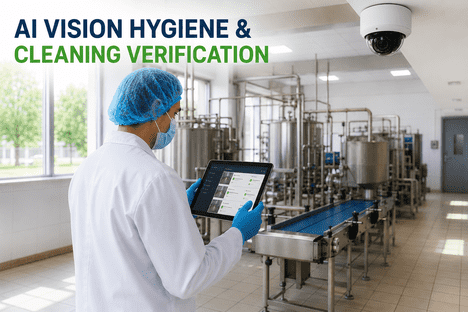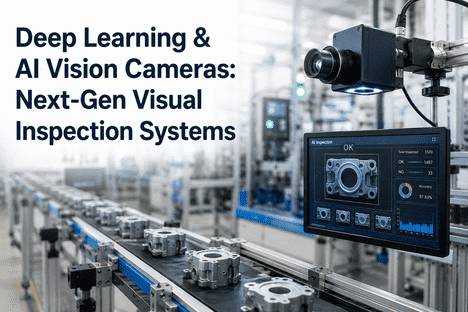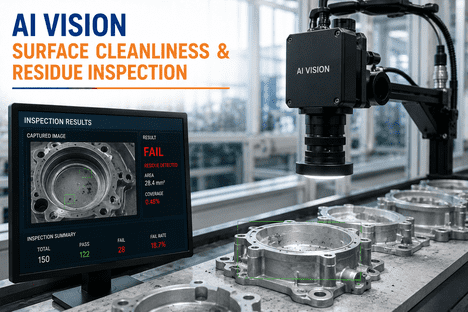
Surface cleanliness verification is one of the most consequential and least reliably performed quality checks in food processing, pharmaceutical manufacturing, medical device production, and industrial coating operations. After every cleaning cycle — CIP, COP, manual wash-down, or automated spray system — the conformance question is the same: is the surface actually clean to the standard required? Visual inspection by operators is the industry default, and it is fundamentally inconsistent. Human detection of residue films, biofilm formation, chemical carry-over, and particulate contamination varies with lighting conditions, fatigue, viewing angle, and individual judgment thresholds. The result is a verification process that passes contaminated surfaces and fails clean ones in patterns that bear no reliable relationship to actual cleanliness status. iFactory's AI Vision Camera applies deep learning anomaly detection to post-cleaning surface inspection, continuously analysing equipment surfaces, contact zones, filling heads, conveyor belts, tanks, and processing tools against validated cleanliness baselines — delivering objective, documented verification results at inspection speeds and consistency levels that no human visual programme can match. Manufacturing and quality teams evaluating AI vision solutions for cleaning validation and residue detection can Book a Demo with iFactory to assess how automated surface cleanliness inspection integrates into their existing cleaning protocols and quality management systems.
Verify Surface Cleanliness After Every Cleaning Cycle — Automatically
iFactory AI Vision delivers objective, documented post-clean inspection for residue, contamination, and biofilm — integrated with your cleaning validation records and quality management system in weeks.
Why Manual Post-Clean Inspection Fails as a Quality Gate
Cleaning validation failures — in regulatory audits, customer quality reviews, and product contamination investigations — almost always trace back to the same root cause: the verification step at the end of the cleaning cycle was subjective, undocumented, or inconsistently applied. Regulatory frameworks including FDA 21 CFR Part 211, EU GMP Annex 15, and ISO 22000 require demonstrable, repeatable cleaning verification — a standard that operator visual inspection cannot reliably meet. iFactory's AI Vision Camera replaces subjective operator assessment with a continuous, calibrated detection system that generates a timestamped, image-backed cleanliness record for every surface inspection event — the same objective evidence that audit programmes, HACCP verification records, and customer quality agreements demand. Quality and operations teams ready to replace inconsistent manual surface inspection with documented AI vision verification can Book a Demo to see iFactory configured for their specific cleaning protocols and surface types.
Residue Film Detection
Thin protein films, fat residues, starch layers, and cleaning chemical carry-over are frequently invisible to the unaided eye under normal lighting conditions. AI vision detects surface reflectance anomalies, colour deviation, and texture inconsistencies that indicate residue presence — catching contamination that passes standard visual inspection.
Biofilm Formation Identification
Recurring biofilm in processing equipment is a persistent food safety and pharmaceutical risk that develops in surface irregularities, welds, gasket interfaces, and dead legs. AI vision detects early-stage biofilm indicators — surface texture changes, localised discolouration — at inspection intervals and coverage levels that scheduled swabbing programmes miss.
Chemical Residue Mapping
Inadequate CIP rinse cycles leave detergent and sanitiser residues on contact surfaces that create both product contamination and allergen cross-contact risks. AI vision maps residue distribution across the full surface area of processing equipment — identifying incomplete rinse coverage that is invisible to spot-check inspection methods.
Particulate Contamination Detection
Foreign material — metal fragments, rubber gasket particles, glass, packaging debris — on cleaned surfaces represents both a direct product safety risk and a cleaning process failure. AI vision detects particulate contamination across conveyor belts, filling surfaces, and processing tables at the particle sizes that matter for product safety risk classification.
Post-Clean Surface Moisture Verification
Excessive residual moisture on cleaned surfaces promotes microbial growth between cleaning and production cycles. AI vision detects abnormal moisture distribution patterns — pooling, inadequate drainage, and incomplete drying in confined surface zones — providing verification data for dry-down validation protocols.
Cleaning Coverage Completeness
Manual cleaning processes miss surface zones in shadow areas, equipment corners, underside surfaces, and behind fittings. AI vision maps cleaning coverage completeness across the full inspection zone, identifying uncleaned or incompletely cleaned areas that pass operator walkthrough inspection but fail objective residue testing.
Manual Surface Inspection vs. iFactory AI Vision: Key Performance Benchmarks
Replacing subjective operator visual inspection with AI vision anomaly detection produces measurable improvements across every cleaning validation metric — from residue detection rates and inspection cycle time to audit readiness and contamination event frequency.
| Cleanliness KPI | Manual Visual Inspection | iFactory AI Vision | Improvement |
|---|---|---|---|
| Residue Detection Rate | ~50–60% (operator-dependent) | 93–98% per inspection event | ~70% improvement |
| Inspection Time Per Surface Zone | 3–8 minutes manual walkthrough | Under 30 seconds automated | 90% faster |
| Cleaning Validation Documentation | Manual log — incomplete or delayed | Automated timestamped image record | 100% audit traceability |
| Contamination Event Frequency | Industry avg: 3–6 events per quarter | Under 1 event per quarter post-deployment | Up to 80% reduction |
| Cleaning Validation Audit Readiness | Periodic — preparation required | Continuous — always audit-ready | Zero-prep audit posture |
How iFactory AI Vision Anomaly Detection Verifies Surface Cleanliness in Real Time
iFactory's AI Vision Camera is deployed at fixed inspection positions covering the critical surface zones of processing equipment — filling heads, conveyor belts, blending vessels, mixing bowls, tanks, and contact surface tables — with calibrated lighting systems that make surface condition anomalies consistently detectable regardless of ambient lighting variation. The deep learning anomaly detection model is trained on validated clean and contaminated surface states for each specific equipment type and material surface during commissioning. After every cleaning cycle, the system performs a full surface inspection pass, generating a zone-by-zone cleanliness map with pass or fail classification for each inspection area. Failed zones generate an immediate alert with image evidence and zone location data, triggering re-cleaning of the specific area before the surface is cleared for production use. Every inspection event — pass or fail — is automatically logged to the cleaning validation record with timestamped image evidence, operator ID where applicable, and the cleaning protocol version applied. This continuous documentation satisfies FDA, EU GMP, FSMA, and ISO 22000 cleaning validation record requirements without any manual data entry. Facilities running allergen changeover protocols benefit specifically from AI vision surface inspection, as cross-contact residue detection provides the objective evidence required for allergen cleaning validation sign-off. Quality, food safety, and regulatory teams evaluating AI vision for cleaning validation can Book a Demo to see iFactory's surface inspection system calibrated for their equipment types and regulatory framework requirements.
Surface Baseline Establishment and Model Calibration
During the commissioning phase, iFactory's AI Vision Camera captures the validated clean state of every monitored surface zone under controlled lighting conditions. The anomaly detection model is trained to distinguish normal surface variation — reflectance differences between surface materials, fixture shadows, and colour variation in multi-material assemblies — from genuine contamination signatures including residue films, particulate deposits, biofilm indicators, and moisture anomalies.
Automated Post-Clean Inspection Trigger
iFactory's system integrates with the cleaning process control system — CIP controller, manual clean completion signal, or cleaning management software — to automatically trigger an inspection cycle at the end of every cleaning event. The system does not depend on operator initiation; inspection begins automatically when cleaning completion is confirmed, eliminating the inspection timing variability that creates gaps in manual verification programmes.
Zone-by-Zone Cleanliness Classification
The AI vision model analyses each defined inspection zone sequentially, generating a pass or fail classification for each zone within the inspection cycle. Failed zones are identified with zone location codes, anomaly type classification — residue, particulate, biofilm indicator, moisture — and severity level. The full zone-level cleanliness map is available within 30 seconds of inspection cycle initiation, providing re-cleaning guidance before production restart decisions are made.
Cleaning Validation Record Generation and QMS Integration
Every inspection cycle automatically generates a structured cleaning validation record containing the inspection date and time, cleaning protocol version, surface zone results, anomaly images with annotations, and the final overall pass or fail classification. These records are pushed to the facility's quality management system via API and stored in iFactory's platform — creating an immutable, continuously updated cleaning validation history that satisfies regulatory audit requirements without manual documentation effort.
Cleaning Is Not Verified Until AI Vision Confirms It
Surface cleanliness inspection has operated for decades on the assumption that an operator walkthrough after cleaning is sufficient verification. The contamination events, regulatory findings, and product recalls that continue to occur in facilities with active cleaning programmes demonstrate that this assumption is structurally incorrect. Human visual inspection is not a reliable cleanliness verification method — it is a documentation ritual that provides the appearance of verification without the substance. iFactory's AI Vision Camera delivers the substance: calibrated anomaly detection trained to the specific residue types, contamination patterns, and surface materials of each facility's equipment, generating objective pass-fail results and complete documentation records for every post-clean inspection event. For food processors managing allergen changeovers, pharmaceutical manufacturers validating cleaning under GMP requirements, and industrial coaters verifying substrate preparation, AI vision surface inspection provides the consistent, documented verification that regulatory frameworks require and that manual methods cannot reliably deliver. Facilities ready to replace subjective post-clean walkthroughs with objective, documented AI vision inspection should Book a Demo to see iFactory configured for their surface types, cleaning protocols, and regulatory reporting requirements.
AI Vision Surface Cleanliness Inspection — Common Questions
Q: What types of residues and contaminants can iFactory AI Vision detect?
iFactory's AI vision anomaly detection system is calibrated to detect protein films, fat and oil residues, starch and sugar deposits, biofilm indicators, cleaning chemical carry-over, particulate contamination including metal fragments and packaging debris, and abnormal moisture distribution. Detection capability is specific to the residue types relevant to each facility's processes and is validated against the facility's own cleaning acceptance criteria during commissioning.
Q: Can iFactory AI Vision satisfy FDA and EU GMP cleaning validation documentation requirements?
Yes — iFactory generates timestamped, image-backed cleaning validation records for every post-clean inspection event, including zone-level results, anomaly classifications, cleaning protocol version, and overall pass-fail status. These records are structured to satisfy FDA 21 CFR Part 211 cleaning validation record requirements, EU GMP Annex 15 cleaning validation documentation standards, and equivalent requirements under ISO 22000 and FSMA frameworks without manual documentation effort.
Q: How does the system handle surface types with variable reflectance or complex geometries?
iFactory's calibration process accounts for surface-specific reflectance variation — stainless steel, HDPE, PTFE, glass, and coated surfaces all have distinct visual signatures at validated clean status. Complex geometries including welds, corner radii, drain ports, and gasket interfaces are mapped as separate inspection zones with calibrated lighting positions during commissioning. The anomaly detection model learns the normal visual state of each zone independently, not as a generalised surface type.
Q: How does iFactory AI Vision integrate with existing CIP systems and QMS platforms?
iFactory integrates with CIP controllers and cleaning management systems via digital I/O signal or OPC-UA connection, receiving cleaning cycle completion triggers automatically. Inspection results and cleaning validation records are pushed to quality management systems — including TraceGains, MasterControl, Veeva Vault, and custom QMS platforms — via REST API. No manual data transfer is required at any stage of the inspection and documentation cycle.
Q: What is the typical timeline for a cleaning validation AI vision pilot?
iFactory's standard surface cleanliness inspection pilot runs over six weeks. Weeks one and two cover camera installation and lighting commissioning at priority inspection zones. Week three covers clean-state baseline capture and anomaly model calibration against the facility's validated cleaning acceptance criteria. Weeks four through six cover live inspection operation with comparison validation against existing swab and ATP testing programmes, generating the performance data needed for full deployment decision-making.
Start a 6-Week AI Vision Cleaning Validation Pilot at Your Facility
iFactory deploys at your critical surface inspection zones in days — no cleaning process modification, no QMS overhaul. Get a site-specific configuration assessment and pilot scope from an iFactory quality inspection specialist.