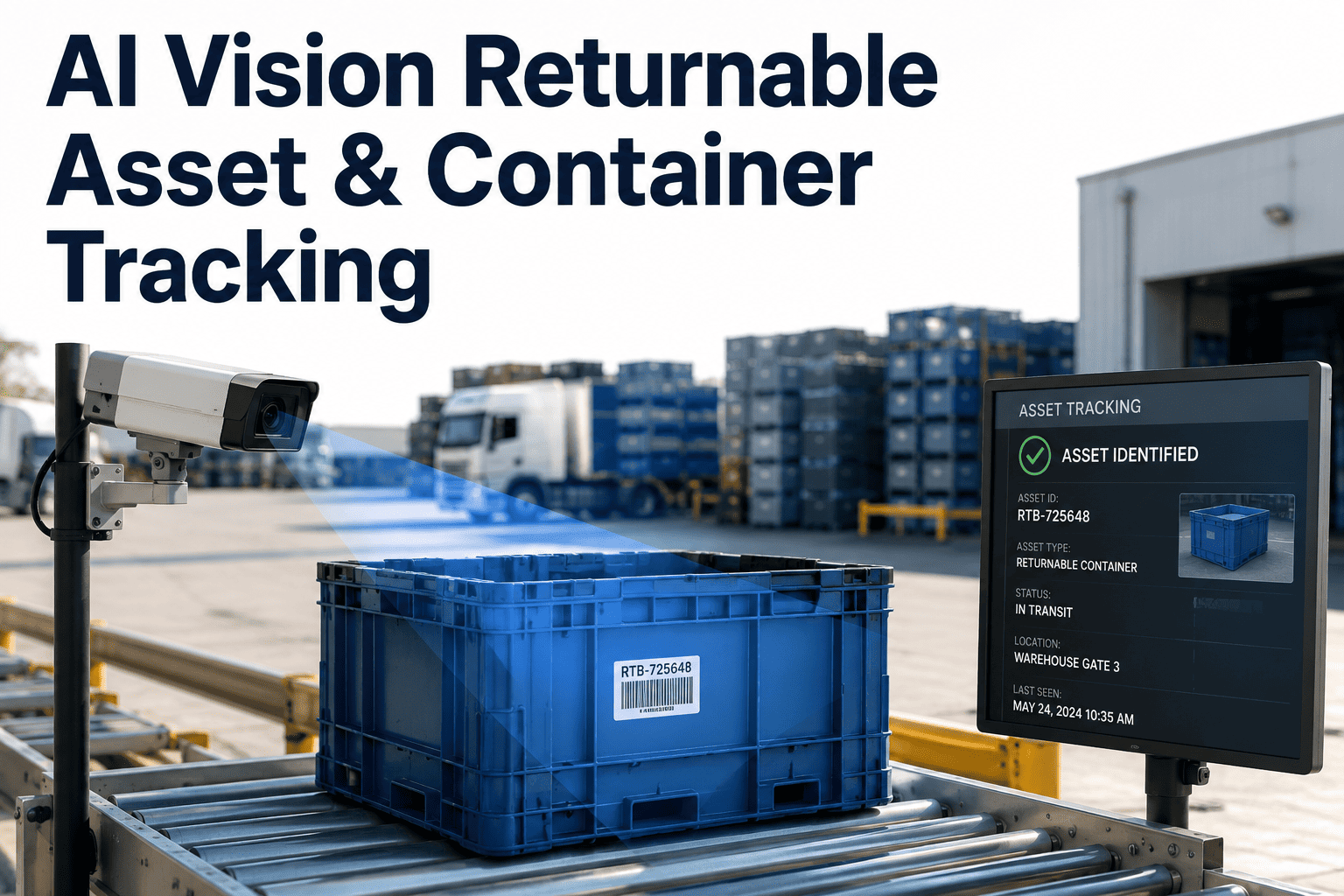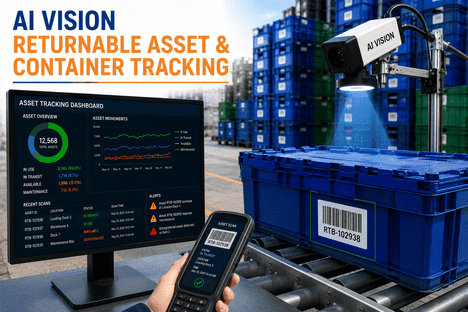
Returnable assets — totes, kegs, IBCs, pallets, crates, and intermediate bulk containers — represent billions of dollars in working capital across logistics, food and beverage, chemical, and manufacturing supply chains. Yet most operations still track these assets through spreadsheets, manual scan events, or not at all. The result is chronic shrinkage, inflated fleet sizes, and poor utilization rates that quietly erode margin on every shipment. iFactory's AI Vision Camera deploys computer vision and deep learning object detection at key handoff points — loading docks, warehouses, returns stations, and distribution hubs — to automatically identify, count, and log every returnable asset in motion, without requiring barcode scans, RFID tags, or manual intervention. The system captures visual data in real time, matches each container against a trained object model, and pushes structured asset events directly into your tracking or ERP platform. The outcome is a live, accurate picture of your entire returnable fleet at every node in the supply chain.
Automate Your Returnable Asset Tracking with AI Vision
iFactory AI Vision Camera detects, counts, and logs every tote, keg, IBC, and container automatically — eliminating shrinkage and giving you real-time fleet visibility from day one.
AI Vision Returnable Asset & Container Tracking: Eliminating Shrinkage and Fleet Waste Through Automated Visual Detection
A technical overview of how iFactory's Vision Object Detection technology tracks totes, kegs, IBCs, and returnable containers at every supply chain touchpoint — reducing shrinkage, improving fleet utilization, and replacing manual scan dependencies with continuous AI-powered visibility. Book a Demo to see iFactory in action across your returnable fleet.
Six Ways Manual Returnable Asset Tracking Bleeds Working Capital from Your Fleet
Every tote that goes unscanned, every IBC that disappears into a customer's yard, and every keg that misses its return window is a direct cost that compounds across your entire fleet. iFactory's AI Vision Camera eliminates these failure modes by making every asset movement visible, automatic, and auditable — regardless of whether anyone remembered to scan. Book a Demo to assess the shrinkage exposure in your current fleet.
High Shrinkage at Unmonitored Handoffs
Returnable assets disappear at dock doors, customer receiving areas, and returns stations where manual barcode scanning compliance is inconsistent. Without passive visual detection, losses are only discovered during periodic reconciliation — weeks or months after the asset left your control.
Oversized Safety Fleets from Poor Visibility
When operators cannot see where their containers actually are, they compensate by purchasing or leasing excess fleet capacity. Most operations carry 20–35% more returnable assets than their utilization data would justify, simply because no one can confirm where the existing fleet is sitting idle.
Manual Scan Compliance Failures
Barcode and RFID-dependent tracking systems rely on human action at every handoff point. In high-throughput environments, scan compliance routinely falls below 60% — creating gaps in asset history that make it impossible to dispute loss claims, enforce deposit recovery, or calculate true fleet turn times.
Slow Return Cycle Detection
Without real-time location visibility, containers that have stalled at a customer site or third-party warehouse go undetected until a shortage occurs upstream. Extended dwell times inflate rental costs, reduce fleet turn rates, and create supply disruptions that affect downstream operations.
Condition Blind Spots at Returns
Containers returned to depot are rarely inspected systematically for damage, contamination, or mixed-type errors. Damaged assets re-enter circulation undetected, causing downstream quality issues and customer disputes. Manual visual inspection at volume is impractical without automated assistance.
No Audit Trail for Dispute Resolution
Customer disputes over lost or damaged returnables are difficult to resolve without timestamped visual evidence of container condition and count at each handoff. Without this, operators absorb costs that are legitimately the customer's liability — a recurring drain that scales with fleet size.
Manual Returnable Tracking vs. iFactory AI Vision: Key Performance Benchmarks
Replacing scan-dependent asset tracking with AI Vision Object Detection produces measurable improvements in shrinkage rates, fleet utilization, and operational throughput across tote, keg, IBC, and pallet return programs. Book a Demo to benchmark your current fleet performance.
| KPI | Manual / Scan-Based Tracking | iFactory AI Vision | Improvement |
|---|---|---|---|
| Annual Asset Shrinkage Rate | 8–22% | 1–3% | Up to 87% reduction |
| Scan / Capture Compliance | 45–65% | 97–99% | ~2x improvement |
| Fleet Safety Stock Requirement | +25–35% buffer | +5–8% buffer | ~75% reduction |
| Returns Processing Throughput | 120–180 units/hr (manual) | 600–900 units/hr (AI) | ~4x improvement |
| Dispute Resolution Time | 5–14 days (no evidence) | Under 24 hours (visual audit trail) | 90%+ faster |
iFactory Vision Object Detection: Four Layers That Make Every Returnable Asset Visible
iFactory does not require changes to your existing container design, tagging strategy, or workforce behavior. The AI Vision Camera operates passively at fixed or mobile inspection points and captures every asset event without human action. Teams that Book a Demo typically see scan compliance reach 97%+ within the first week of deployment.
Vision Object Detection — Asset Identification Without Tags
iFactory's deep learning object detection models are trained to recognize totes, IBCs, kegs, pallets, and crates by shape, size, color, and surface markings — even without barcodes or RFID chips. Cameras mounted at dock doors, conveyor entries, and returns stations capture every asset passing through the field of view and log a timestamped detection event with container type, count, and condition flag.
Visual Fingerprinting and Container Classification
The system builds a visual model for every container class in your fleet — distinguishing your blue 600L IBCs from a customer's identical units, separating damaged totes from serviceable ones, and flagging mixed-type returns before they re-enter the wrong inventory pool. Classification accuracy improves continuously as the model accumulates site-specific training data from your actual fleet.
Automated Asset Event Logging and ERP Integration
Every detection event is structured into an asset movement record — container type, quantity, location, timestamp, and condition code — and pushed directly into your WMS, ERP, or returnable asset management platform via standard API. No manual data entry, no reconciliation lag. Asset histories build automatically across every node in your supply chain.
Fleet Utilization Analytics and Shrinkage Alerts
iFactory's analytics layer tracks dwell time, turn rates, and location distribution across your entire returnable fleet. Assets that exceed configurable dwell thresholds trigger automated alerts for recovery action. Fleet utilization dashboards identify which container classes are undersupplied, oversupplied, or consistently going missing at specific customer locations — enabling data-backed fleet right-sizing and deposit enforcement.
Stop Losing Returnable Assets to Blind Spots
iFactory AI Vision Camera deploys at your dock doors and returns stations in weeks — no container tagging, no infrastructure overhaul, no workforce behavior change required.
From Camera Installation to Full Fleet Visibility: iFactory's 5-Week Deployment Program
iFactory follows a structured deployment program that integrates AI Vision into your existing returnable asset workflow without disrupting daily operations. Facilities completing the program report average shrinkage rate reduction of 70%+ and scan compliance improvement from below 60% to over 97% within the first month of full operation.
Camera Installation and System Integration
iFactory AI Vision Cameras are installed at dock doors, returns stations, conveyor entry points, and any other high-flow asset movement locations. The system integrates with your WMS, ERP, or asset tracking platform via standard API. No operational downtime is required at any point during installation.
Visual Model Training and Container Fingerprinting
AI models are trained against your specific container classes — totes, IBCs, kegs, pallets — using live footage from your facility. Normal condition baselines are established for each type, and anomaly detection thresholds are calibrated against your maintenance team's known standards for damage classification.
Live Asset Event Logging Activates
The system begins generating structured asset movement records and pushing them into your tracking platform in real time. Your team begins receiving automated returns counts, condition flags, and dwell alerts. Scan compliance rates climb immediately as manual gaps are filled by passive AI detection.
Full Fleet Visibility and Analytics Online
Fleet utilization dashboards, shrinkage alert rules, and dispute audit trail archives are fully operational. Your team has complete, real-time visibility into every returnable asset across every node — from outbound shipment to returns processing — without any ongoing manual tracking effort.
"We were losing close to 14% of our IBC fleet every year and had no way to prove at which customer site the losses were occurring. Within six weeks of deploying iFactory's AI Vision Cameras at our four distribution depots, our shrinkage rate dropped to under 2%, our returns processing throughput nearly tripled, and we recovered enough idle fleet capacity to defer a container procurement order worth over $400,000. The visual audit trail alone changed every conversation we have with customers about disputed losses."
Returnable Asset Losses Are Predictable — and Preventable with AI Vision
Shrinkage, poor fleet utilization, and scan compliance failures in returnable asset programs are not random events — they are the predictable outcome of monitoring systems that depend on human action at every critical handoff. iFactory's AI Vision Object Detection removes that dependency entirely. By deploying computer vision at the points where assets change hands, iFactory creates a continuous, passive record of every container movement — without tags, without scanners, and without behavioral change from your workforce. The result is a returnable fleet that is fully accounted for at all times, sized accurately to actual utilization, and protected by a timestamped visual audit trail that makes loss disputes resolvable in hours rather than weeks. Logistics operators looking to reduce shrinkage, right-size fleet capacity, and maximize the return on their container investment should Book a Demo to see how iFactory's AI Vision Camera integrates with their existing operations and asset classes.
Frequently Asked Questions
Q: Can iFactory AI Vision track returnable assets without barcodes or RFID tags?
Yes — iFactory uses deep learning object detection to identify containers by visual characteristics including shape, size, color, and surface markings. No modification to existing containers is required. The system can be deployed against your current fleet without any hardware changes to the assets themselves.
Q: What container types does iFactory Vision Object Detection support?
iFactory is trained to detect and classify totes, intermediate bulk containers (IBCs), kegs, pallets, crates, drums, and custom returnable packaging. Models are trained against your specific container classes during the visual fingerprinting phase, ensuring accurate classification for your particular fleet mix.
Q: How does iFactory integrate with our existing WMS or ERP system?
iFactory connects to all major WMS and ERP platforms via standard REST API, including SAP, Oracle, Microsoft Dynamics, Blue Yonder, and custom-built systems. Asset movement events are pushed in structured JSON format and can be mapped to your existing asset tracking data model without schema changes on your side.
Q: How quickly does the AI model learn our specific container types?
Visual fingerprinting and baseline model training completes within the first 21 days of deployment using live footage from your facility. Initial detection accuracy typically reaches 92%+ in week three and improves to 97–99% by day 60 as the model accumulates additional training data from your specific operational conditions.
Q: Can iFactory operate at high-throughput returns processing environments?
Yes — iFactory AI Vision Cameras support throughput rates of up to 900 container units per hour at a single detection point, operating at sub-second detection latency. Multiple cameras can be networked at a single location to cover wide conveyor belts or multi-lane dock configurations without performance degradation.
Q: What is the typical ROI timeline for iFactory AI Vision in a returnable asset program?
Most facilities recover full platform deployment costs within 3–5 months through direct shrinkage reduction alone. Secondary savings from fleet right-sizing, reduced manual labor at returns processing, and avoided dispute costs typically add 40–60% to the total first-year return. Facilities with shrinkage rates above 10% often achieve payback within the first 8 weeks of full operation.
Future-Proof Your Returnable Fleet Against Shrinkage and Blind Spots
Speak with an iFactory logistics technology specialist today. Get a site-specific assessment of your current returnable asset tracking gaps and a clear deployment roadmap — no obligation, no pressure.