Deploying AI vision cameras in an oil refinery, chemical reactor bay, grain elevator, or offshore platform is not a matter of picking a rugged enclosure and hoping for the best. Every camera installed inside a classified hazardous area must carry a specific certification marking — ATEX in Europe, IECEx internationally, or NEC Class I/II Division 1/2 in North America — and the marking must match the zone, gas group, and temperature class of the atmosphere it is monitoring. Getting this wrong is not a paperwork issue. An uncertified camera in a Zone 1 gas atmosphere becomes a legally documented ignition source, and industrial insurers will not cover an incident where uncertified equipment was found in the exclusion perimeter. The good news is that any modern IP camera — including the ones running iFactory's AI vision analytics — can operate safely in Zone 1, Zone 2, Class I Division 1, and Class I Division 2 areas when installed inside a certified explosion-proof or intrinsically safe housing. Facilities scoping AI vision in classified areas can book a working session with our hazardous-area engineering team.
AI vision in Zone 1, Zone 2, Class I Division 1 and Division 2 — deployed correctly
Certified explosion-proof and intrinsically safe housings let modern AI cameras operate inside oil and gas, chemical, pharmaceutical, and grain-handling facilities without becoming an ignition source. iFactory's engineering team specifies, sources, and installs the right housing for your zone classification.
What every character on an ATEX nameplate actually means
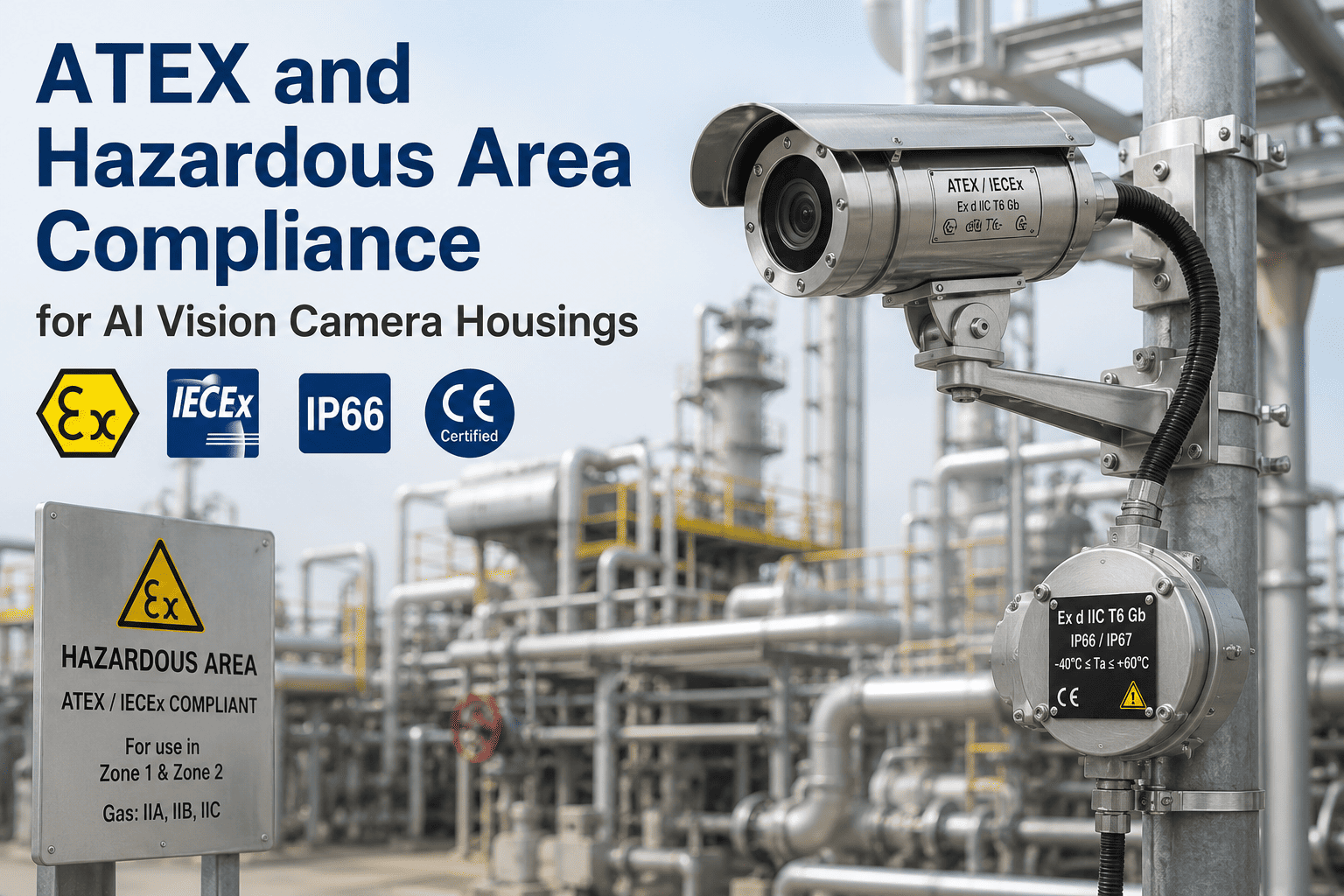
Every ATEX-certified camera housing carries a marking string that looks impenetrable at first glance — something like "II 2G Ex db IIC T4 Gb". Every character is a load-bearing element. Read the string wrong and you have specified the wrong housing for your zone. Read it correctly and you have a complete, auditable spec that any hazardous-area engineer can verify against your area classification drawings.
Group II means surface industries — everything except underground mines. Group I is reserved for mines with methane firedamp hazard.
Category 2 means Zone 1 approved, safe with one expected fault. G means gas atmosphere. Use D for combustible dust environments.
Ex db is a flameproof enclosure — strong enough to contain an internal explosion and cool escaping gases below the ignition threshold.
IIC is the most stringent gas group — covers hydrogen and acetylene. Equipment rated IIC also works in IIA and IIB. Never the reverse.
T4 caps the maximum surface temperature at 135°C. Standard for petrochemical industries where solvents ignite above that threshold.
Gb is high protection level for gas Zone 1. The Ga/Gb/Gc scheme is the IECEx-aligned refinement of the older Category 1/2/3 codes.
The zone hierarchy — how often the explosive atmosphere is present
Every classified area is assigned a zone number based on the frequency and duration of the explosive atmosphere. The zone number drives every downstream decision — enclosure type, certification level, cabling method, cost. In practice, Zone 1 installations cost 40 to 60 percent more than comparable Zone 2 installations because of the stricter housing and cable-gland requirements.
Explosive gas or vapor is present continuously, for long periods, or frequently — more than 1000 hours per year. Typical: inside solvent tanks, fuel vessel headspace, reactor interiors. Requires EPL Ga, ATEX Category 1.
Explosive atmosphere likely to occur occasionally in normal operation — between 10 and 1000 hours per year. Typical: near loading arms, pump seals, sample points. Requires EPL Gb, ATEX Category 2. Most common industrial camera application.
Explosive atmosphere not likely in normal operation, and if it occurs, only for a short time — under 10 hours per year, roughly 0.1 percent of operating time. Typical: perimeter around Zone 1, buildings housing Zone 1 processes. Requires EPL Gc.
Dust equivalents follow the same logic — Zone 20 (continuous dust), Zone 21 (likely in normal operation), and Zone 22 (unlikely, short duration). Grain elevators, flour mills, sugar refineries, and metal-powder handling all classify under the 20/21/22 dust system.
ATEX, IECEx, and NEC — three certifications, one physical hazard
The three certification frameworks that dominate global hazardous-area work each cover the same underlying physics, but they apply in different regions and use different marking systems. Modern camera housings are typically dual or triple certified so a single unit can be installed across Europe, the Middle East, Asia-Pacific, and North America without re-engineering.
Mandatory for all electrical equipment placed on the European market for use in explosive atmospheres. Certification by an EU-recognized Notified Body. Marking includes the hexagonal Ex symbol, Group, Category, and EPL.
The IEC certification scheme accepted globally as the benchmark for explosion-protected equipment. Particularly dominant in Middle East, Asia-Pacific, and Africa. Uses EPL codes (Ga/Gb/Gc, Da/Db/Dc) rather than category numbers.
The traditional North American system uses Class (I gas, II dust, III fibers) plus Division (1 continuous/likely, 2 abnormal only). NEC 505/506 also permits the Zone system for new installations. UL and FM certification typical for US.
Seven engineering approaches to keep the camera from igniting the atmosphere
Every "Ex" code on a nameplate refers to a specific engineering technique for preventing the equipment from becoming an ignition source. Camera housings for AI vision typically use one of three approaches — flameproof (Ex d), pressurized (Ex p), or increased safety (Ex e) — depending on the zone and the ambient conditions of the deployment.
Housing strong enough to contain an internal explosion and cool escaping gases below the surrounding atmosphere's ignition point through engineered flame paths. Dominant approach for Zone 1 camera housings.
Enhanced construction that eliminates arcs, sparks, and hot surfaces under normal operation. Common for junction boxes and terminal enclosures paired with a flameproof camera body.
Circuit energy is limited so low that ignition is not physically possible, even under multiple fault conditions. The only method approved for Zone 0 (Category 1) equipment.
Housing maintained at positive pressure with clean air or nitrogen so the flammable atmosphere physically cannot enter the enclosure. Popular for large control cabinets and analyzer houses.
Spark-producing components are encased in a compound or resin that isolates them from the hazardous atmosphere. Common in sensors and small electronic assemblies.
Equipment designed so that no sparks, arcs, or hot surfaces occur under normal operation. Zone 2 only — offers cost-effective coverage where explosive atmospheres are rare.
Dust-tight construction that prevents combustible dust from entering the enclosure. The primary method for Zone 20, 21, and 22 dust environments such as grain elevators.
Deploy AI vision anywhere on your classified footprint
iFactory delivers the full stack — certified housing selection, hazardous-area engineering, cable-gland specification, edge server, AI models, and audit-ready commissioning documentation. Turnkey delivery across ATEX, IECEx, and NEC classified areas.
Match the maximum surface temperature to the atmosphere's auto-ignition point
Every camera housing produces heat. The temperature class on the nameplate caps how hot the outer surface is permitted to reach — and that cap must sit safely below the auto-ignition temperature of every substance in the atmosphere. T4 is the working standard across petrochemical facilities because many common solvents and refinery gases ignite above 135°C.
Where certified AI vision cameras are being deployed today
The industries below drive the majority of hazardous-area camera deployments worldwide. In each case, iFactory's AI vision runs inside a housing certified for the specific zone, gas group, and temperature class present at that installation point.
Wellheads, separation trains, gas processing, and compression skids. Flameproof housings with 316L stainless steel bodies for offshore salt-spray environments.
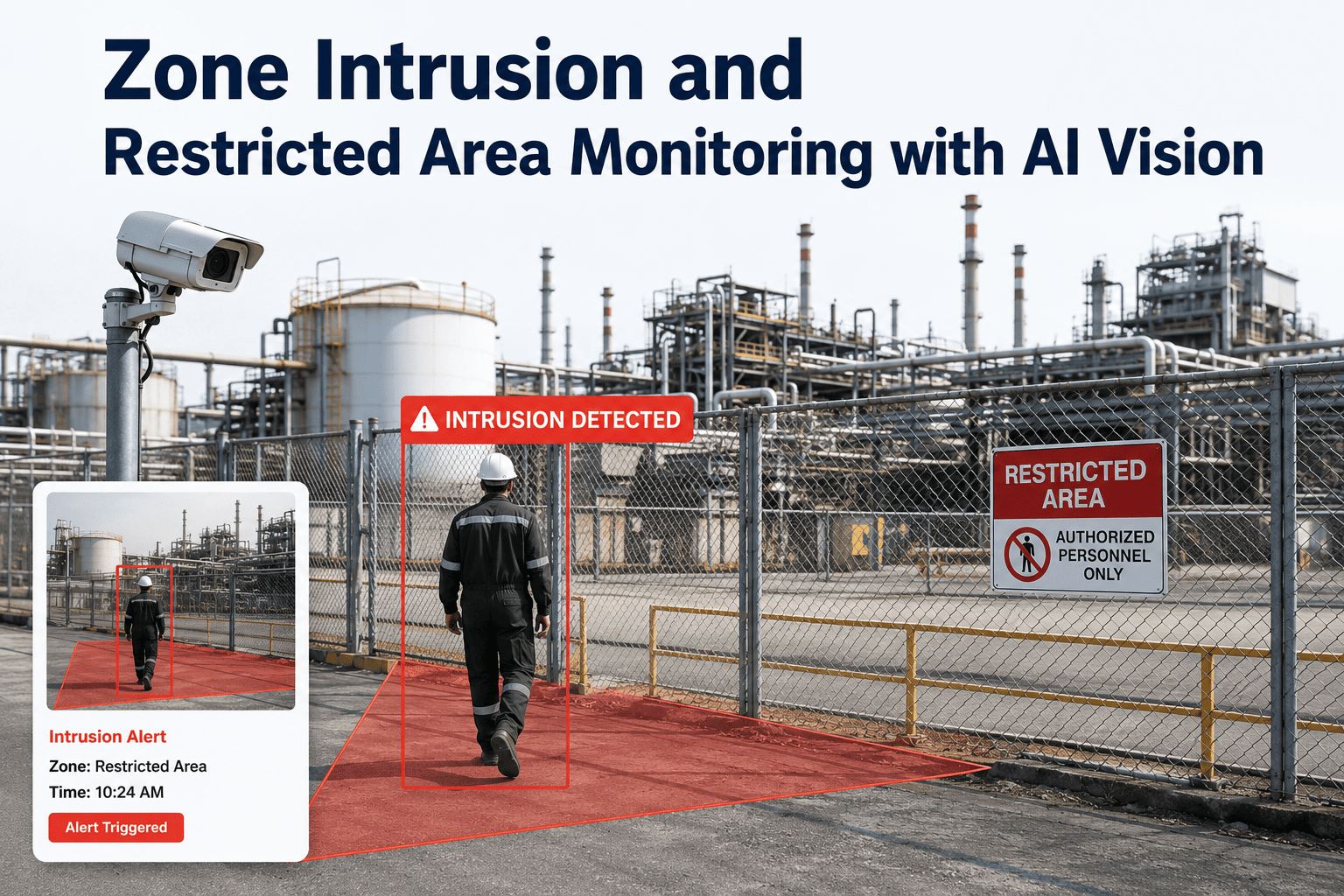
Reactor bays, catalyst regeneration, tank farms, loading racks. Continuous AI monitoring of flare stacks, leak detection, and unauthorized zone entry.
Solvent handling, reactor rooms, distillation columns. High gas group IIC coverage for hydrogen and acetylene atmospheres common in specialty chemicals.
Elevators, silos, mills, bagging lines. Dust-tight Ex tb housings monitor combustible dust accumulation and confined-space entry compliance.
API synthesis, solvent recovery, clean-in-place systems. Cleanroom-compatible finishes on flameproof housings for GMP-regulated production areas.
Platforms, FPSOs, LNG carriers. Marine-grade 316L housings with dedicated IECEx certification accepted globally for cross-flag deployments.
Common questions about AI vision in hazardous areas
Can we install a standard AI vision camera inside an explosion-proof housing, or does the camera itself need certification?
A standard IP camera can be installed inside a certified explosion-proof housing that carries the ATEX, IECEx, or NEC certification for the target zone — the housing is the certified device, not the camera. This is the dominant approach for AI vision in hazardous areas because it keeps the camera on standard commercial hardware while transferring the certification burden to the enclosure. The housing must be sourced from a certified manufacturer with a valid Notified Body certificate for the zone, gas group, and temperature class present at your installation. Facilities can schedule a scoping call to review housing options matched to their site classification drawings.
What is the practical difference between Class I Division 1 and ATEX Zone 1?
Class I Division 1 and ATEX Zone 1 are broadly similar but not identical. Class I Division 1 encompasses both Zone 0 (continuous atmosphere) and Zone 1 (occasional atmosphere) under the older two-tier North American system. ATEX Zone 1 covers only the occasional-atmosphere case. In practical terms, a Class I Division 1 rated housing is normally accepted as suitable for both Zone 0 and Zone 1 installations, while a housing rated only for Zone 1 does not automatically cover Zone 0. Modern dual-certified housings carry both markings, which is the safer specification choice for facilities that operate across regions.
How do we know what zone classification applies to a specific point on our floor plan?
Zone classification is not a guess — it is the output of a formal Hazardous Area Classification assessment carried out by qualified engineers using the source-of-release method described in IEC 60079-10-1. The assessment produces marked-up drawings showing every Zone 0, 1, 2 (or 20, 21, 22) region across the facility, along with the gas or dust group and temperature class that applies. Most operating plants already have these drawings on file with their EHS or process safety team. iFactory's engineering team reviews your existing HAC drawings during scoping and specifies housings that match every camera location without over-specifying and inflating cost.
Do certified housings compromise camera image quality or AI detection accuracy?
Modern flameproof housings use optical-grade glass or sapphire viewing windows engineered to minimize distortion, and iFactory's AI models are trained against imagery captured through certified housings so detection accuracy is preserved end-to-end. Housings also include heater elements for cold-climate operation and thermal management to keep the internal camera within its rated operating temperature. Where necessary, we specify housings with integrated wipers, defoggers, or purge systems for outdoor and marine environments. The result is imagery indistinguishable from a standard housing for the purposes of AI object detection, PPE recognition, and behavioral analytics.
How long does it take to specify, procure, and install certified AI vision in a classified area?
A typical hazardous-area AI vision deployment runs 10 to 16 weeks — slightly longer than a general-plant deployment because certified housings, cable glands, and conduit systems are made to order rather than off the shelf. The pathway includes HAC drawing review, housing and gland specification, procurement from a certified vendor, field installation by hazardous-area qualified electricians, and commissioning documentation for the operator's compliance file. Pilot deployments on a single classified area can be as short as 8 weeks. Facilities scoping a rollout should contact our support team for a deployment plan matched to their site's classification scope.
Turn every classified area into monitored, audit-ready compliance
iFactory delivers AI vision inside certified housings matched to your hazardous area classification — no over-spec, no compliance gaps. Full stack includes HAC drawing review, housing selection, cable-gland specification, edge server, models, and commissioning documentation. Deployed in 1000+ plants worldwide.