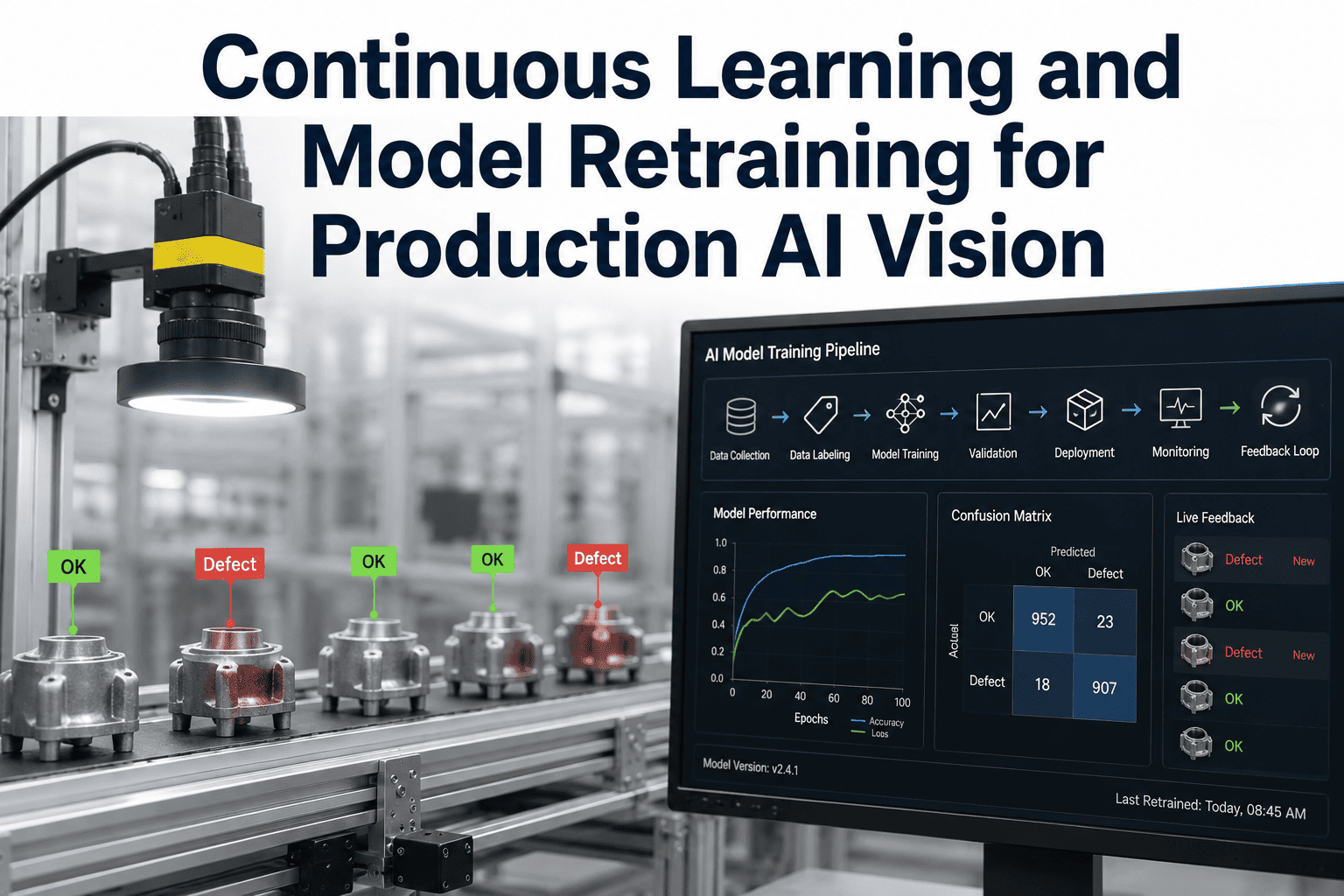
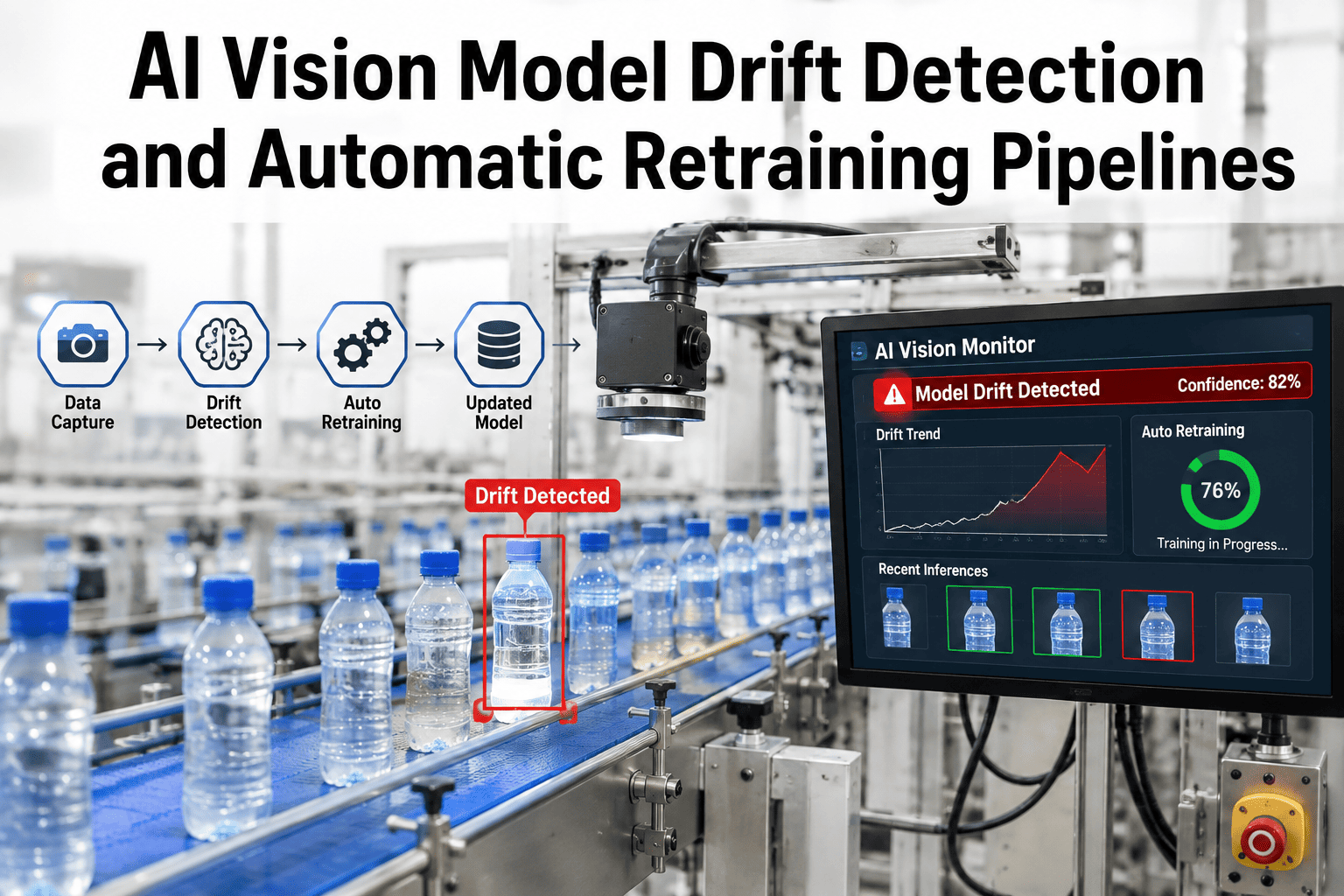
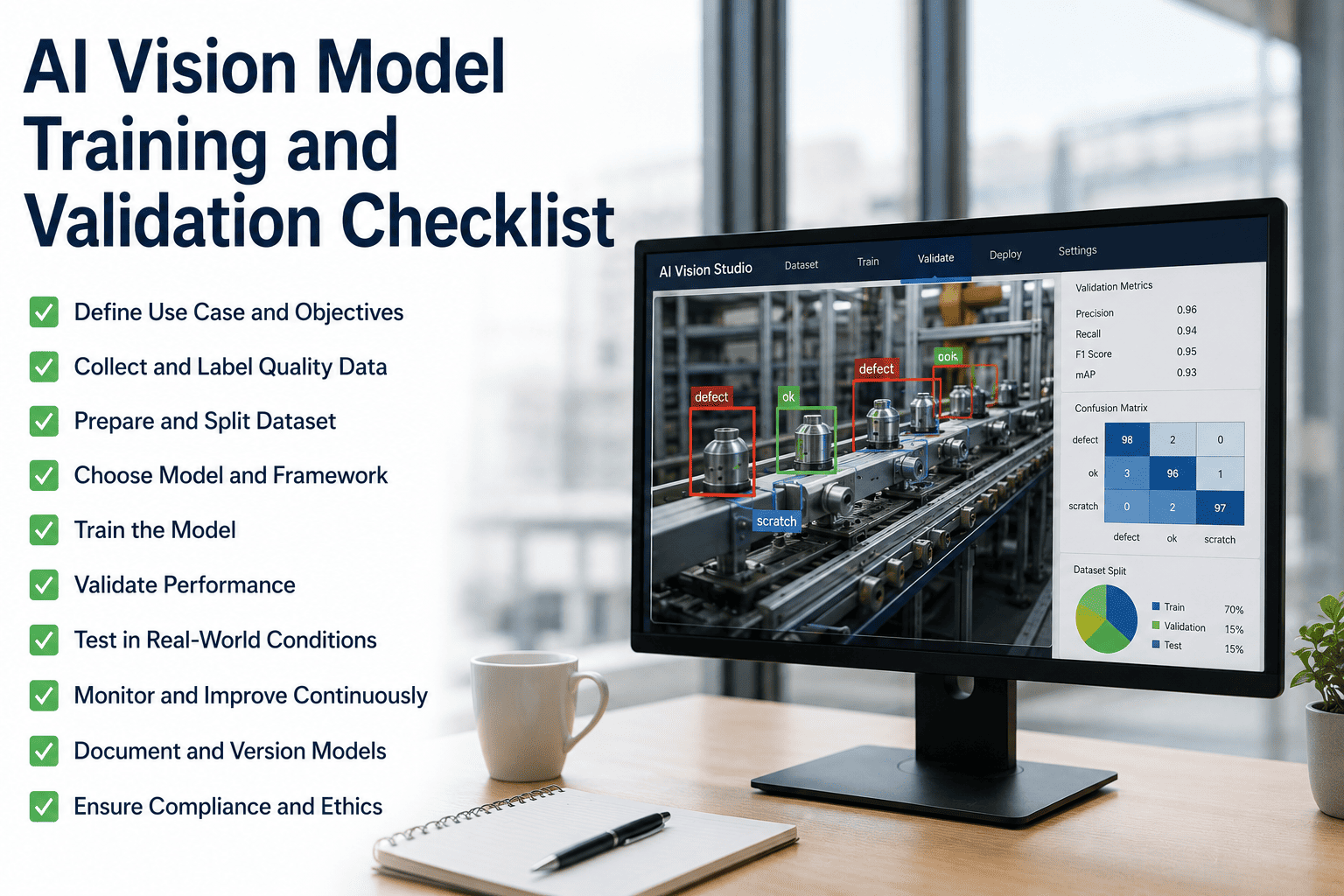
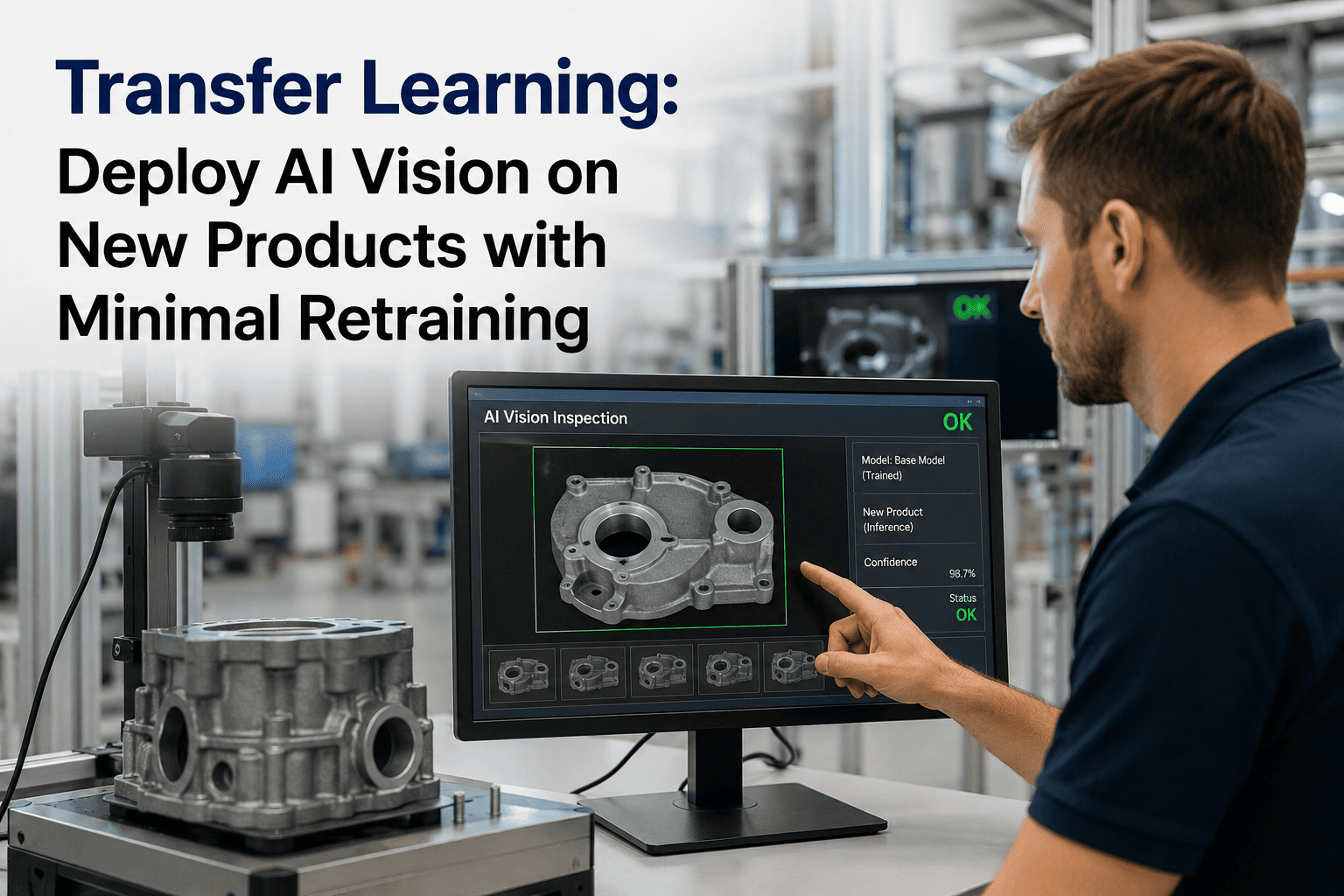
Production AI vision systems typically deploy at 90-92% accuracy — impressive enough to secure stakeholder approval yet insufficient for zero-defect manufacturing where false positives create operator alarm fatigue and missed defects trigger field failures costing $180K per incident on average. Traditional AI deployment treats models as fixed artifacts frozen at training day: deploy, monitor drift dashboards, then retrain quarterly through disruptive redeployment cycles consuming 3-4 weeks of coordination each round. iFactory's continuous learning platform inverts this pattern entirely — running active learning algorithms that surface the most informative edge cases from live production traffic, streamlining labeling to 10x throughput, and deploying updated models weekly to reach 99%+ accuracy within the first week while eliminating quarterly retraining shutdowns. Book a Demo to see how iFactory drives production AI vision from launch-day 90% to sustained 99%+ across your inspection lines within 8 weeks.
99%+
Sustained accuracy after continuous learning cycles vs 90-92% static baseline
7 Days
Time to production-grade accuracy through active learning iterations
10x
Labeling throughput vs manual review of every production frame
8wks
Full deployment from pilot to portfolio-wide continuous learning
Static AI Models Decay. Continuous Learning Compounds Accuracy Weekly.
iFactory's active learning engine identifies the most informative edge cases from every production shift, streams them through streamlined labeling, retrains models weekly and deploys updates via edge orchestration — driving accuracy from 90-92% launch baseline to sustained 99%+ within the first week and preventing the model drift that quietly kills static AI deployments.
How Continuous Learning Turns 90% Launch-Day Models Into 99%+ Production Systems
Every production AI vision deployment begins with a training dataset that captures 80-85% of real-world variation — the remaining 15-20% (unusual lighting, rare defect types, new product SKUs, seasonal material shifts) only appears once cameras start running on the actual line. Traditional AI stops here: the deployed model handles what it was trained on and flags everything else as low-confidence or, worse, misclassifies silently. Continuous learning transforms edge cases from failure modes into training fuel — the active learning engine ranks every uncertain prediction by information value, routes the top samples to labelers, and folds new knowledge back into the model within days. See how six active learning capabilities compound accuracy weekly across your production lines.
01
Active Learning Data Selection
AI ranks predictions by information value using uncertainty, ensemble disagreement and embedding-space rarity. The top 2-3% most informative frames feed the labeling queue — delivering 40x accuracy gain per labeled sample vs random sampling.
02
Uncertainty Sampling Engine
Monte Carlo dropout, deep ensembles and softmax entropy measure genuine model confusion on live inference. Low-confidence predictions surface for expert review; high-confidence cases process automatically — routing human attention exactly where it improves accuracy most.
03
Human-in-the-Loop Labeling
Purpose-built interface with pre-annotations, keyboard shortcuts, and inter-annotator quality control enables domain experts to review 400-600 samples per hour — 10x manual baseline. Quality gates enforce labeling accuracy before samples enter training.
04
Automated Retraining Pipelines
Weekly retraining jobs trigger automatically once labeling queues clear thresholds. Hyperparameter search, augmentation strategy and architecture selection run without manual intervention — data science teams review results rather than orchestrating pipelines.
05
A/B Champion-Challenger Validation
New model candidates run in shadow mode against the production champion for 24-72 hours. Statistical tests on precision, recall and business metrics gate promotion — preventing regression while accepting genuine improvements automatically without deployment risk.
06
Edge Deployment Orchestration
Approved models push over-the-air to edge inference nodes with atomic rollback, canary deployment and health monitoring. Model updates roll out to hundreds of cameras within minutes — no line stops, no manual configuration, no downtime windows.
The Accuracy Journey: How AI Vision Climbs From 91% to 99%+ Week by Week
The gap between launch-day accuracy and production-grade accuracy isn't closed by better initial training — it closes only by systematic learning from real production edge cases. Each week's retraining cycle absorbs the previous week's rare failures, unusual lighting and new product variations, driving cumulative accuracy improvement that a static model can never match. Request the accuracy trajectory report showing week-by-week improvement curves from live customer deployments.
Day 1
91%
Launch baseline. Model handles trained distribution but misses rare defect variants and unusual lighting creating operator alerts.
›
Week 1
96%
First active learning cycle complete. Top 500 uncertain frames labeled and retrained. Rare defect recall jumps 60%; false positives drop 45%.
›
Week 4
98.2%
Four retraining cycles absorbed. Seasonal material variation and shift-change lighting covered. Manual review load drops 55% from baseline.
›
Week 8
99.3%
Production-grade sustained accuracy. Continuous learning maintains performance against product changes, tooling wear and supplier shifts automatically.
How Continuous Learning Differs From Static AI Deployment
Most enterprise AI vision deployments follow the classic MLOps textbook: train once, deploy, monitor drift dashboards, escalate to data science when accuracy falls below threshold, then retrain quarterly through weeks of coordination. iFactory's continuous learning architecture is engineered for the opposite pattern — where production data itself trains the next model automatically and drift is prevented rather than detected after damage occurs. Compare iFactory continuous learning against your current AI vision retraining baseline directly.
| Capability |
Static AI Deployment |
iFactory Continuous Learning |
| Accuracy Trajectory |
Peaks at deployment; degrades 2-5% quarterly as production distribution shifts. Requires manual detection and reactive retraining. |
Improves from 91% launch to 99%+ within first week. Sustained accuracy through continuous absorption of edge cases. |
| Training Data Selection |
Bulk random sampling for quarterly retraining. Most labeled data provides marginal accuracy gain due to redundancy. |
Active learning ranks frames by information value. Top 2-3% selected — 40x accuracy gain per labeled sample. |
| Retraining Cadence |
Quarterly cycles requiring 3-4 weeks of data collection, labeling coordination, model training and deployment. |
Weekly automated retraining once labeling queue thresholds clear. Zero coordination overhead for data science teams. |
| Deployment Downtime |
Line stops or manual reconfiguration for model updates. 2-4 hour deployment windows scheduled around production. |
Over-the-air edge deployment with atomic rollback. Zero production disruption during model updates across the fleet. |
| Labeling Efficiency |
40-60 samples per hour reviewed manually. Bulk labeling campaigns consume domain expert time in coordinated bursts. |
400-600 samples per hour through pre-annotated interface with keyboard shortcuts and quality control automation. |
| Drift Response |
Reactive — drift detected in dashboards, escalated to data science, retraining scheduled weeks later while accuracy degrades. |
Preventive — new patterns absorbed continuously before impacting production accuracy or generating false alerts. |
| Total Cost of Ownership |
Recurring quarterly projects consuming 200-400 data science hours plus labeling campaigns and deployment coordination. |
One-time deployment then autonomous. Data science teams focus on new use cases rather than maintaining deployed models. |
Weekly Retraining Automation. Live in 8 Weeks. Accuracy Evidence in Week 4.
iFactory's fixed-scope program means no data science hiring, no MLOps platform build, and no quarterly retraining campaigns — just continuous accuracy improvement running autonomously across your inspection fleet from week 4 onward.
iFactory Continuous Learning 8-Week Deployment Program
Every iFactory continuous learning engagement follows a structured 8-week program transitioning AI vision from static deployment to weekly retraining automation — with the first active learning cycle running by week 4 and full portfolio automation by week 8.
01
Instrumentation
Inference telemetry, uncertainty logging and edge case capture activated on production models
02
Active Learning
Uncertainty sampling, ensemble disagreement and embedding rarity engines configured for your models
03
Labeling Setup
Pre-annotation workflow, keyboard shortcuts and inter-annotator quality control activated
04
Retraining Pipeline
Automated weekly training with hyperparameter search and augmentation strategy configured
05
A/B Validation
Shadow-mode champion-challenger validation with statistical gating for model promotion enabled
06
Fleet Rollout
Edge orchestration active across all inference nodes; continuous learning running portfolio-wide
Weeks 1-2
Baseline & Instrumentation
Production inference telemetry capturing prediction confidence, embedding vectors and edge case metadata activated
Current model accuracy baseline established with segmentation by product SKU, shift and defect class
Labeling interface deployed with pre-annotation and quality control configured for domain experts
Weeks 3-4
First Active Learning Cycle
Active learning ranks 2 weeks of production frames selecting top 500 informative edge cases for labeling
Expert reviewers process labels through streamlined interface at 400-600 samples per hour throughput
First retrained model hits 96%+ accuracy on validation. A/B shadow mode validates against production champion
Weeks 5-6
Retraining Automation
Weekly retraining pipelines fully automated: labeling triggers, training jobs, validation gates, edge deployment
Champion-challenger promotion criteria calibrated to your precision, recall and cost-of-error thresholds
Accuracy hits 98%+ sustained across production distribution. Manual review load down 55% from baseline
Weeks 7-8
Portfolio Continuous Learning
All production lines on continuous learning. Edge orchestration deploys updates without downtime
Data science handoff complete — continuous learning runs autonomously; team refocuses on new use cases
ROI report delivered: accuracy gain quantified, false positive reduction measured, retraining cost eliminated
ROI IN 6 WEEKS: MEASURABLE ACCURACY GAINS FROM WEEK 4
Manufacturers completing the 8-week program report an average of $1.4M in annualized cost avoidance within 6 weeks of deployment — through reduced false-positive investigation, eliminated quarterly retraining projects, and defect escape prevention worth $180K per incident avoided.
$1.4M
Avg. annualized savings by week 6
96%+
Accuracy achieved by week 4
55%
Manual review load reduction
Continuous Learning Results Across Production AI Vision Deployments
These outcomes are drawn from iFactory continuous learning deployments across three production AI vision applications. Each use case reflects 6-month post-deployment performance measured against the customer's static AI baseline. Request the full case study report for the inspection application most relevant to your production line.
A tier-1 automotive supplier running body panel scratch inspection across 12 stamping lines launched at 90.8% accuracy but faced rising false positives from new aluminum-magnesium alloy variants and shift-change lighting drift. Static quarterly retraining scheduled 14 weeks out could not respond fast enough — operator alarm fatigue was already dropping true-defect response rates. Continuous learning activated in week 3 identified the alloy variants as top information-value edge cases, retrained within 6 days, and achieved 98.6% accuracy by week 4. By month 6 the model reached 99.4% sustained accuracy, false positives dropped 62%, and quarterly retraining projects eliminated entirely saved 380 data science hours annually.
99.4%
Sustained accuracy after 6 months of continuous learning
62%
False positive reduction eliminating operator alarm fatigue
380
Data science hours saved annually vs quarterly retraining
A contract electronics manufacturer running 8 SMT lines deployed AI solder inspection at 92.3% accuracy but struggled with rapidly changing product mix — 40+ new PCB designs introduced monthly created constant distribution shift. Traditional retraining could not keep pace; manual review of low-confidence predictions consumed 4 full-time reviewers. Continuous learning cut this dramatically: active learning identified highest-value new-design samples, weekly retraining absorbed them within days of first appearance, and accuracy climbed to 99.1% by week 8. Manual review team reduced from 4 to 1 reviewer, and defect escape rate to customer dropped 78% preventing 14 field-return incidents worth $2.5M annually.
99.1%
Accuracy achieved despite 40+ new designs monthly
78%
Reduction in defect escapes to customer
$2.5M
Annual field-return costs prevented through faster learning
A packaged foods manufacturer running seal integrity inspection across 6 packaging lines launched at 91.5% accuracy but encountered seasonal packaging material variation (film thickness, adhesive formulation) creating 3-4 week accuracy degradation cycles annually. Static retraining lagged material changes by 2 months — during transitions, seal failures escaped to distribution creating recall risk and $340K per incident cost exposure. Continuous learning inverted this pattern: active learning detected packaging material shifts within 2 days of first appearance, retrained models absorbed variation within a week, and accuracy stayed above 98.5% through all seasonal transitions. Zero recall-triggering seal escapes over 12 months post-deployment.
98.5%
Sustained accuracy through all seasonal material transitions
0
Recall-triggering escapes over 12 months post-deployment
2 Days
Detection of material variation vs 2-month static baseline
Frequently Asked Questions
How does active learning select which production frames to label for retraining?
Active learning combines three signals to rank frames by information value: uncertainty sampling using softmax entropy and Monte Carlo dropout, disagreement scoring between ensemble model heads, and embedding-space rarity measuring how different a frame is from existing training data. The top 2-3% ranked frames feed the labeling queue. This delivers 40x more accuracy gain per labeled frame than random bulk sampling — meaning the same accuracy improvement in weeks rather than quarters of coordinated retraining campaigns.
Book a demo to see active learning ranking on your production data.
Does continuous learning require additional labeling team headcount to sustain weekly cycles?
No — most customers reduce labeling headcount despite higher retraining cadence. The active learning engine surfaces only the most informative 2-3% of frames, and the streamlined labeling interface with pre-annotations, keyboard shortcuts and quality control enables 400-600 samples per hour throughput vs 40-60 in manual baseline workflows. A single reviewer working 4 hours weekly can sustain continuous learning for a typical inspection line. Weekly cycles process more informative data with less total labeling effort than quarterly bulk campaigns.
How does A/B champion-challenger validation prevent model regression during weekly updates?
Every retrained model runs in shadow mode against the production champion for 24-72 hours, generating predictions on live traffic without acting on them. Statistical tests on precision, recall, calibration and business-specific metrics (defect escape rate, false positive rate, throughput impact) compare challenger against champion side by side. Only models exceeding statistical significance thresholds on primary metrics get promoted to production. This prevents any regression while accepting genuine improvements automatically — no manual review needed for standard promotions and full audit trails maintained.
What happens when production distribution changes dramatically due to new products or process modifications?
Continuous learning handles distribution shift automatically because the active learning engine detects distribution changes through embedding-space rarity metrics before accuracy degrades noticeably. New product SKUs, tooling changes and process modifications generate high information-value edge cases that flow to the labeling queue immediately. Retraining absorbs the new distribution within 1-2 weekly cycles — a fraction of the time required to detect drift in static deployments and coordinate reactive retraining campaigns weeks after quality has already suffered.
Can continuous learning integrate with existing MLOps platforms or does it require replacement?
iFactory continuous learning integrates with existing MLOps infrastructure including MLflow, Kubeflow, SageMaker and Vertex AI through standard APIs — no platform replacement required to activate weekly retraining automation. The active learning selection engine, streamlined labeling workflow and edge deployment orchestration layer on top of your existing training and serving infrastructure. Most customers keep their preferred experiment tracking, model registry and feature store while gaining continuous learning automation. Integration completes within the 8-week total deployment scope.
Turn Every Production Frame Into Training Fuel. Deploy Continuous Learning in 8 Weeks.
iFactory gives AI vision teams active learning selection, automated retraining, A/B validation and edge deployment orchestration — fully deployed across your inspection fleet in 8 weeks with 96%+ accuracy demonstrated by week 4 and 99%+ sustained by week 8 across every production line.
Active learning selects top 2-3% most informative edge cases
10x labeling throughput through streamlined workflow interface
Weekly automated retraining eliminates quarterly project cycles
Edge deployment orchestration updates fleet with zero downtime