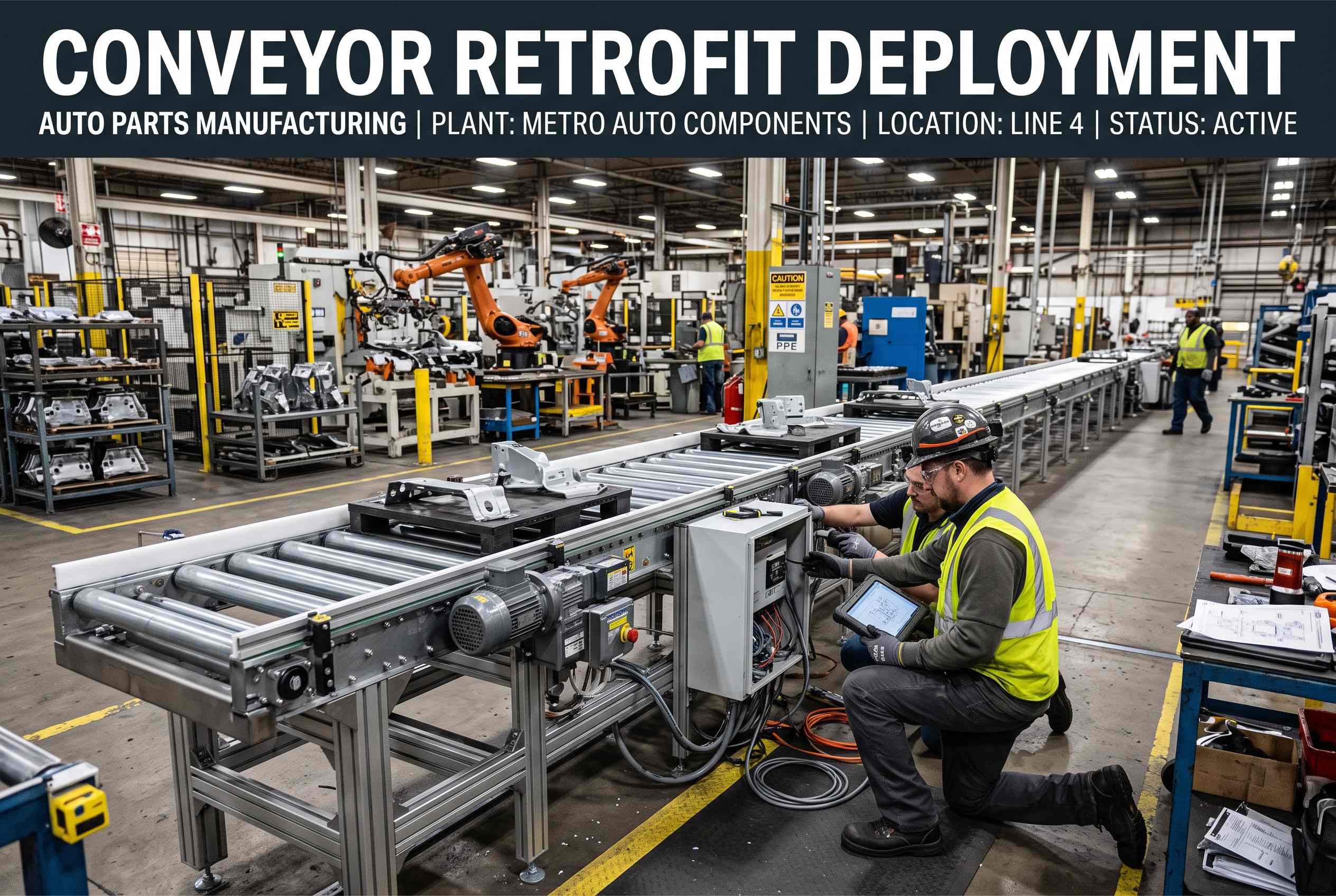
Your stamping press is running 60 strokes a minute, parts are flying off the exit conveyor, and the operator at the end-of-line inspection station is doing what every operator does — picking up one part in ten, checking for burrs, putting it back, and hoping the other nine are fine. By the time the SPC chart catches a burr-height drift, you've already shipped 400 borderline parts into the machining cell. If this sounds familiar, an AI vision conveyor retrofit on your existing auto parts line is the fastest way to get from 10% sampling to 100% inspection without ripping out your presses or rewiring your PLC architecture — and it's exactly what Tier 1 and Tier 2 suppliers under NAICS 3363 are deploying right now to cut PPM defect rates and scrap costs before the next OEM audit cycle.
What an AI Vision Conveyor Retrofit Actually Delivers on an Auto Parts Line
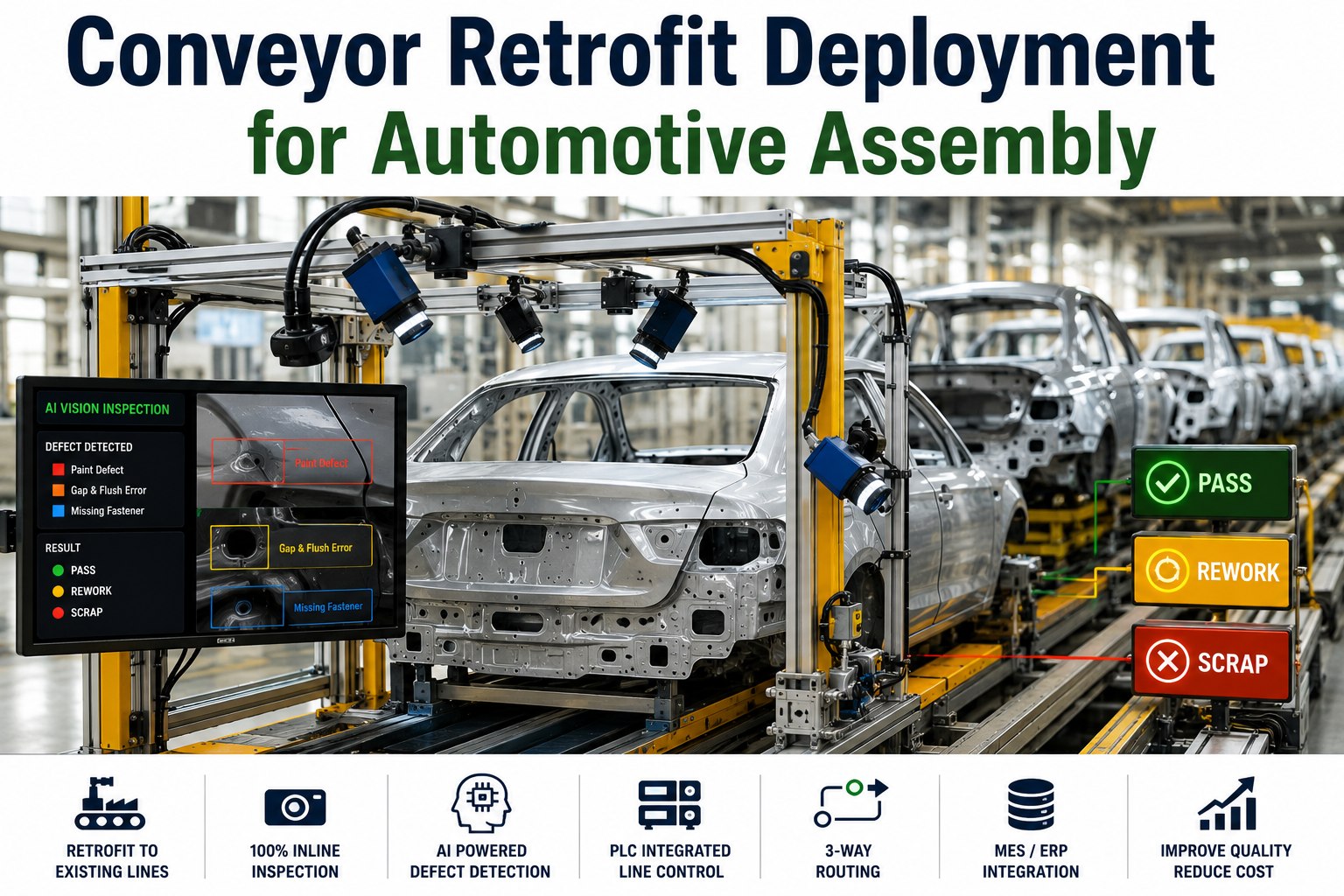
On-prem GPU inference, 100% in-motion inspection, and automated pass/rework/scrap routing — layered onto your existing stamping and machining conveyors without replacing the line.
Press Exit Capture
High-speed cameras mount over the existing conveyor at the stamping press exit — no line stoppage, no mechanical modification.
GPU Inference Engine
On-prem NVIDIA GPU appliance runs deep-learning models at line speed — burrs, porosity, missing operations flagged in under 80 milliseconds.
Level 2 Routing
PLC/DCS tag write triggers a three-way diverter — pass, rework, scrap — with zero operator intervention at full conveyor speed.
MES / ERP Identity
Every part's inspection result maps to its MES batch ID and ERP work order — full genealogy from coil lot to shipped container.
Why Sampling Inspection Fails on High-Speed Stamping Lines
The math against manual sampling on a modern stamping line is brutal. At 60 strokes per minute, a single missed burr-height drift runs for 8 minutes before the next hourly sample — that's 480 defective parts flowing into your machining cell or, worse, into a customer's incoming inspection. The cost isn't just the scrap. It's the machining cell tooling that chews through burr-laden parts, the rework labor at the deburr station, and the PPM hit on your monthly supplier scorecard that triggers an OEM audit. Book a single-line retrofit assessment to see exactly where your sampling gap is leaking margin.
typical sampling rate on high-speed stamping exits — meaning 90% of parts ship uninspected
defective parts produced between hourly SPC samples on a 60-SPM press before drift is caught
average annual scrap and rework cost at a mid-size Tier 2 stamping plant — per industry benchmark studies
of automotive supplier quality escapes trace back to processes with sampling-only inspection regimes
Before vs. After: The Retrofit Impact on Line Operations
The clearest way to understand what a conveyor retrofit changes is to put the before and after side by side. Same press, same conveyor, same operators — but a fundamentally different inspection and routing outcome once AI vision and Level 2 PLC control are layered on top.
Manual Sampling & Paper Genealogy
- Inspection rate1 in 10 parts sampled
- Defect detectionBurr height drift caught 8+ min late
- RoutingOperator pulls part, manual sort bin
- RCA dataPaper traveler, manual PLC log pull
- PPM to customer250–600 PPM typical
- Audit response2–3 days to reconstruct lot genealogy
100% AI Inspection & Auto-Routing
- Inspection rate100% of parts, in motion
- Defect detectionBurr drift flagged in <80ms per part
- Routing3-way diverter: pass / rework / scrap
- RCA dataPLC tags + vision frames auto-linked
- PPM to customerUnder 50 PPM within 90 days
- Audit responseLot genealogy in under 10 minutes
Curious what the before-to-after delta looks like on your specific line? Book a retrofit ROI walkthrough with iFactory's auto parts vision team and we'll model it against your current PPM and scrap numbers.
Deploy AI Vision on Your Line in 8 Weeks — Fixed Price
iFactory's single-line conveyor retrofit covers camera mounting, on-prem NVIDIA GPU inference, PLC tag integration, and MES/ERP identity mapping — delivered on a fixed-price, fixed-timeline basis so your finance team knows the number before kickoff.
What the Vision Models Catch at Full Conveyor Speed
The deep-learning models deployed in an iFactory retrofit are trained on auto parts defect libraries specific to NAICS 3363 processes — stamping, machining, casting, and assembly. These aren't generic vision templates. They're tuned to the defect modes your quality engineers already log in 8D reports, and they run on every part that crosses the camera gate.
Burr Height & Edge Flash
Excess burr at trim edges, die-roll on drawn cups, edge flash on progressive stampings — flagged against tolerance bands per part number.
Porosity & Surface Voids
Cast and sintered part porosity, shrink voids, cold shuts on machined surfaces — segmented by severity and location zone.
Missing Operations
Undrilled holes, missing tapped threads, absent chamfers, skipped deburr — caught by comparing part state to the operation routing.
Form & Dimensional Drift
Draw depth variation, flange angle drift, hole-position shift — tracked as trend data feeding back into press die maintenance triggers.
Cracks & Laps
Micro-cracks at bend radii, forging laps, fatigue fissures on machined surfaces — caught at sub-millimeter scale before heat treat.
Label & Code Verification
Part-marking OCR, 2D data matrix, laser-etch legibility — verified against the MES work order identity before the part enters the rack.
Three-Way Routing: How Pass, Rework, and Scrap Decisions Happen Automatically
The real operational power of the retrofit isn't the inspection — it's what happens after. Every inspected part gets a disposition decision in real time, written directly to the Level 2 PLC/DCS, which actuates the diverter gate on the conveyor. No operator judgment, no manual sort bins, no "I'll deal with that later" scrap pile that grows through the shift.
Pass Lane
Condition: All vision checks within tolerance, part identity verified against MES work order.
PLC Action: Diverter holds straight — part continues to next operation or pack-out. Vision frame and result logged to batch record.
Rework Lane
Condition: Defect is recoverable — excess burr, minor form offset, surface contamination within rework spec.
PLC Action: Diverter routes to rework loop. MES flags the part with rework operation code and required station.
Scrap Lane
Condition: Defect unrecoverable — crack, severe porosity, missing critical operation, dimensional out-of-bounds.
PLC Action: Diverter routes to scrap bin with weight sensor. ERP logs scrap cost against work order and coil lot in real time.
Want to see how the PLC tag mapping and diverter logic work on your specific conveyor layout? Talk to a vision integration specialist about your Level 2 architecture.
MES, ERP, and QMS Integration: Closing the RCA Loop
Inspection without integration is just a camera taking pictures. The retrofit's value compounds when every vision result, every PLC tag, and every diverter action flows back into your MES, ERP, and QMS — creating an automated root-cause-analysis loop that used to take a quality engineer three days to assemble manually.
PLC / DCS Tag Capture
Press tonnage, stroke count, die temperature, lubrication flow, conveyor speed — captured at the moment of inspection and timestamped to the vision frame. When a defect spike appears, the press parameters at that exact stroke are already linked.
MES Identity Mapping
Each part maps to its MES work order, operation sequence, coil lot, and operator ID. The vision system reads the part mark — or infers identity from conveyor position and stroke count — and writes the inspection result against that record via API.
ERP Cost & Scrap Logging
Scrap and rework events post to the ERP work order in real time — material cost, labor burden, and overhead applied automatically. No end-of-shift manual scrap reconciliation, no "where did this scrap come from?" investigations.
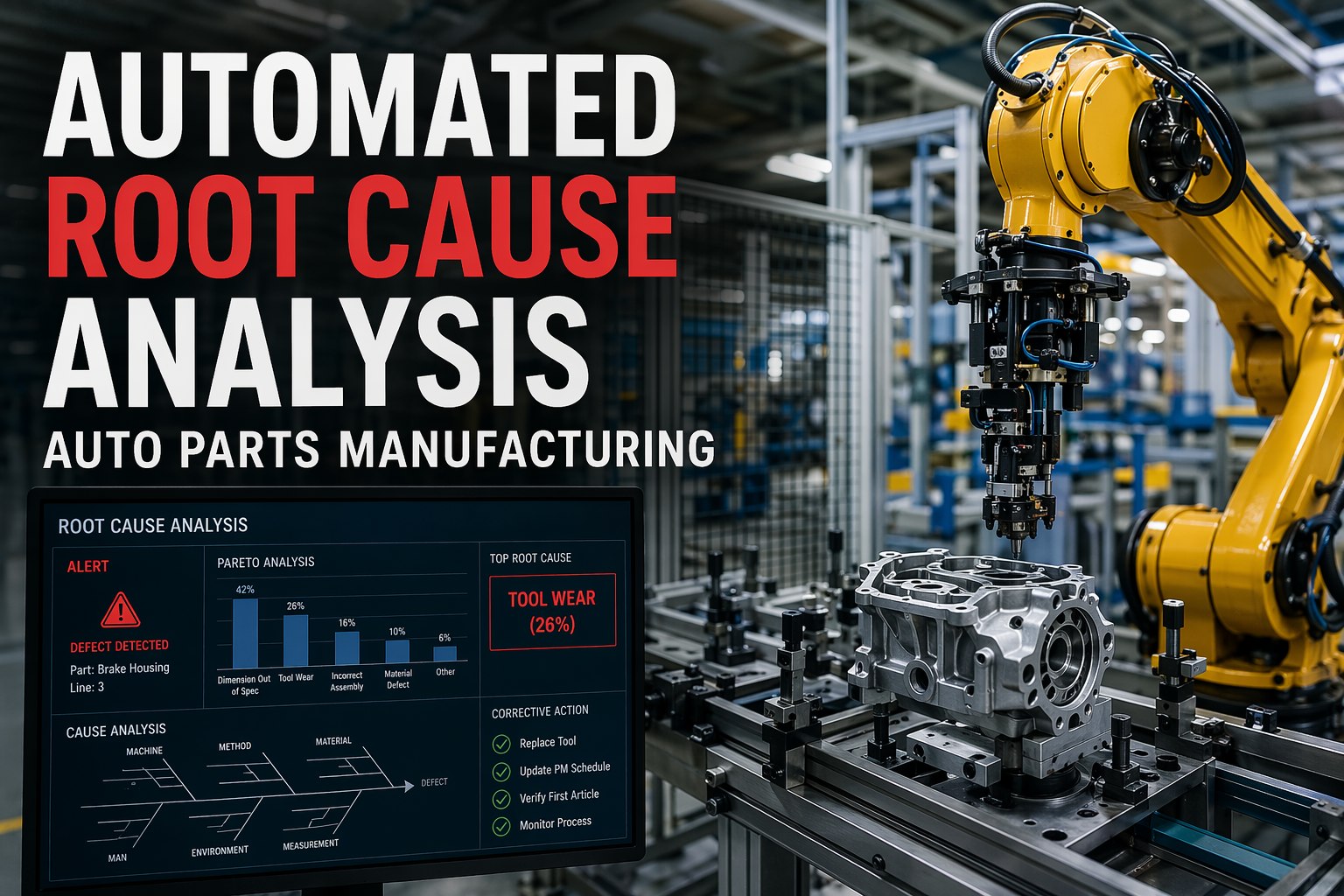
QMS & Automated RCA
When a defect trend breaches a threshold — say, burr height drifting over 3 consecutive parts — the QMS auto-generates an 8D trigger with the linked press parameters, vision frames, and lot genealogy attached. The quality engineer opens a pre-populated investigation, not a blank form.
Running a legacy MES or a custom ERP? Book an integration architecture session — iFactory's API layer connects to SAP, Oracle, Epicor, Infor, and custom MES platforms via standard REST/OPC-UA interfaces.
Get the 8-Week Pilot Scope & ROI Worksheet
See the fixed-price scope, timeline, hardware list, and projected scrap-cost recovery for a single-line AI vision conveyor retrofit at your plant — built around your press speed, part mix, and current PPM baseline.
The 8-Week Deployment Timeline: What Happens When
A single-line retrofit shouldn't be a multi-quarter capital project. iFactory's fixed-price pilot is structured as an 8-week deployment — from site survey to production go-live — with clear milestones at each phase so your operations and quality teams know exactly when to expect what.
Site Survey & Line Mapping
Engineering team walks the line, maps conveyor geometry, identifies camera mount points, and audits PLC tag availability. No production stoppage required.
Model Training & Tuning
Defect images from your 8D history and sample parts are used to train and validate the deep-learning models. Tolerance bands set per part number and defect category.
Hardware Install & Network
Cameras, lighting, GPU appliance, and network drops installed during planned maintenance windows. Conveyor runs normally outside install windows.
PLC Integration & Diverter Test
Level 2 tag mapping configured, diverter actuation tested with sample parts at full line speed. Pass/rework/scrap routing validated before go-live.
MES / ERP API Integration
Work order identity mapping, scrap posting, and QMS 8D triggers configured and tested against your live MES and ERP environments via API.
Shadow Mode & Validation
System runs in shadow — inspecting and logging but not actuating the diverter. Quality team validates detection accuracy against manual review of a 500-part sample.
Production Go-Live
Diverter goes live. Full 100% inspection, automated routing, and MES/ERP genealogy active. Baseline PPM and scrap-cost tracking begins against pre-retrofit numbers.
The ROI Math: What the Retrofit Pays Back
The reason auto parts plants are retrofitting AI vision onto existing conveyors — instead of waiting for the next greenfield line build — is that the payback period is measured in months, not years. Here's the cost-recovery structure that makes the 8-week pilot financeable out of the quality budget, not just capital expenditure.
Scrap Cost Reduction
Catching defects at the press exit — before they consume machining cell time, tooling wear, and labor — typically cuts scrap cost by 40–60% on the retrofitted line within the first quarter.
Rework Recovery
Automated rework routing recovers parts that would otherwise be scrapped or missed entirely. The rework lane typically recovers 1.5–2% of throughput that was previously lost.
PPM & Scorecard
Moving from 250+ PPM to under 50 PPM protects your OEM supplier scorecard rating, avoids chargebacks, and reduces the risk of a mandated supplier audit that costs 6 figures in internal labor.
Audit & RCA Labor
Automated lot genealogy and pre-populated 8D triggers cut quality engineering time per investigation from 2–3 days to under 2 hours — freeing your team for prevention, not paperwork.
Want the ROI worksheet pre-filled with your line's throughput, part value, and current scrap rate? Book a 30-minute pilot scoping call and we'll build it live with you.
Expert Perspective
We were sampling one part in twelve off the press exit and writing the results on a paper traveler. The OEM audit found 340 PPM on our last shipment and we spent three days pulling PLC logs and paper records to do the RCA. After the retrofit, we inspect every part, the diverter sorts automatically, and when the OEM asks for lot genealogy I pull it in eight minutes. The thing that surprised me most was the RCA piece — our quality engineer used to spend half her week reconstructing investigations. Now the 8D comes pre-loaded with the vision frame and the press tonnage at the exact stroke that made the bad part.
— David Rennke, Plant Manager, Tier 2 Stamping & Machining Supplier (NAICS 3363)
lot genealogy pull time vs. 3 days with paper travelers and manual PLC log reconstruction
typical payback period on a single-line conveyor retrofit from scrap savings alone
reduction in quality engineering hours spent on manual RCA and audit response
Frequently Asked Questions
Can the AI vision system be retrofitted onto an existing conveyor without replacing the line?
Yes. The retrofit is designed specifically for existing stamping press exits, machining cell outfeeds, and assembly conveyors. Cameras and lighting mount on overhead frames above the existing belt, the GPU inference appliance sits in a control cabinet, and the diverter gate is installed at a natural transition point on the conveyor. No press modification, no conveyor replacement, and no production stoppage beyond planned maintenance windows for hardware install.
How does the system handle different part numbers running on the same line?
The vision models are trained per part family, and the MES integration tells the system which work order is currently running. When a changeover happens, the MES work order update triggers the vision system to load the corresponding model and tolerance set automatically. For mixed-model lines running in sequence, the system reads part marks or uses conveyor position and stroke count to infer identity — no manual model switching required.
What PLC and DCS platforms does the Level 2 integration support?
iFactory's integration layer supports standard industrial protocols including OPC-UA, EtherNet/IP, Profinet, and Modbus TCP. This covers the major PLC platforms — Allen-Bradley, Siemens, Mitsubishi, Omron — and most DCS architectures used in auto parts plants. The tag mapping is configured during Weeks 5–6 of the deployment, and the diverter actuation is tested at full line speed before go-live. Talk to a vision integration specialist about your specific PLC setup.
How long does it take to see a measurable reduction in PPM and scrap cost?
Most plants see a measurable PPM drop within the first 30 days of production go-live, as the system catches defects that were previously escaping the sampling regime. The full impact — 250+ PPM down to under 50 PPM — typically stabilizes within 90 days as the models continue to learn from production data and the quality team tunes tolerance bands. Scrap cost reduction tracks directly with PPM improvement and is visible in the ERP work order cost reports from day one.
What does the fixed-price 8-week pilot include, and what does it cost?
The pilot covers a single line end-to-end: site survey, model training, camera and GPU hardware, installation, PLC integration, MES/ERP API connections, shadow-mode validation, and production go-live. The fixed price is scoped against your line speed, number of part numbers, and integration complexity — and includes the ROI worksheet pre-filled with your baseline numbers. Book a pilot scoping demo to get a fixed-price quote for your specific line.
The Bottom Line on Conveyor Retrofits for Auto Parts Plants
The plants winning the PPM battle in NAICS 3363 aren't the ones building new lines — they're the ones getting 100% inspection and automated routing onto the conveyors they already have. An AI vision conveyor retrofit turns a 10% sampling process into a full-coverage, auto-routing, MES-integrated inspection system in 8 weeks, without replacing a single press or rewiring a single cabinet. The scrap cost drops, the PPM drops, the audit response time drops, and your quality engineers stop reconstructing paper investigations. If you're still sampling one in ten parts off the press exit, the math is already running against you — book a fixed-price pilot scoping call and see what 100% inspection does for your line.
Stop Sampling. Start Inspecting Every Part.
Book a 30-minute scoping call with iFactory's auto parts vision team. Walk away with a fixed-price 8-week pilot quote, an ROI worksheet built around your line's numbers, and a clear path from 250 PPM to under 50.