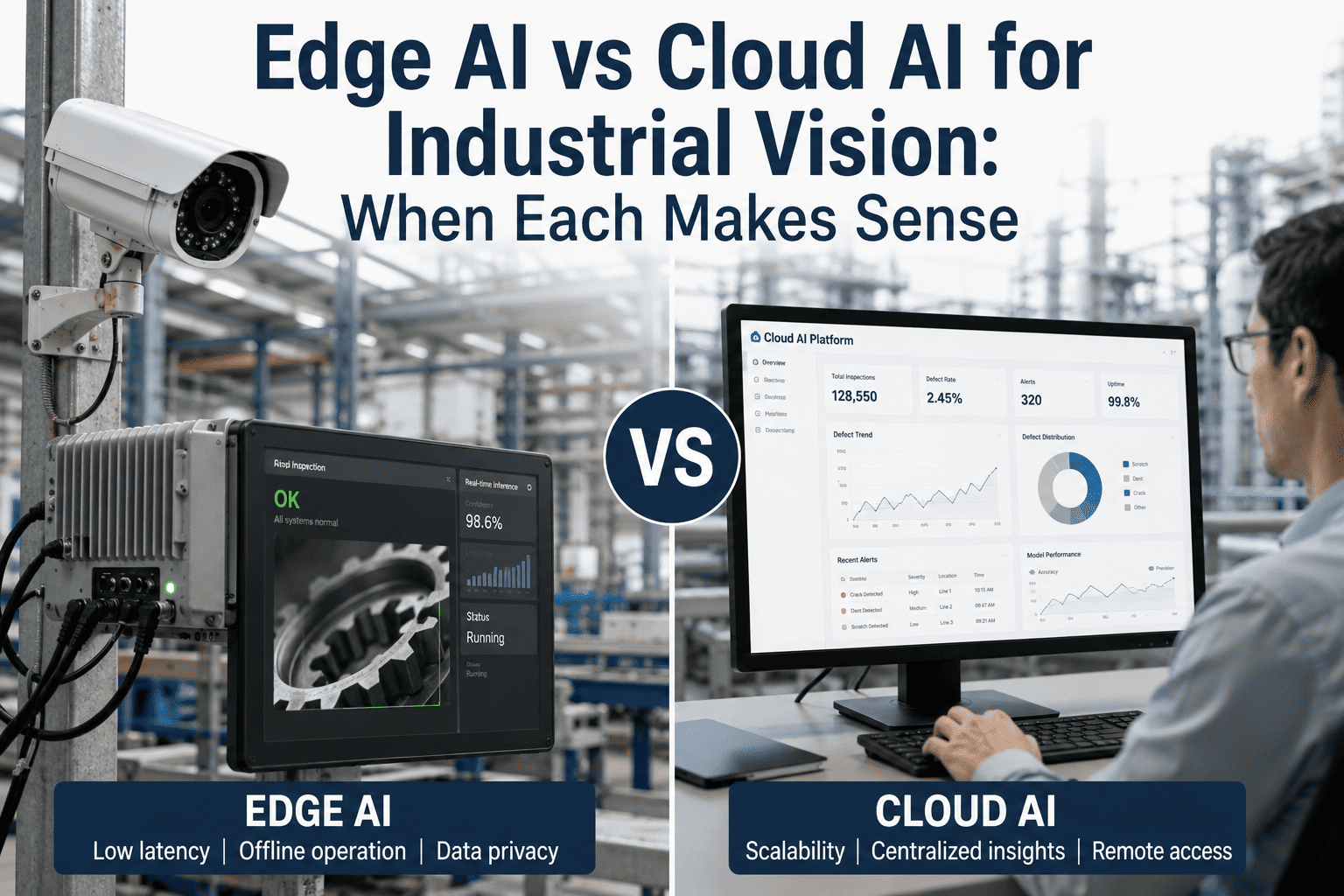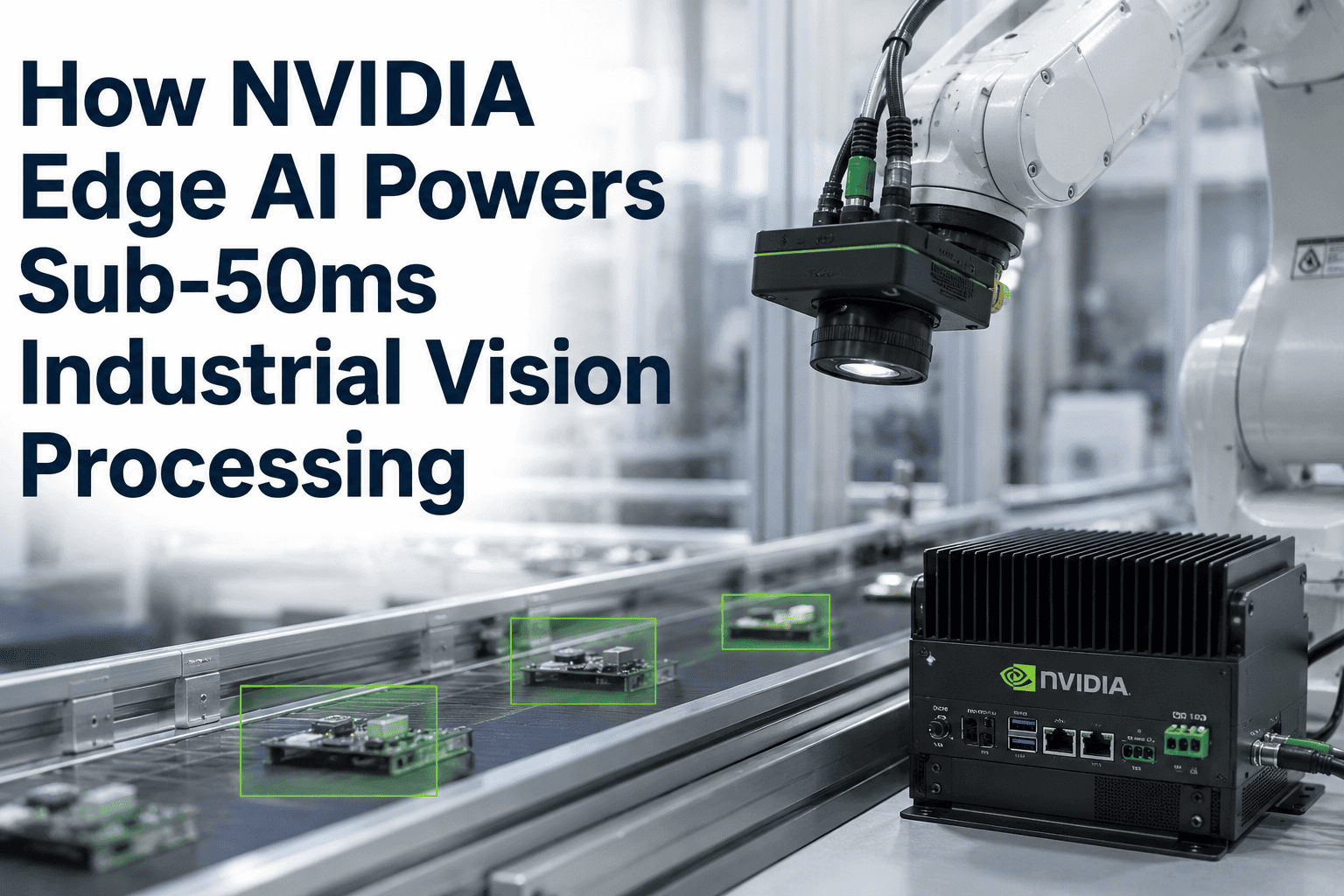
The gap between a factory-floor decision and a data-centre round trip is measured in milliseconds — and those milliseconds decide whether a defect gets caught, a robot stops safely, or a production line keeps moving. NVIDIA edge AI processors, deployed on-premise at the camera or line controller, deliver vision inference in under fifty milliseconds without ever touching the internet. No cloud latency, no bandwidth ceiling, no sensitive production imagery leaving the facility. To see how this looks running on your production line, Book a Demo with iFactory AI.
Real-Time Industrial Vision on NVIDIA Edge AI — Zero Cloud Dependency.
iFactory AI deploys turnkey NVIDIA-powered edge inference on your production floor — Jetson modules and GPU appliances that process every camera frame locally, in under fifty milliseconds.
Cloud Vision vs. Edge Vision — The Millisecond Gap That Decides Everything
A high-speed inspection line running two hundred parts per minute has a decision budget of roughly three hundred milliseconds per part. A collaborative robot needs to detect a human intrusion in twenty to fifty milliseconds to trigger a protective stop. A pick-and-place robot has fifty to one hundred milliseconds between image capture and command issue. Cloud vision inference, by contrast, incurs one to two seconds of round-trip delay in typical deployments — with worst-case tail latency stretching to five hundred milliseconds even before the model runs. For every workload where milliseconds matter, cloud is architecturally excluded.
The chart above reflects typical measured latencies for a standard object-detection workload across deployment models. Cloud latency is not just slow — it is unpredictable. A network path variance of even fifty milliseconds is enough to break a hard-real-time inspection loop. Edge inference on NVIDIA silicon eliminates the network entirely, producing consistent, single-shot latencies that fit inside the tightest production constraints.
Choosing the Right Edge Silicon for Your Vision Workload
NVIDIA Jetson is a family of edge AI modules built on the same Ampere GPU architecture and JetPack software stack, scaled across power envelopes from ten watts to seventy-five watts. The right choice depends on the number of camera streams, model complexity, and thermal budget of the deployment location. iFactory AI's engineering team specifies the appropriate module for each site based on inference load, redundancy requirement, and site environment.
Jetson Orin Nano
Jetson Orin NX
Jetson AGX Orin
AGX Orin Industrial
Where the Milliseconds Go — A Frame-Level Breakdown
Sub-fifty-millisecond inference is not a single step. It is a tightly engineered pipeline where every stage from sensor capture to decision output has a strict time budget. The stages below show how iFactory AI structures a typical production vision loop on NVIDIA edge hardware, with representative timings for a standard object-detection workload at 1080p.
Sensor Capture
Industrial camera captures the frame and pushes it directly over MIPI CSI or GigE Vision into the Jetson module memory pool.
Preprocessing
Frame is resized, normalized, and colour-space converted on the GPU using CUDA kernels — no round trip to system memory required.
Model Inference
TensorRT-optimized model runs on the Ampere GPU or offloads to NVDLA accelerators, producing classifications and bounding boxes.
Postprocessing
Non-maximum suppression, confidence filtering, and business-logic rules are applied on the same device to produce a decision event.
Actuation Command
Decision is written directly to PLC or reject actuator over EtherCAT or OPC-UA — closing the loop inside the total thirty-millisecond budget.
Ready to Map Your Vision Workload to the Right NVIDIA Edge Hardware?
iFactory AI runs a workload assessment — camera counts, model complexity, thermal envelope, redundancy — and returns a fully specified hardware and software configuration for your line.
Six Reasons Manufacturing Vision Belongs at the Edge, Not in the Cloud
The move to on-premise inference is not purely a latency argument — although latency alone is decisive for real-time workloads. Six structural advantages combine to make NVIDIA edge deployment the correct architectural choice for production vision, quality inspection, and safety-critical monitoring across virtually every discrete and process manufacturing environment.
Predictable Latency
Every inference happens on-device with no network variance. Ninety-five-percent tail latency stays within tight bounds — the property that matters most for hard-real-time control loops on production lines.
Data Sovereignty
Proprietary product imagery, defect signatures, and process footage never leave the facility. Compliance with ITAR, GDPR, and internal IP policies becomes trivial because there is nothing to transmit.
Offline Operation
Production continues through network outages, ISP failures, and VPN degradation. The inspection loop is architecturally independent of the WAN — a requirement in remote, air-gapped, and high-security sites.
Bandwidth Efficiency
Only structured decision events flow upstream, not raw video. A twenty-camera line generating multiple terabytes per day of imagery reduces to kilobytes of event data reaching central systems.
Cost Inversion at Scale
Cloud inference charges per call. At five to ten million inferences per day — typical for high-throughput plants — edge deployment becomes thirty to fifty percent cheaper over a three-year TCO horizon.
Multi-Stream Concurrency
A single AGX Orin module runs eight concurrent video streams with multiple AI models per stream. Consolidation replaces a rack of thin clients with a compact fanless appliance at the line.
Vision Workloads That Only Work on Edge Silicon
Certain industrial vision workloads have latency budgets that cloud infrastructure fundamentally cannot meet. The workloads below list the target latency window and the reason edge deployment is the only architectural fit — regardless of network quality, bandwidth, or cloud region proximity.
High-Speed Defect Detection
Inspection lines running 100–200 parts per minute need a per-part decision inside three hundred milliseconds. Edge inference at thirty milliseconds leaves headroom for the reject actuator to physically remove defective units before they leave the station.
Collaborative Robot Safety
Human-approach detection for cobots demands twenty to fifty millisecond total latency from camera to protective stop. Any cloud round trip is architecturally excluded because the safety envelope has been breached before the frame reaches the data centre.
Robotic Pick-and-Place
Vision-guided pick cells need fifty to one hundred millisecond cycle time from image capture to gripper command. Edge inference on Jetson AGX Orin delivers this consistently across variable object orientation and lighting.
Real-Time PPE Compliance
Safety monitoring on production floors needs a decision fast enough to trigger an alert before the worker completes the unsafe action. Sub-second edge inference makes proactive intervention feasible, not just retrospective reporting.
Conveyor Flow Anomaly Detection
Blockage, spillage, and material flow anomalies need to be caught the moment they begin forming. Continuous edge inference against every frame identifies developing anomalies inside the visual signature window rather than after the event.
How iFactory AI Delivers Turnkey NVIDIA Edge Vision to Your Line
A production edge vision deployment is not just NVIDIA silicon. It is the integrated stack from camera to model to plant network that has to be engineered as a single system. iFactory AI ships the complete stack — hardware, software, integration — pre-validated for the industrial environment and deployment class the customer operates in.
Business Applications
CMMS work orders, MES quality events, and dashboards fed by structured detection outputs — the layer plant operators and reliability leaders actually consume.
Vision AI Models
TensorRT-optimised detection, classification, and anomaly models trained on customer footage and calibrated to plant-specific materials, lighting, and belt geometry.
Inference Runtime
NVIDIA JetPack, TensorRT, DeepStream, and Triton Inference Server orchestrate multi-camera, multi-model workloads on the same edge appliance.
NVIDIA Edge Silicon
Jetson Orin modules — Nano, NX, or AGX — housed in ruggedised, fanless industrial appliances rated for the plant environment and thermal load.
Industrial Cameras
GigE Vision, USB3 Vision, or MIPI CSI cameras with the optics and illumination engineered for the specific inspection or monitoring task.
From Latency Constraint to Competitive Advantage
The plants that adopt NVIDIA edge vision are not just replacing cloud inference — they are unlocking use cases that cloud infrastructure could never serve. Inline defect rejection at two hundred parts per minute, cobot safety envelopes measured in tens of milliseconds, continuous PPE compliance across full shifts, and material flow monitoring that catches anomalies inside the visual signature window rather than after the event. Every one of these workloads is decision-critical, and every one of them requires deterministic edge latency to actually work in production.
iFactory AI delivers this stack as a single, turnkey deployment — the NVIDIA hardware sized to your workload, the vision models trained on your production footage, the integration to your PLCs and CMMS pre-validated. The customer decision is not whether to build an edge AI capability from raw components. It is whether to bring the fully engineered stack online in weeks, on your line, with the recovery and reliability outcomes documented before you scale.
NVIDIA Edge AI for Industrial Vision — FAQs
What is the real-world inference latency of NVIDIA Jetson for industrial vision?
Measured latency for a standard object-detection model at 1080p on Jetson AGX Orin typically falls between fifteen and forty milliseconds end-to-end from sensor capture to decision output, depending on model complexity and preprocessing needs. Quantized models with TensorRT optimisation can push single-camera inference under twenty milliseconds. To see benchmarked latencies for your specific model and camera setup, Book a Demo with the iFactory team.
Can NVIDIA edge AI operate completely offline with no internet connection?
Yes — every Jetson-powered iFactory deployment runs air-gap ready and operates entirely on the plant network with no dependency on external connectivity. Inference, model execution, alerting, and CMMS integration all function through local network paths. Cloud connectivity is optional, used only for model updates and aggregated analytics where the customer chooses to enable it, never for real-time inspection decisions.
How does edge AI cost compare to cloud vision inference at production scale?
Cloud vision incurs per-inference charges that scale linearly with production volume. Above roughly five to ten million inferences per day — typical for a high-throughput plant with a dozen cameras — edge deployment becomes thirty to fifty percent cheaper over a three-year total cost of ownership horizon. Our workload assessment produces the specific breakeven curve for your camera count and shift pattern so the ROI decision is quantified, not guessed.
Which Jetson module is right for my line — Nano, NX, or AGX Orin?
The right choice depends on how many camera streams, how complex the inference model, and how tight the latency budget. Jetson Orin Nano covers single-camera single-model workloads at forty TOPS. Orin NX handles multi-camera cells up to six streams at 157 TOPS. AGX Orin at 275 TOPS delivers whole-line coverage with up to eight concurrent streams. iFactory's engineering team sizes the module against your specific workload profile — Contact our expert to walk through the options.
Does the edge appliance integrate with our existing PLCs, SCADA, and MES systems?
Yes — the iFactory edge stack exposes detection events over OPC-UA, EtherCAT, Modbus TCP, and REST, allowing direct integration with PLCs, SCADA platforms, and MES systems including SAP, Siemens, and Rockwell. Structured event streams flow into CMMS and quality management systems automatically. The integration layer is designed to fit existing plant network topology without requiring parallel infrastructure or protocol translation appliances.
Deploy Sub-50ms Vision on Your Highest-Value Line in Weeks, Not Quarters.
Book a working session with iFactory AI. We map your camera counts, latency budget, and integration constraints — and return a fully specified NVIDIA edge deployment plan sized for your line.