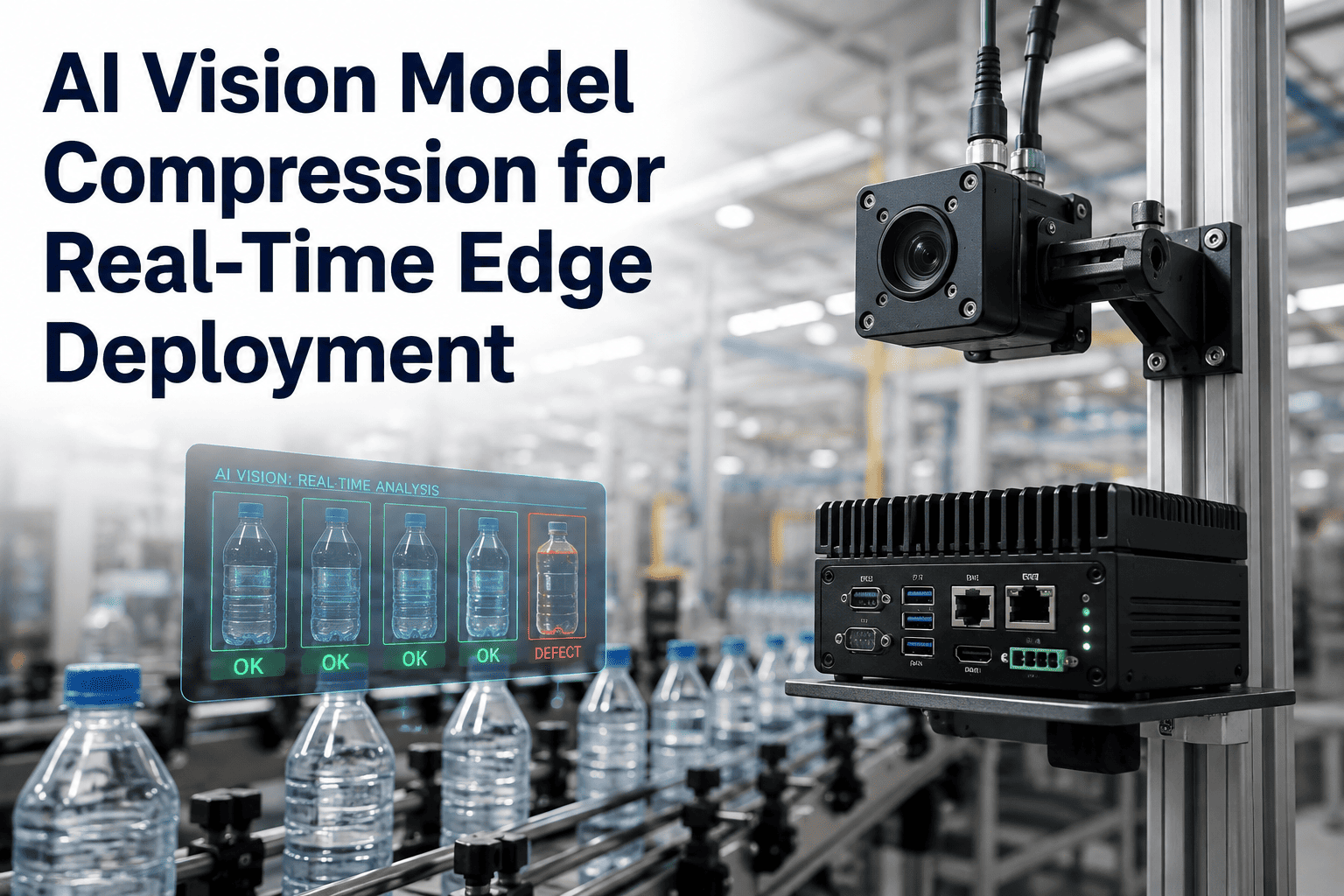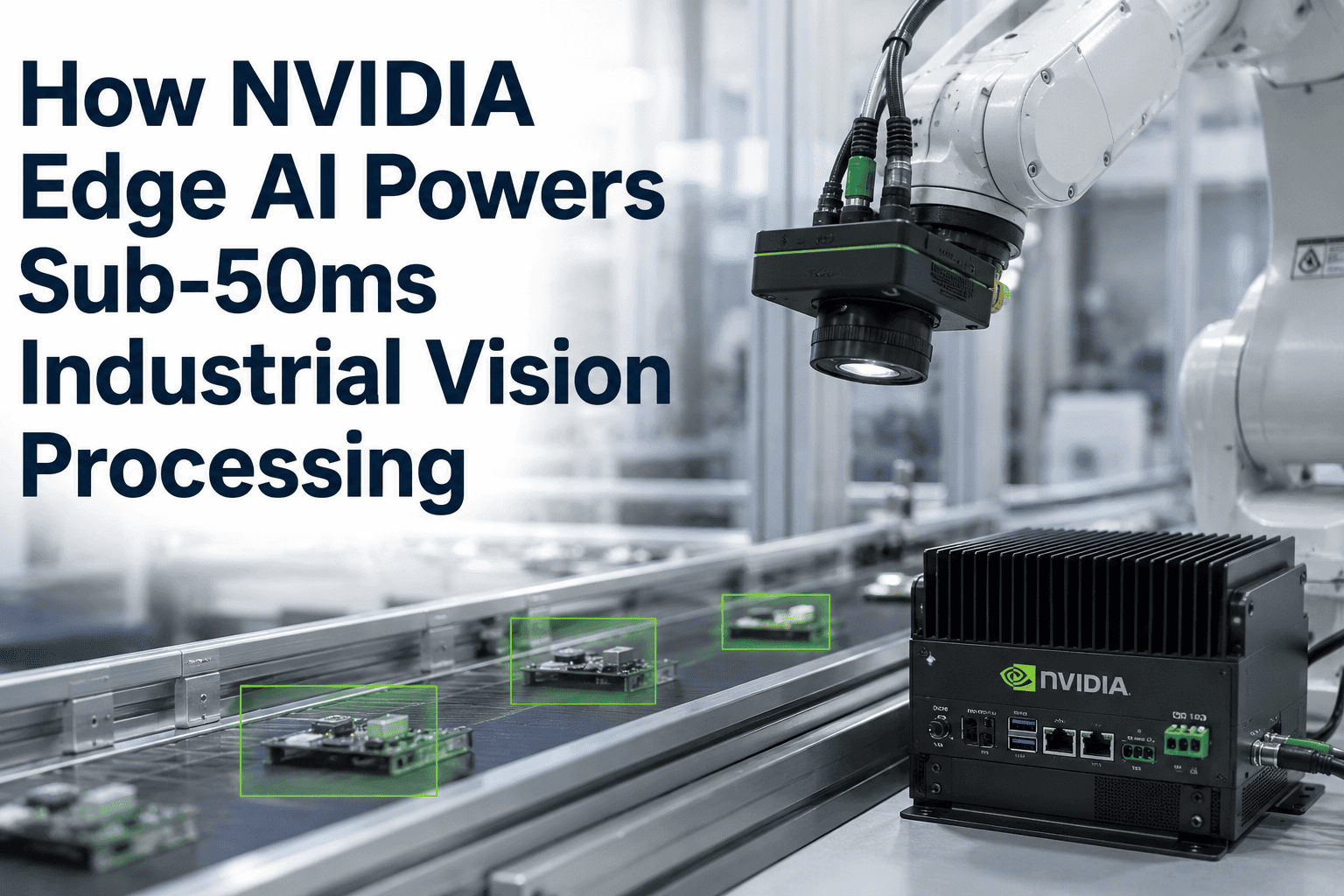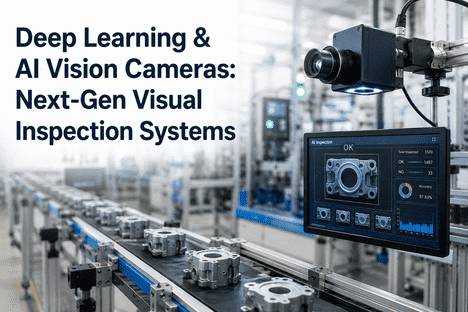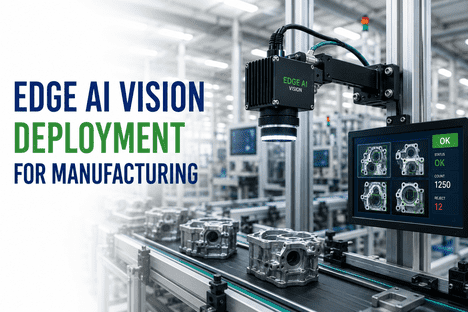
Edge AI vision deployment is the practice of running deep learning inference models directly on hardware located at the production floor — eliminating cloud round-trips, keeping sensitive image data on-premise, and achieving the sub-100ms latency that real-time manufacturing inspection demands. A pre-configured NVIDIA edge server positioned at the machine level runs defect detection, PPE compliance, thermal anomaly, and leak detection models simultaneously, without sending a single frame outside the facility's network perimeter. iFactory's Edge AI Vision Platform is purpose-built for this deployment model: a single industrial-grade edge node handles multiple vision workloads across semiconductor fabrication, electronics assembly, food processing, and discrete manufacturing environments — delivering consistent inference performance even in air-gapped or bandwidth-constrained facilities.
Why Edge Deployment Outperforms Cloud for Manufacturing Vision
Cloud-based vision AI introduces network latency that is fundamentally incompatible with high-speed production lines. A PCB assembly line running at 2,000 units per hour cannot wait 400–800ms for a cloud inference response — defective boards exit the inspection station before the result arrives. Edge AI eliminates this constraint by processing camera frames on local GPU hardware, delivering inference results in under 100 milliseconds from frame capture to defect classification. This latency profile enables real-time reject actuation, immediate operator alerts, and closed-loop process control without any dependency on internet connectivity or data center availability. Manufacturing facilities with strict data sovereignty requirements — semiconductor fabs handling IP-sensitive process data, defense contractors operating on air-gapped networks, pharmaceutical manufacturers subject to 21 CFR Part 11 — cannot route inspection imagery through public cloud infrastructure regardless of latency tolerance. On-premise edge deployment satisfies data residency obligations while maintaining full model performance. iFactory's AI vision camera platform is designed for exactly this deployment architecture: all inference, model management, and inspection data remain within the facility's four walls.
iFactory Edge AI Vision Platform: Core Capabilities
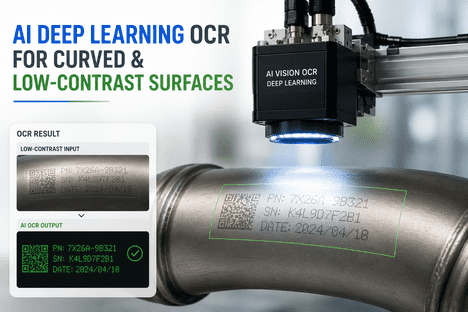
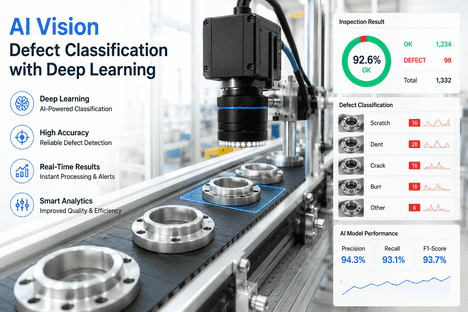
iFactory's edge AI vision platform consolidates multiple inspection workloads onto a single pre-configured NVIDIA edge server, replacing the fragmented approach of dedicated vision controllers for each inspection station. The platform runs parallel inference pipelines that handle surface defect detection, dimensional measurement, barcode and OCR verification, PPE compliance monitoring, thermal anomaly detection, and fluid leak detection — all simultaneously on one compute node. Deep learning models are trained on customer-specific defect libraries and deployed to the edge server without requiring cloud connectivity for model updates or retraining cycles. The platform integrates with existing manufacturing infrastructure through OPC-UA and REST APIs, connecting defect detection events directly to MES work order systems, SCADA platforms, and CMMS maintenance workflows. When defect density exceeds SPC thresholds, the edge server generates automated work orders with attached defect images, location maps, and tool correlation data — closing the loop between inspection and maintenance action without manual intervention.
| Inspection Workload | Model Type | Inference Latency | Output Action |
|---|---|---|---|
| Surface Defect Detection | CNN / Transformer classification | <50ms per frame | Reject signal + CMMS work order |
| PPE Compliance | Object detection (YOLO-class) | <80ms per frame | Real-time operator alert |
| Thermal Anomaly | Thermal + RGB fusion model | <100ms per frame | Predictive maintenance trigger |
| Leak Detection | Semantic segmentation | <90ms per frame | SPC alert + line stop signal |
| Barcode / OCR Verification | OCR + classification pipeline | <40ms per scan | MES traceability update |
All workloads run concurrently on the same NVIDIA edge hardware, eliminating the per-station controller costs that typically inflate vision system CAPEX by 40–60% in multi-camera deployments. Book a Demo to see the platform running multiple inspection models simultaneously on a single edge node.
NVIDIA Edge Hardware: The Compute Foundation
iFactory's platform ships on pre-configured NVIDIA edge servers selected for industrial thermal tolerance, long product lifecycle availability, and GPU compute density that matches multi-model inference workloads. The NVIDIA Jetson family — spanning Jetson Orin NX for compact single-station deployments to full AGX Orin configurations for multi-camera line-level installations — provides the GPU architecture that runs TensorRT-optimized vision models at peak efficiency. TensorRT model optimization reduces inference latency by 30–50% compared to unoptimized PyTorch or ONNX model execution, directly enabling the sub-100ms performance guarantee across all supported workloads. Hardware arrives factory-configured with the iFactory inference engine, Docker-containerized model serving, and OTA update capability — eliminating the integration effort that typically delays vision system commissioning by weeks. Industrial enclosures rated for IP65 environments, DIN-rail mounting configurations, and operating temperature ranges from -20°C to 60°C ensure the edge server performs reliably in factory floor conditions that would stress consumer or commercial computing hardware. For facilities requiring redundant inference capability, iFactory supports clustered edge configurations where a secondary node automatically assumes inference workloads if the primary node requires maintenance — maintaining zero inspection downtime during hardware servicing.
Air-Gapped and Restricted Network Deployment
Defense, aerospace, semiconductor, and critical infrastructure manufacturers operate under network security requirements that prohibit outbound data transmission regardless of encryption strength. iFactory's edge AI vision platform is designed for full air-gapped operation: model deployment, retraining data collection, inspection result storage, and system updates all operate without internet connectivity. Model updates are delivered via validated USB transfer or isolated internal network segments when regulatory protocols require change control documentation for every software modification. Inspection imagery never leaves the facility's physical perimeter — a requirement that cloud-dependent vision AI vendors cannot satisfy by architecture. SPC data, defect pareto reports, and OEE metrics are served to internal dashboards through the facility's existing intranet infrastructure. For facilities that allow controlled external connectivity, iFactory supports a hybrid architecture where edge inference remains fully local while aggregated, anonymized quality metrics are optionally synchronized to enterprise analytics platforms. The decision boundary between on-premise and external data flows is configurable at the field level — specific camera streams or inspection data categories can be designated as permanently local while operational summary data flows to corporate systems. Book a Demo to discuss how iFactory's edge architecture meets your facility's specific data security requirements.
Multi-Model Inference on a Single Edge Node
The engineering challenge in edge AI vision deployment is not running one model well — it is running four or five inspection models simultaneously without GPU contention causing latency spikes that degrade any individual workload. iFactory's inference engine uses a priority-scheduled GPU allocation system that reserves deterministic compute slices for latency-critical workloads like line-speed defect detection while running lower-priority models such as thermal monitoring in the remaining compute headroom. This architecture guarantees that defect detection inference remains below 50ms even when the same GPU is simultaneously processing PPE compliance video and thermal anomaly frames from different camera streams. Model containerization via Docker isolates each inference pipeline, enabling independent model updates without restarting the entire inspection system — a critical requirement for continuous production environments that cannot tolerate inspection downtime during model version changes. The platform supports model A/B testing at the edge: a new defect detection model can run in shadow mode alongside the production model, with both results logged for comparison, before the updated model is promoted to production without any physical access to the edge server. This capability dramatically accelerates model improvement cycles in facilities where physical access to production equipment requires maintenance window scheduling weeks in advance.
Deployment Architecture and Integration Workflow
iFactory's edge AI vision deployment follows a structured commissioning process designed to minimize production impact and accelerate time-to-value. Site assessment establishes camera placement geometry, lighting requirements, and network topology for edge server connectivity to inspection stations and enterprise systems. The NVIDIA edge server is configured off-line with base software, initial models, and network credentials before arriving at the facility — reducing on-site commissioning time to camera mounting, cable runs, and network configuration rather than software installation and debugging. Integration with MES, SCADA, and CMMS platforms is handled through pre-built OPC-UA and REST API connectors that map iFactory inspection events to the data structures each enterprise system expects. Custom integration development is available for facilities with proprietary system architectures. Model training uses customer-supplied defect imagery collected during the commissioning period, with iFactory's annotation and training pipeline producing production-ready models within two to four weeks of image collection completion. Go-live validation includes a parallel run period where edge AI results are compared against existing inspection methods before the system assumes primary inspection responsibility. Ongoing model maintenance — retraining on new defect types, adjusting classification thresholds for process changes, adding new inspection stations — is managed remotely through iFactory's model management portal without requiring on-site visits.
A standard iFactory edge AI vision deployment from site assessment to production go-live runs 6–10 weeks: 1 week site assessment and hardware configuration, 1–2 weeks on-site installation and integration, 2–4 weeks model training on customer defect imagery, 1–2 weeks parallel validation run, and go-live cutover. Facilities with existing camera infrastructure and accessible integration APIs achieve the lower end of this range. Multi-line deployments with complex MES integration requirements fall toward the upper bound. Book a Demo to receive a site-specific deployment timeline estimate based on your facility's configuration.
Industries Deploying iFactory Edge AI Vision
Edge AI vision deployment addresses inspection challenges across manufacturing sectors where real-time defect detection, data sovereignty, and high-throughput performance requirements align with on-premise inference architecture. Semiconductor and advanced electronics manufacturing uses iFactory's platform for wafer surface inspection, die-level defect classification, solder joint verification, and PCB component presence and orientation checking at speeds that exceed human inspector capability. Food and beverage packaging lines deploy the platform for fill level verification, label placement inspection, cap seal integrity, and contamination detection at line speeds up to 1,200 units per minute. Automotive and discrete manufacturing facilities use the multi-model capability to simultaneously inspect dimensional tolerances, surface finish quality, and assembly completeness at final inspection stations. Pharmaceutical manufacturers subject to FDA and EMA inspection data integrity requirements operate iFactory's air-gapped configuration to maintain 21 CFR Part 11 compliant audit trails for every inspection event. Battery cell manufacturing — a rapidly scaling application driven by EV production growth — uses the platform for electrode coating uniformity inspection, separator defect detection, and cell can surface inspection across gigafactory-scale production volumes. Each industry deployment uses the same NVIDIA edge hardware and iFactory inference engine, with application-specific models and integration configurations tailored to the production environment.
Frequently Asked Questions About Edge AI Vision Deployment
iFactory's edge AI vision platform achieves sub-100ms inference latency across all supported workloads, with defect detection models optimized via TensorRT running below 50ms per frame. This performance is sustained under multi-model concurrent execution — running defect detection, PPE compliance, and thermal monitoring simultaneously on the same NVIDIA edge GPU without latency degradation on any individual workload. Actual latency depends on image resolution, model complexity, and the number of concurrent inference pipelines, and iFactory provides workload-specific latency benchmarks during the pre-deployment assessment.
Yes. iFactory's edge AI vision platform is designed for full air-gapped operation with no internet connectivity requirement. All inference, inspection data storage, SPC monitoring, dashboard serving, and alert generation run entirely on the local edge server. Model updates are delivered via validated offline transfer processes compliant with change control requirements. This architecture satisfies the data residency and network security requirements of semiconductor fabs, defense manufacturers, and regulated pharmaceutical facilities that cannot permit outbound data transmission from production equipment.
The number of concurrent camera streams depends on the NVIDIA edge hardware configuration and the inference complexity of each model. A standard NVIDIA AGX Orin deployment handles 4–8 simultaneous camera streams running multi-class defect detection at 1080p resolution within sub-100ms latency constraints. Lower-resolution streams or simpler classification models allow higher camera counts on the same hardware. For facilities requiring more than 8 concurrent streams, iFactory supports clustered edge configurations where multiple servers share the inspection workload coordinated through a local inference scheduler.
iFactory's edge AI platform integrates with MES, SCADA, and CMMS systems through OPC-UA and REST API connectors. Defect detection events trigger automated work order creation in connected CMMS platforms with defect images, location data, and tool correlation information attached. Lot disposition decisions are communicated to MES systems via configurable data mappings that match the target system's expected schema. For SCADA integration, SPC threshold violations generate OPC-UA alarm events that connect to existing alarm management workflows without custom development. Integration configuration is completed during the commissioning phase by iFactory's engineering team.
A standard iFactory edge AI vision deployment runs 6–10 weeks from site assessment to production go-live. The timeline includes one week for site assessment and hardware pre-configuration, one to two weeks for on-site installation and enterprise system integration, two to four weeks for model training on customer defect imagery, and one to two weeks for parallel validation before go-live cutover. Facilities with existing camera infrastructure and standard MES integration requirements typically achieve the shorter end of this range. Contact iFactory's engineering team to receive a site-specific timeline estimate based on your production environment and integration requirements.