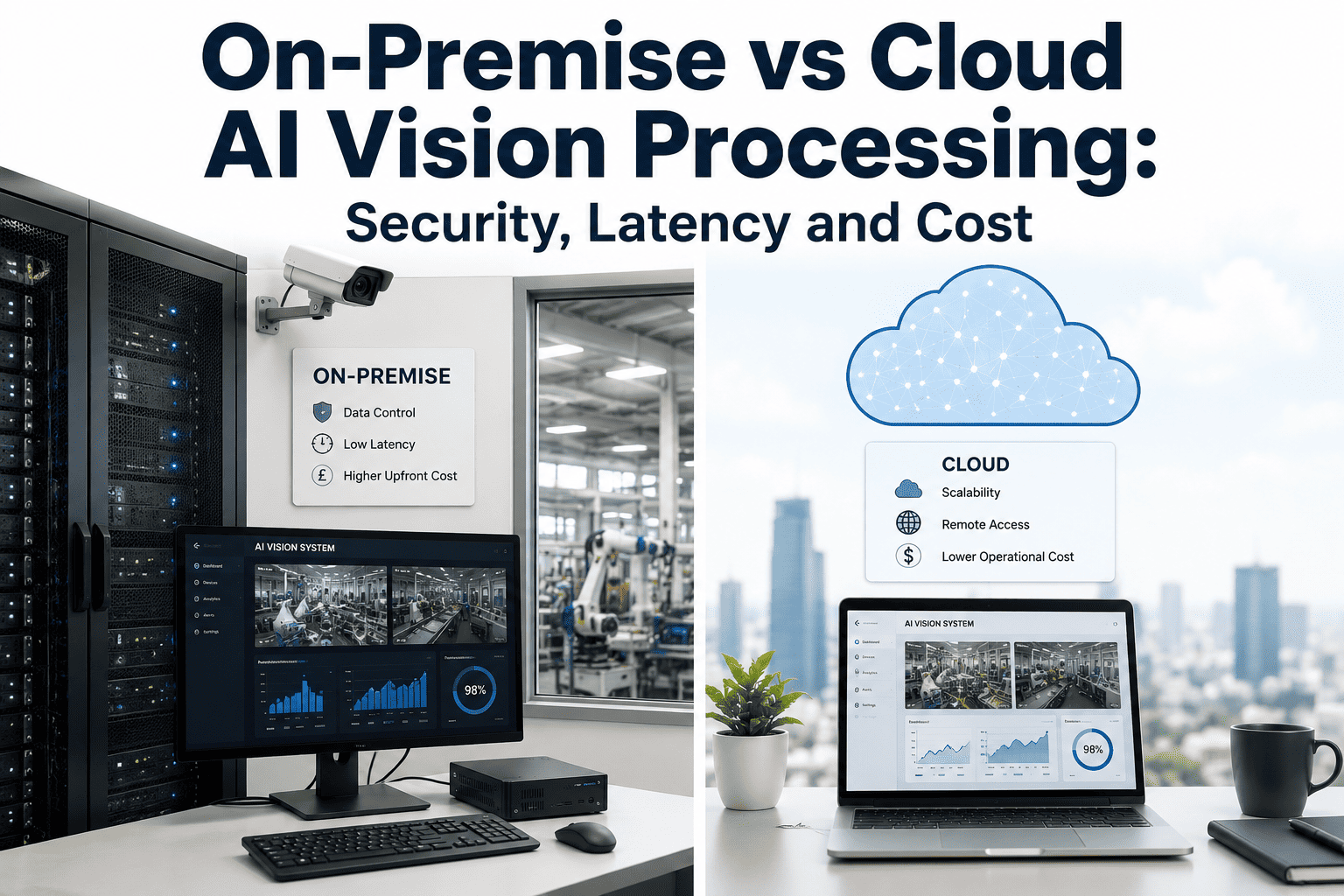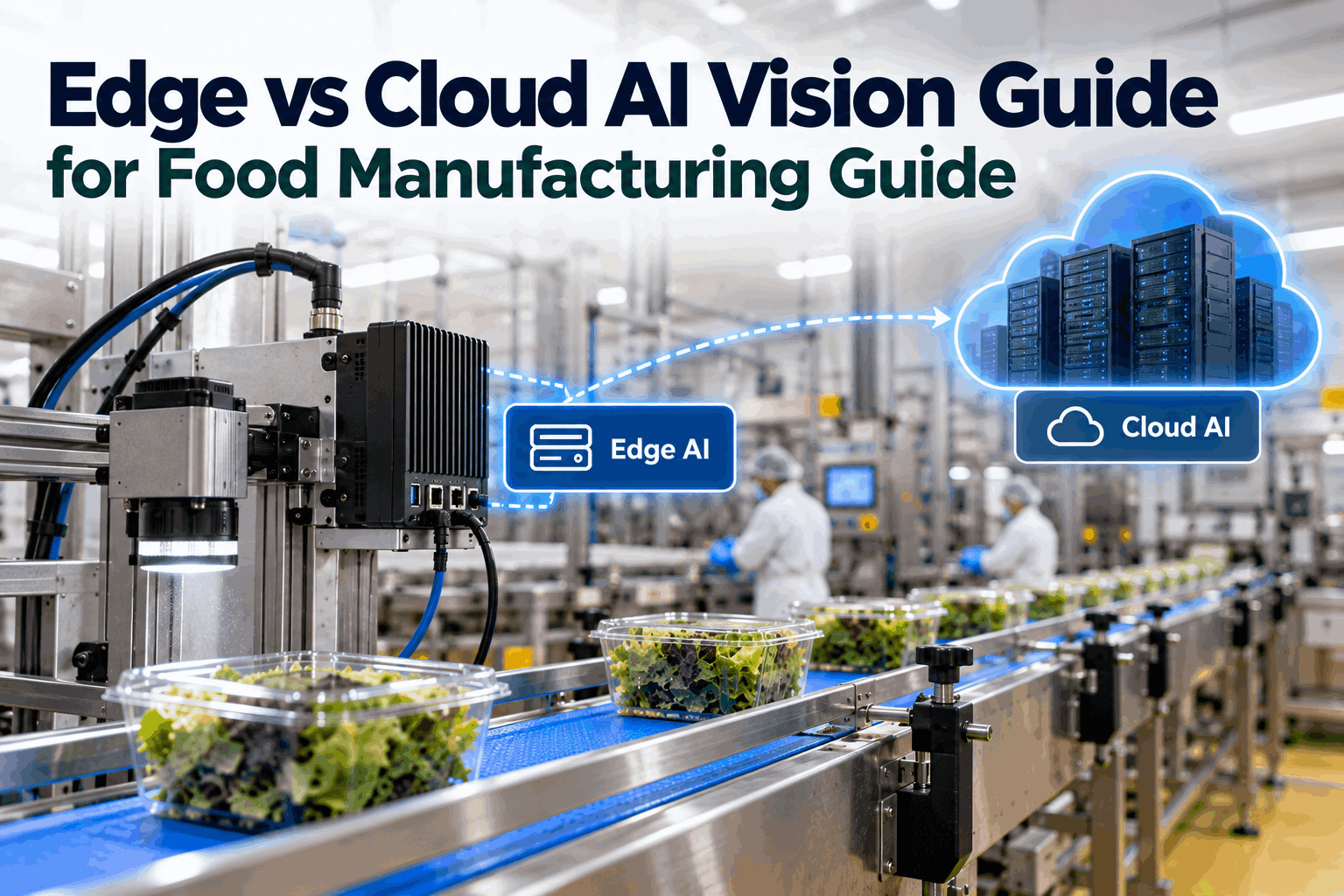
Once a food plant has AI vision working on one line, the next question is where the AI should run as it spreads to ten lines or five plants. Cloud looks simpler to manage. Edge looks safer for the line. The honest answer depends on four things: how fast the reject decision must be made, how much image data the cameras produce, who may see the images, and what each option costs over time. Talk it through for your own lines in a short architecture call.
Edge or Cloud? Decide Line by Line, Defect by Defect
Safety-critical inspection usually belongs at the edge, next to the rejector. Training, fleet comparison and long-term analytics often sit well in the cloud. This guide shows how to make that split with real numbers for latency, bandwidth, data control and cost.
Edge Is Not One Thing
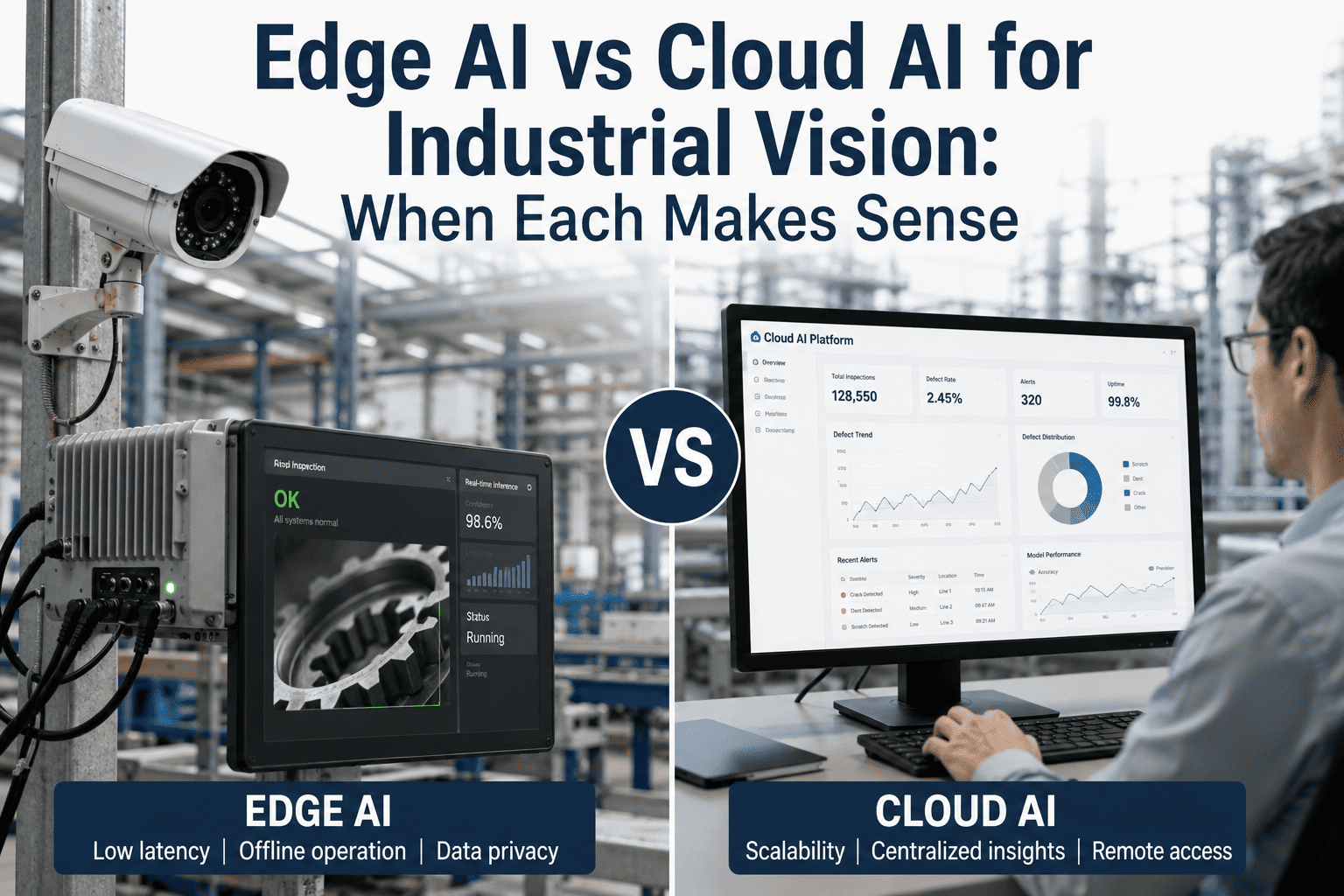
"Edge" covers more than one location. A smart camera runs a small model inside the camera itself. A line or plant edge server sits in a panel or server room and serves several cameras with far more computing power. The cloud runs in a provider's data centre, reached over the plant's internet link. Most food plants that scale vision end up using two of the three, with each doing the job it suits best. Ask our support team which mix fits your lines.
The Reject Window Decides First
Every inspection has a deadline. A product passes the camera, travels to the rejector, and the decision must arrive before it gets there. The time available is the distance from camera to rejector divided by belt speed. In the example below, a tray seal camera sits 0.42 m before the rejector on a line running at 1.5 m/s, which leaves 280 ms. Edge inference uses a small, predictable part of that. A cloud round trip adds network time that varies from moment to moment, and if the internet link fails, inspection stops. Work out your own reject windows with our vision engineers.
Cameras Produce More Data Than Plant Links Carry
Vision cameras generate a surprising amount of data. A single 5-megapixel monochrome camera at 30 frames per second sends 150 megabytes every second, which is 1.2 gigabits per second, before compression. That already fills a standard 1 Gb Ethernet link. Multiply by the cameras on several lines and the total is far above what most plant internet connections can upload. Compressing images reduces the load, but it can blur exactly the small defects you are looking for. Edge processing avoids the problem by sending only results and a sample of images. Check your camera data rates with our team.
Who Can See Your Images, and Where They Are Kept
Inspection images are not just pictures of product. They can show new packaging before launch, recipes on the line, and sometimes workers who can be identified, which brings privacy law such as the GDPR into play in Europe. Retail customers may also set rules on where their data can be stored. Inspection results are part of your quality records too. Under the FDA's Food Traceability Rule, now due for compliance by July 20, 2028, covered firms must be able to give FDA traceability records within 24 hours of a request. Keeping images and results on site gives you direct control, while cloud storage needs clear contracts on location and access. Review your data rules with our support team.
Keep the Reject Decision on Site
iFactory runs vision inference on an AI server in your plant, so the line keeps inspecting even if the internet link fails. Results and chosen images can still feed group-wide dashboards and model training.
Where the Money Goes in Each Model
Edge and cloud spread their costs differently. Edge needs hardware up front and someone to look after it. Cloud turns most costs into monthly fees that grow with usage, plus the network upgrades needed to send the data. Neither is cheaper in every case. A fair comparison runs over three to five years and uses your own camera counts, data volumes and prices. Build that comparison with our team.
A Placement Rule for Every Inspection Point
The simplest way to decide across many lines is to sort every inspection point by what happens if a decision is late or missing. Food safety checks must never depend on an internet link. Quality grading needs fast decisions but can tolerate a short fallback. Trend analytics can wait minutes or hours. Sort your inspection points in a criticality workshop.
Hybrid: Decide at the Edge, Learn Centrally
For most food manufacturers with several lines, the architecture that works is a hybrid. Each plant runs inference on site, close to the cameras and rejectors. Only results, defect images and a sample of good images travel to a central system, which may be in the cloud or a company data centre. That central system compares lines, retrains models and sends new versions back out. See this flow on your own lines in a working session.
Six Things That Make Scaling to Many Lines Easier
The architecture choice matters most when vision moves from one line to many. These six practices keep multi-line rollouts manageable, whichever mix of edge and cloud you choose. Our support team can share a rollout plan template.
Eight Questions to Ask Before You Sign
Vision vendors describe their architecture in very different ways, and "edge" or "cloud-native" can mean almost anything in a sales deck. These eight questions get to what actually happens on your lines. Ask them of every supplier, including us, and compare the answers side by side. If an answer is vague, ask for a diagram of where each image goes and how long it is kept. Bring your shortlist to a vendor comparison call.
Edge AI Server, Vision Models and Central View in One Package
iFactory delivers food plant vision as a turnkey bundle. A pre-configured NVIDIA AI server ships racked and ready with the vision models and line connectors pre-loaded, so inference runs in your plant and images stay under your control. You rack it, plug in power and Ethernet, and the AI is live. To scope it for your lines, request a turnkey quote.
- Pre-configured NVIDIA AI edge server, racked and ready
- Vision models trained on your own product images
- Camera, PLC and rejector integration per line
- Central dashboard for results across lines and sites
- Model version control and staged rollout
- QA, engineering and IT team training
- 24×7 remote monitoring of models and hardware
Server installed on the plant network, cameras and PLCs connected, data rules agreed.
Models trained and run in monitor mode, compared with manual inspection.
Rejection switched on, central view connected, teams trained.
Edge-First Vision That Still Scales Across Plants
iFactory keeps the inspection decision in the plant and gives group teams the central view they need. Our support team can walk you through a pilot plan.
What Food Manufacturers Ask About Edge vs Cloud AI Vision
Inspect at the Line, Learn Across the Group
Run vision inference in each plant and share results centrally, so every line inspects on time and every site benefits from what the others learn. The full system is delivered turnkey and goes live in 6 to 12 weeks.