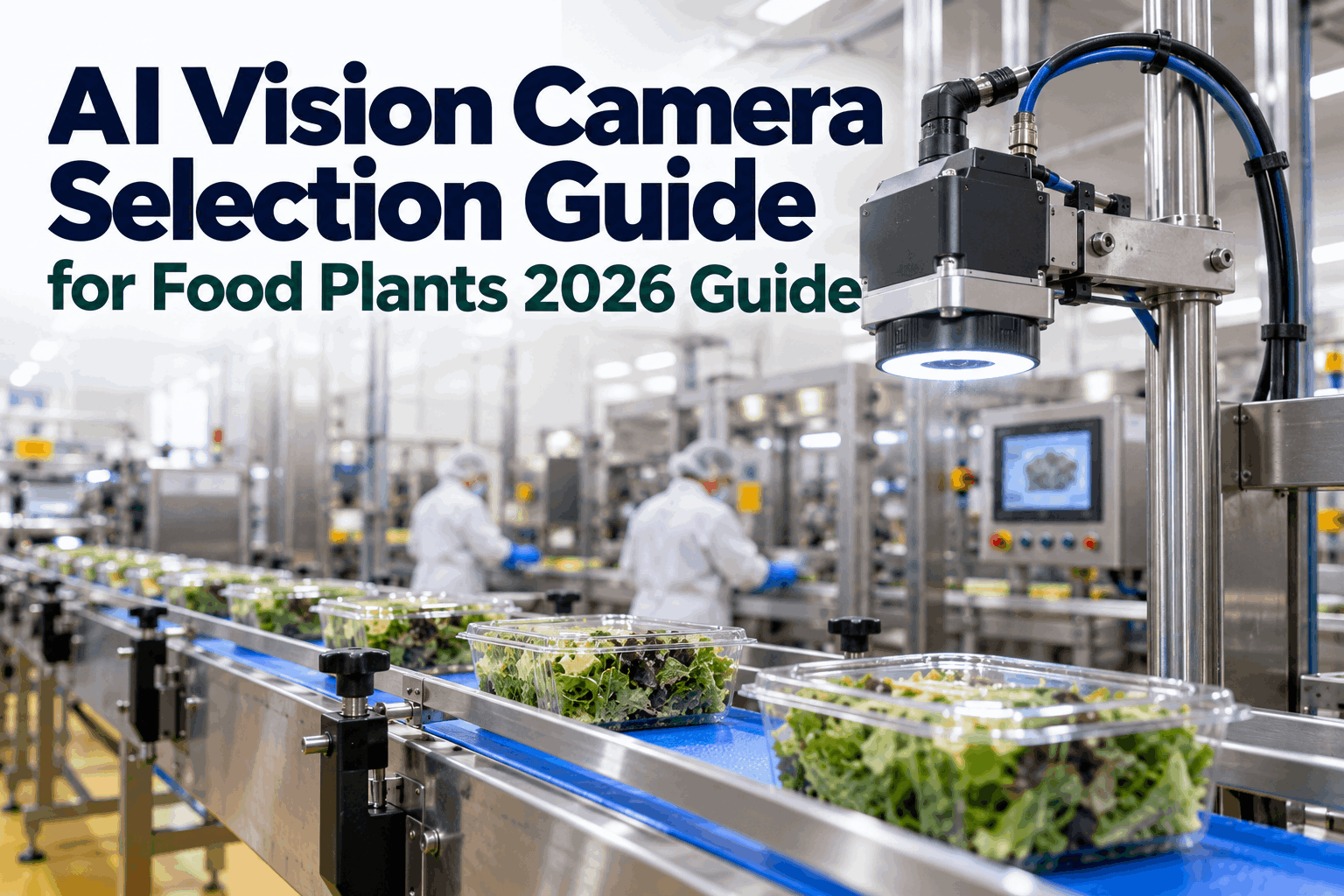
AI Vision Camera Selection Guide for Food Plants 2026 Guide

By Josh Brook on October 16, 2026

ai-vision-camera-selection-guide-for-food-plants-2026-guide

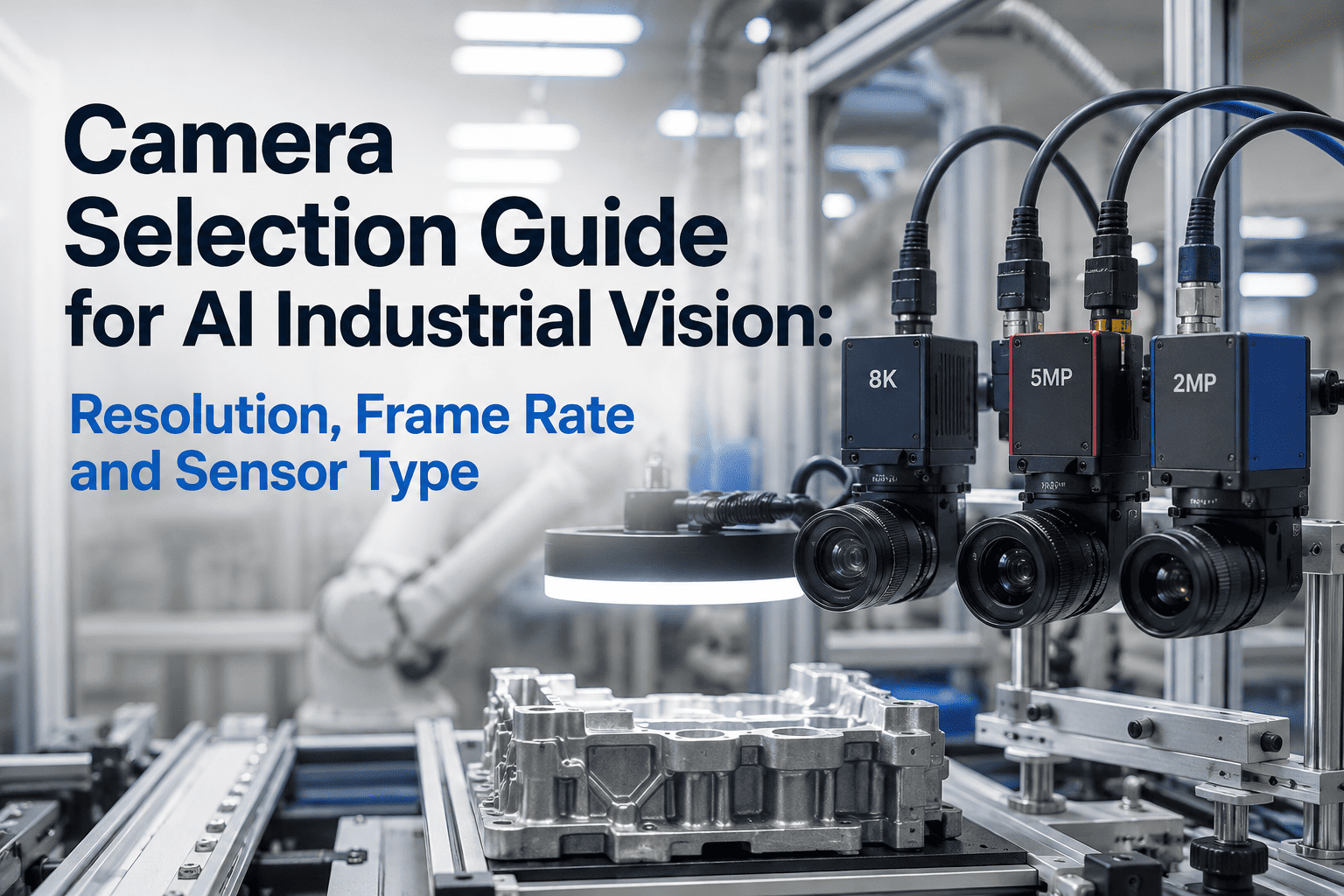
Most AI vision projects in food plants that fail don't fail because of the AI. They fail because the wrong camera was chosen: a sensor too slow for the line, a resolution too coarse for the defect, or a housing that leaks after the first washdown. This guide helps you choose line-scan, area-scan, multispectral or 3D by defect type, line speed and hygiene zone, with the sums to back it up. Bring a real line to a short camera sizing session.

AI VISION · CAMERA GUIDE · 2026

Choose the Camera From the Defect, the Speed and the Washdown Zone

Four camera types cover nearly every food inspection job. The right one depends on what the defect looks like, how fast the product moves and how harsh the cleaning is. Get those three right and the AI has a fair chance.

Camera picker · Biscuit line 4Draft
DefectBurnt edges, broken pieces
Smallest defect2 mm
Belt1,000 mm wide, 0.8 m/s
ZoneWet clean, after oven
Recommendation
Colour line-scan, 2k pixels, IP69K housing 2,000 px across for 0.5 mm pixels · line rate about 1.6 kHz
START WITH THE DEFECT

Four Questions to Answer Before Looking at Cameras

Camera catalogues lead with megapixels and frame rates, but those numbers mean nothing until you know what the camera must see. Answer these four questions for each inspection point first. They decide the camera type, the resolution, the speed and the housing, roughly in that order. Our vision team can help you fill them in for a specific line.

1
What makes the defect different?Colour, shape, height, or something inside or under the surface
2
How small is the smallest defect?In millimetres, on the real product, not the spec sheet
3
How does product move?A continuous bed on a wide belt, or separate items, pouches or jars
4
Where will the camera live?Wet high-care zone, dry packing hall, chiller or next to an oven
THE FOUR CAMERA TYPES

Area-Scan, Line-Scan, Multispectral and 3D Compared

Area-scan cameras take a full picture in one shot. Line-scan cameras build an image one row of pixels at a time as the product passes, which suits continuous, wide belts. Multispectral and hyperspectral cameras see beyond visible colour, often into near-infrared, so they can tell materials apart by their chemistry. 3D cameras measure height and shape. Each one solves a different problem, and many lines end up with two types. Compare them for your products in a vision planning call.

Area-scan
Best for

Separate items: jars, trays, pouches, labels, seals and caps

Food examples

Label and date code checks, lid placement, seal area of trays

Watch out

Motion blur at speed, uneven light across wide fields

Line-scan
Best for

Continuous product across wide belts at high speed

Food examples

Biscuits, bakery, sheeted dough, nuts, cereal, sliced products

Watch out

Needs an encoder on the belt and a bright, even line light

Multispectral
Best for

Defects with the same colour as the product but a different material

Food examples

Plastic or film on meat, bruises under fruit skin, fat and moisture

Watch out

Higher cost, more data, needs careful model training

3D
Best for

Height, volume, shape and fill level

Food examples

Portion volume, pizza topping height, burger shape, tray fill

Watch out

Shiny or translucent product can scatter laser or pattern light

Where cameras stop

Dense contaminants inside the product, such as bone, glass, stone or metal, are a job for X-ray and metal detection, not optical cameras. A good vision plan says clearly which hazards each technology covers, so nothing is assumed to be caught by the wrong one.

DECISION TREE

Which Camera Type for Which Defect

Follow the questions from the top. The first "yes" points you to a camera type. If more than one branch applies, you probably need two inspection points, which is common on meat, produce and ready-meal lines. Walk through your own defects with our support team.

Q1Is the defect visible as a change in colour or surface on the outside?
Yes
Is product a continuous bed on a wide, fast belt?
Yes: line-scanNo, separate items: area-scan
NoGo to Q2
Q2Is the defect about height, volume or shape?
Yes
3D camera
NoGo to Q3
Q3Is it a different material that looks the same, or just under the surface?
Yes
Multispectral or hyperspectral
NoDense and inside the product: X-ray or metal detection
BY DEFECT TYPE

Common Food Defects and the Camera That Fits

The matrix below links common food plant inspection jobs to a starting camera choice and the lighting that usually makes the defect stand out. Lighting matters as much as the sensor. A good camera with the wrong light will miss defects that a modest camera with the right light catches easily. Review your list in a defect mapping session.

Inspection job
Example product
Starting camera
Lighting that helps
Bake colour and burnt edges
Biscuits, crackers, bread
Colour line-scan
Bright, even line light across the belt
Broken or misshapen pieces
Cookies, chips, nuggets
Line-scan or 3D
Backlight or contrasting belt for outline
Seal contamination
Trays, pouches, flow wrap
Area-scan
Diffuse light to cut glare from film
Label, date and allergen text
Jars, cartons, packs
Area-scan
Diffuse or dome light on curved or glossy packs
Plastic or film on product
Meat, poultry, cheese
Multispectral / NIR
Broadband halogen or matched NIR light
Bruises and soft spots
Apples, potatoes, berries
Multispectral
Controlled light in an enclosed tunnel
Portion volume and fill
Ready meals, trays, cups
3D
Laser line or pattern, shielded from ambient light
RESOLUTION AND SPEED

Three Sums That Size the Camera

High inspection speeds are where most camera choices go wrong. These three calculations catch the problem before you buy. A common rule of thumb is to cover the smallest defect with at least three to four pixels, so the AI has enough detail to judge it. The example uses the biscuit line from the top of the page: a 1,000 mm belt at 0.8 m/s with a 2 mm smallest defect. Check your own figures with our engineers.

1 · Pixel size
Smallest defect ÷ pixels per defect
2 mm ÷ 4 = 0.5 mm per pixel
2 · Pixels across
Field of view ÷ pixel size
1,000 mm ÷ 0.5 mm = 2,000 pixels, so a 2k sensor
3 · Line rate
Belt speed ÷ pixel size
800 mm/s ÷ 0.5 mm = 1,600 lines per second
If you use an area-scan camera instead

Keep motion blur under one pixel. Maximum exposure is pixel size divided by speed: 0.5 mm ÷ 800 mm/s = 0.000625 s, or 625 microseconds. Short exposures need more light, which is why strobed LED lighting is common on fast area-scan stations.

Get the Sizing Right Before You Buy

Send us the defect, the belt and the zone. We work out pixel size, sensor width, line rate and lighting, then test the choice on sample images from your product before any hardware is ordered.

Biscuit line 4 · QA lead and iFactory
QA leadWe want to run the belt at 1.2 m/s next year. Does the camera still work?
iFactoryAt 0.5 mm pixels you would need 2,400 lines per second. Pick a 2k line-scan rated well above that now, so the speed-up needs no new camera.
QA leadAnd the light?
iFactoryFaster lines mean shorter exposure per line, so plan for a brighter line light too.
WASHDOWN ZONES

Match the Housing to the Cleaning Regime

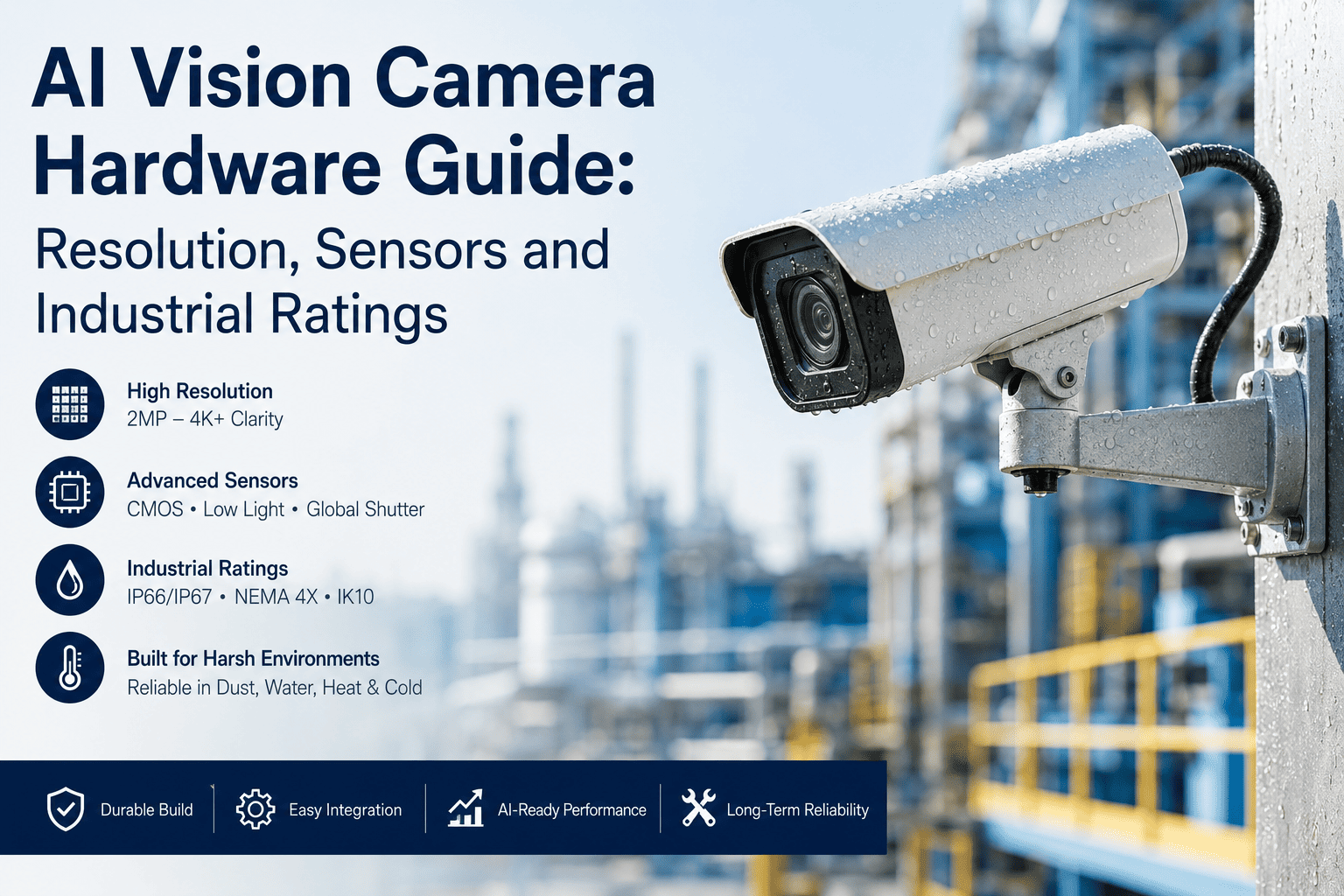
A camera that can't survive cleaning will fail long before its sensor wears out. IP69K is the rating most food plants ask for in wet areas. Under ISO 20653, it means the enclosure withstands water at 80°C and 80 to 100 bar, sprayed from 100 to 150 mm at four angles. That is close to what a sanitation crew's lance does. IP67 and IP68 cover immersion, not high-pressure jets, so they are not substitutes. Hygienic design matters as much as the rating: smooth stainless surfaces, no crevices and sloped tops so water runs off. Ask our support team which housings suit each zone.

High-care wet zone
IP69K, stainless, hygienic designRaw meat, poultry, dairy and ready-meal areas with daily high-pressure, hot cleaning and chemicals.
Low-risk wet zone
IP67 or IP69K, protective windowWashed weekly or with low-pressure hoses. Check chemical resistance of seals and windows.
Dry packing hall
IP65 or better, dust protectionCartons, labels and secondary packaging. Dust and flour matter more than water.
Chillers and freezers
Heated window, condensation controlMoving between cold rooms and warm areas fogs lenses. Choose rated operating temperature.
Next to ovens and fryers
Cooling jacket, heat-rated cableRadiant heat and grease vapour shorten camera life without cooling and regular lens cleaning.
COMMON MISTAKES

Six Camera Choices That Cause Trouble Later

These mistakes show up again and again on food lines. Each one is cheap to avoid at the design stage and expensive to fix after installation. If you are about to place an order, a quick check in a design review is worth the time.

Sizing for today's speedLine speeds go up. Leave margin on line rate or frame rate.
Buying pixels, not lightMost poor images come from lighting, not the sensor.
Ignoring the encoderLine-scan without belt speed sync stretches or squashes images.
Wrong IP rating for the zoneIP67 in a high-pressure washdown area fails within months.
One camera for everythingColour defects and hidden plastic need different sensors.
No sample testingAlways test real product images before ordering hardware.
BEFORE YOU ORDER

An Eight-Point Buyer's Check for Each Inspection Point

Run through these eight points for every camera position before the purchase order goes out. If any answer is "we're not sure yet", that is the item to settle first, because each one is far harder to change once the camera is mounted, cabled and validated. Go through the list with us in a pre-order review.

1Defects listed, with the smallest size measured on real product
2Camera type chosen from the defect, not the price list
3Pixel size, sensor width and line or frame rate calculated
4Margin left for future line speed increases
5Lighting type and brightness matched to exposure time
6Housing rating and materials matched to the cleaning regime
7Encoder, trigger and rejector timing agreed with controls
8Sample images captured and tested before ordering
TURNKEY AI DEPLOYMENT

Cameras, Lighting, AI Server and Models in One Package

iFactory delivers food plant vision as a turnkey bundle. Cameras and lighting are sized for each inspection point, and a pre-configured NVIDIA AI server ships racked and ready with the vision models pre-loaded, so inference runs at line speed on site. You rack it, plug in power and Ethernet, and the AI is live. To scope it for your lines, request a turnkey quote.

What's Included
  • Camera and lighting sizing for each inspection point
  • Washdown-rated housings matched to each zone
  • Pre-configured NVIDIA AI edge server, racked and ready
  • Vision models trained on your own product images
  • PLC link to rejectors and line stops
  • Operator and QA team training
  • 24×7 remote monitoring of models and hardware
Live in 6–12 weeks
Wk 1–4
Size and Install

Defects mapped, cameras and lights sized and tested on samples, hardware installed.

Wk 5–8
Train and Validate

Models trained on your product, run in monitor mode and checked against manual inspection.

Wk 9–12
Go-Live and Training

Rejection switched on, thresholds agreed with QA, teams trained.

HOW iFACTORY FITS

Vision Built Around Your Product, Not a Catalogue

iFactory starts with the defect and the line, then picks the hardware, so the AI gets images it can work with. Our support team can walk you through a pilot plan.

1
Sized from the defect. Pixel size, line rate and lighting are calculated before hardware is chosen.
2
Tested on your product. Camera choices are checked on real sample images first.
3
Built for washdown. Housings and cabling are matched to each hygiene zone.
4
Runs at line speed. Inference happens on site, close to the rejector.
1000+
Industrial clients running iFactory
99.9%
Platform uptime for production lines
6-12 wks
From racked server to live vision inspection
FREQUENTLY ASKED QUESTIONS

What Food Plant Teams Ask About AI Vision Cameras

Should we use a line-scan or an area-scan camera?
Use line-scan for continuous product on a wide, fast belt, such as biscuits, nuts or sliced product, because it builds a sharp image row by row with even lighting across the full width. Use area-scan for separate items such as jars, trays and pouches, where a single snapshot per item is simpler. Many lines use both at different points.
How much resolution do we need?
Work back from the smallest defect. A common rule is to cover it with three to four pixels. Divide the defect size by that number to get pixel size, then divide the field of view by pixel size to get the pixels needed across the image. More resolution than that adds cost and data without improving detection much.
When do we need a multispectral camera?
When the defect looks like the product in normal colour, but is a different material or sits just under the surface. Plastic or film on meat, bruises under fruit skin and some foreign materials are typical cases. These cameras see in near-infrared bands where materials differ, but they cost more and need careful model training.
Is IP67 good enough for a food plant?
Only in areas without high-pressure washdown. IP67 covers temporary immersion, not jets. In wet high-care areas cleaned with hot, high-pressure water, choose IP69K, which is tested with 80°C water at 80 to 100 bar. Also check that seals and windows resist your cleaning chemicals.
Can a vision camera replace X-ray or metal detection?
No. Optical cameras see surfaces, and multispectral cameras see a little way under them. Dense contaminants inside the product, such as bone, glass, stone or metal, need X-ray or metal detection. Vision works alongside these systems to cover different hazards.
How do we test a camera before buying?
Capture sample images of real product, including known defects, under the planned lighting. Train or test a model on those images and check whether the smallest defects are clearly visible. Our support team can run this test on your samples.

The Right Camera Makes the AI Look Smart

Map your defects, size your cameras and test on real product before you buy. iFactory delivers cameras, lighting, AI server and models as one turnkey package, live in 6 to 12 weeks.

Example sizing summary · Line 4
Camera typeColour line-scan
Pixels across2,000 for 0.5 mm pixels
Line rate needed1,600 lines per second
HousingIP69K, stainless
Tested on sample images first

Share This Story, Choose Your Platform!