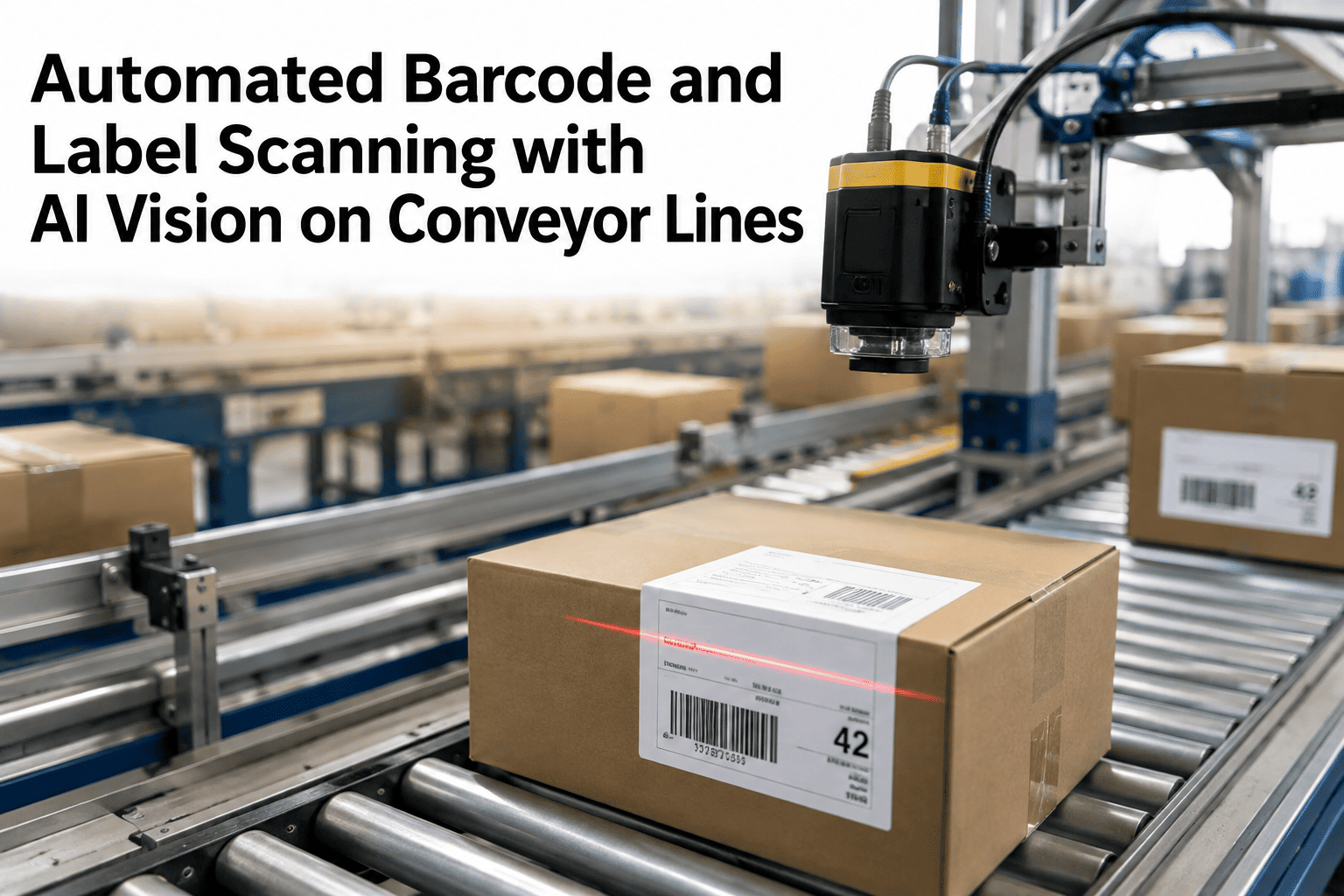
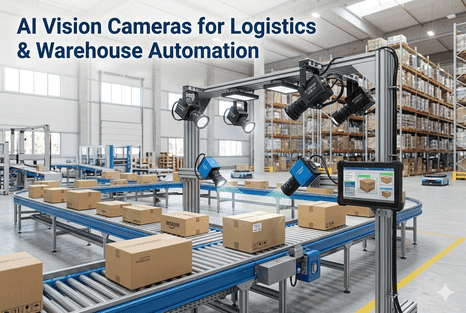
A pallet moving down a conveyor at full speed can carry six or eight barcodes at once — case labels, shipping labels, hazmat placards, lot codes — angled every which way, some scuffed, some overlapping. A handheld scanner needs the worker to stop the pallet, find each code, and aim directly at it. An AI vision camera reads all of them in a single frame, at full line speed, without anyone touching a trigger. That single difference is why warehouses are quietly replacing scan tunnels and manual re-scan stations with camera-based systems this year. This breaks down what changes on the floor, what it costs when it fails today, and how to book a demo to see it running on your own line data.
Warehouse Vision
Automated Barcode and Label Scanning with AI Vision on Conveyor Lines
Cameras decode every barcode on a pallet in one pass, at full conveyor speed, without a worker ever touching a trigger or pausing the line.
85–95%
Fewer no-read events
Sub-50ms
Edge inference latency
3.5 m/s
Supported line speed
The Bottleneck
Why a "Simple" Scan Step Keeps Stopping Your Line
Most operations leaders think of barcode scanning as a solved problem, right up until they pull the rescan logs for a single shift and see how much of the team's time is going toward re-aiming a handheld at a code that was already printed correctly. Fixed laser and CCD scanners reject any barcode that falls outside a set reflectance or contrast threshold, even when the code is fully readable to a human. Thermal and ink-jet print variability alone produces no-read rates in the 3 to 8 percent range on many production lines, and organizations still leaning on 1D barcodes report first-pass scan failures around 7 percent industry-wide. On a line moving 400 units a minute, a no-read rate of just 5 percent means 20 stoppages every single minute — each one pulling a worker off other tasks to manually re-aim a scanner at a pallet that has already left the read zone.
The costs compound quietly. Facilities still running 1D barcode workflows can lose more than 800,000 dollars a year to shipment errors, relabeling, and rescan labor combined. None of that shows up as one dramatic failure — it shows up as a few extra seconds per pallet, a few extra minutes per shift, a few extra people scheduled just to walk the line and re-scan what the fixed reader missed. Multiply that across a full year of shifts and the number stops looking like an operational inconvenience and starts looking like a line item worth putting in front of finance.
What One No-Read Costs
Line stops or pallet is pulled aside
Worker walks over, re-aims handheld scanner
Pallet re-enters queue, sequence disrupted
Downstream sortation timing drifts
Multiplied across a shift, this is where labor budgets quietly leak.
How It Works
From Pallet to Decoded Data in Under 50 Milliseconds
01
Capture Every Angle
Cameras mounted above and alongside the conveyor capture the full pallet face as it moves, regardless of which direction individual labels are oriented, so a code facing sideways or toward a neighboring pallet is still in frame.
02
Decode Multiple Codes at Once
The AI model locates and decodes every 1D barcode, 2D QR code, and data matrix symbol in the frame simultaneously, rather than hunting for one code at a time the way a laser scanner is built to work.
03
Recover Marginal Codes
Where a fixed-threshold scanner would reject a scuffed or low-contrast label as a no-read, deep learning recovery reads partial ink dropout and damaged label corners that still carry complete data.
04
Push Structured Data Downstream
Decoded tracking numbers, SKUs, and destination data feed directly into your WMS or sortation controller, with no manual keying step in between.
See Multi-Barcode Scanning Running on Your Line Layout
A short walkthrough shows how AI vision integrates with your existing conveyor and camera infrastructure — no scanner replacement required to get started.
Fixed Scanners vs AI Vision
Where the Old Approach Runs Out of Road
| Capability | Fixed Laser / CCD Scanner | AI Vision Camera |
| Barcodes read per pass |
One at a time, needs alignment |
Multiple codes in one frame, any orientation |
| Label orientation tolerance |
Requires line-of-sight targeting |
Reads at varied angles and lighting |
| Handling of damaged labels |
Rejects below contrast threshold |
Recovers partial ink dropout and scuffed corners |
| Worker intervention needed |
Manual re-aim on every no-read |
None during normal operation |
| Existing camera reuse |
Not applicable |
Works with ONVIF or RTSP cameras already installed |
The Numbers Behind the Decision
What Warehouses Are Actually Measuring
7%
First-pass scan failure rate reported across facilities still relying primarily on 1D barcodes
$800K+
Annual cost some facilities absorb from shipment errors, relabeling, and rescan labor on 1D workflows
85–95%
Reduction in no-read events reported when deep learning recovery replaces fixed-threshold decoding
45–90 sec
Picker time burned per manual intervention when scanner read rates degrade below 95 percent
The Accuracy Math
Small Read-Rate Gaps Become Large Annual Costs
Manual Entry Baseline
Warehouses relying on manual data entry typically land in the 63 to 85 percent accuracy range, with roughly one keying error for every 300 keystrokes — a gap that barcode scanning of any kind closes significantly.
Fixed Scanner Reality
Well-implemented barcode scanning routinely reaches 95 to 99.9 percent accuracy, but that top end depends heavily on print quality staying consistent, which is rarely true across a full production run.
Cost Per Mistake
A single shipping mistake — wrong item, wrong quantity, wrong address — typically costs between 50 and 250 dollars once labor, return freight, and customer service time are counted.
Where AI Vision Closes the Gap
By recovering codes that fall below a fixed scanner's contrast threshold rather than rejecting them outright, AI vision pushes read rates toward the high end of that range without requiring perfect print quality on every label.
On the Floor
A Mixed-Label Pallet, Handled Without Stopping
A distribution center receiving mixed-carrier freight was seeing a steady stream of pallets pulled off the line for manual re-scan — case labels angled toward the wall, hazmat placards overlapping shipping labels, and a label printer running slightly hot that softened barcode edges just enough to fall below the fixed scanner's contrast threshold. None of those labels were actually unreadable. They were unreadable to a scanner built to expect one code, facing forward, at full contrast. Once AI vision cameras replaced the fixed reader at that station, the same pallets passed through without a single pause, decoding every label in the frame regardless of angle or print quality, and the re-scan station that used to need two people running it full time was reassigned to other work.
The underlying lesson generalizes beyond that one facility: most no-read problems are not actually data problems, they are targeting problems. The barcode is there, the data is intact, and the scanner simply was not built to find it under real-world conditions. Once the reading method stops assuming a single, forward-facing, high-contrast code and instead captures the whole scene the way a person would look at a pallet, most of what used to count as a scanning failure disappears.
Why Now
The Gap Between Manual and AI-Driven Scanning Is Widening
The performance gap between manual scanning processes and AI-driven platforms has widened noticeably in the past few years, driven by two forces arriving at the same time: edge AI inference finally matured to the point where it can keep up with real conveyor speeds, and the commercial consequences of shipping accuracy failures grew sharp enough that operations leaders can no longer treat occasional mis-ships as a rounding error. A facility that could tolerate a 5 to 7 percent scan failure rate five years ago is now competing against distribution centers running at 99 percent-plus first-pass accuracy, and the gap shows up directly in fulfillment speed and customer complaint volume.
Edge AI Has Matured
Sub-50ms inference on-premise GPU hardware means decoding happens fast enough for full conveyor speed, with zero cloud dependency to introduce latency or a single point of failure.
Shipping Accuracy Now Has Commercial Teeth
Chargebacks, compliance penalties, and customer dissatisfaction from mislabeled shipments have made scanning accuracy a line-item business risk, not just an operations detail.
No Infrastructure Rip-Out Required
The system integrates with ONVIF-compatible or RTSP-capable cameras already installed on most lines, which removes the biggest cost and timeline barrier to piloting AI vision.
Labor Shortages Compress Headcount
Rising shipment volumes combined with tighter available headcount make passive, camera-based capture more attractive than adding re-scan staff to cover the gap.
Deployment Reality
What Actually Changes on the Floor During Rollout
Most facilities assume moving to AI vision scanning means ripping out existing camera infrastructure and scheduling a multi-week line shutdown. In practice, the platform is built to plug into ONVIF-compatible or RTSP-capable cameras that are frequently already mounted above conveyors and sortation points for security or quality monitoring. That means the first pilot often runs on hardware that is already bolted to the ceiling, with the AI decoding layer added on top rather than a full teardown.
Edge processing happens on-premise using NVIDIA GPU hardware, which matters for two practical reasons. First, sub-50ms inference latency keeps pace with conveyor speeds up to 3.5 meters per second without introducing a queue behind the read point. Second, zero cloud dependency means a facility's internet connection going down for a few minutes does not take barcode reading down with it — a real risk in remote distribution centers where connectivity is not always guaranteed. It also means sensitive freight and label data never has to leave the building to get decoded, which matters for facilities handling regulated goods or customer data under contractual restrictions.
Typical Rollout Sequence
Audit existing camera coverage on target line
Connect AI decoding layer to live feed
Run parallel with existing scanner for validation
Cut over once read-rate targets are met
Most single-line pilots are scoped in weeks, not quarters.
Readiness Check
Signs Your Line Is Ready for AI Vision Scanning
1Your team maintains a dedicated re-scan station just to catch what the fixed scanner missed
2No-read rates on thermal or ink-jet printed labels regularly sit above 3 to 5 percent
3Pallets carry multiple labels — case, shipping, hazmat, lot — that need separate scan passes today
4Line speed has increased faster than your scanning infrastructure has been upgraded
5You already have ONVIF or RTSP cameras mounted near the conveyor for security or QA
If two or more of these sound familiar, a pilot on a single line is usually enough to see whether the read-rate improvement holds under your actual volume and label mix. The pilot does not need to touch every conveyor in the facility — most teams start with the line that generates the most rescan volume, since that is where the payback shows up fastest and where the case for a wider rollout gets made with real numbers instead of projections.
Measuring the Pilot
What to Track Before and After Switching to AI Vision
| Metric | How to Measure It Today | What Improvement Looks Like |
| First-pass read rate |
Rescan events logged by your WMS over a 30-day window |
Read rate climbs toward 99%+ without a hardware swap |
| Manual intervention time |
Minutes per shift spent re-aiming handheld scanners |
Time reallocated to picking, packing, or QA work |
| Line stoppages per hour |
Sortation controller logs or manual shift notes |
Stoppages tied to no-reads drop toward zero |
| Mis-ship rate |
Customer complaints and return logistics tied to wrong labels |
Fewer downstream errors traced back to a scan failure |
Pulling this baseline before a pilot starts is what turns "it seems faster" into a number finance can approve. Most facilities already have the first-scan-versus-rescan data sitting in their WMS logs — the work is mostly in pulling it by station rather than collecting anything new.
Common Questions
Barcode Scanning with AI Vision, Explained
Does this replace the cameras and scanners we already have installed?
In most deployments, no full replacement is needed. The platform is built to integrate with any ONVIF-compatible or RTSP-capable camera already mounted on your line, so the existing hardware investment stays in place while the AI decoding layer runs on top of it. This keeps installation timelines short and avoids a full scanner infrastructure rebuild.
Talk to support about what's already on your floor.
Can it really read multiple barcodes on one pallet at the same time?
Yes, this is the core capability that separates it from fixed-position scanners. The system decodes 1D barcodes, 2D QR codes, and data matrix formats simultaneously within a single captured frame, regardless of how many labels are visible or which direction each one faces. A pallet with six differently oriented labels is read in one pass rather than six separate scan attempts.
Book a demo to see this on sample pallets from your own operation.
What happens to labels that are damaged, scuffed, or printed too light?
Fixed-threshold scanners reject any code below a set contrast or reflectance grade, even when the underlying data is fully intact and readable. The deep learning model behind this system is trained to recover data from partial ink dropout, overprinted symbols, damaged label corners, and substrate wrinkle distortion, cutting no-read events by 85 to 95 percent compared to conventional scanner baselines.
How fast does the system need to process each pallet to keep up with our line?
Processing happens at the edge on-premise, with inference latency under 50 milliseconds and no cloud round-trip in the decoding path. That speed is what makes full-line-speed reading possible on high-throughput conveyor and sortation environments, where any added delay per pallet compounds into a real bottleneck across a shift.
Contact our team to confirm compatibility with your current line speed.
How long does it typically take to get a pilot running on one line?
Because the platform works with cameras already installed in most cases, a scoped pilot on a single conveyor or sortation point can usually be evaluated in a matter of weeks rather than months, with no need to wait on new hardware procurement. The exact timeline depends on your current camera coverage and network setup.
Book a scoping call to get a timeline specific to your facility.
Stop Losing Throughput to No-Reads
Put AI Vision on Your Line and Watch the Re-Scan Station Empty Out
See how iFactory's AI vision cameras decode every barcode on a pallet in one pass, using the camera infrastructure you likely already have installed.