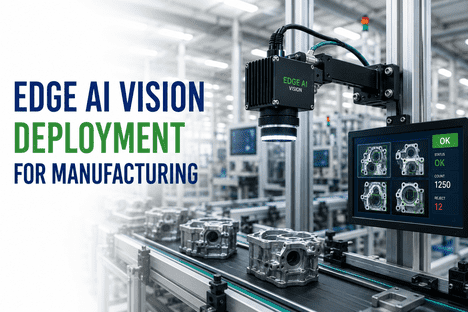
Every AI vision deployment eventually comes down to one architectural decision that ripples through security, latency, cost and reliability: where does the inference actually run? Some vendors sell only cloud, others only edge — neither answer fits every plant. The right choice depends on your line speed, your OT network policies, your data sovereignty rules and how many sites you plan to operate. iFactory ships both architectures because production reality demands the choice, not the other way around. To see the actual numbers on your specific workload, book a demo with our architecture team.
Vision Processing Architecture
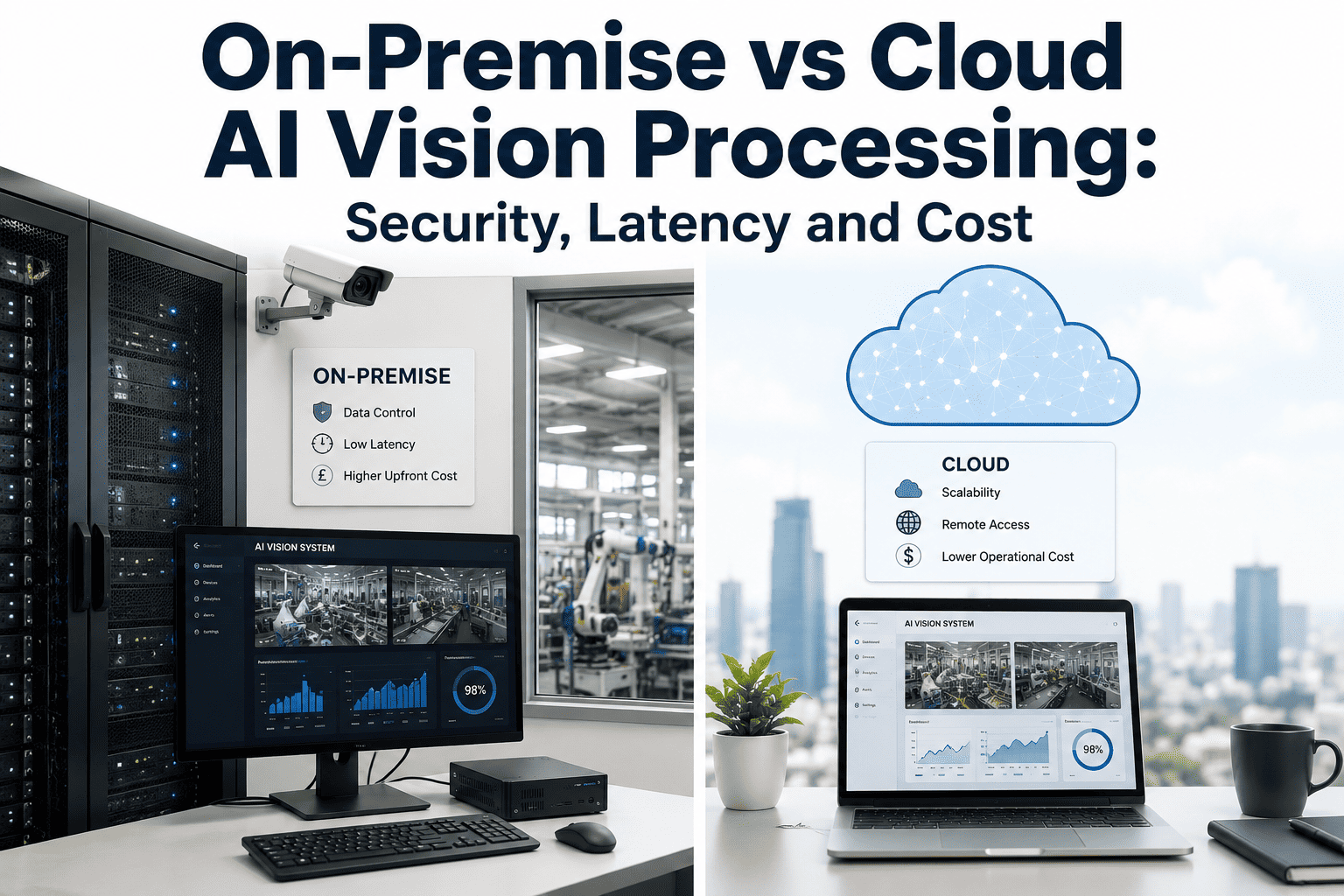
On-Premise vs Cloud AI Vision: The Numbers That Decide Where Inference Actually Runs
Latency, security and total cost of ownership — measured against your line speed, your network topology, and the data your regulator says can never leave the building.
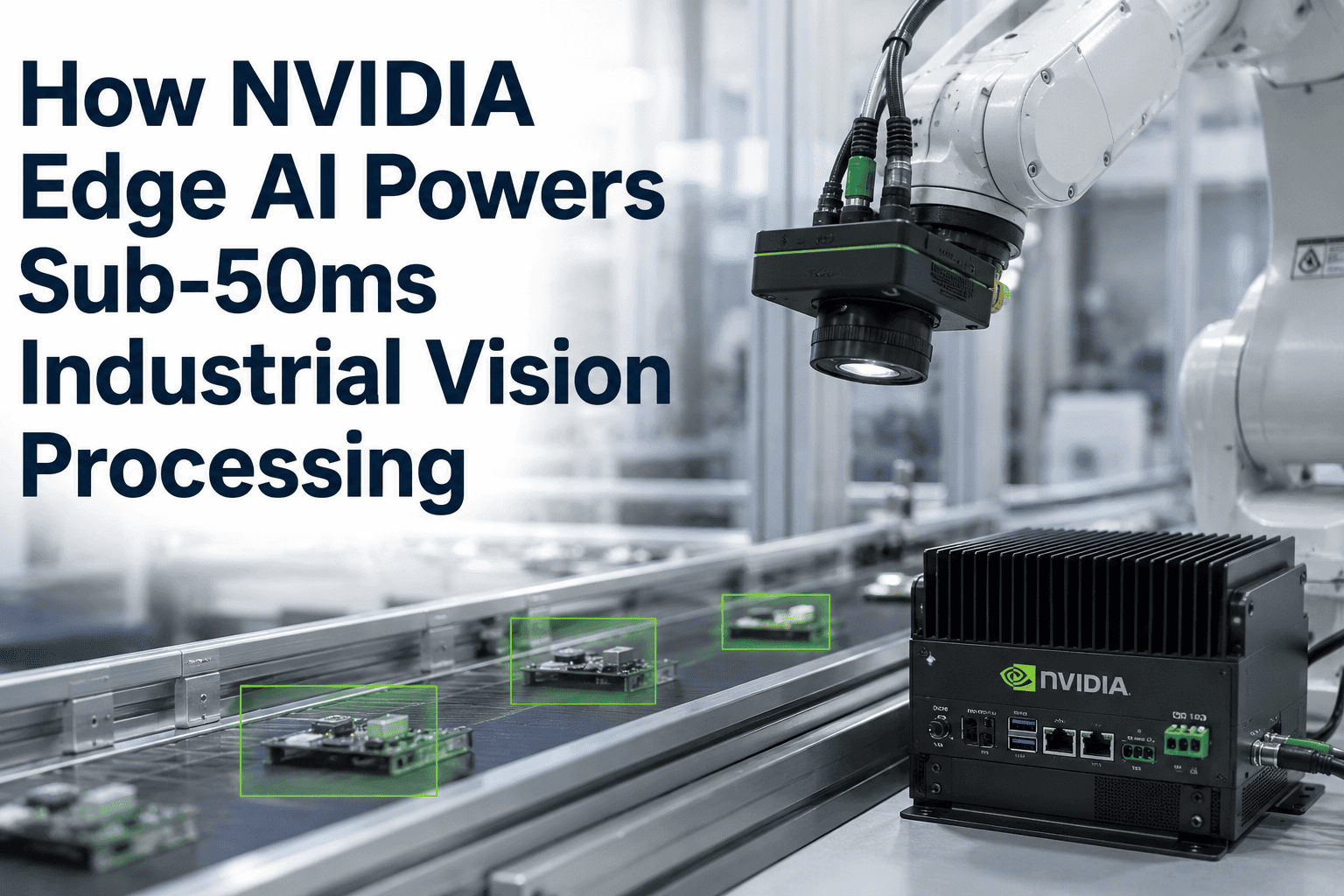
15-50ms
Edge inference latency window
200-2000ms
Cloud round-trip latency range
18-24 mo
Edge-vs-cloud cost crossover
The Real Question Isn't Edge vs Cloud — It's What Runs Where
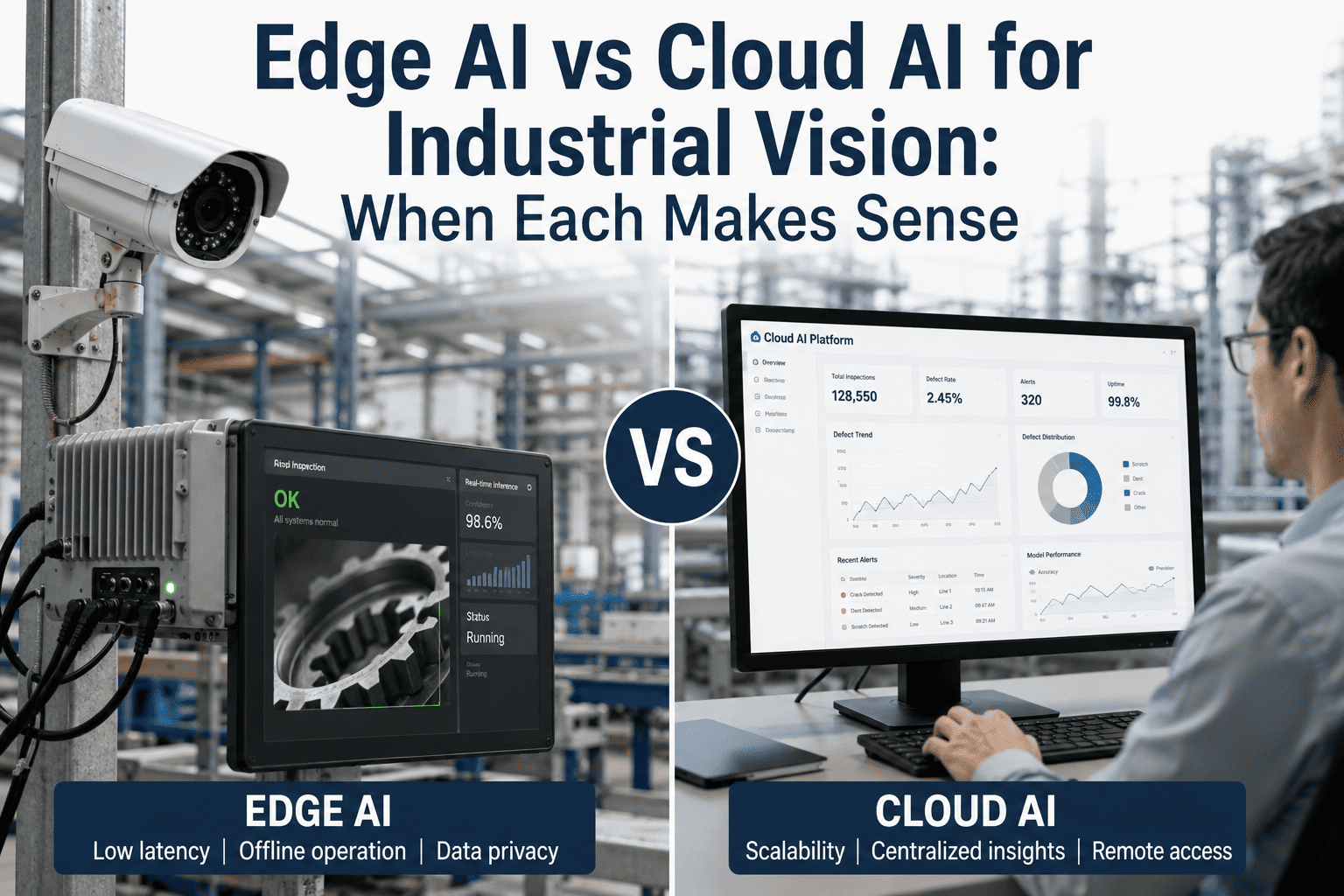
The edge-versus-cloud debate is usually framed as a binary. It is not. Every serious industrial AI deployment ends up running some workload on edge hardware inside the plant and some workload in a cloud region far away — and the engineering job is to draw the line in the right place. Real-time inspection decisions have to happen where the part is. Model training, cross-site benchmarking and long-horizon analytics have to happen where the compute is cheap and elastic. The architecture that wins is the one that maps each workload to the layer that can physically satisfy its constraints.
On-Premise / Edge
Local Inference
Runs on GPU/NPU inside the plant
Decisions in 15 to 50 milliseconds
Images never leave the facility
Operates through network outages
VS
Public / Private Cloud
Remote Inference
Runs on hyperscale cloud GPUs
Round-trip 200 ms to 2 seconds
Images uploaded to remote region
Requires stable internet uplink
Latency: Where Physics Wins Over Connectivity
Line speed sets a hard decision budget. A caster running 200 parts per minute gives inspection roughly 300 milliseconds to see the part, classify it and trigger the reject actuator. A cloud round-trip can burn that entire budget on network transit alone — and can do so unpredictably, spiking to two seconds under congestion. That is why every serious high-speed inspection sits on edge hardware.
What Actually Happens Between Camera and Decision
Edge Path
Capture 5ms
GPU inference 20ms
Actuator 10ms
~35 ms total
Cloud Path
Capture 5ms
Encode 15ms
Upload 80ms
Queue 40ms
Cloud infer 60ms
Download 80ms
Actuator 10ms
~290 ms average, spikes to 2 s
Cloud latency is not just larger — it is also less predictable, which is often the harder problem for a synchronous production line.
Line Speed Decides Whether Cloud Is Even Possible
Below a certain throughput, cloud latency fits comfortably inside the decision window. Above it, cloud is physically off the table regardless of price. The table below is the sanity check every deployment engineer runs before writing a single line of code.
| Line Speed |
Decision Budget |
Edge Feasible? |
Cloud Feasible? |
| 60 parts/minute |
1000 ms |
Yes |
Yes |
| 120 parts/minute |
500 ms |
Yes |
Risky |
| 200 parts/minute |
300 ms |
Yes |
No |
| 400 parts/minute |
150 ms |
Yes |
No |
| 1000 parts/minute |
60 ms |
Yes |
No |
| Robotic pick-and-place |
50-100 ms |
Yes |
No |
| Cobot safety stop |
20-50 ms |
Yes |
No |
Security: Why OT Networks Refuse to Send Images to the Cloud
Beyond speed, many factory floors simply cannot send inspection data anywhere. Operational technology networks at ISA-95 Levels 0 to 2 are deliberately isolated from corporate IT and the public internet for safety and compliance reasons. Add data sovereignty rules in defence, pharmaceutical and semiconductor production and cloud stops being a technology decision — it becomes a legal one.
Edge — Data Never Leaves
Camera
>
Edge GPU
>
Decision
Plant Boundary Never Crossed
Cloud — Data Crosses Multiple Boundaries
Camera
>
Firewall
>
Internet
>
Cloud
>
Decision
Every hop is an attack surface and a compliance exposure
Industries Where Cloud Is Effectively Prohibited
Defence & aerospace
ITAR and equivalent controls forbid production data leaving the country of manufacture.
Pharmaceutical
GxP-validated systems and Part 11 data integrity rules make cloud audits punishing.
Semiconductor
Wafer and mask images are the crown jewels of IP — never leave the fab boundary.
Automotive OEM
Tier-1 confidentiality clauses and part-number secrecy prevent third-party hosting.
Cost: The 18-to-24 Month Crossover Point
Cloud looks cheaper on day one — no hardware to buy, subscription starts at a few hundred dollars a month. Then the meter runs. For a single high-speed line, edge AI typically reaches cost parity with cloud within 18 to 24 months once subscription fees, per-inference charges and egress bandwidth are modelled honestly. Beyond that point, cloud costs keep climbing linearly while edge costs flatten.
Cumulative 5-Year TCO (Illustrative, Single Inspection Station)
On-Premise / Edge (front-loaded CapEx, flat OpEx)
Cloud (low start, linear OpEx growth)
Want the Real TCO on Your Specific Workload?
Our architects model both scenarios against your line speed, camera count, image resolution and inference frequency — then send back a per-station cost curve that shows exactly when each architecture wins on your numbers.
Head-to-Head: Edge vs Cloud on the Eight Things That Matter
Beyond latency and cost, five other dimensions shift the architecture decision. This is the scorecard experienced deployment engineers walk through before recommending a stack.
Dimension
On-Premise / Edge
Cloud
Latency
15-50 ms, predictable
200-2000 ms, variable
Data sovereignty
Images never leave plant
Crosses public internet
Offline operation
Runs through outages
Stops with internet
Upfront cost
High CapEx (hardware)
Low, subscription-based
Scaling to many sites
Per-site hardware
Centralised, elastic
Model updates
Push to each device
One deploy, all sites
Bandwidth demand
Near zero
Heavy image upload
Attack surface
Air-gap possible
Internet-exposed path
When to Choose Edge, Cloud or Hybrid
Nine of ten serious industrial deployments end up hybrid. The question is which decisions live where. Use this map as a starting point — then adjust for the constraints your regulator, your CFO and your CISO each impose.
Choose Edge When
Line speed > 120 parts/minute
OT network is air-gapped or ISA-95 restricted
Data cannot legally leave the country/site
Internet is unreliable or intermittent
Safety-critical closed-loop control
Choose Cloud When
Batch analysis or post-shift review
Low-volume, non-real-time workloads
Rapid prototyping and pilot phases
Central model training on aggregated data
No local IT staff to maintain hardware
Choose Hybrid When
Real-time inspection on multiple sites
Fleet-wide model retraining is needed
Executive dashboards span many plants
Only failed-part images need cloud review
Compliance allows metadata, not raw images
The Hybrid Architecture — Edge for Decisions, Cloud for Intelligence
The pattern that wins in practice keeps inference at the edge and reserves the cloud for everything that benefits from scale: model training, cross-site benchmarking, drift detection and long-horizon analytics. Only a thin stream of metadata and flagged frames travels upstream — never full production video.
Cloud Layer
Model training, cross-site benchmarking, drift monitoring, executive dashboards, MES/ERP integration
Encrypted upstream: metadata + flagged frames only
Gateway Layer
Local buffer, encryption, store-and-forward queue during outages, tenant separation
Downstream: model updates, config, thresholds
Edge Layer (on the plant floor)
GPU/NPU inference, camera capture, reject actuator triggers, sub-50 ms decisions, offline operation
The Deployment Checklist That Prevents Regret
Every architecture failure iFactory engineers have seen in the field traces back to one of these questions going unanswered before hardware shipped. Work through them before you commit.
01
What is the maximum decision latency my line can tolerate under worst-case network conditions?
If the answer is under 100 milliseconds, cloud is off the table for the inference path.
02
Is my OT network segmented from corporate IT and the public internet?
If yes, edge is not just preferable — it is the only architecture your CISO will sign off on.
03
Can production images legally leave the site, the country, or the customer boundary?
Defence, pharma and semiconductor customers almost always answer no. That answer decides your architecture.
04
What does a five-year TCO look like at my actual inference volume and image size?
Model both curves honestly. Cloud looks cheap in year one and hurts by year three at industrial volumes.
05
Do I need one central model deployed across many sites, or one model per line?
Fleet-wide updates favour a cloud control plane even when inference stays local at the edge.
Frequently Asked Questions
Can cloud AI models run in OT-isolated environments?
Not directly. OT networks at ISA-95 Levels 0 through 2 are deliberately isolated from corporate IT and the public internet for safety and cyber-security reasons. Sending inspection images across that boundary defeats the isolation, and most CISO organisations refuse to authorise it. The workable pattern is an edge inference tier that runs entirely inside the OT segment, with a tightly controlled diode or one-way gateway pushing anonymised metadata upstream for analytics. To design that boundary correctly,
book a session with our architects.
What does a realistic edge AI hardware setup cost?
A production-grade edge inference node for a single inspection station typically ranges from six to fifteen thousand dollars including GPU or NPU accelerator, industrial enclosure, camera trigger interface and reject actuator I/O. Multi-line deployments amortise controllers, networking and switching across stations, which drops per-station cost meaningfully. The upfront number looks large next to a cloud subscription — until you multiply the cloud fee across 60 months and add bandwidth, which almost always tips the math toward edge for high-volume lines.
How is model updating handled on edge devices at scale?
Modern edge platforms use a cloud control plane that never touches production images but does push signed model artifacts, threshold configurations and firmware updates down to every device. Updates roll out in stages — canary devices first, then rings — with automatic rollback if the new model degrades on validation frames. This gives you cloud-style fleet management without cloud-style data exposure, which is exactly what most regulated manufacturers need. Talk to
our deployment team for details on the update workflow.
What happens to inspection when the internet connection drops?
On a properly designed edge deployment, absolutely nothing. Inference continues locally on the GPU, reject signals still fire on the line, and pass/fail decisions still stream to the MES and PLC as normal. When connectivity returns, buffered metadata and any flagged frames sync upstream through the gateway. A pure cloud deployment, by contrast, stops inspecting the moment the WAN link fails — which for many plants means stopping the line altogether, an unacceptable operational risk.
How does iFactory recommend structuring an edge-plus-cloud deployment?
iFactory ships a three-tier reference architecture: edge nodes handle sub-50 millisecond inference on the plant floor, a local gateway buffers and encrypts upstream traffic and holds state during network outages, and a cloud control plane centralises model training, drift monitoring and multi-site benchmarking. Full production images never leave the plant. Only metadata, flagged frames and drift signals travel upstream. This pattern satisfies both operational speed and regulatory review across every industry we deploy in.
Don't Buy Architecture From a Vendor Who Sells Only One
The right vision architecture depends on numbers that only your line, your network and your regulator can supply. iFactory ships edge, cloud and hybrid — and our engineers will model all three against your actual specifications before recommending anything. You get the architecture that fits your production reality, not a vendor's product catalogue.