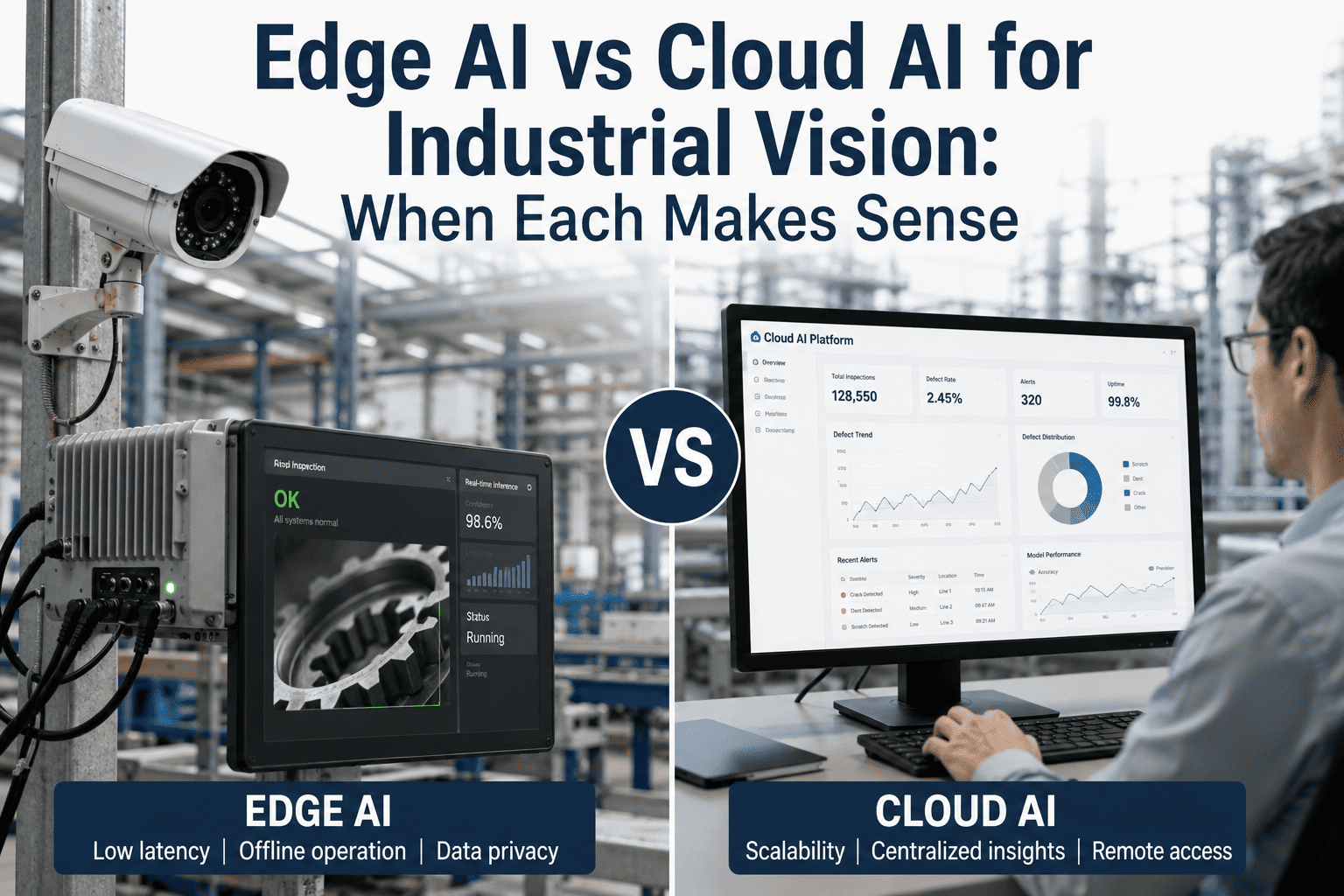
Edge AI vs Cloud AI for Industrial Vision: When Each Makes Sense
By Johnson on July 14, 2026
The industrial AI world stopped pretending edge and cloud were competing philosophies the day AWS shut down Panorama in May 2026 and left every customer to build a custom edge plus cloud orchestration from scratch. Real deployments run in three latency tiers — single-digit millisecond decisions at the line, shift-level analytics on a local server, and fleet-wide model training in the cloud — because that is the only architecture that survives a factory network. This is the honest breakdown of when each tier wins, what workloads belong at each layer, and how to size the hybrid split without over-buying either side. To have an architect model the split on your specific lines, book a 30-minute architecture walkthrough.
Deployment Architecture Guide
Edge AI vs Cloud AI for Industrial Vision — When Each Actually Makes Sense
Latency, data sovereignty, model training, fleet management, and cost all pull the architecture in different directions. This is the practical breakdown of where inference should run for real-time inspection, where the cloud earns its keep, and why the honest answer is almost always both.
Runs on NVIDIA GPU at the line, keeps inspecting when the internet drops, keeps data on the plant floor.
Cloud AI
1-2s
Round-trip inference latency
Elastic compute for model training, fleet-wide analytics, drift detection, and centralized version control.
The Latency Reality — What "Real-Time" Actually Means at the Line
On a line running 200 parts per minute, the decision budget per unit is around 300 milliseconds. A cloud round-trip typically eats 1-2 seconds — and worst-case cloud latency hits 300-500ms even on the fastest connections. Numbers this small settle most architecture debates before cost even enters the conversation.
On any line above 200 parts per minute, cloud round-trip inference cannot hit the decision window. Edge is not preferred — it is the only architecture that works. Below that line speed, the choice widens.
Edge AI — Where It Genuinely Wins
Edge AI runs inference on the camera or on a local NVIDIA GPU node inside the plant. That single architectural choice unlocks five properties that cloud-only deployments structurally cannot match at industrial line speed.
Edge Win 01
Deterministic Sub-10ms Latency
On-camera inference on NVIDIA hardware returns pass or fail decisions in single-digit milliseconds. No round-trip, no jitter, no dependence on WAN quality. The Frontec CNN weld-nut deployment hit 0.14 second response time against a 0.2 second requirement at 99% accuracy.
Network-Outage Immunity
The camera keeps inspecting when the WAN drops, when there is planned network maintenance, or when the plant is deliberately segmented for OT isolation. A cloud-only deployment stops the moment the connection breaks — an unacceptable production risk for most manufacturers.
Data Sovereignty and Air-Gap Ready
Regulated environments — defense, ITAR, pharma, aerospace, some automotive — cannot send production imagery to a public cloud. Edge inference keeps images, models, and results inside the facility. That architecture is often the foundation of the compliance story.
No Recurring Inference Fees
Cloud AI charges per inference, per gigabyte of egress, and per hour of GPU time. Edge is a one-time hardware investment that runs at flat cost forever. On a high-volume line, cloud fees usually cross the edge capex figure by year two.
Bandwidth Preservation
A single 5MP camera at 30 fps generates about 450 MB per minute of raw imagery. Sending that stream to the cloud is either impossible on typical factory networks or requires compression that degrades the model input. Edge processes raw locally and ships metadata upstream.
Cloud AI — Where It Earns Its Keep
Cloud is the wrong tier for real-time inference on a fast line. It is the right tier for everything that is not a per-part decision — model training, fleet-wide learning, long-range analytics, and the multi-plant management layer edge cannot deliver on its own.
Model Training and Retraining
Distributed GPU training on aggregated defect data across every plant in the fleet produces models that no single site could train in isolation. This is where drift detection triggers retraining, where new SKUs get onboarded, and where model versions are cut before rollout to the edge.
Fleet-Wide Model Management
A model registry, version control, canary rollouts across edge cohorts, and blue-green deployment for zero-downtime transitions. Doing this independently at each edge node across dozens of plants is not a realistic proposition — cloud orchestration is the only sane pattern.
Cross-Site Analytics
Defect trends across a fleet of plants surface patterns no single-site view can detect — a supplier-quality issue, a shared tooling problem, a seasonal drift. That analytical layer is naturally centralized in the cloud where the data can be aggregated safely.
Long-Range Historical Trends
Multi-year defect archives, root-cause investigation across historical inspection data, and regulatory audit trails live naturally in cloud storage. The workloads are compute-heavy and data-hungry but not time-critical — the cloud's exact sweet spot.
Head-to-Head — Edge vs Cloud vs Hybrid
Ten dimensions that decide the architecture. Read down the columns for the trade-off you accept the moment you commit to a lane.
Dimension
Edge Only
Cloud Only
Hybrid
Inference latency
<10ms
1-2 seconds
<10ms local
Network-outage tolerance
Full
None
Full
Data sovereignty
On-prem
Off-prem
On-prem inference
Line speed ceiling
Unlimited
<200 ppm
Unlimited
Recurring cost
Low
High
Medium
Model training
Local, limited
Full scale
Cloud-side
Fleet model management
Manual, per node
Centralized
Centralized
Drift detection
Local
Fleet-wide
Fleet-wide
Bandwidth requirement
Low
Very high
Low upstream
Multi-plant scalability
Complex
Native
Native
Map Your Workloads to the Right Tier
Bring your line-speed profile, connectivity constraints, and multi-site rollout plan. An architect will map every workload to the correct latency tier in a single session.
The Hybrid Truth — Three Latency Tiers on the Same Asset
Real deployments run three problems at three speeds on the same equipment. Sub-10ms edge inference for the per-part decision, shift-level analytics on a local server every few hours, and fleet-wide model retraining in the cloud on a monthly cycle. Same data, three tiers, three time horizons.
Metadata flows upstream from edge to cloud; retrained models flow back down. The plant floor keeps its decision speed; the cloud keeps its learning scale. Both layers earn their keep on the same asset.
The Five-Question Decision Framework
Every architecture debate resolves once these five questions get honest answers. The framework does not tell you edge or cloud — it tells you where each workload belongs on the ISA-95 hierarchy.
What is your fastest line speed in parts per minute?
Above 200 parts per minute the decision budget per unit is under 300ms — edge is the only architecture that fits. Below that, cloud inference becomes viable and cost becomes the deciding factor rather than latency.
Can production imagery legally leave the facility?
ITAR, defense, some pharma, and regulated automotive workloads cannot send raw imagery to a public cloud. Edge inference is a compliance requirement, not a preference — the architecture question is settled before it starts.
How many plants will run this architecture?
Single-plant deployments can operate pure-edge with local model management. Multi-plant fleets need cloud orchestration for canary rollouts, drift monitoring, and fleet-wide retraining — hybrid becomes the practical answer above two or three sites.
How often do models need to be retrained?
Stable production with quarterly retraining tolerates a lightweight cloud footprint. Frequent SKU changes, new alloys, or seasonal drift push retraining monthly and demand a proper cloud-side pipeline for versioning and rollout.
Is your WAN reliable enough to bet production on?
Factory networks are segmented, subject to maintenance windows, and share bandwidth with other OT traffic. Any architecture that stops inspecting when the WAN drops is a production liability — edge inference is the default answer for uptime.
Three Deployment Patterns That Actually Work
Naming the patterns matters, because the trade-offs travel with the pattern rather than the vendor. These are the three that keep showing up across successful multi-site deployments.
Pattern A: Pure Edge, Single Plant
One-plant deployment, high-speed lines, regulated environment, or air-gapped OT network. Every camera runs inference on-device. Local server handles CMMS integration and shift reports. No cloud dependency, no recurring inference fees.
Best fit: defense, ITAR, regulated pharma, single-site producers
Pattern B: Hybrid Edge + Cloud Orchestration
Edge inference for per-part decisions, local plant server for shift analytics, cloud for model training, drift detection, and fleet-wide rollout. Metadata flows up, retrained models flow back down. The default architecture for multi-plant fleets.
Best fit: multi-plant manufacturers, growing fleets, regulated with orchestration needs
Pattern C: Cloud-First with Edge Cache
Low-speed lines under 200 parts per minute where latency is not the constraint. Cloud runs primary inference; a lightweight edge cache holds a fallback model for network outages. Lower capex, higher recurring cost, works only inside a tight latency envelope.
Best fit: prototype lines, low-volume assembly, pilot programs
Frequently Asked Questions
How much faster is edge inference than cloud in practice?
Edge inference on an on-camera NVIDIA GPU returns pass or fail decisions in single-digit milliseconds. A cloud round-trip typically eats 1-2 seconds of variable latency, since the image has to travel to a remote data center, get processed, and travel back. On a line running 200 parts per minute the decision budget per unit is around 300ms — cloud round-trip is not too slow by a little, it is too slow by an order of magnitude. To see the latency profile against your line speed, book a demo.
If edge is faster and cheaper to run, why bother with cloud at all?
Because the workloads that require cloud are not the per-part decisions. Fleet-wide model training, drift detection, canary rollouts to multiple edge cohorts, cross-site analytics, and long-range trend analysis all need the elastic compute and centralized management that only the cloud delivers. Doing that at the edge independently across dozens of plants is not a realistic proposition — hybrid is the correct architecture for any fleet above two or three sites. To scope the split for your operation, talk to a specialist.
What happens to inspection when the WAN goes down?
On a pure-edge or hybrid architecture, inspection continues without interruption because the model runs locally on the camera or plant server. Inspection results and event logs buffer locally during the outage, then synchronize upstream when connectivity restores — so the audit trail has no gaps. On a cloud-only architecture, inspection stops the moment the WAN drops and does not resume until connectivity returns. That difference is why edge is the default answer for uptime-critical production. To see network-outage failover in a live demo, book a walkthrough.
Does edge deployment mean higher upfront cost?
Yes, edge carries higher one-time hardware cost — typical single-station deployments land in the $2,000-$15,000 range depending on camera and compute selection, and full-line multi-camera builds go higher. But it eliminates recurring inference fees, cloud storage costs, and data egress charges that compound over the life of a cloud-first deployment. On high-volume production, edge economics almost always favor edge by year two or three. For a modeled TCO comparison, reach out to a specialist.
How do we manage model versions across dozens of edge nodes?
Through a cloud-side model registry that pushes updates to edge cohorts using canary rollouts and blue-green deployment patterns — new versions validate on small edge populations before full-fleet rollout, and rollback is a one-click action if drift shows up. Automated retraining pipelines trigger when accuracy degrades or data drift crosses configured thresholds. That orchestration layer is exactly what pure-edge cannot deliver and pure-cloud cannot afford at line speed, which is the case for hybrid on any multi-plant fleet. To see the fleet management layer in action, book a demo.
Design the Right Architecture Before You Buy the Hardware
Map Every Workload to the Right Latency Tier — In a Single Session
Bring your line speed profile, connectivity constraints, plant count, and regulatory requirements. In 30 minutes an architect will place each workload on the right tier — per-part decisions at the edge, shift analytics locally, fleet learning in the cloud — and give you a bill of materials sized to the split. No over-buying either side.