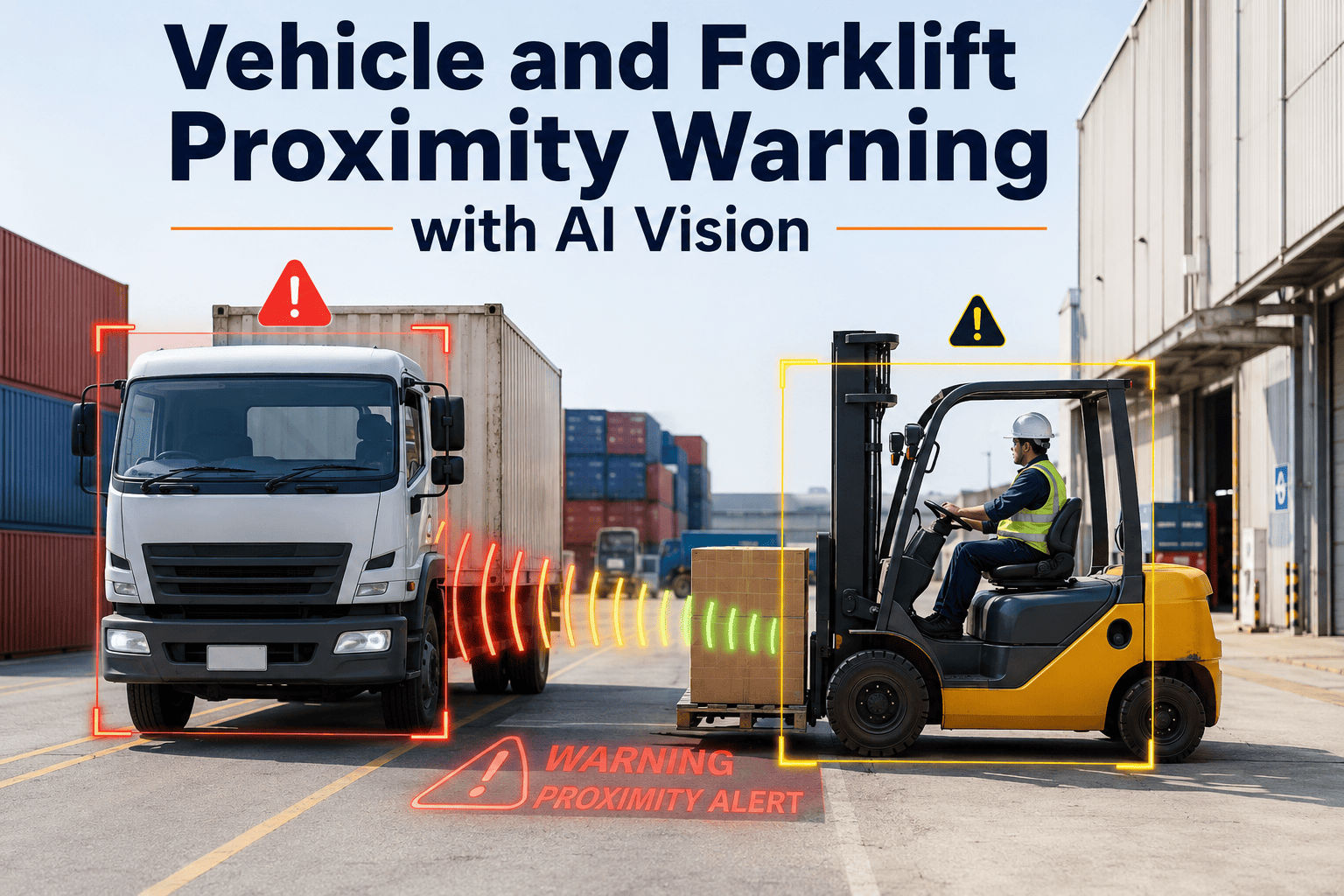
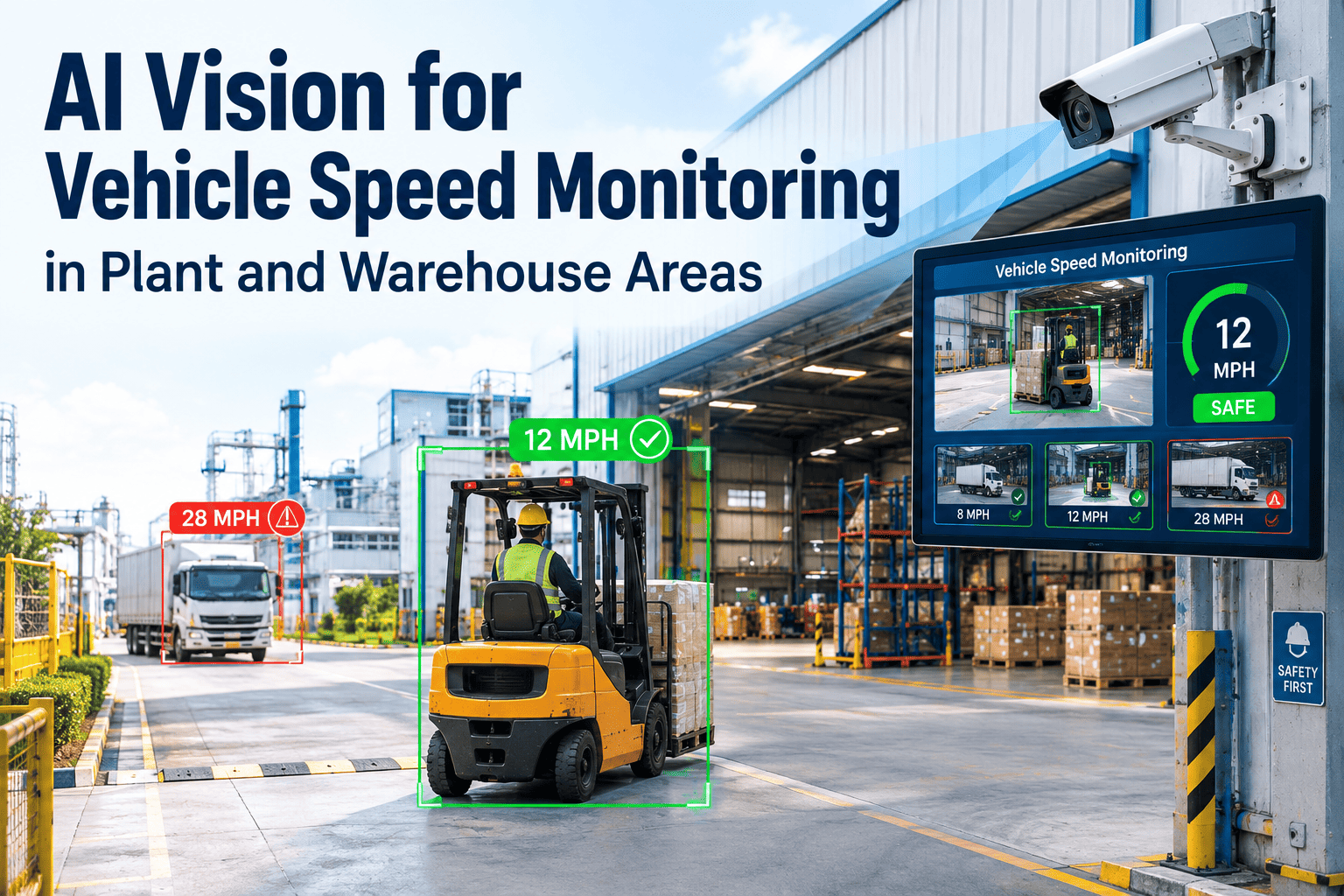
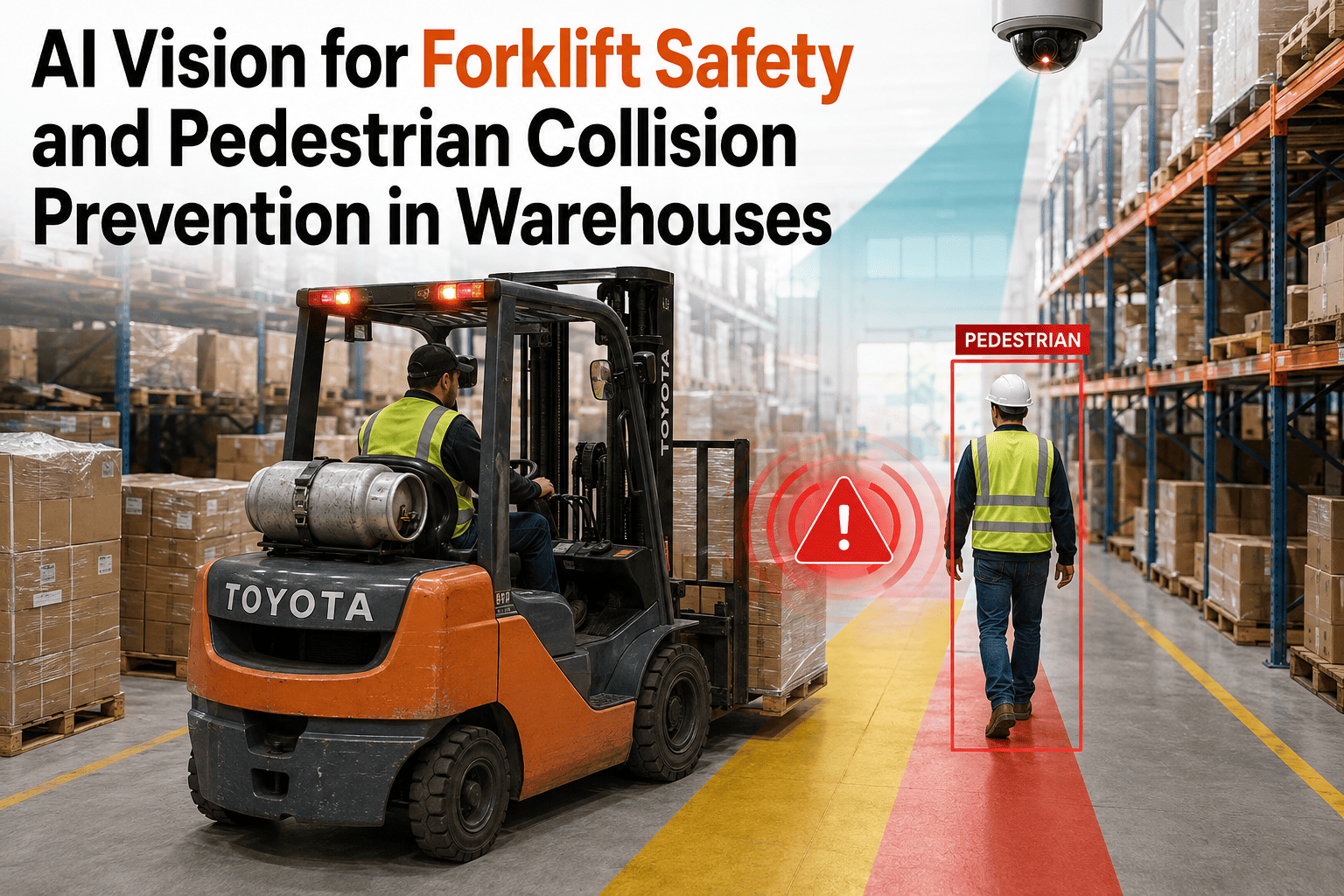
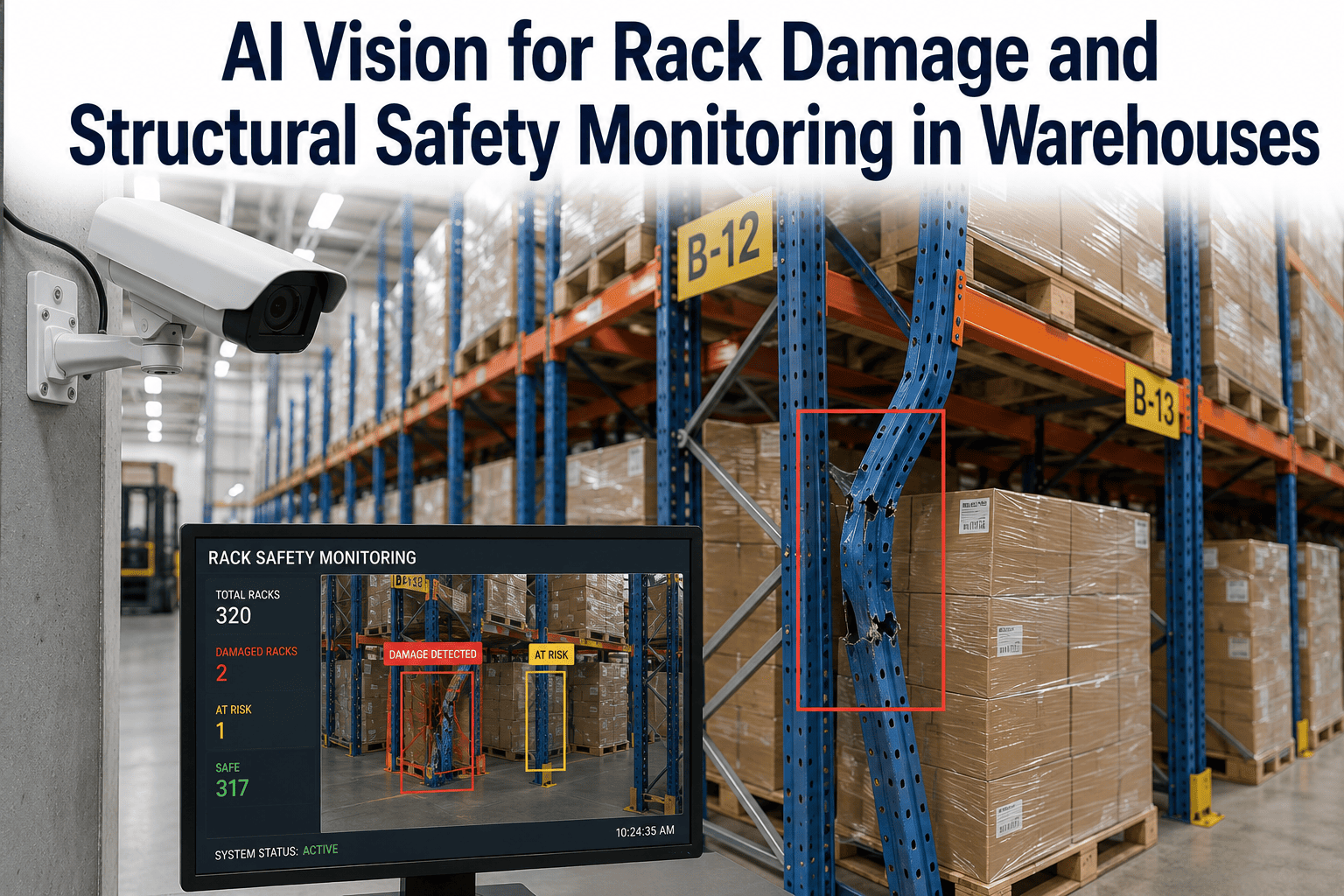
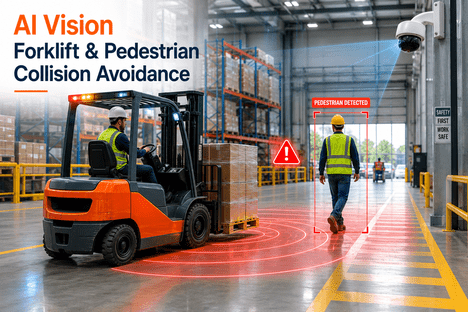
Every four days in the United States a warehouse worker is killed by a forklift, and thousands more are struck each year by machines they never saw coming around a blind corner or across a busy dock aisle. OSHA estimates 35,000 to 62,000 forklift injuries occur annually, and 36% of forklift fatalities involve pedestrians rather than operators. Painted lines, backup alarms, mirrors, and operator training all depend on human awareness at the exact moment attention lapses. iFactory's AI vision watches every blind corner, dock crossing, and aisle intersection continuously, and you can book a demo to see it running on a facility layout like yours.
FORKLIFT SAFETY · PEDESTRIAN DETECTION · PROXIMITY WARNING · AI VISION
Detect Every Dangerous Approach Between Forklifts, Vehicles, and Workers — Before Contact Range
iFactory's AI vision uses your existing facility cameras to identify forklifts, pallet jacks, and pedestrian workers in real time, calculating closing distance and triggering automated warnings plus OSHA-ready documentation the instant a dangerous approach begins.
62K
Forklift Injuries Per Year, U.S. (OSHA upper estimate)
36%
Of Forklift Fatalities Involve Pedestrians
$41K
Average Workers' Comp Claim Per Forklift Injury
94%
Reduction In Near-Misses After AI Vision Deployment
THE COLLISION PATTERNS
Six Geometry Problems That Cause Almost Every Forklift-Pedestrian Incident
Forklift-pedestrian collisions cluster around a small number of predictable line-of-sight failures. The scenarios below account for the majority of struck-by-vehicle cases in OSHA severe injury reports, and none of them can be solved by painted lines or operator judgment alone.
01
Blind Corner Emerging
A loaded forklift rounds a racked aisle corner with zero line of sight to a pedestrian approaching from the intersecting aisle. Neither party sees the other until inside stopping distance.
02
Dock Door Crossing
Loading docks concentrate forklift traffic, delivery drivers, and pickers into overlapping paths. Twenty-five percent of warehouse accidents happen in the dock zone where trailers and freight break visibility.
03
Reverse Travel Blindside
Operators reversing with a raised mast or bulky load lose rear visibility almost entirely. A pedestrian crouched to pick or scan behind the truck sits below the operator's sightline.
04
Narrow Aisle Occupancy
A pedestrian steps into a narrow pick aisle as a forklift enters from the opposite end. Aisle width leaves no lateral clearance and no exit route once the vehicle is committed.
05
Intersection Simultaneous Approach
Two forklifts or a forklift and a foot traveler approach an unmarked cross-aisle intersection at the same instant, each expecting the other to yield. Fixed signage cannot resolve real-time ambiguity.
06
Trailer Yard Vehicle Traffic
Outdoor yards mix spotters, yard trucks, and delivery tractors between staging and dock doors. Vehicle-to-vehicle and vehicle-to-worker proximity share the same uncontrolled space.
THE PROXIMITY ZONES
How the System Maps Distance Between Every Vehicle and Every Worker In View
Rather than a single trigger distance, the AI classifies every vehicle-to-worker relationship into one of three zones based on distance, closing speed, and approach angle. Alerts escalate as the relationship moves from monitored to imminent, so operators are not flooded by false alarms on distant objects.
SAFE · Beyond 5m · No alert
CAUTION · 3m to 5m · Visual indicator + logging
DANGER · Under 3m · Audible + supervisor alert
Adaptive Not Static
Zone radii adjust automatically to forklift speed and load weight. A truck at rated speed with a full pallet triggers earlier than one crawling.
Direction Aware
A pedestrian beside a forklift on a parallel path does not trigger the same alert as one on a converging vector, because approach angle is scored before escalation.
Zone Per Area
Loading docks, main aisles, and production floors carry their own tuned thresholds. High-density pick zones use tighter rules than open receiving areas.
DETECTION PIPELINE
Four Stages From Camera Frame To Real-Time Warning
The full loop from image capture to alert delivery runs in under 150 milliseconds, faster than human reaction time and inside the window needed for a moving forklift to slow. Every stage runs on edge hardware inside the facility, so there is no cloud round-trip in the safety path.
STEP 01
Frame Capture From Existing Cameras
The platform ingests RTSP video from IP cameras already installed at your dock doors, intersections, and blind corners. No custom camera hardware is required.
STEP 02
Object Classification and Tracking
Deep learning models identify each object as a forklift, pallet jack, reach truck, pedestrian, or delivery vehicle. Every object gets a persistent tracking ID across frames.
STEP 03
Distance and Vector Calculation
Calibrated camera geometry converts pixel positions into real-world distances between every vehicle and pedestrian in view. Closing speed and approach angle are calculated frame-over-frame.
STEP 04
Zone Rule Evaluation and Alert Delivery
The proximity is scored against zone rules and triggers the appropriate response, from a silent log entry to a supervisor SMS to an audio-visual alert at the corner beacon.
Your Cameras Are Already Watching — Let AI Read What They See Before The Next Near-Miss Becomes A Recordable Incident
iFactory's AI vision turns your existing dock, aisle, and intersection cameras into a continuous proximity monitoring system that alerts operators and supervisors the moment a dangerous approach begins.
HEAD TO HEAD
Traditional Forklift Safety Controls vs AI Vision Proximity Warning
Floor markings, backup alarms, and speed limits cover the administrative and engineering layers of the hierarchy but cannot deliver real-time proximity detection. The comparison below maps where AI vision fills the residual gap.
| Safety Dimension |
Traditional Controls |
iFactory AI Vision Proximity Warning |
| Detection Method |
Painted lines, mirrors, backup beepers, and operator judgment at the moment of exposure |
Computer vision on live camera feeds detects every vehicle and pedestrian in frame |
| Pedestrian Coverage |
Requires pedestrian to see, hear, and react to a warning issued at close range |
Detects every pedestrian in view without tags, wearables, or vests required |
| Reaction Time Available |
Warning arrives when both parties are already at close range with limited stopping distance |
Sub-150ms detection to alert, providing measurable additional response distance |
| Near-Miss Documentation |
Not documented; near-misses surface only through voluntary reporting |
Every proximity event logged with timestamp, video clip, and tracking data |
| Adaptation To Zones |
Fixed floor markings and static signage that cannot adjust to changing conditions |
Zone thresholds configured per area with tighter rules in dock zones and blind corners |
| False Alarm Rate |
Backup alarms trigger on static objects and lead to operator alarm fatigue |
Context-aware alerts based on approach vector and closing speed rather than simple presence |
| OSHA Investigation Support |
Manual reconstruction from operator interviews and paper logs |
Timestamped video clips, tracking data, and proximity metrics generated automatically |
THE COST OF ONE INCIDENT
Why A Single Forklift-Pedestrian Collision Justifies The Entire Program
Direct workers' compensation is the smallest line item on the incident cost sheet. Indirect costs including investigation time, OSHA penalties, litigation exposure, and lost production typically run four to six times the direct claim.
$41,003
Direct Workers' Comp Claim
Average direct claim per forklift injury (NCCI). Motor-vehicle-related claims average $91,433 across lost-time claims.
$16,550
Per OSHA Serious Violation
Standard serious penalty. Willful violations reach $165,514 per citation and one incident often triggers multiple citations.
18 days
Median Days Away From Work
Median lost-time per BLS data, rising to 22 days for DART cases. Every lost day requires overtime or temp labor.
$200K+
Total Impact Per Serious Incident
Direct plus indirect costs including investigation, retraining, premium increases, and litigation exposure routinely exceed $200,000.
DEPLOYMENT
What A Rollout Looks Like Across Your Existing Facility Infrastructure
Deployment is designed around what your facility already has rather than new capital purchases. Rollouts begin by mapping the highest-risk zones, then extending camera coverage only where existing views are incomplete.
Week 1
Site Walkthrough and Risk Zone Mapping
Safety and operations teams walk the facility with an iFactory engineer to identify blind corners, dock crossings, and high-traffic intersections. Existing camera coverage is documented against the risk map to quantify gaps before any hardware is added.
Weeks 2-3
Camera Integration and Edge Deployment
RTSP streams from existing IP cameras connect to edge processing devices installed on your network. New cameras are added only in blind spots where existing coverage misses the identified risk zones.
Weeks 4-5
Zone Tuning and Alert Configuration
Proximity thresholds, escalation rules, and alert channels are configured per area. Alerts route to local audio-visual beacons, supervisor devices, and your WMS or safety platform for logging.
Weeks 6-8
Pilot Validation and Rollout Expansion
The system runs in monitoring-only mode on pilot zones to validate detection accuracy against real traffic. Once tuned, coverage expands to remaining zones and operator briefings are delivered.
MEASURED RESULTS
Outcomes From Facilities Running AI Proximity Warning
The figures below reflect verified outcomes from U.S. warehouse, distribution, manufacturing, and food processing facilities running AI vision proximity detection over a minimum twelve-month operating period.
94%
Reduction
Documented Near-Miss Events Per Month
Near-miss events drop by 94% because dangerous approaches are prevented directly and because operators and pedestrians adjust behavior once they know the zone is being monitored.
86%
Fewer Vehicle Incidents
Within First 90 Days Of Operation
The initial three-month window sees an 86% reduction in vehicle-related incidents as behavior adjusts and supervisor coaching targets the operators generating the most alerts.
$280K
Annual Savings
Workers' Comp and Compliance Per Site
Average yearly reduction in workers' comp, OSHA compliance, insurance premium adjustments, and reactive investigation costs at a typical U.S. site in the first full year.
150ms
Detection Latency
Frame Capture To Alert Delivery
The full loop from camera frame to alert delivered at the corner beacon or supervisor device runs under 150 milliseconds, faster than human visual reaction time.
FREQUENTLY ASKED QUESTIONS
Questions From Safety and Operations Leaders About AI Proximity Warning
Do pedestrians need to wear RFID tags or beacons for the system to detect them?
No, the AI vision detects pedestrians directly from camera imagery using object detection models trained on warehouse and manufacturing environments. That means the system protects contractors, delivery drivers, visitors, and any worker whose vest or badge might be missing on a given shift. Coverage is universal from the moment a person enters the field of view, closing the tag-compliance gap that limits every wearable-based approach.
Book a demo to see tag-free detection running on your facility layout.
Will this generate so many alerts that operators start ignoring them like a legacy backup alarm?
Alarm fatigue is the primary failure mode of legacy proximity systems and it is designed against directly. Alert thresholds use closing speed, approach angle, and zone type rather than raw presence, so parked pallets and static racks in view do not trigger anything. Sensitivity is tunable per zone, so a busy pick aisle uses tighter rules than an open receiving area. Operators experience alerts as meaningful signal rather than constant background noise.
Contact our support team to review alert tuning for your traffic patterns.
Can we use our existing IP cameras and network or does this require a full hardware refresh?
Existing IP cameras with RTSP output work directly with the platform in most facilities. Rollouts only add cameras where current coverage misses the specific intersections and dock zones flagged during the walkthrough. Edge processing devices install on your existing network without cloud connectivity for real-time safety decisions, keeping latency low and preserving bandwidth for operational systems. Most facilities complete deployment without a full-scale hardware refresh.
Book a demo for a compatibility review of your camera infrastructure.
How does the recorded event data support OSHA compliance and incident investigations?
Every proximity event, near-miss, and alert is captured automatically with a timestamp, a short video clip of the approach, and structured tracking data including closing distance and approach angle. OSHA investigators and safety teams work from objective visual evidence rather than reconstructing events from operator interviews weeks later. Trend analysis surfaces the corners, shifts, and operators generating the most alerts so coaching and layout changes target actual exposure.
Contact our support team to discuss OSHA 300 integration.
How quickly do most facilities see measurable reductions in near-misses after go-live?
Most facilities see a measurable near-miss reduction within the first few weeks of operation. Direct proximity warnings prevent specific approaches that would have escalated, while operators and pedestrians actively modify behavior once they know alerts are being logged. The 86% vehicle incident reduction figure typically materializes within the first 90 days, with continued gains as zone tuning and supervisor coaching close remaining exposure.
Book a demo for a rollout timeline based on your facility size.
Every Forklift-Pedestrian Fatality Was Preceded By Dozens Of Undocumented Near-Misses — Turn Those Signals Into A Preventable Trendline
iFactory's AI vision runs on your existing cameras, detects every dangerous approach in under 150 milliseconds, and generates the OSHA-ready documentation your safety program has been reconstructing manually. Book a demo to see proximity monitoring on your intersections, docks, and blind corners.