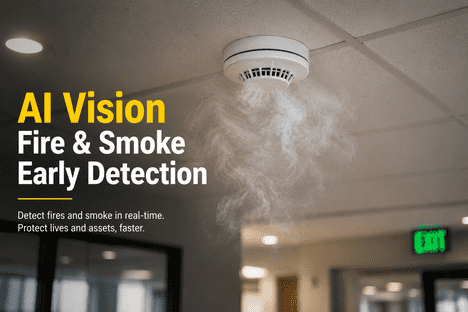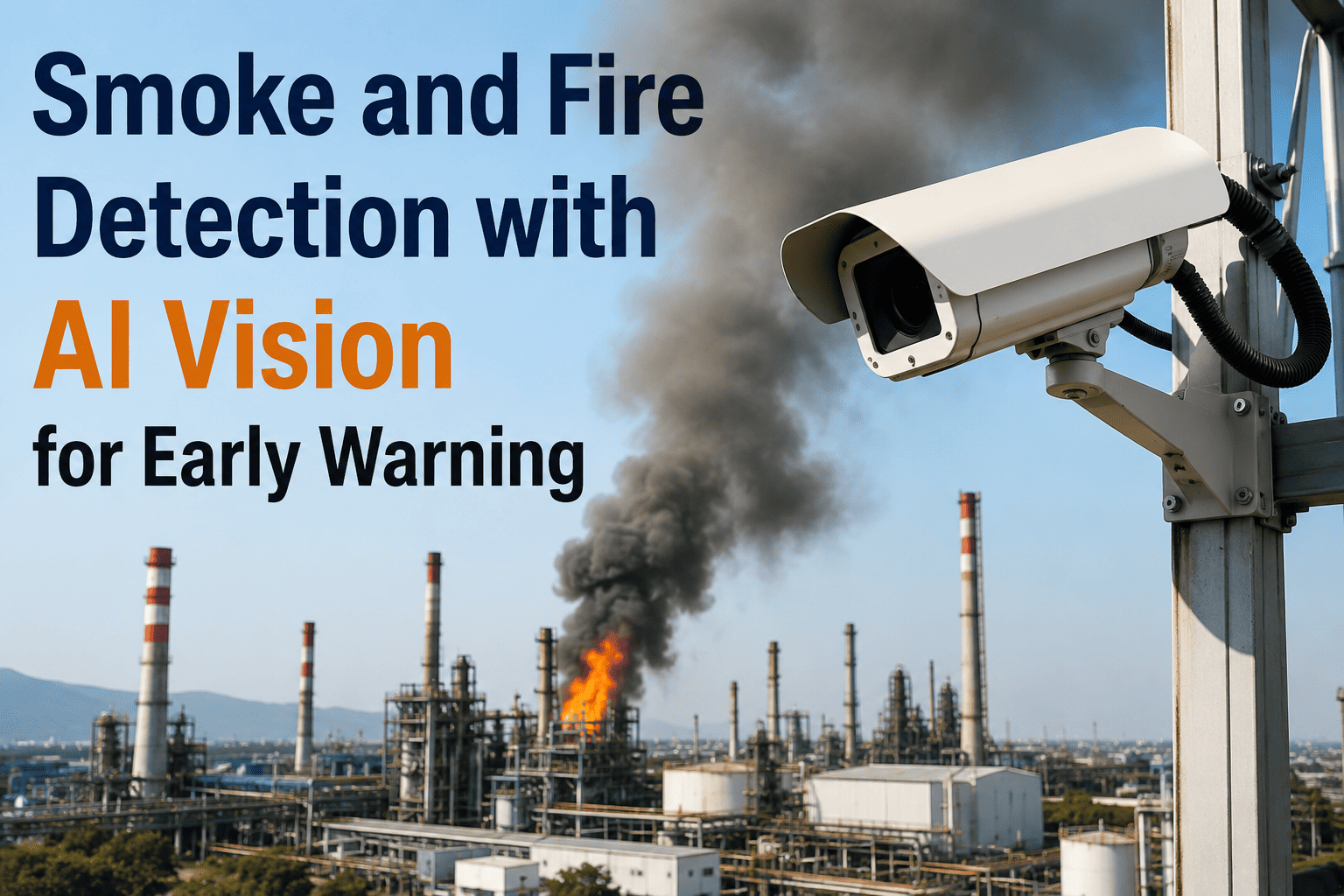
Every second matters once a fire starts, and traditional smoke detectors depend on smoke physically reaching the sensor, which can take far longer in large, open, or high-ceiling industrial spaces than most people realize. AI vision cameras watch the entire visual field continuously, spotting the earliest wisps of smoke or the specific flicker signature of a flame long before particles drift up to a ceiling-mounted detector. Just as important, these systems are trained to tell a genuine fire apart from steam, dust clouds, or sudden lighting changes, which is where older motion-based systems tend to generate a stream of false alarms that teams eventually learn to ignore. Facilities running AI-based fire and smoke monitoring alongside conventional detection consistently see faster confirmed alerts and far fewer nuisance triggers, which is why safety teams are increasingly choosing to request a live demonstration of the detection speed.
AI VISION FOR FIRE AND SMOKE
See Fire Risk Before It Reaches a Ceiling Sensor
AI cameras continuously scan for smoke wisps and flame signatures across the full visual field, delivering earlier and more accurate alerts than point detectors alone.
Detection Speed: Traditional Sensors vs AI Vision
Point-type smoke detectors need particles to travel to the sensor location. AI vision watches the source directly, which is especially valuable in large open bays, warehouses, and high-ceiling process areas.
Point Smoke Detector
Depends on smoke reaching ceiling height
Heat Detector
Triggers only after significant heat buildup
AI Vision Camera
Flags visible smoke or flame at the source in seconds
Full Field
Continuous visual coverage instead of single-point sensing locations
Source-Level
Detection at the point of ignition rather than after particles disperse
Fewer False Alarms
Context-aware models distinguish real fire from steam, dust, and glare
High-Risk Zones Where Early Detection Matters Most
Warehouses and High-Bay Storage
Racked storage fires can spread through flue spaces quickly, and high ceilings delay smoke reaching traditional detectors mounted overhead.
Electrical and Switchgear Rooms
Early flame or smoldering detection at electrical panels can prevent an arc event from escalating into a full electrical fire.
Loading Docks and Outdoor Yards
Open-air areas typically lack point detectors entirely, leaving a visibility gap that camera-based monitoring is well suited to close.
Process and Production Floors
Steam, dust, and welding sparks are common here, making false-alarm-resistant detection especially valuable for uninterrupted operations.
How AI Fire Detection Confirms a Real Event
1
Continuous Visual Scanning
Cameras monitor the full field of view around the clock, watching for the specific texture and movement patterns of smoke or flame.
2
Pattern Classification
The model compares the detected pattern against trained smoke and flame signatures, filtering out steam, dust, and lighting artifacts.
3
Instant Verified Alert
Once confirmed, an alert with a live video clip is sent to safety personnel and integrated fire panels for immediate response.
4
Incident Record and Review
Every confirmed and near-miss event is logged with footage, supporting post-incident review and ongoing model tuning for the site.
Fire Types Common to Industrial Sites
Fire classification systems used in NFPA guidance help determine both suppression method and the visual signature a detection system needs to recognize.
Class A: Ordinary Combustibles
Wood pallets, packaging, and paper storage produce visible smoke early, making camera-based detection especially effective in warehouse settings.
Class B: Flammable Liquids
Fuel, solvent, and oil fires often ignite quickly with a distinct flame signature that vision models are trained to recognize immediately.
Class C: Electrical Fires
Smoldering insulation or arcing in switchgear can precede visible flame by several minutes, which is exactly the window early smoke detection targets.
Class D: Combustible Metals
Metalworking and grinding operations carry a distinct spark and flare pattern that detection models learn to separate from routine process activity.
Fitting Into Your Existing Fire Safety Program
AI vision is designed to strengthen an existing fire safety program rather than replace the procedures and equipment already in place.
Fire Panel Integration
Confirmed detections can trigger the same notification chain used by conventional detectors, keeping response procedures consistent across the site.
Mobile Responder Alerts
Designated safety personnel receive alerts directly on mobile devices with location and video, even when they are away from a central control room.
Incident History Dashboard
Every confirmed and near-miss event is retained for review, helping safety teams identify recurring risk areas across the facility over time.
Test Detection Against Your Own Facility's Risk Areas
Walk through how AI vision would monitor your highest-risk zones, from warehouse racking to electrical rooms.
Frequently Asked Questions
Most facilities deploy AI vision as a complementary layer rather than a full replacement, since building and fire codes in many jurisdictions require certified point-type detectors as part of a compliant life safety system. AI vision adds earlier, source-level detection in large or open areas where point detectors are slower to respond, and it also extends coverage to outdoor and semi-outdoor areas where traditional detectors are impractical to install. The combination gives facilities both code compliance and meaningfully faster early warning.
The AI model is trained on the specific visual behavior of real smoke and flame, including how they move, spread, and change in density over time, which differs meaningfully from steam plumes, airborne dust, or the brief sparks generated during welding or grinding. Rather than triggering on any bright or hazy pattern, the model requires the sustained characteristics of an actual combustion event before issuing an alert, which is what allows it to operate reliably in process areas where these background conditions are common. Facilities can review real false-alarm performance data during a demo session.
Yes, and this is one of the areas where AI vision provides coverage that traditional point detectors simply cannot, since heat and smoke detectors are generally installed indoors and rarely extend to yards, loading docks, or outdoor storage areas. Weatherproof cameras positioned to monitor these zones allow the same detection model to flag early fire risk in outdoor storage of pallets, scrap, or raw materials, closing a common blind spot in many facility fire safety programs.
Confirmed AI detections can be configured to send notifications to on-site safety personnel, mobile alerts to designated responders, and in many cases integrate with existing fire panel or building management systems to trigger the same notification chain used for a conventional detector activation. This means the AI system supplements the existing emergency response workflow rather than requiring an entirely separate procedure, and every alert includes a video clip so responders can visually verify the situation before dispatching resources. Teams can request an integration walkthrough by contacting support.
Flame detection generally performs well in low-light and nighttime conditions since flame signatures are visually distinct even in darkness, and cameras can be paired with infrared or thermal sensing for additional low-light reliability. Smoke detection in very low light is more dependent on ambient illumination or supplemental lighting near the monitored zone, so facilities with critical overnight risk areas often add basic lighting or thermal camera coverage to maintain consistent detection performance around the clock.
EARLY WARNING SAVES RESPONSE TIME
Add Source-Level Fire Detection to Your Safety Program
Get a personalized walkthrough of AI fire and smoke detection mapped to your facility's actual risk areas.