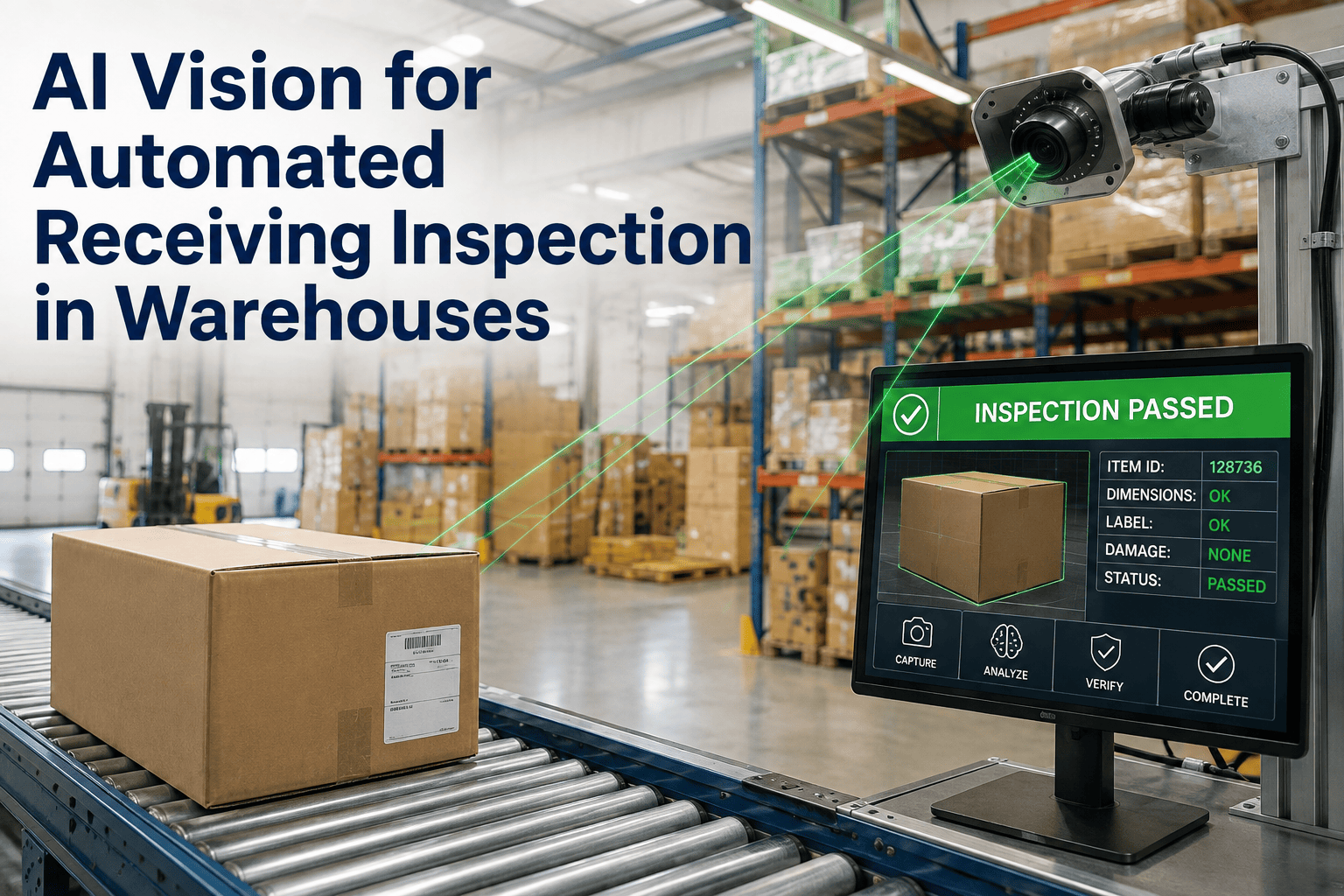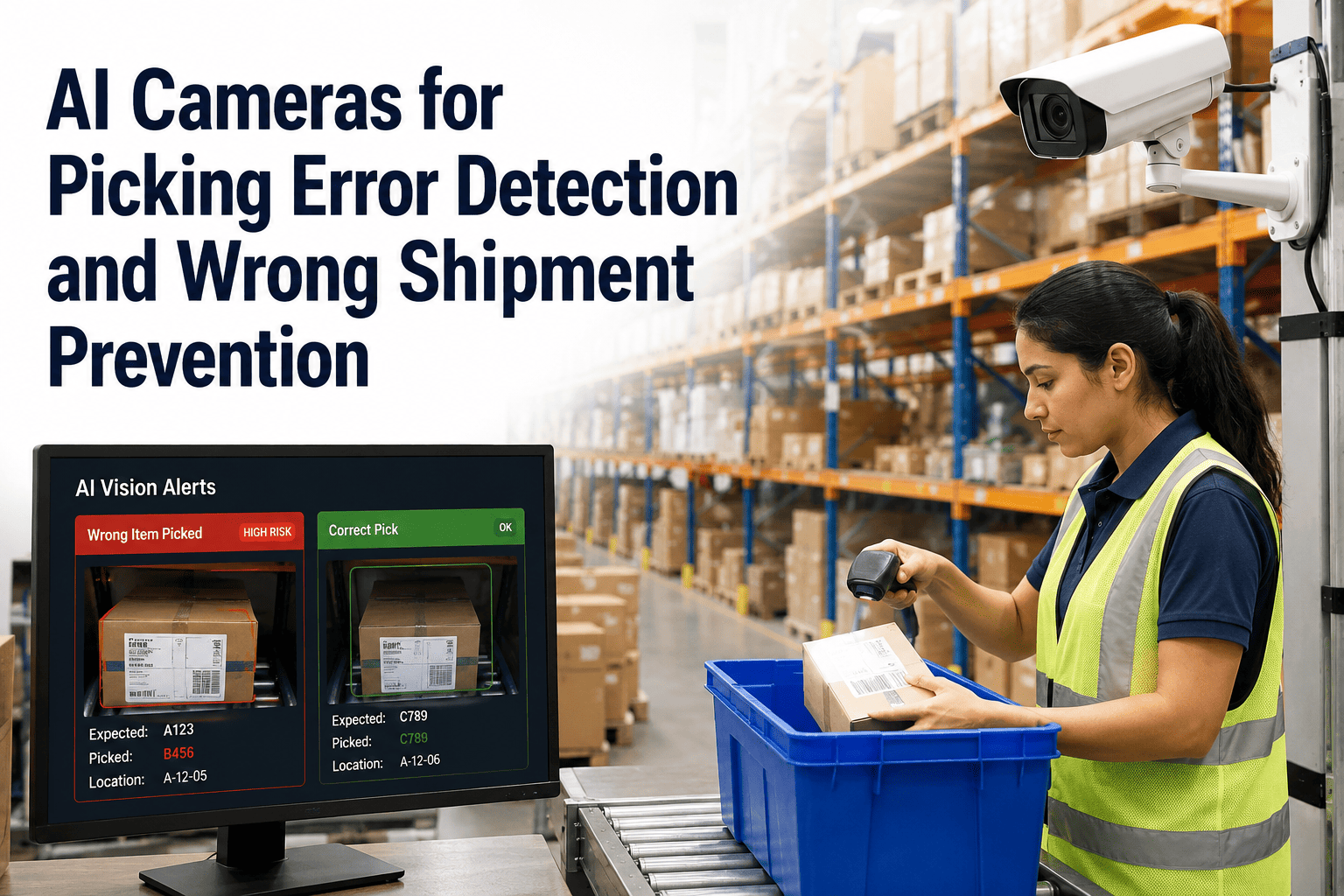
A wrong shipment rarely gets caught at the source. It ships, the customer opens the box, and the cost shows up weeks later as a return, a chargeback, and a support ticket that damages trust more than any single line item ever could. Most warehouses still rely on the picker's own eyes as the last line of defense against SKU mix-ups and quantity errors. AI camera verification changes that by checking every pick against the order before the box is sealed, and the fastest way to see it working is to book a demo.
Catch the Wrong Pick Before It Becomes a Wrong Shipment
AI cameras verify SKU, quantity, and label match at the point of pick, stopping errors before they reach the box, the truck, or your customer's doorstep.
The True Cost of a Picking Error Is Never Just the Item
A single wrong pick sets off a chain reaction that most cost models underestimate. It is not only the value of the misshipped item, it is the return shipping, the replacement order, the restocking labor, and in business-to-business relationships, the erosion of trust that follows a customer who now double-checks every shipment you send them.
SKU, quantity, or label mismatch goes undetected at the pick face
Order packs and leaves the dock with no verification checkpoint
Error surfaces days later, often after the customer has already needed the item
Reverse logistics, replacement order, and support time compound the original cost
What AI Picking Verification Checks at Every Order
Cameras positioned at pick stations and pack tables compare what the picker physically selects against the digital order, catching four categories of error that manual double-checking routinely misses under fatigue and time pressure.
Confirms the item picked visually matches the SKU on the order, catching look-alike product mix-ups.
Counts units placed into the tote or box against the ordered quantity, flagging over-picks and short-picks.
Reads shipping and product labels to confirm the correct label is applied to the correct package.
Verifies every component of a multi-item kit or bundle is present before the box is sealed.
Manual Double-Check Versus AI Verification
Manual quality checks depend on a second person's attention holding steady across an entire shift. AI verification applies the same standard to every single order, all day, without fatigue.
| Factor | Manual Double-Check | AI Camera Verification |
|---|---|---|
| Orders checked | Sample-based, 10 to 20 percent | 100 percent of orders |
| Detection consistency | Declines with fatigue and shift length | Constant across every shift |
| Time added per order | 15 to 40 seconds | Under 3 seconds, in-line |
| Error visibility | After the fact, if caught at all | Real-time alert before sealing |
Stop relying on a tired second glance to catch six-figure shipping errors. See how AI verification runs inline with your existing pick and pack process.
Which Order Types Carry the Highest Error Risk
Not every order carries the same risk of a picking mistake. Complexity, SKU similarity, and pick density all influence how often an error slips past a rushed or fatigued picker, and understanding where risk concentrates helps prioritize where verification delivers the fastest return.
Orders with five or more line items compound risk with every additional pick, since a single miss can invalidate the entire shipment.
Products that differ only by size, color, or a small packaging variant are the most common source of visually driven pick mistakes.
Error rates climb measurably during peak volume as pick rates increase and the time available for self-verification shrinks.
Items pickers have not yet memorized carry a higher mistake rate until muscle memory builds over repeated cycles.
Fitting Verification Into Your Existing Pick and Pack Layout
Deployment is designed around your current station footprint rather than requiring a redesigned workflow. Cameras are positioned at the natural point where an item is already handled, so verification becomes part of the motion pickers and packers already perform.
Camera captures the item as it leaves the slot and enters the tote
Second checkpoint verifies full order contents before the box is sealed
Final camera confirms the shipping label matches the verified order contents
Only fully verified orders are cleared to load, closing the loop before departure
Turning Verification Data Into Root Cause Fixes
Every flagged error is more than a single correction, it is a data point that reveals where your picking process has a structural weakness. Over weeks of operation, verification data builds a clear picture of which SKUs, stations, and shift patterns generate the most mistakes, letting supervisors fix causes instead of only catching symptoms.
Identifies specific products that generate repeated confusion, often signaling a need for better slotting separation or clearer labeling.
Reveals whether certain pick stations have layout or lighting issues that contribute to higher error rates than others.
Surfaces whether errors climb during specific hours, often pointing to staffing, fatigue, or training gaps worth addressing directly.
Tracks how quickly new pickers reach the facility's baseline accuracy, helping refine onboarding and training programs.
Verification Coverage Across Fulfillment Channels
Different fulfillment channels carry different error tolerances and order profiles. A single-item direct-to-consumer order carries different risk than a complex wholesale order with dozens of line items, and verification is tuned to the specific demands of each channel running through your facility.
| Fulfillment Channel | Typical Order Profile | Primary Verification Focus |
|---|---|---|
| Direct-to-consumer e-commerce | 1 to 3 line items, high volume | SKU and quantity match per order |
| Wholesale and B2B | 10+ line items, palletized | Full order completeness and kit accuracy |
| Retail replenishment | Case and pallet quantities | Case count and store-specific labeling |
| Subscription and kitting | Fixed multi-component bundles | Kit completeness before sealing |
Frequently Asked Questions
Does AI picking verification slow down the pick and pack process?
No, verification happens in-line as part of the existing pick and pack motion rather than as a separate inspection step. The camera captures and confirms the pick within a couple of seconds while the item is already in the picker's hand, so there is no added stop, scan, or manual confirmation step required. Most facilities report no measurable change to pick rate after the system is tuned to their station layout, and some see a modest speed improvement because pickers spend less time second-guessing ambiguous SKUs. You can walk through the exact station setup with the iFactory support team.
How does the system tell apart similar-looking products?
The vision model is trained on your specific product catalog, including packaging variants, color options, and size differences that commonly get confused during manual picking. Where two products are visually near-identical, the system cross-references barcode or label data captured in the same frame rather than relying on appearance alone. This layered approach is what allows it to catch errors that a human eye moving quickly would miss, particularly for private-label goods or products that only differ by a small printed variant code.
What happens when the system flags a discrepancy?
When a mismatch is detected, the picker or packer receives an immediate alert at the station, typically before the box is sealed and moved to the next stage. The order is held at that point rather than allowed to continue down the line, giving the operator a chance to correct the pick on the spot. Every flagged event is logged with a timestamp and image, which builds a data trail that supervisors can use to spot recurring error patterns tied to specific SKUs, stations, or shifts.
Can the system integrate with our existing warehouse management and order system?
Yes, the verification system pulls the expected SKU, quantity, and kit composition directly from your order management or WMS in real time, so there is no duplicate data entry required. Verified pick confirmations can also be pushed back into your system as a quality checkpoint, giving you an auditable record of accuracy alongside your existing fulfillment data. Integration timelines depend on your specific WMS, and the iFactory team will confirm compatibility during a technical review.
How much does picking error detection typically reduce return rates?
Facilities implementing AI pick verification typically see wrong-item and wrong-quantity return rates drop by 70 to 90 percent within the first few months, since the majority of these errors are caught before the order ever ships rather than discovered by the customer. The exact reduction depends on your current error rate, order complexity, and SKU similarity across your catalog. To get a projection based on your order volume and current return data, book a demo with iFactory.
Every wrong shipment is a preventable cost. Talk to iFactory about deploying AI pick verification across your fulfillment lines.