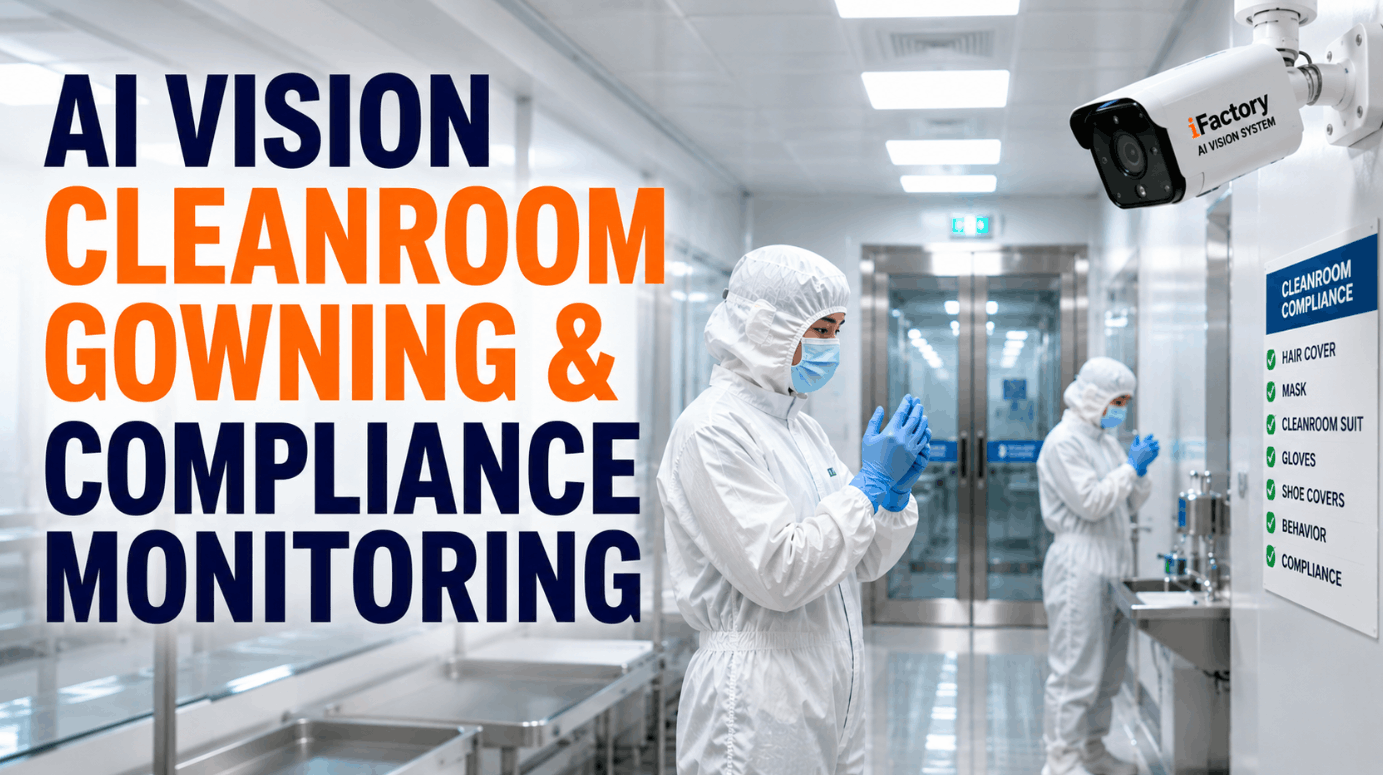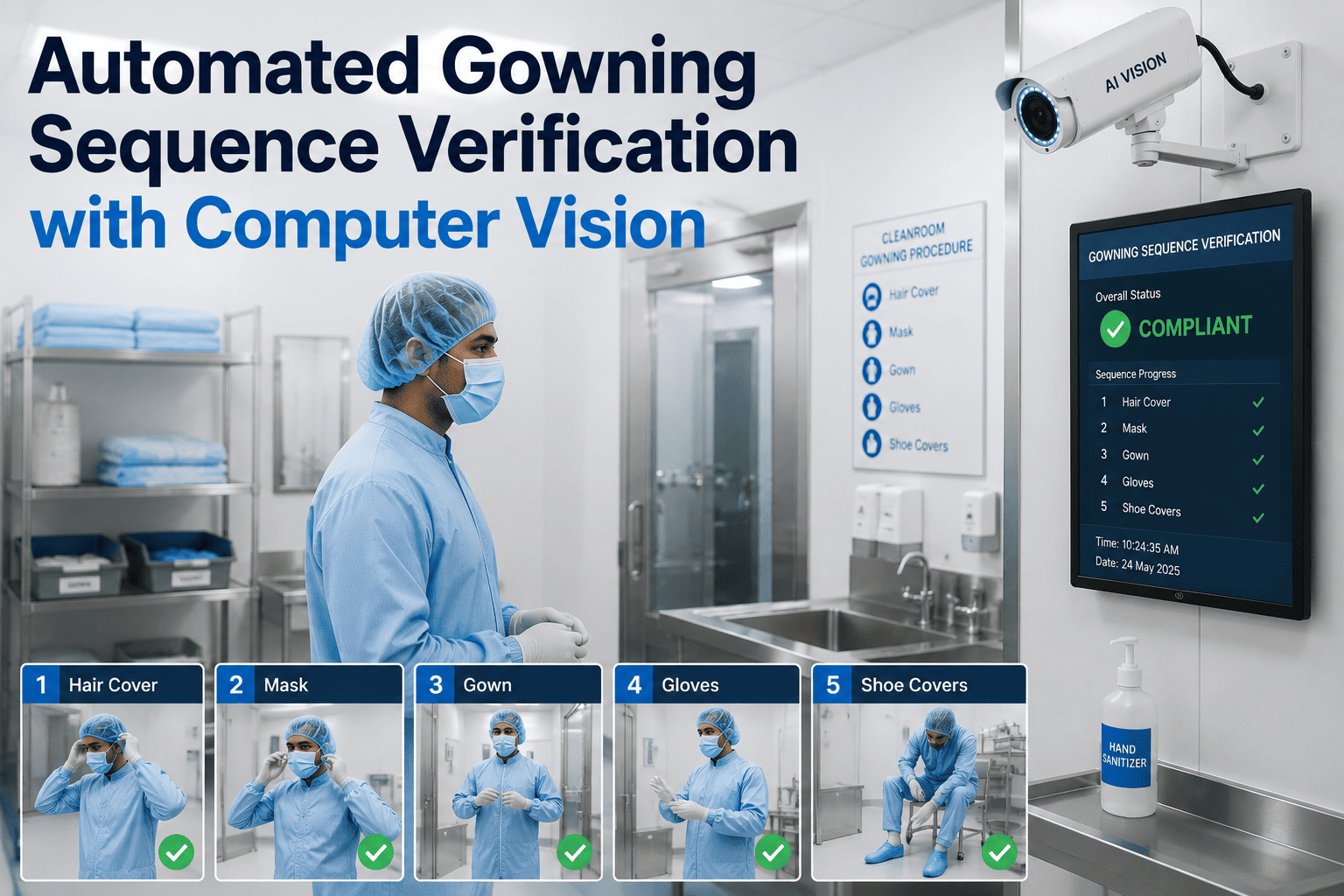
In pharmaceutical cleanrooms, the gowning sequence is a validated procedure where the order of donning matters as much as the garments themselves — putting on a coverall before the hood creates a contamination pathway at the collar that the individual garments cannot compensate for, and donning gloves before the sleeve seal is checked exposes bare wrist skin to the sterile barrier surface. Manual observation can verify that garments are present, but consistently tracking whether each garment was donned in the correct sequence, at the correct station, without a skipped step, across dozens of operators per shift, is beyond what any human observer can reliably deliver. Computer vision solves this by watching the sequence in order — each step must be detected and confirmed before the system advances to the next, and any skip, swap, or wrong-order event triggers an immediate alert before the operator reaches the cleanroom door. Quality teams building or upgrading gowning compliance systems can book a 30-minute demo to see iFactory's sequence verification mapped to their specific gowning SOP.
Automated Gowning Sequence Verification with Computer Vision
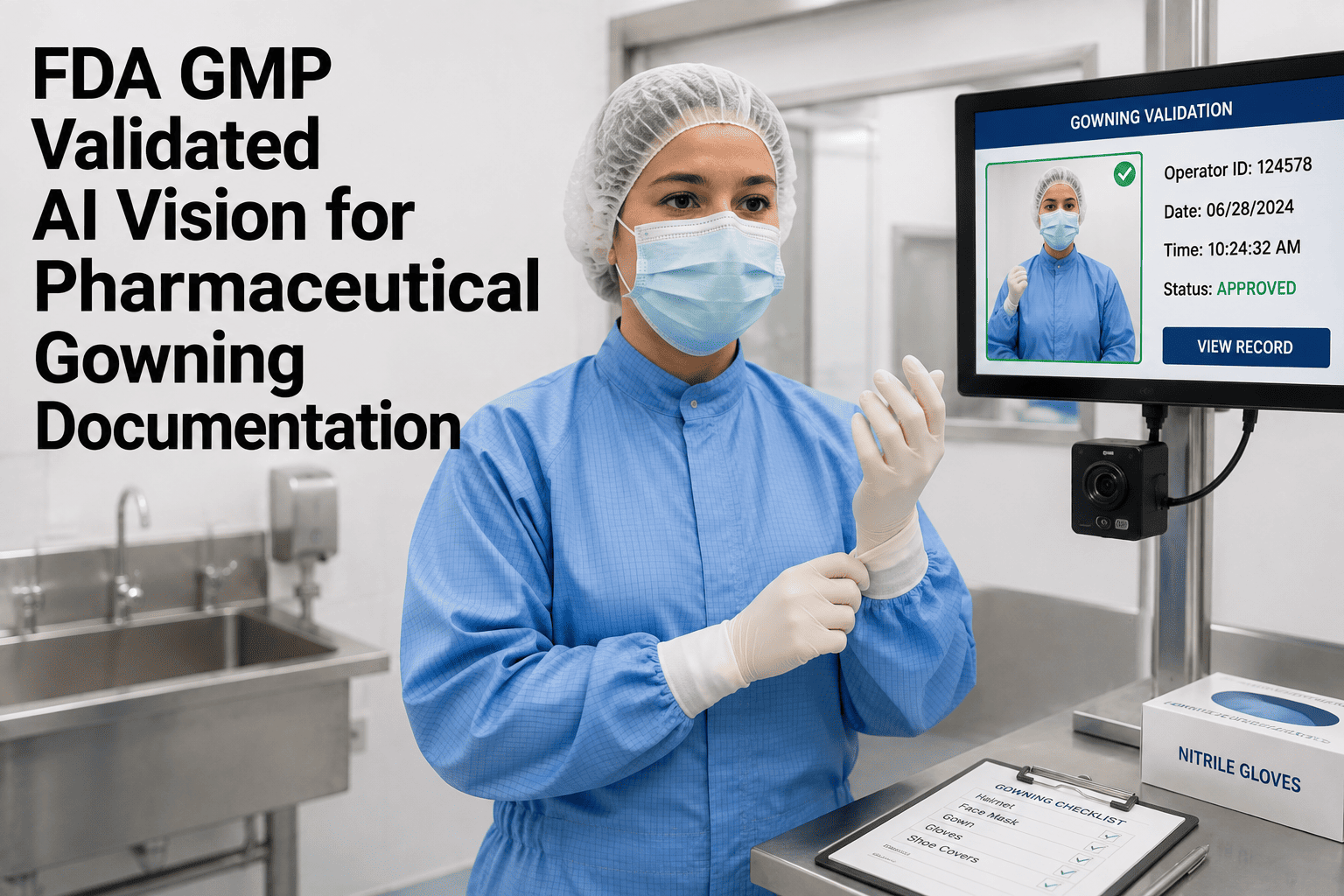
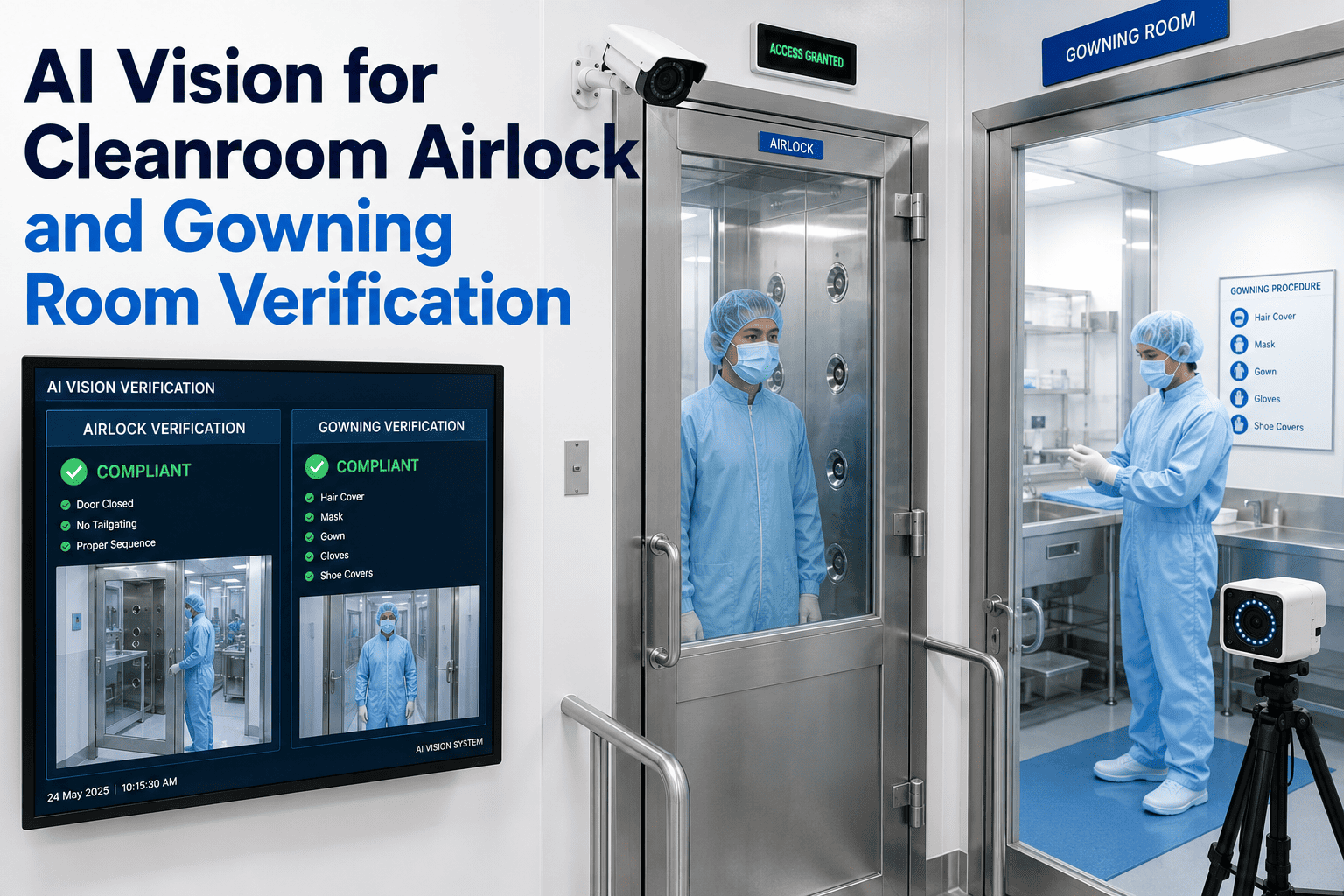
AI enforces the correct donning order step by step — sticky mat, shoe covers, hair cover, mask, coverall, hood, goggles, inner gloves, boot covers, outer gloves — flagging any skip, swap, or wrong-order event before the operator reaches the cleanroom.
Why Sequence Matters — Not Just Garment Presence
Most gowning verification approaches — manual checklists, mirror self-checks, post-gowning spot observations — confirm that garments are on. They do not confirm that garments were donned in the correct order. This distinction matters because the sequence itself is a contamination control, not just a convenience. Every step in the gowning sequence is positioned where it is because of how gravity, particle shedding, and garment contact interact during donning.
The gowning sequence follows a strict top-to-bottom order because particles shed from upper body surfaces — hair, scalp, face — fall downward under gravity. If the coverall is donned before the hood, scalp particles land directly on the sterile coverall shoulder during hood placement. The sequence prevents contamination from falling onto already-gowned surfaces.
Each layer must cover or overlap the layer beneath it — hood tucked under coverall collar, glove cuffs rolled over coverall sleeves, boot covers secured over coverall legs. If gloves are donned before the coverall, bare skin contacts the coverall sleeve exterior during donning, transferring skin cells directly to the sterile barrier surface.
Shoe covers go on before the coverall to prevent the coverall legs from dragging on the floor during donning. A coverall that touches the floor picks up particles from the gowning room surface — even a cleanroom-rated gowning room surface — and carries them directly into the classified production area. Sequence enforces the barrier between floor contamination and garment sterility.
The Correct Gowning Sequence — Step by Step with AI Verification
The sequence below represents a standard ISO 5 and Grade A/B gowning procedure. Each step includes the contamination-control reason the step sits at that position in the sequence, and the specific AI verification the computer vision system performs before advancing to the next step.
Step on Sticky Mat
Hand Sanitization
Shoe Covers
Hair Cover (Bouffant Cap)
Face Mask
Coverall
Hood
Goggles or Safety Glasses
Boot Covers
Sterile Outer Gloves
Common Sequence Errors AI Catches Before They Reach the Cleanroom
Sequence errors are among the most frequent gowning violations in pharmaceutical cleanrooms, and they are also the hardest for manual observers to catch because the end result — all garments visually present — looks correct even when the donning order was wrong. AI catches sequence errors because it watches the process, not just the outcome.
| Sequence Error | Why It Happens | Contamination Risk | AI Detection Method |
|---|---|---|---|
| Coverall before shoe covers | Operator rushes and reaches for the coverall bag first | Coverall legs drag on floor, picking up particles carried into the cleanroom | AI tracks garment detection timestamps — coverall detected before shoe covers triggers sequence error |
| Hood before coverall | Operator dons hood immediately after hair cover as a natural head-to-foot assumption | Hood cannot tuck under collar because coverall is not on yet — collar gap persists after coverall is donned over hood | AI verifies coverall collar is present before hood detection event is accepted as valid |
| Gloves before coverall | Operator puts on inner gloves early to avoid touching garments with bare hands | Glove exterior contacts coverall sleeve interior during donning, transferring hand bacteria to inner garment surface | AI requires coverall and sleeve verification before glove detection is registered |
| Goggles before hood | Operator puts goggles on immediately after mask as part of facial PPE grouping | Goggle strap sits under hood fabric instead of over it — removing goggles later pulls hood out of position | AI verifies hood presence before goggle detection is accepted in the sequence |
| Skipped sticky mat | Operator walks past the mat during high-traffic shift change | Gross floor contamination enters gowning area on shoe soles, contaminating the gowning room floor surface | AI detects operator entering gowning area without mat contact and blocks sequence initiation |
| Hand sanitization skipped | Operator forgets or assumes gloves will compensate | Transient microbial flora on hands transfers to every garment touched during donning | AI monitors sanitizer dispenser zone — no dispenser activation detected blocks sequence progression |
See sequence verification catch a wrong-order event in real time.
A 30-minute demo runs through correct and incorrect gowning sequences on live footage — showing exactly how AI detects skipped steps, wrong-order events, and sequence violations that look correct to the naked eye because all garments end up in place.
Configurable SOP Mapping — Your Sequence, Not a Generic Template
Gowning SOPs vary across facilities, cleanroom classifications, and product types. AI sequence verification is not a fixed ten-step template — it is a configurable rule engine that maps to each facility's documented gowning procedure exactly as written in the SOP, including steps that are specific to the site and not part of any generic industry standard.
Classification-Specific Sequences
An ISO 8 gowning SOP may require only six steps — shoe covers, hair cover, mask, frock, gloves, and self-check — while an ISO 5 or Grade A/B SOP requires the full ten-step sterile sequence with double-gloving, goggles, and boot covers. The AI system runs the correct sequence for each gowning room based on the cleanroom classification it gates, not a one-size-fits-all checklist.
Site-Specific Additions
Some facilities add steps not found in generic standards — a second hand sanitization after shoe covers, a beard cover step for operators with facial hair, a sterile sleeve step for arm-length operations, or a specific folding technique for garment removal from packaging. Any step the SOP documents can be added to the AI verification sequence as a required checkpoint.
Product-Specific Variations
A facility manufacturing both injectable sterile products and non-sterile oral solids may use different gowning sequences for different production areas on the same floor. AI supports multiple sequence profiles running simultaneously across different gowning rooms, each mapped to the product and classification of the cleanroom it serves.
Regulatory Framework Alignment
Whether the facility operates under FDA 21 CFR Part 211, EU GMP Annex 1, PIC/S guidelines, WHO GMP, or multiple frameworks simultaneously, the sequence verification rules can be configured to reflect the specific regulatory language governing gowning at that site. The compliance evidence the system generates references the applicable framework and clause.
From Detection to Retraining — The Feedback Loop
Sequence verification is not just a gate control — it generates a dataset that transforms how gowning training programs are designed, delivered, and evaluated. Instead of annual refresher sessions covering the entire gowning procedure for all operators, training becomes targeted at the specific sequence errors that actually occur, delivered to the specific operators who make them.
AI identifies a sequence error — coverall before shoe covers — for Operator A at 07:14 AM on Tuesday, logged with step-level timestamps and the specific sequence deviation.
Operator A receives an immediate alert at the gowning station identifying the out-of-order step. Entry is held until the operator removes the coverall, dons shoe covers, and re-dons the coverall in correct order. Corrected-and-passed status is logged.
Over 30 days, the system identifies that Operator A has made the same coverall-before-shoe-covers error four times, while Operators B through F have zero instances of this specific error. The pattern indicates an individual retraining need, not a systemic SOP clarity issue.
The training team delivers a focused session to Operator A covering the specific contamination risk of coverall floor contact, with the operator's own violation data as the training material. Post-training, the system tracks whether the error recurs — providing measurable retraining effectiveness evidence for the next audit.
Frequently Asked Questions
How does AI distinguish between a genuinely wrong sequence and a garment adjustment that looks like an out-of-order step?
The AI model is trained on thousands of real gowning events, including normal garment adjustments that occur during correct-order donning — pulling a coverall collar up, resettling a hood, adjusting a mask strap. The system tracks the primary donning event for each garment, not every hand-to-garment contact, so adjusting a hood that was correctly donned at Step 7 does not trigger a false sequence error at Step 4. During the deployment calibration phase, the system runs in observation mode to learn the facility's specific donning patterns and adjustment behaviors, tuning the detection thresholds so that only genuine out-of-order donning events are flagged. If a borderline detection does occur, the operator can acknowledge it at the station and the event is logged for model refinement. Book a demo to see how the system distinguishes primary donning events from adjustment movements in real gowning footage.
Can the system enforce different gowning sequences for different cleanroom classifications within the same facility?
Yes — each gowning room is configured with its own sequence profile that matches the cleanroom classification it gates. A gowning room leading to an ISO 8 area may run a six-step verification sequence (shoe covers, hair cover, mask, frock, gloves, self-check), while a gowning room leading to an ISO 5 or Grade A zone runs the full ten-step sterile sequence including hood, goggles, boot covers, and double-gloving. Sequence profiles are managed independently, so adding or removing a step in one profile does not affect any other gowning room. Facilities that use the same physical gowning room for different production areas can even switch between profiles based on which cleanroom door the operator is heading toward, using the badge-in destination to select the applicable sequence automatically. Contact iFactory Support for details on multi-profile configuration within a single gowning room.
How does sequence verification data support FDA and EU GMP audit readiness?
FDA inspectors and EU GMP competent authorities do not just ask whether gowning happened — they ask for evidence that gowning was performed correctly, consistently, and in accordance with the facility's documented SOP. Sequence verification data provides exactly this evidence: a timestamped, operator-identified record showing that each garment was donned in the documented order, with pass or fail status at each step. When an auditor asks for gowning records on a specific production date for a specific batch, the quality team retrieves the full sequence verification log for every operator who entered the cleanroom during that production window. The data also demonstrates training effectiveness — if the auditor asks how the facility verifies that retraining corrected a specific gowning error, the trend data shows the error rate before and after the training intervention. Book a demo to review the audit-ready report formats the system generates.
What is the typical deployment timeline for sequence verification in a pharmaceutical cleanroom?
A typical deployment covers four phases over six to eight weeks. Week one involves a site assessment where iFactory's deployment team maps the facility's gowning SOP to the AI sequence logic, determines camera placement for each checkpoint, and identifies integration points with existing access control and interlock systems. Weeks two and three cover hardware installation — cameras, edge processing unit, and network cabling — typically completed without production shutdown. Weeks three through five are the calibration period, where the system runs in observation mode against live gowning events, tuning detection models to the facility's specific garments, lighting conditions, and operator behaviors. Weeks six through eight are the validation phase, completing IQ, OQ, and PQ documentation for GMP compliance. After validation, the system transitions to live enforcement mode with real-time alerting and door-hold integration active. Contact Support to schedule a site assessment and receive a deployment timeline specific to your facility layout and regulatory requirements.
Does the system work with both disposable and reusable cleanroom garments?
Yes — the AI detection models are trained on both disposable (single-use polypropylene, Tyvek) and reusable (polyester, laundered cleanroom garments) gowning systems. The visual characteristics of these garment types differ — disposable garments are typically white and smooth-textured, while reusable garments may carry color-coding, seam patterns, or laundering wear marks — and the AI model accounts for these differences in its garment detection logic. Facilities that use a mix of disposable and reusable garments within the same gowning sequence (for example, disposable bouffant caps and masks with reusable coveralls and boots) are fully supported, as the system identifies each garment type independently. If a facility changes garment suppliers or switches between disposable and reusable systems, the detection model is updated during a brief recalibration period. Book a demo to see garment detection running on both disposable and reusable cleanroom garment types.
Gowning compliance is not just wearing the right garments — it is wearing them in the right order. AI enforces both.
iFactory's computer vision platform verifies the donning sequence step by step, mapped to your exact SOP, catching skips, swaps, and wrong-order events that look correct to the naked eye. A 30-minute demo maps your documented gowning procedure to AI sequence verification and shows sequence error detection running on live footage.