Cleanroom door interlocks prevent both airlock doors from opening simultaneously, and that mechanical safeguard has protected pressure cascades for decades — but interlocks only verify that doors are closed, not that the person standing between them is correctly gowned. An operator can badge through the outer door, walk past the gowning station with an exposed hairline or a mask below the nose, and reach the inner door without any system verifying garment compliance before the interlock releases. AI vision cameras close that gap by verifying gowning completion at every transition point inside the airlock and gowning room sequence, holding the inner door locked until every garment passes visual verification, and logging the entire event with operator ID and timestamp for GMP documentation. Facilities designing or upgrading cleanroom access control systems can book a 30-minute demo to see how iFactory integrates AI gowning verification into airlock interlock logic.
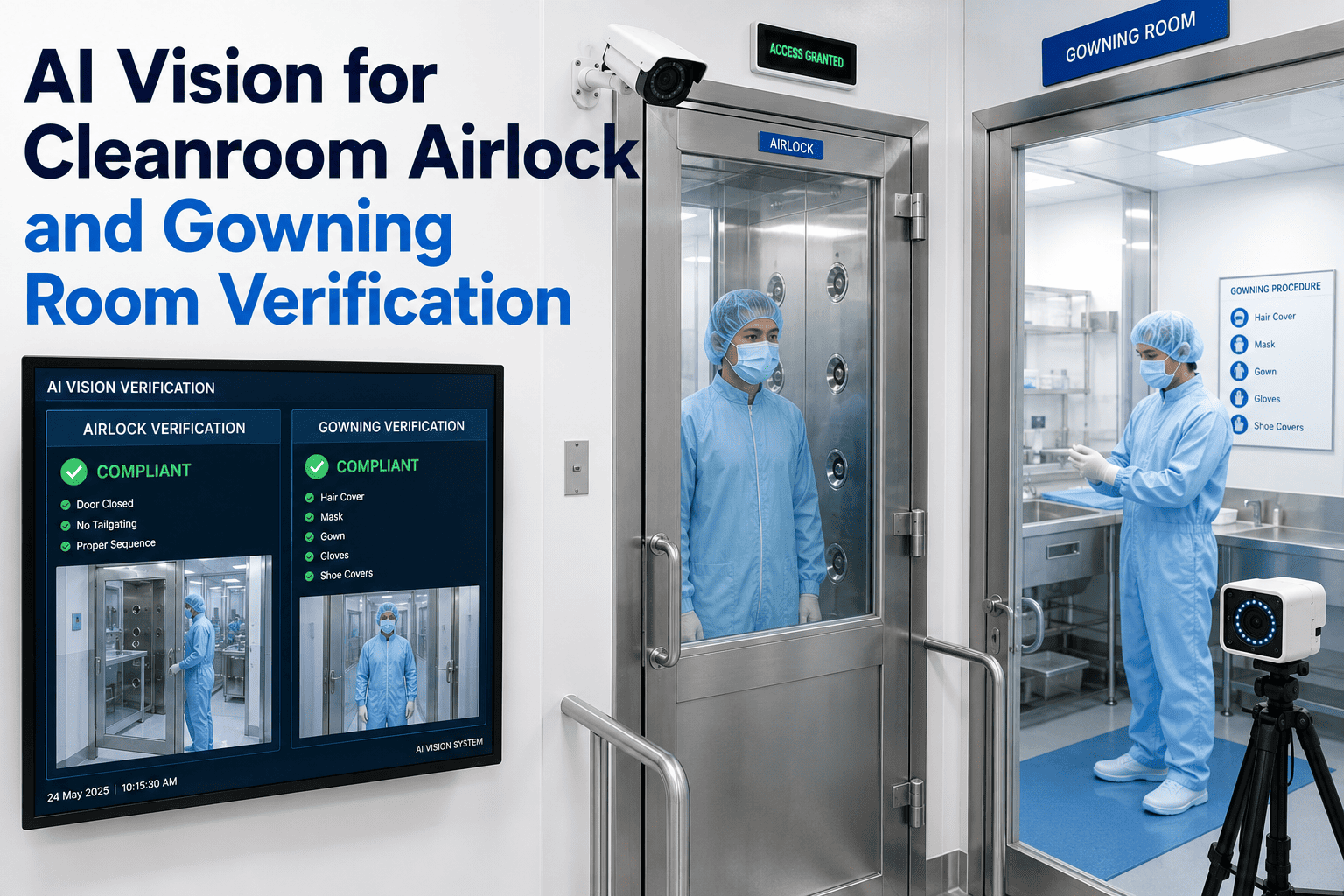
AI Vision for Cleanroom Airlock and Gowning Room Verification
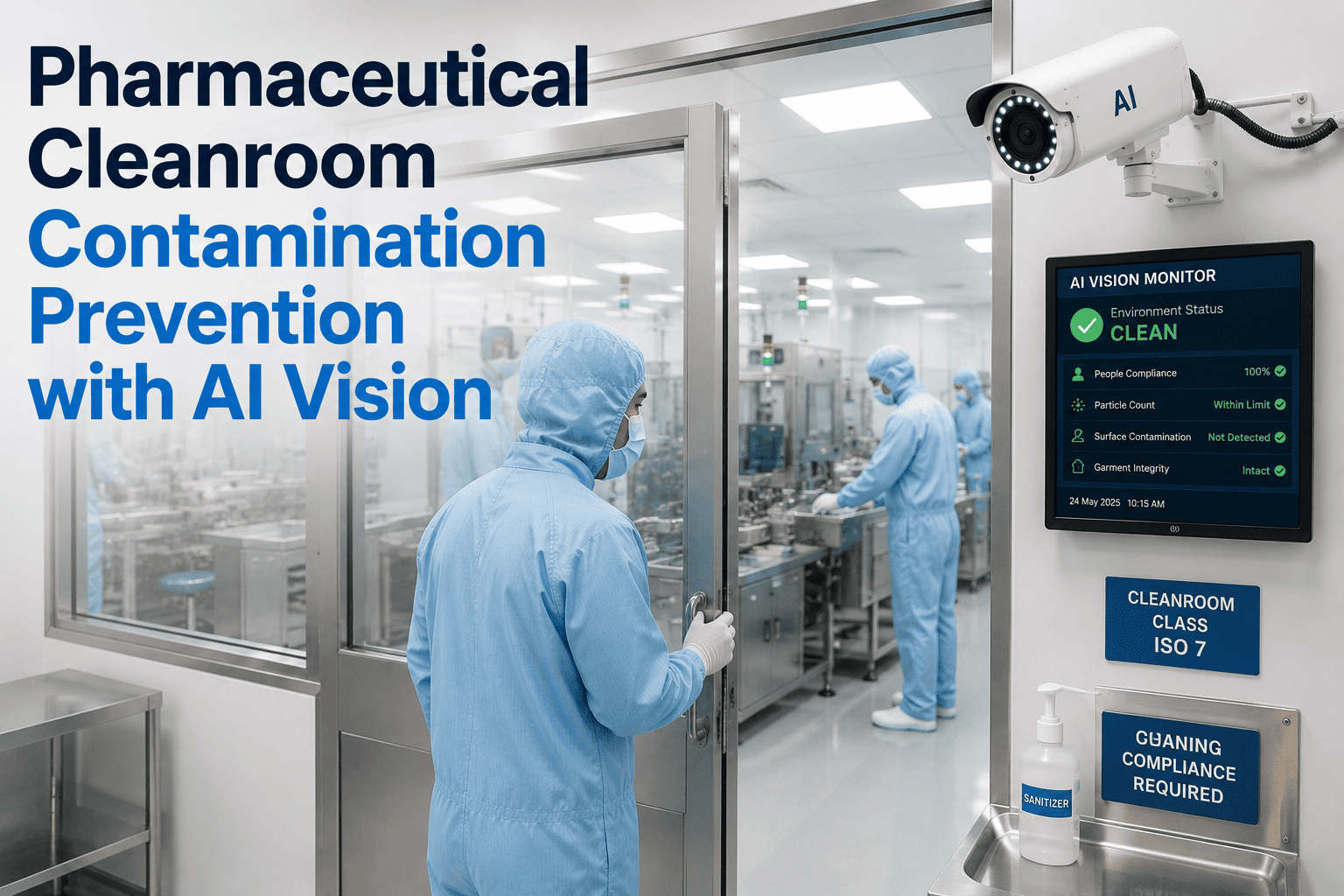
Camera-based gowning verification integrated into airlock interlock logic — inner doors stay locked until AI confirms every garment is correctly donned, creating a contamination barrier that checks the person, not just the door.
The Gap Traditional Interlocks Leave Open
Every pharmaceutical cleanroom uses door interlocks as a baseline contamination control — they prevent both airlock doors from opening at the same time, maintaining pressure differentials that keep unfiltered air out of classified zones. But interlocks solve only the mechanical problem. The personnel problem — whether the operator between those doors is properly gowned — remains entirely unverified by any automated system in the vast majority of facilities operating today.
Zone-by-Zone — Where AI Cameras Sit in the Airlock Sequence
The airlock and gowning room sequence in a pharmaceutical cleanroom is a series of controlled transitions from unclassified corridor space through increasingly cleaner zones until the operator reaches the production floor. AI cameras are positioned at specific transition points within this sequence — not as general surveillance, but as verification gates that each serve a defined compliance function.
Corridor / Entry
Operator badges at the outer airlock door. Access control authenticates the credential. AI camera captures operator ID and confirms the person entering matches the badge used — preventing tailgating and unauthorized entry into the gowning sequence.
Pre-Gown Station
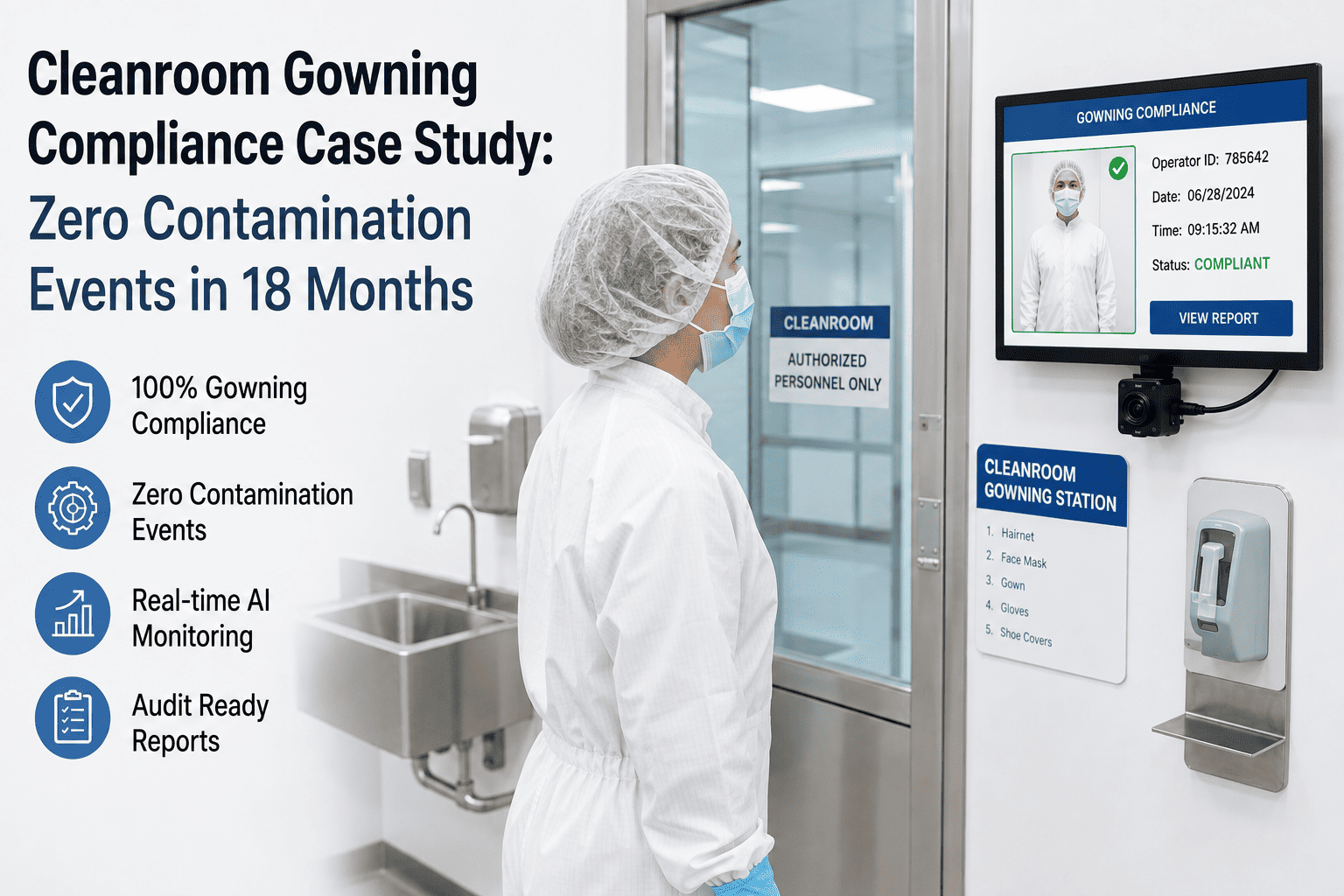
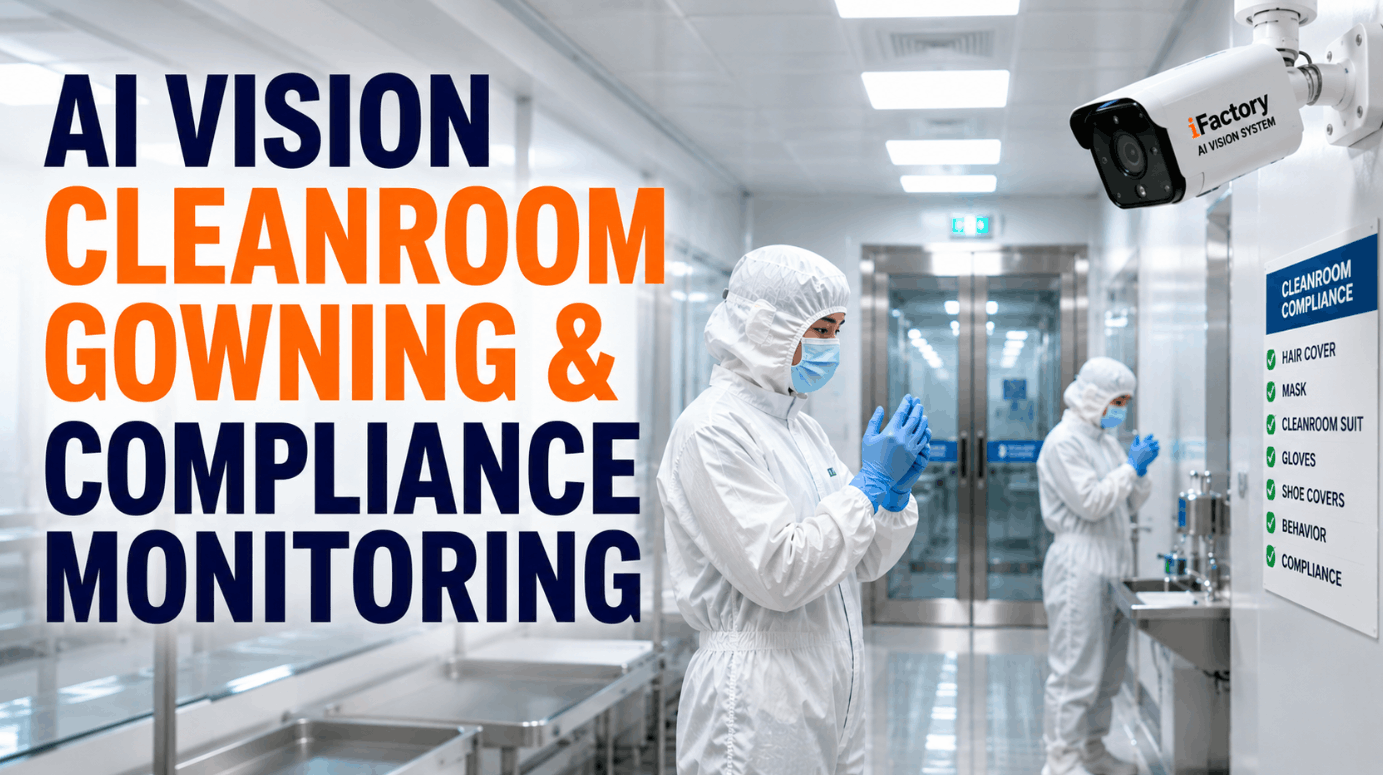
Camera verifies hand sanitization, shoe cover placement, and hair cover enclosure. The operator moves to the gowning bench where a second camera confirms coverall donning, hood placement and collar seal, face mask fit, and goggle position. Each garment verification is logged individually.
Final Verification Gate
Before the inner door interlock releases, a camera performs a full-body composite verification — all garments confirmed present, all seals intact, glove cuffs overlapping sleeves, boot covers secured at the calf. This is the last automated checkpoint. If any garment fails, the inner door stays locked and the operator sees exactly which item needs correction.
Cleanroom Floor
Only operators who pass every verification checkpoint reach the production area. The compliance record — operator ID, timestamp, zone transitions, garment-by-garment pass status — is already logged before the first step onto the classified floor.
How AI Integrates with Existing Interlock and BMS Systems
AI gowning verification does not replace existing door interlock hardware, building management systems, or access control infrastructure — it adds a verification layer on top of them. The integration architecture is designed so that the AI acts as an additional input to the interlock release logic, not as a replacement for the mechanical and pressure-based controls already in place.
Access Control System
The AI platform receives badge authentication events from the existing access control system via standard protocols. This links operator identity to every gowning verification event — the system knows who is gowning, not just that someone is gowning. If the access control system uses RFID, biometric, or PIN authentication, the AI platform integrates with any of these credential types without requiring hardware replacement.
Door Interlock Controller
The AI verification result feeds into the door interlock controller as a binary signal — gowning passed or gowning not passed. The interlock release logic adds AI verification as a required condition alongside the existing door-closed sensor and pressure-differential check. The inner door releases only when all three conditions are simultaneously satisfied: outer door sealed, pressure cascade confirmed, and AI gowning verification passed.
Building Management System
Gowning compliance events are logged to the facility's BMS or environmental monitoring platform alongside pressure, temperature, humidity, and particle count data. This means gowning compliance is time-correlated with environmental conditions — when an environmental monitoring excursion occurs, the quality team can immediately verify whether gowning compliance was maintained during the same time window.
Quality Management System
Violation events, trend data, and operator compliance histories export directly into the facility's QMS through API integration. When a gowning deviation triggers a CAPA, the investigation starts with objective data — which operator, which garment, which checkpoint, what time — rather than relying on interviews and paper logbooks that reconstruct events from memory.
Map AI verification into your existing interlock and access control architecture.
A 30-minute demo walks through the integration points between AI gowning verification, your door interlock controller, access control system, and BMS — with a signal-level diagram showing exactly how AI adds to the interlock release logic without replacing existing hardware.
What Happens When the Airlock Fails to Verify — Real Scenarios
The value of AI-integrated airlock verification becomes concrete when you walk through the specific failure scenarios it prevents — each of these situations has occurred in real pharmaceutical facilities, and each has resulted in contamination events, batch losses, or regulatory citations.
Tailgating Through the Outer Door
A second person follows the badge holder through the outer door before it closes. The interlock does not detect the additional person. Both enter the gowning room, but only one was authenticated. The unauthorized person may skip gowning steps entirely with no record of their presence.
The AI camera at the outer door detects two people entering on a single badge event. The system flags the tailgating event, locks the inner door, and logs the incident with timestamp and visual evidence. The second person must badge in separately before any further transition is allowed.
Incomplete Gowning at Shift Change
During a busy shift change, operators rush through gowning. One operator's hood sits above the coverall collar, exposing the hairline. The manual observer is monitoring three other operators simultaneously and does not catch the gap. The operator enters the cleanroom with a compromised barrier at the neck.
The AI camera at the final airlock checkpoint detects the hood-collar gap during the full-body composite scan. The inner door stays locked. The operator sees a display indicating the specific issue — hood not sealed at collar — corrects the garment, and re-scans. Entry is permitted only after the gap is closed and verified.
Mask Slip During Airlock Transit
An operator correctly dons all garments at the gowning bench, but while walking through the airlock to the inner door, the face mask slips below the nose bridge. No system detects this because the gowning observation happened earlier at the bench. The operator enters the cleanroom with an unsealed mask.
The final airlock camera re-verifies every garment at the inner door — including the mask. The mask slip is detected at the point of entry. The inner door holds. The operator adjusts the mask, the system re-scans and confirms the seal, and entry proceeds. The slip event is logged even though it was corrected, providing data for retraining if the operator's mask slips frequently.
Pressure Cascade Protection — The Airlock Behavior Problem
Airlocks maintain pressure cascades of 10 to 15 Pascals between adjacent zones, and research confirms that when an airlock door opens, the differential pressure disappears immediately and contaminated air can migrate into the cleanroom within seconds. AI vision adds a behavioral control layer that reduces the frequency and duration of pressure cascade disruptions caused by personnel behavior.
Doors Held Open
Operators propping airlock doors open — even briefly, to pass materials to a colleague — collapses the pressure cascade and allows unfiltered air to flow directly into the classified zone. AI detects doors held open beyond the configured time threshold and triggers an immediate alert to both the operator and the BMS, with the event logged for trending.
Simultaneous Door Operation
Mechanical interlocks prevent both doors from opening at the same time, but interlock bypass events — whether intentional or due to hardware malfunction — do occur. AI provides an independent verification layer that detects both-doors-open conditions even when the interlock controller fails to prevent them, creating a redundant safeguard for the most critical pressure cascade failure mode.
Excessive Dwell Time
Operators lingering in the airlock — stopping to check a phone, adjusting garments extensively, or waiting for a colleague — extend the door-open-to-door-closed cycle time, which increases the volume of air exchanged between zones during each transition. AI monitors dwell time per operator per transition and flags extended cycles that exceed the facility's contamination control threshold.
Reverse Traffic Flow
When operators exit through entry airlocks or re-enter after stepping out without re-gowning, the pressure cascade is stressed and contaminated garments may re-enter classified space. AI detects directional violations — personnel moving against the defined flow — and blocks the inner door until the correct sequence is followed from the beginning.
Frequently Asked Questions
Does AI airlock verification slow down personnel throughput during shift changes?
The AI verification scan at the final airlock checkpoint takes under two seconds per operator — the camera captures a composite image and the edge processing unit returns a pass or fail result in real time. For operators who are correctly gowned, the verification adds no perceptible delay because the scan completes while the interlock is cycling through its normal door-close and pressure-equalization sequence. Delays only occur when the system detects an actual gowning failure — and in those cases, the delay is preventing a contamination event, not creating a throughput problem. Facilities processing large shift changes of 20 or more operators have found that the AI verification step fits within the existing interlock cycle time without extending the overall changeover window. Book a demo to see the verification timing against a simulated shift-change scenario.
Can the system differentiate between gowning requirements for different cleanroom classifications?
Yes — the verification profile is configurable per airlock and per target cleanroom classification. An airlock leading to an ISO 8 area may require only coverall, hair cover, shoe covers, and gloves, while an airlock leading to an ISO 5 or Grade A/B area requires the full gowning sequence including hood, goggles, double-gloving, and sterile boot covers. Each airlock's camera is configured with the garment checklist that matches the classification of the cleanroom it gates. If a facility has multiple airlock paths leading to different classification zones, each path runs its own verification profile independently. This means the system enforces the correct gowning standard for each zone without requiring operators to remember which garments apply where — the AI enforces it at the door. Contact iFactory Support for details on multi-zone verification configuration.
What happens during a power failure or system outage — do operators get locked inside the airlock?
The AI verification system is designed with a fail-safe architecture that follows the same safety principles as the existing door interlock. During a power failure, doors default to their facility-configured fail-safe state — typically fail-unlock for personnel safety, following fire code and egress requirements. The AI system logs the outage event, marks the time window as unverified, and resumes verification as soon as power is restored. If the edge processing unit loses connectivity but power remains, the system can operate in degraded mode using local detection models cached on the edge unit. In all scenarios, personnel safety takes absolute priority over contamination control — the system is never configured to lock operators inside an airlock under any failure condition. Book a demo to review the fail-safe architecture and disaster recovery procedures in detail.
How does AI airlock verification address EU GMP Annex 1 airlock requirements?
The 2022 revision of EU GMP Annex 1 places significant emphasis on airlock design, personnel flow control, and the prevention of contamination during zone transitions. Annex 1 requires that airlocks be designed to prevent simultaneous opening of doors, that personnel follow documented gowning procedures before entering classified areas, and that the site's Contamination Control Strategy address personnel practices at every transition point. AI verification directly supports all three requirements by enforcing gowning compliance at the airlock level — not relying on human observation alone — and generating the continuous compliance evidence trail that competent authorities expect during GMP inspections. The system's integration with door interlocks also provides documented proof that the airlock's contamination barrier function extends beyond pressure control to include personnel verification. Contact Support to review how AI airlock verification maps to specific Annex 1 clauses in the personnel and premises sections.
Can AI verification be retrofitted to existing airlocks without replacing the door interlock hardware?
Yes — the AI verification system is designed as an add-on layer, not a replacement for existing interlock hardware. The cameras mount to the airlock ceiling or walls using cleanroom-rated housings that do not affect pressure differentials or room classification. The AI output feeds into the existing interlock controller as an additional input signal — the same way a badge reader or pressure sensor provides input to the interlock logic. No existing interlock wiring, sensors, or controllers need to be replaced. The most common retrofit involves adding two to three cameras per airlock, running sealed cabling to the edge processing unit mounted outside the classified area, and configuring the interlock controller to require the AI pass signal before releasing the inner door. Typical retrofit installation takes one to two days per airlock without production shutdown. Book a demo to receive a retrofit assessment for your specific airlock hardware and interlock controller model.
Your interlock checks the door. AI checks the person. Together, they check everything.
iFactory's AI vision platform integrates gowning verification directly into airlock interlock logic — inner doors stay locked until every garment passes visual verification, creating a contamination barrier that protects both pressure cascades and personnel compliance. A 30-minute demo maps AI verification into your specific airlock layout and interlock architecture.