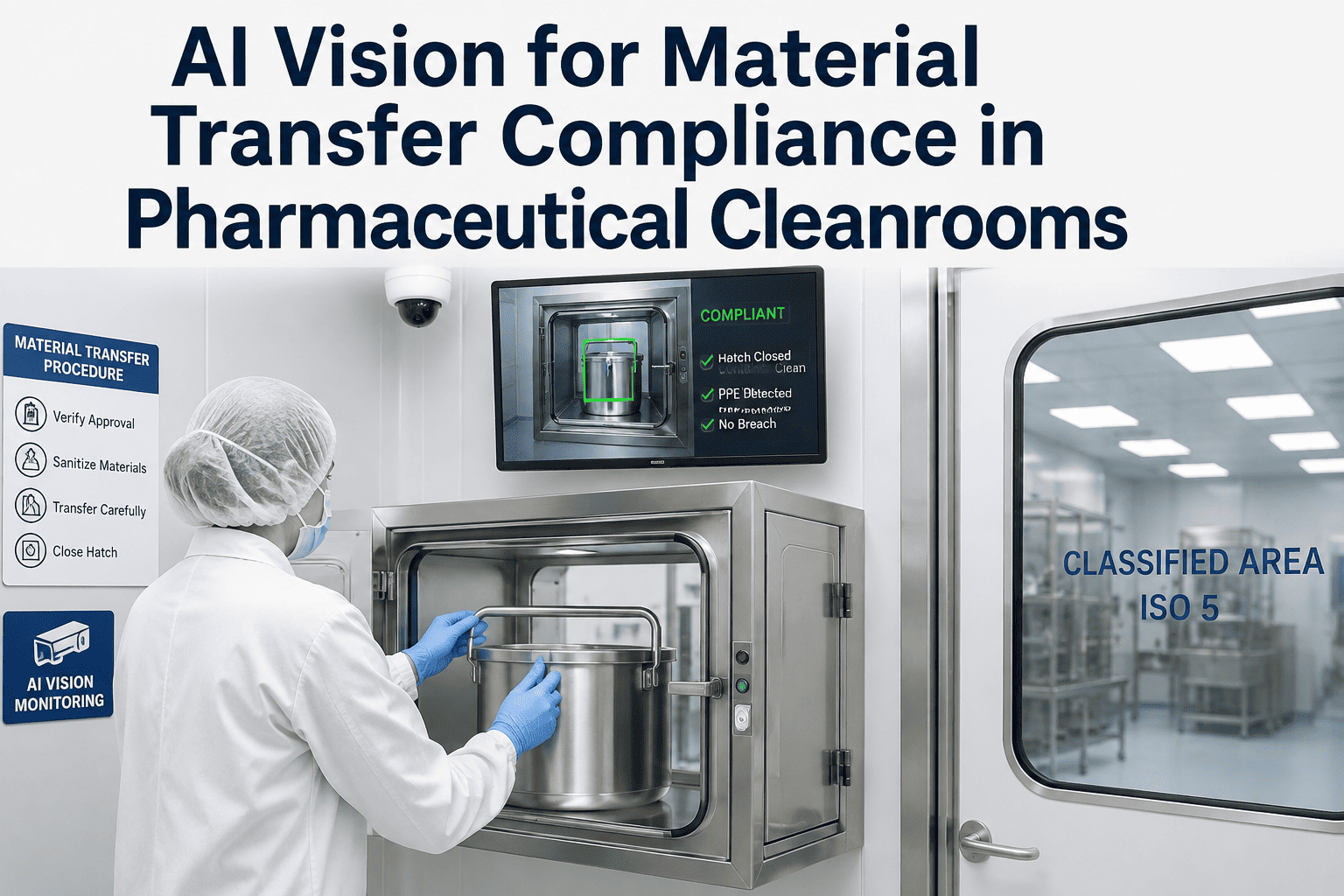
A carton of stoppers arrives at the Grade C side of a material airlock. The operator wipes it down, places it inside the pass-through hatch, closes the door, and initiates the decontamination cycle. Somewhere in that sequence — the wipe pattern, the contact time, the sporicide coverage, the interlock discipline — sits the single most-cited contamination pathway in modern sterile manufacturing, and it sits there almost entirely unwatched between validation studies. See how iFactory's AI vision layer monitors every pass-through hatch, material airlock, and transfer trolley sequence in real time so that decontamination compliance is verified continuously, not sampled quarterly.
AI Vision for Material Transfer Compliance in Pharmaceutical Cleanrooms
Continuous vision-based monitoring of pass-through hatches, material airlocks, and transfer trolley procedures — verifying that every material entering a classified area was actually decontaminated according to the SOP, not just recorded as decontaminated.
Why Material Transfer Remains the Most-Cited Contamination Pathway
Under the revised EU GMP Annex 1, the transfer of equipment and materials into and out of cleanrooms and critical zones is formally recognized as one of the greatest potential sources of contamination. Regulators expect airlocks and pass-through hatches to be designed and operated to provide physical separation and to minimize microbial and particulate contamination between grades. Yet the actual moment of transfer — the wipe-down, the sporicide contact time, the hatch closure, the interlock cycle — depends almost entirely on operator behavior that is validated once, then trusted for months.
The result is a structural gap between what the SOP says happens and what actually happens on the floor at 2:47 a.m. on a Sunday shift. Manual observation catches perhaps a percent of transfers. Batch record review catches documentation errors, not procedural ones. Environmental monitoring catches the contamination after it has already entered the classified area. AI vision closes the gap by watching every transfer, every shift, against the SOP the site has already validated.
Where Material Actually Crosses a Classification Boundary
Materials arrive from warehouse or ancillary areas. Outer packaging is removed, primary surfaces are wiped, and items are staged for transfer. AI vision confirms that outer packaging was actually removed, that the correct sporicide was used, and that wipe coverage reached every declared surface before the item touched the hatch.
Items sit inside the hatch or MAL for the validated contact time under localized HEPA airflow, VHP exposure, or UV-C dose depending on the design. AI vision confirms both doors were not opened simultaneously, the contact time was met in full, and no items were added or removed mid-cycle to break the interlock discipline.
Materials cross into the classified area only after the cycle completes and the clean-side door is opened. AI vision timestamps the entry, links it to the operator, batch, and material, and flags any transfer that skipped a step or shortened a cycle so it can be investigated before it appears in an environmental monitoring excursion.
Six Procedural Failures That Slip Past Manual Oversight
Both hatch doors opened within seconds of each other under time pressure, breaking the airflow cascade and pushing lower-grade air directly into the classified area during the transfer window.
Sporicide contact time or VHP cycle ended early because the operator opened the clean-side door as soon as the visible cycle indicator changed, without verifying full dwell against the validated recipe.
Wipe pattern missed the underside, corners, or seams of a carton, leaving untreated surfaces to enter the airlock and reducing the effective decontamination coverage below the validated threshold.
An item not on the approved material list was transferred without pre-approval because it was small, urgent, or piggybacked onto an approved transfer — the exact scenario Annex 1 explicitly names as a contamination risk.
The dirty-side door was reopened mid-cycle to add a forgotten item, resetting the effective contact time to zero without any corresponding update to the batch record or transfer log.
Transfer trolley wheels crossed the classification boundary without the required wheel wipe or dedicated clean-side trolley swap, carrying lower-grade particulate directly into the classified corridor.
Move From Sampled Verification to Continuous Compliance
iFactory's AI vision layer monitors every pass-through hatch, MAL, and transfer trolley procedure against your validated SOP — surfacing procedural drift before it becomes an environmental monitoring excursion.
Eight Checkpoints Verified Automatically on Every Transfer
Item is visually identified and cross-checked against the approved material list for the destination grade. Unapproved items generate an immediate alert before the hatch is even opened.
Vision confirms secondary packaging was actually removed on the dirty side, not carried into the airlock still shrink-wrapped or in its shipping carton.
The correct disinfectant is dispensed and applied. Wipe coverage is monitored against a validated pattern so missed surfaces are flagged before the item enters the hatch.
The dirty-side door is confirmed fully closed and latched before the decontamination cycle timer begins, preventing partial closures that quietly leak the pressure cascade.
Full validated contact time is enforced — VHP exposure, UV-C dose, or sporicide dwell — and any early door opening or interruption is logged with the exact remaining time cut short.
Simultaneous opening of both doors, or clean-side opening before cycle completion, is caught in the moment rather than reconstructed later from door sensor logs alone.
The classified-side operator retrieves the item using compliant gowning and handling technique, with the retrieval linked to the batch, material, and destination room in one continuous record.
A complete audit-ready record is generated automatically — item, operator, cycle parameters, timestamps, deviations — replacing paper transfer logs that inspectors know are filled out retrospectively.
Three Detection Layers Working Together in Real Time
Cameras positioned at each transfer point recognize the specific objects being moved — cartons, IBCs, trolleys, tools, waste bins — and the specific actions being performed on them, such as wiping, spraying, placing, closing, and retrieving. This layer produces the raw stream of what is happening at every hatch in the facility.
The recognized actions are checked against the site's validated transfer SOP for that specific hatch, grade transition, and material class. The model knows which actions must happen, in what order, for what duration, and with what tools — and flags any deviation in real time rather than at end-of-shift.
Every transfer generates a structured, timestamped record linked to operator, batch, material, and destination room. The ledger is queryable during inspections, supports investigations without pulling video manually, and gives quality assurance a continuous view of transfer compliance rather than a periodic snapshot.
Where This Maps to the Guidance You Already Follow
| Regulatory Expectation | What AI Vision Contributes |
|---|---|
| Annex 1 §4.10 — Transfer as contamination source | Continuous monitoring of every transfer event, not periodic behavioral audits, at the exact point identified as highest risk. |
| Annex 1 §4.13 — Validated transfer into Grade A | Enforcement of the validated cycle in real time, preventing the shortcut behaviors that quietly degrade validated processes between requalifications. |
| Approved material list discipline | Automatic identification of items being transferred and cross-check against the site's approved list before the hatch opens. |
| Interlock and pressure cascade integrity | Detection of simultaneous door openings and early cycle terminations in the moment they happen, not after downstream monitoring detects consequences. |
| Contamination Control Strategy (CCS) documentation | A continuous, structured evidence base of transfer compliance that plugs directly into the CCS narrative inspectors now expect to see supported by data. |
| Data integrity and ALCOA+ principles | Automatically generated transfer records with attributable, contemporaneous, and original evidence, replacing manually completed transfer logs. |
The Operational Difference Between Sampled and Continuous
When an EM excursion or a sterility failure investigation begins, the transfer ledger is already there — searchable by room, time, material, and operator — so investigators reach root cause without spending weeks reconstructing behavior from door logs and paper transfer sheets.
A missed wipe or shortened cycle can be flagged to the shift supervisor while the operator is still at the hatch, turning corrective action into an in-the-moment conversation rather than a retrospective CAPA weeks after the behavior became habitual.
When an inspector asks how transfer compliance is monitored, the answer is a queryable record of every transfer for the requested period rather than a stack of paper logs and a promise to pull the corresponding camera footage manually.
Validation and requalification effort shifts from repeatedly re-observing the same routine transfers to focusing on the specific transfer types, materials, or shifts where the vision layer has surfaced actual procedural drift.
What Bringing AI Vision Into an Existing Cleanroom Actually Looks Like
The most common concern from quality and engineering teams is that adding vision-based monitoring will require modifying the classified environment itself. In practice, it does not. Cameras are external, low-profile, and positioned to view transfer points through existing viewing panels or from adjacent non-classified corridors wherever possible, so the classified airflow, gowning, and cleaning regimes are unaffected. Where cameras must sit inside a classified area, they are specified in materials and surface finishes compatible with the site's existing sanitization protocols so they can be wiped down with the same agents used on the rest of the room.
The SOP layer is configured against the site's existing validated transfer procedures rather than requiring the site to adopt a generic template — because every facility's approved material list, grade transitions, and cycle parameters are different, and a monitoring layer that ignores those differences would generate constant false positives. Integration with existing SCADA, BMS, and EBR systems is handled through standard interfaces so the vision layer supplements the existing quality architecture rather than replacing pieces of it.
Frequently Asked Questions
Turn Every Material Transfer Into a Documented, Compliant Event
iFactory's AI vision layer verifies decontamination and interlock compliance on every pass-through hatch, airlock, and transfer trolley — continuously, automatically, and inspection-ready from day one.