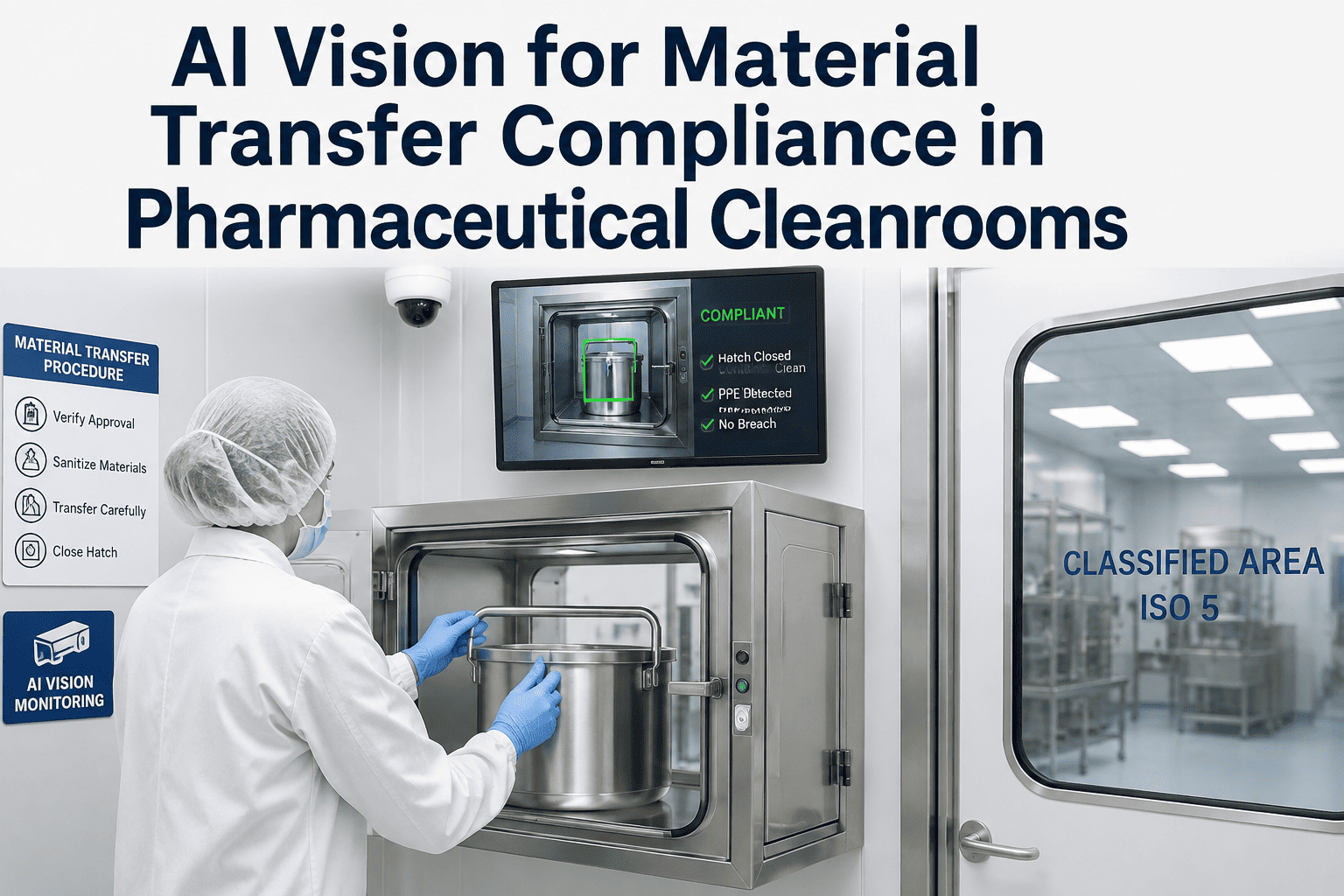
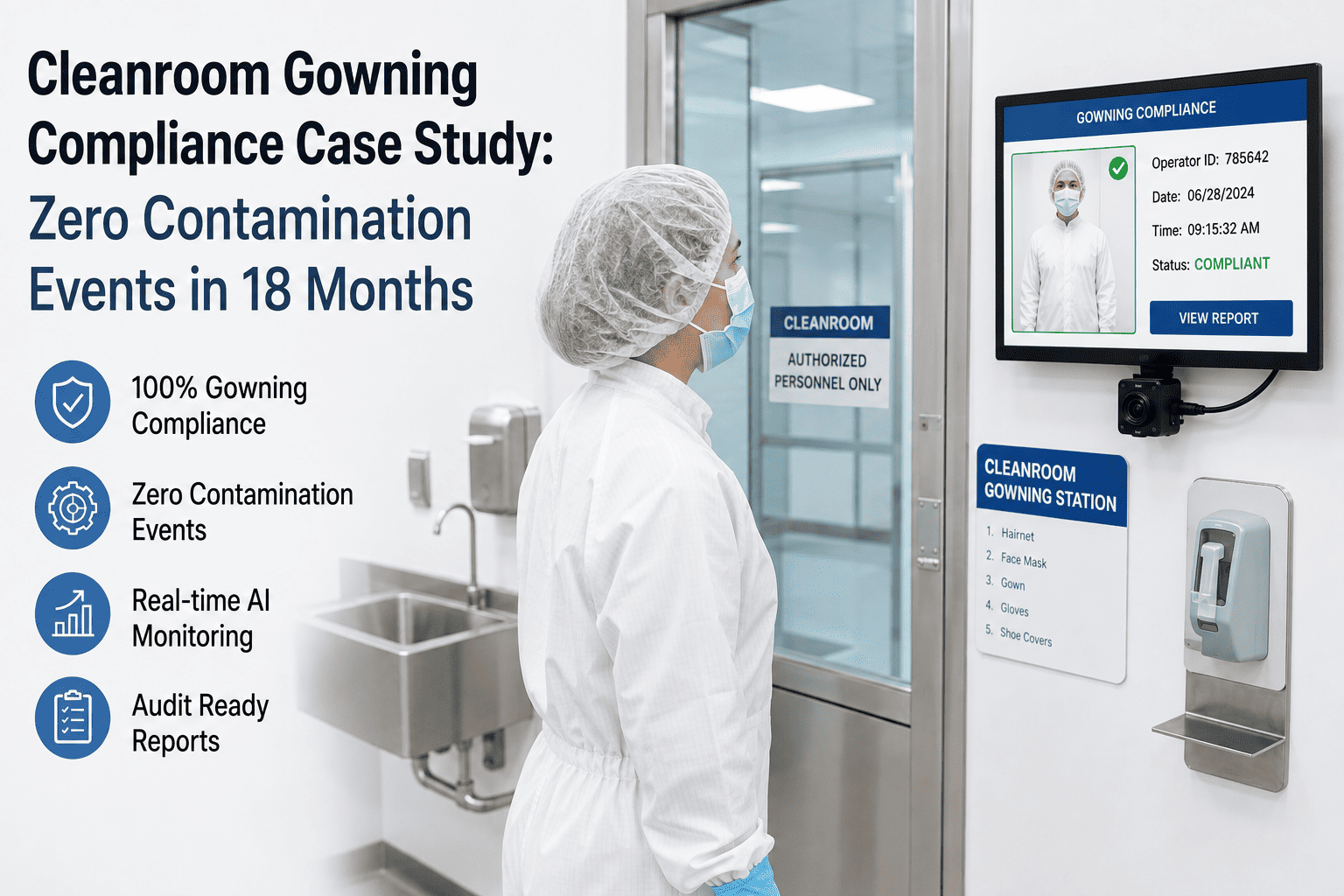
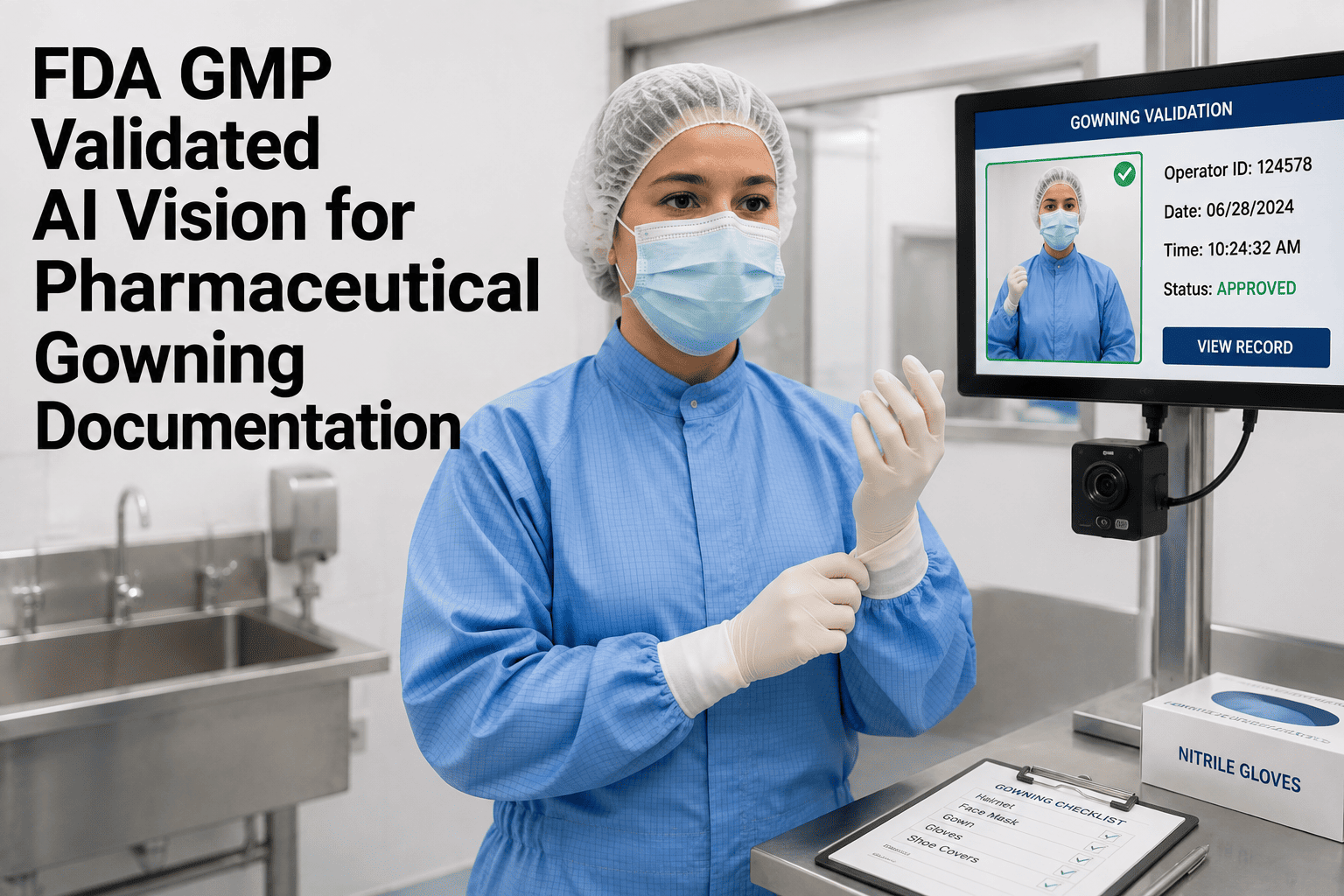
Cleanroom contamination traces back to people more often than any other source — personnel generate roughly 100,000 airborne particles per minute even while sitting still, and that number climbs to five million during active movement across the gowning area and production floor. Every skipped step, loose hood seal, or uncovered wrist creates a direct contamination pathway that manual audits catch only intermittently and after the fact. AI vision systems change this equation by watching every gowning step in real time — verifying coverall closure, hood seal, mask fit, glove overlap, boot cover placement, and goggle position before the operator ever crosses the cleanroom threshold. Pharmaceutical and biotech quality teams evaluating vision-based gowning verification can book a 30-minute demo to see how iFactory's AI camera platform documents gowning compliance automatically against FDA and EU GMP Annex 1 requirements.
AI Vision for Cleanroom Gowning Compliance Monitoring
Camera-based verification of every gowning step — coverall, hood, mask, gloves, boots, and goggles — with automated violation detection, real-time alerts, and GMP-ready documentation that replaces manual observation logs with objective, timestamped evidence.
Why Manual Gowning Checks Fail at Scale
Pharmaceutical cleanroom gowning follows a strict sequence — hand sanitization, shoe covers, hair cover, face mask, coverall, hood, goggles, first glove layer, boot covers, and sterile outer gloves — and every step matters because a single gap in barrier integrity introduces skin cells, hair, and microbial flora directly into classified production areas. The problem is not that operators do not know the sequence. The problem is that manual observation cannot watch every person, every time, at the speed production demands.
Observer Fatigue
A trained gowning observer watching a busy shift change monitors dozens of operators in sequence. Attention drifts after the first hour, and subtle errors — a hood not tucked under the coverall collar, a glove cuff not overlapping the sleeve — pass unnoticed. Manual observation captures what the observer happens to see, not what actually occurs.
Shift-Change Bottlenecks
Peak gowning traffic happens at shift change, exactly when observation coverage is thinnest because the outgoing quality team is handing over to the incoming one. The highest contamination-risk window coincides with the weakest monitoring window — a structural gap no amount of staffing fully closes.
Documentation Gaps
Paper-based gowning logs record that an observation happened, not what was actually observed in reproducible detail. When an FDA auditor or EU GMP inspector asks for evidence of gowning compliance on a specific date for a specific batch, the documentation trail is often a checkbox rather than verifiable proof of each garment being correctly donned.
Inconsistent Standards
Different observers apply different severity thresholds. One trainer may flag an exposed wrist as a critical violation; another may note it as minor. Without a single, objective standard applied to every gowning event, compliance quality varies from shift to shift and observer to observer.
How AI Vision Verifies the Gowning Sequence
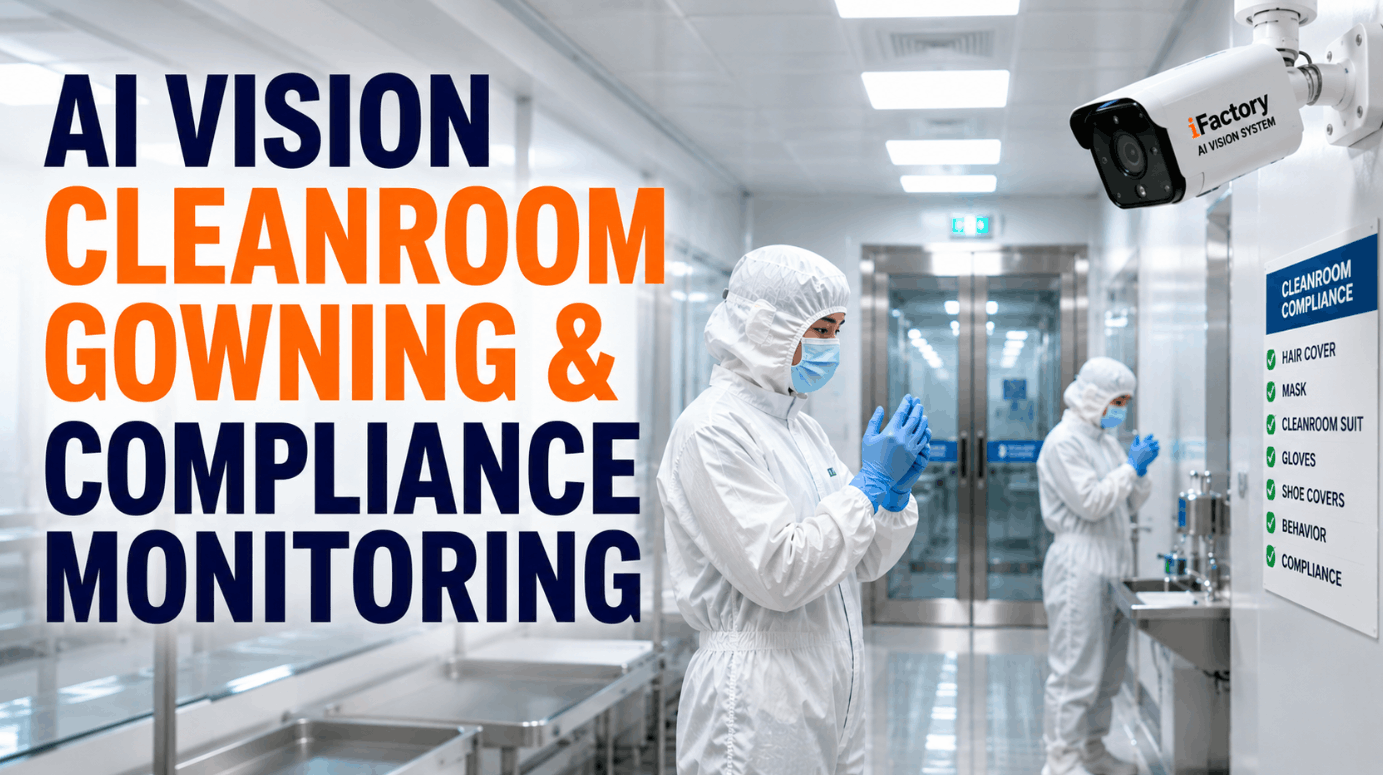
AI-powered gowning verification works by positioning cameras at defined checkpoints within the gowning room — typically at the transition bench between the dirty side and clean side, and at the final entry point before the cleanroom door. The system does not record general surveillance footage. It performs targeted garment-by-garment verification against a trained model of correct gowning, flagging specific deviations in real time.
Checkpoint 1 — Pre-Gown Station
Camera verifies hand sanitization completion, shoe cover placement on both feet, and hair cover fully enclosing all visible hair before the operator moves past the transition bench.
Checkpoint 2 — Coverall and Hood
System confirms coverall is zipped or snapped to the collar, hood is seated over the hair cover with no exposed skin at the forehead or neck, and the hood-to-coverall overlap meets the facility's minimum seal specification.
Checkpoint 3 — Mask and Goggles
AI verifies face mask covers nose and chin completely with no visible gaps at the nose bridge or cheek line, and goggles or safety glasses are in position if required by the cleanroom classification level.
Checkpoint 4 — Gloves and Boot Covers
Camera confirms inner glove layer is on and outer sterile gloves overlap the coverall sleeve cuff, boot covers are secure over shoe covers, and no skin is exposed at the ankle or wrist. Sterile glove sanitization step is time-verified.
Checkpoint 5 — Entry Gate Clearance
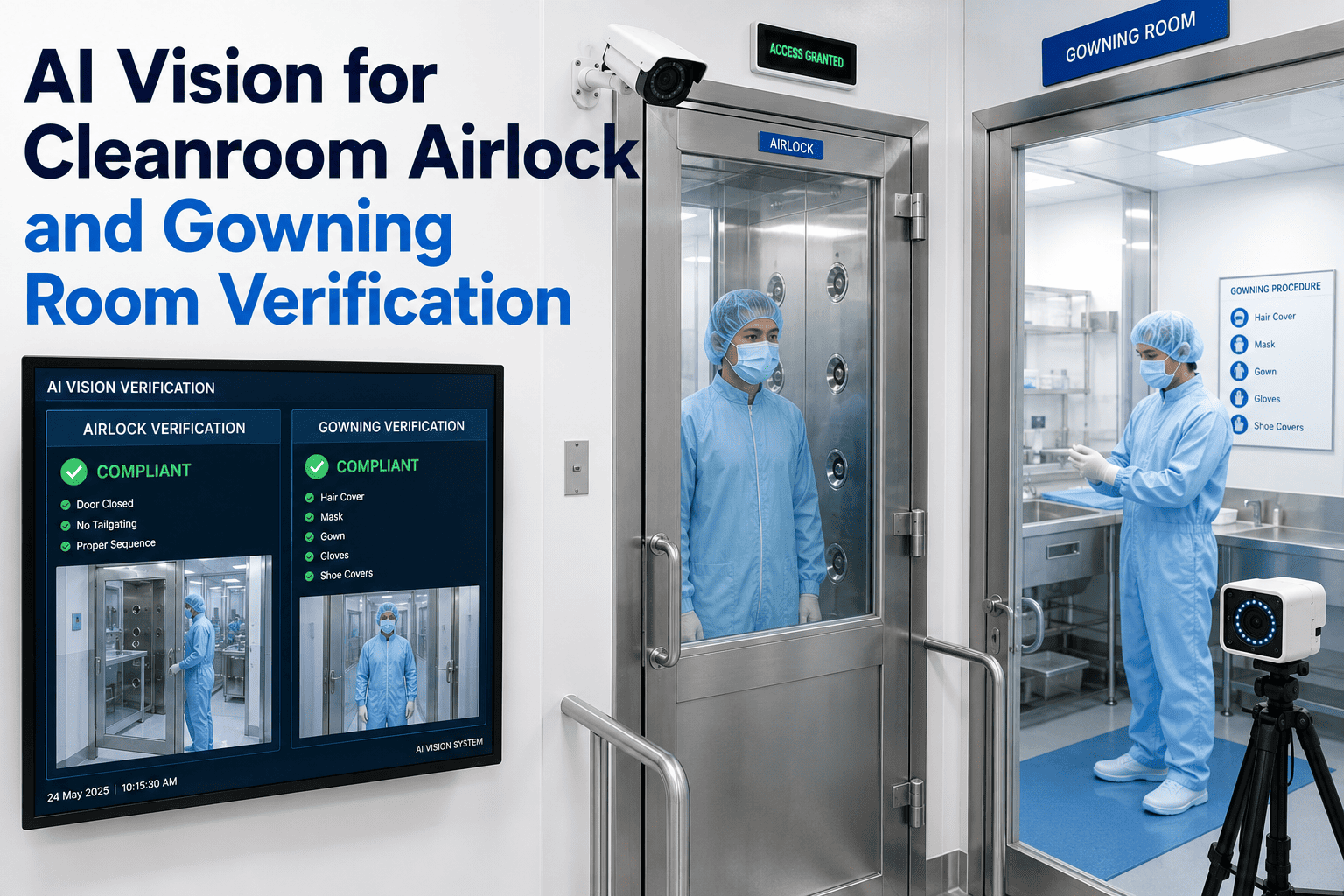
A final full-body verification composite confirms all garment layers are in place before the cleanroom entry door is released. If any garment fails verification, the system holds the door lock and alerts the operator to the specific item requiring correction.
What AI Cameras Detect — Garment-Level Verification
Each garment in the gowning sequence carries a specific contamination-control function, and AI vision is trained to verify each one independently rather than treating gowning as a single pass-or-fail event. The table below maps each garment to its contamination-control role and the specific verification the AI camera performs.
| Garment | Contamination-Control Role | AI Camera Verification | Common Violation Detected |
|---|---|---|---|
| Coverall | Full-body particle barrier against skin cell shedding | Closure seal from collar to ankle, no open zippers or unfastened snaps | Partial zip, collar gap exposing neck skin |
| Hood | Scalp and hair containment — hair sheds 40,000+ skin cells per minute | Hood tucked under coverall collar, no hair visible at forehead or temple | Hood sitting above collar line, exposed hairline |
| Face Mask | Respiratory droplet and facial skin containment | Full nose-to-chin seal, no lateral gaps at cheek line | Mask below nose bridge, loose fit at sides |
| Goggles | Eye-area skin and eyelash particle containment (ISO 5 and above) | Goggles seated against hood, no open gaps at brow or temple | Goggles missing entirely, pushed up onto forehead |
| Inner Gloves | First barrier against hand-borne microbial transfer | Both hands gloved before coverall donning, no bare skin at wrist | One glove missing, glove torn at fingertip |
| Outer Sterile Gloves | Final sterile contact barrier for Grade A/B operations | Sterile glove cuff overlapping sleeve, sanitization step completed | Cuff not overlapping sleeve, no sanitization detected |
| Boot Covers | Floor-to-garment contamination barrier | Covers fully over shoe covers and secured at calf | Boot cover loose at ankle, cover not pulled above shoe |
See garment-level verification running on a live cleanroom feed.
iFactory's AI vision platform demonstrates each checkpoint verification against real gowning footage during the demo — quality teams can map their own gowning SOP to the system's detection model in the same session.
Regulatory Framework — FDA and EU GMP Annex 1 Gowning Requirements
Gowning compliance is not optional guidance — it is a direct regulatory requirement under both FDA cGMP (21 CFR Parts 210 and 211) and EU GMP Annex 1 (2022 revision), and the updated Annex 1 document has expanded the personnel section from 562 words to over 1,600 words, tripling the regulatory weight placed on gowning, training, and personnel monitoring compared to the prior version. AI vision directly addresses several of the most audit-sensitive requirements in both frameworks.
21 CFR 211.28 — Personnel Practices
Requires that personnel wear clean clothing appropriate for the duties they perform and that protective apparel is worn as necessary to protect drug products from contamination. FDA warning letters routinely cite exposed skin, inadequate gowning, and bare hands in classified areas as direct violations — AI vision provides timestamped evidence that each person entering the cleanroom met garment requirements.
Section 7 — Personnel (2022 Revision)
The revised Annex 1 requires that garments be visually checked for cleanliness and integrity immediately before and after gowning, that personnel in Grade A and B areas receive aseptic gowning training and periodic requalification at least annually, and that personnel monitoring include gown sampling after critical interventions. AI cameras serve as the continuous visual check that the Annex describes, generating the evidence trail regulators expect without relying on intermittent human observation.
Warning Letter Patterns
Recent FDA warning letters have specifically cited operators with exposed facial skin and hair entering ISO 5 areas, sterile gowns touching the floor during donning, and operators blocking first air during filling — all behaviors that AI vision cameras are trained to detect and document in real time. A contamination-related recall can exceed three million dollars before accounting for production downtime, remediation, and brand damage.
Contamination Control Strategy
Annex 1 requires every site to maintain a documented Contamination Control Strategy covering at least sixteen elements, including personnel practices, gowning, training, monitoring, and continuous improvement. AI-based gowning verification feeds directly into the CCS by providing objective personnel compliance data that can be trended, analyzed for recurring failure modes, and used to target retraining at specific operators or specific garment steps.
Measurable Impact — What Changes After Deployment
The value of AI gowning verification is not theoretical — it shows up in specific, measurable operational improvements that quality teams can track from the first month of deployment forward.
Audit Readiness
Every gowning event is recorded with operator ID, timestamp, garment-by-garment pass or fail status, and photographic evidence. When an FDA or competent authority inspector asks for gowning records on a specific production date, the quality team retrieves a complete, searchable dataset instead of a paper logbook.
Targeted Retraining
Instead of blanket annual requalification for all operators, AI data identifies which specific operators fail which specific garment steps most frequently. Training resources are directed at actual failure modes rather than general refresher content — reducing retraining hours while improving compliance outcomes.
Reduced Deviation Investigations
When an environmental monitoring excursion occurs, the first question is always whether gowning compliance was maintained during the relevant production window. AI-verified gowning records answer that question in minutes rather than days of manual log review and operator interviews.
Deployment Architecture — Camera Placement and Integration
AI gowning verification integrates into existing cleanroom infrastructure without disrupting gowning room layout, airflow patterns, or personnel traffic flow. The system architecture is designed around three layers: edge cameras at gowning checkpoints, an on-site processing unit that runs the vision model locally to protect data residency, and a dashboard layer that connects into the facility's existing quality management and environmental monitoring systems.
Camera Layer
Cleanroom-rated cameras are mounted at the transition bench, the coverall donning station, and the pre-entry mirror or final checkpoint. Camera specifications are selected for the cleanroom classification — non-particle-generating housings for ISO 5 and 7 gowning rooms, with sealed cable routing that does not compromise room pressure differentials. Typical installations use two to four cameras per gowning room depending on room geometry and operator throughput.
Edge Processing
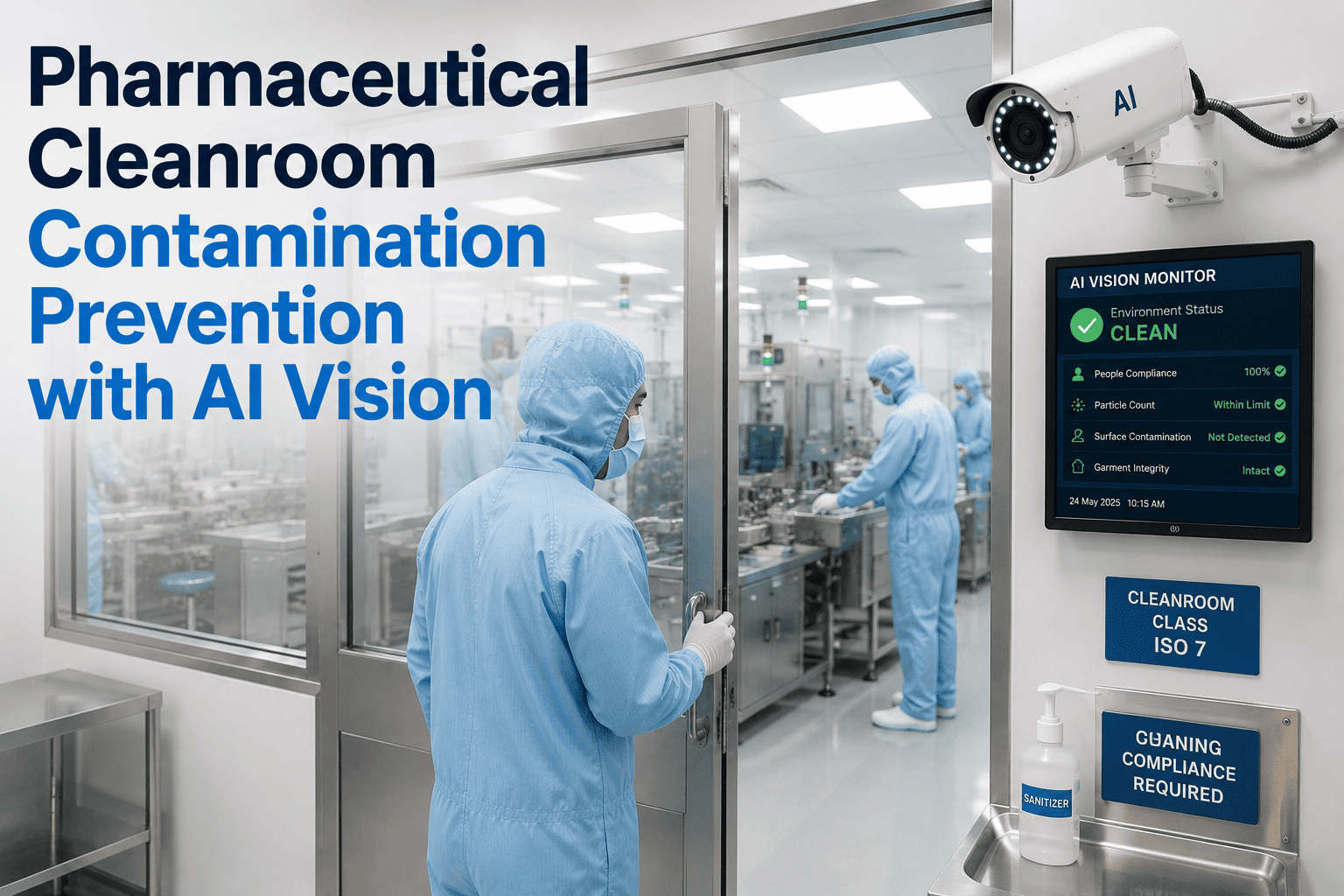
The AI model runs on a local edge compute unit, not in a remote cloud environment. Frame-level gowning analysis stays within the facility's network boundary, addressing data privacy and GxP data residency requirements. The edge unit processes garment detection, operator identification, and compliance scoring in real time — the delay between a garment violation and the operator alert is typically under two seconds.
Dashboard and Integration
Compliance data feeds into a browser-based dashboard showing live gowning status by operator, historical compliance trends by shift and garment type, and deviation event logs that export directly into CAPA and deviation management workflows. API integration connects gowning compliance data to existing QMS platforms, environmental monitoring databases, and batch record systems so gowning evidence is linked to the production batches it covers.
Frequently Asked Questions
Does AI gowning verification replace human gowning trainers and observers?
No — AI verification supplements human oversight, it does not eliminate it. The system provides continuous, objective monitoring that catches violations human observers miss due to fatigue, distraction, or shift-change coverage gaps, but the gowning training program itself still requires qualified trainers who teach operators the correct sequence, fit technique, and contamination-control rationale. What changes is that trainers gain data on exactly which operators and which garment steps need the most attention, making the training program more targeted and more effective rather than less staffed. Quality teams retain full authority over gowning SOPs, pass and fail thresholds, and corrective action decisions — the AI provides evidence, not judgment. Contact iFactory Support for detailed documentation on the human-AI responsibility split in gowning compliance programs.
How does AI gowning verification satisfy EU GMP Annex 1 personnel monitoring requirements?
The 2022 revision of EU GMP Annex 1 requires that garments be visually checked for cleanliness and integrity immediately before and after gowning, that personnel in Grade A and B areas undergo gowning qualification and periodic reassessment at least annually, and that monitoring include gown sampling after critical interventions. AI vision directly addresses the visual check requirement by performing it on every gowning event rather than on a sample basis, and generates the timestamped evidence trail that competent authorities expect during inspections. The system also feeds operator-level compliance data into the annual requalification process, giving quality teams objective performance history rather than relying solely on periodic spot-check observations. Book a demo to see how Annex 1 personnel monitoring maps to the iFactory verification workflow.
What happens when the AI camera detects a gowning violation in real time?
When a garment fails verification — for example, a hood not tucked under the coverall collar, or a mask sitting below the nose bridge — the system immediately alerts the operator through a visual indicator at the gowning station, identifying the specific garment and the specific issue that needs correction. If the facility uses an interlocked entry system, the cleanroom door remains locked until the operator corrects the violation and the system re-verifies the garment. Every violation event is logged with operator ID, timestamp, garment type, violation type, and whether the operator corrected the issue before entry. This log feeds directly into the deviation management workflow so quality teams can trend violation types over time and identify systemic issues versus one-off errors. Contact Support to learn how real-time alerting integrates with your existing facility access control system.
Can the system be validated for GMP-regulated pharmaceutical manufacturing?
Yes — iFactory's AI vision platform is designed for deployment in GMP-regulated environments and follows a validation approach aligned with GAMP 5 and the FDA's 2023 Computer Software Assurance guidance. The validation package includes installation qualification, operational qualification covering each garment detection model, performance qualification against a defined set of pass and fail gowning scenarios, and ongoing system suitability testing procedures. Because the AI model runs on a local edge compute unit rather than a cloud-hosted service, the validation boundary is contained within the facility's own infrastructure, simplifying the qualification scope. Data integrity controls — including audit trails, electronic signatures, and access controls — are built into the platform to meet 21 CFR Part 11 and Annex 11 requirements. Book a demo to review the validation documentation package with iFactory's compliance team.
What cleanroom classifications and gowning levels does the AI system support?
The system supports gowning verification across all standard cleanroom classifications — from ISO 8 environments where basic gowning (coverall, hair cover, shoe covers, gloves) is required, through ISO 7 and ISO 6 areas with full gowning including hoods and masks, to ISO 5 and Grade A/B sterile environments requiring double-gloving, goggles, and sterile garment protocols. The garment checklist and verification rules are configurable per gowning room and per cleanroom classification, so a facility with multiple classification zones can run different verification profiles for different areas from the same platform. The system also adapts to site-specific gowning SOPs — if a facility requires a specific garment sequence that differs from the generic ISO standard, the detection model is configured to match the site's own documented procedure rather than imposing a generic template. Contact iFactory Support to discuss configuration for your specific cleanroom classification layout.
Gowning compliance is the first line of contamination defense. Make it objective, continuous, and audit-ready.
iFactory's AI vision platform verifies every gowning step, every operator, every shift — replacing checkbox logs with garment-level, timestamped compliance evidence that stands up to FDA and EU GMP Annex 1 scrutiny. A 30-minute demo builds a live verification view against your own gowning SOP and cleanroom layout.