An FDA inspector doesn't ask whether your gowning procedure exists — they ask you to prove it was followed, for a specific operator, on a specific date, months ago. If that proof lives in a paper logbook with a supervisor's initials and a checkbox, you're relying on memory and honesty under pressure. If it lives in a system that automatically captured a timestamped photo, personnel ID, and pass or fail status the moment the gowning event happened, you have an answer in seconds instead of a scramble through file cabinets. This looks at what FDA 21 CFR Part 11 actually requires from gowning documentation, where paper-based logs fail that standard, and how to book a demo to see a compliant audit trail generated automatically.
Cleanroom Safety · GMP Documentation
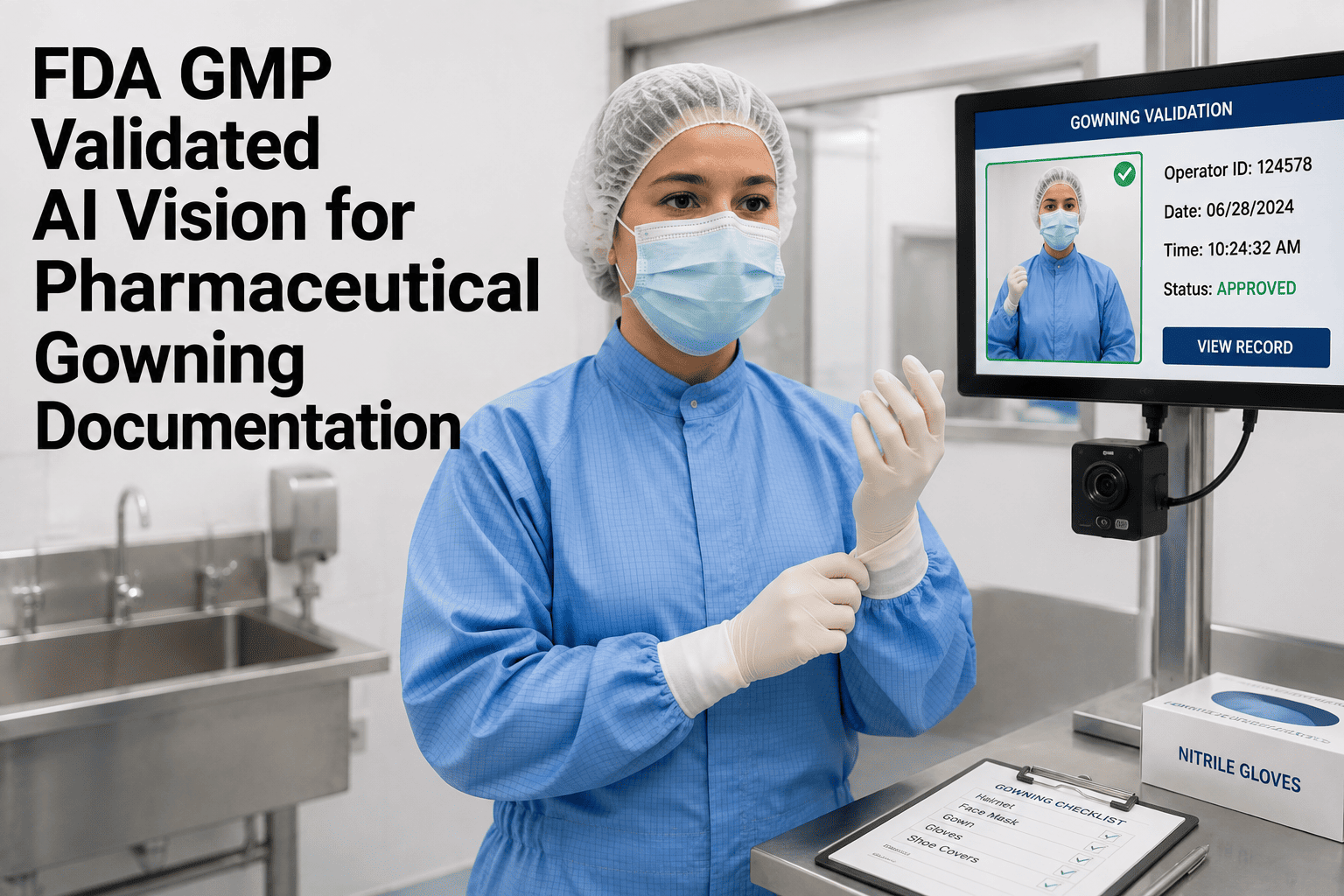
FDA GMP Validated AI Vision for Pharmaceutical Gowning Documentation
Every gowning event captured with a timestamp, personnel ID, compliance status, and photo evidence — generated automatically, in a 21 CFR Part 11 compliant audit trail an inspector can pull in seconds, not a paper log your team has to reconstruct under pressure.
Sample Audit Trail Entry
Timestamp08:42:16 UTC
Operator IDBadge-matched
Gowning StatusPass — 6 of 6 items verified
Photo EvidenceAttached, tamper-evident
Record StatusLocked, non-editable
Why This Matters
Gowning Failures Show Up in Warning Letters, Not Just Logbooks
Recent FDA enforcement actions keep landing on the same theme: personnel observed moving between classified zones without proper gowning protocol, investigators unable to verify that gowning procedures were actually followed rather than just documented on paper, and firms cited for lapses in gowning technique alongside broader contamination control failures. A review of recent 483s and warning letters across sterile manufacturing shows personnel and aseptic technique lapses — including improper gowning — as one of the most frequently cited contributors to environmental monitoring positives in ISO 5 and ISO 7 spaces. When gowning is implicated, inspectors expect retraining, requalification, and documented evidence that the corrective action actually addressed the root cause, not just a revised SOP.
The pattern that keeps surfacing is not that gowning procedures are missing — most sites have a detailed SOP. It's that the evidence a specific person followed that SOP on a specific day, in the correct sequence, does not exist in a form an inspector can trust. A paper checklist with initials confirms someone was present, not that gowning was verified against the sequence, and it certainly does not survive the question "can you show me the record was not altered after the fact."
Documentation and audit trail shortfalls remain one of the most consistently cited categories across recent 483s and warning letters, often appearing alongside the same personnel and environmental monitoring findings that gowning lapses produce — which means a documentation gap rarely shows up in isolation. Once an inspector finds one weak link in the record-keeping chain, the review tends to widen into every other electronic record the facility maintains, turning a single gowning question into a much broader data integrity audit.
The Regulation, Plainly
What 21 CFR Part 11 Actually Requires From an Electronic Record
Most gowning documentation debates get stuck on a technology question — camera versus paper, automated versus manual — when the actual test is a regulatory one: does the record meet the specific structural requirements 21 CFR Part 11 lays out for electronic records and signatures. Four requirements come up repeatedly in inspections and in the checklist guidance issued around Part 11 compliance.
Computer-Generated, Not Manually Entered
Section 11.10(e) requires audit trails to be secure, computer-generated, and automatically time-stamped — a supervisor typing a time into a spreadsheet field does not meet this bar.
Tamper-Evident by Design
No user, including administrators, can modify an entry once it's recorded. The record has to be structurally incapable of quiet editing, not just governed by a policy against it.
Identity, Action, Date and Time Captured
Every entry needs to independently record who performed the action, what the action was, and exactly when it happened — captured by the system itself, not self-reported.
Retained and Reviewable on Demand
Records must be preserved at least as long as the electronic records they document, and available in human-readable form for FDA review at any point during that period.
Paper vs Automated
Where a Paper Gowning Log Fails an Inspection
| Requirement | Paper Logbook | AI Vision Audit Trail |
| Timestamp accuracy |
Hand-written, self-reported |
System-generated at moment of event |
| Tamper resistance |
Can be re-written or backdated |
Locked record, non-editable by any user |
| Photo evidence |
Not typically captured |
Attached automatically to every event |
| Operator identity verification |
Initials, unverified |
Matched against badge and camera capture |
| Retrieval speed for an inspector |
Manual search through binders or files |
Filterable by date, operator, or status in seconds |
| Sequence verification |
Assumes order was followed |
Confirms each gowning step in correct sequence |
See What an Inspector-Ready Gowning Record Actually Looks Like
A short walkthrough shows how AI vision captures gowning compliance automatically and generates the audit trail your QA team would otherwise assemble by hand.
How It Works
From Gowning Event to Locked Compliance Record
01
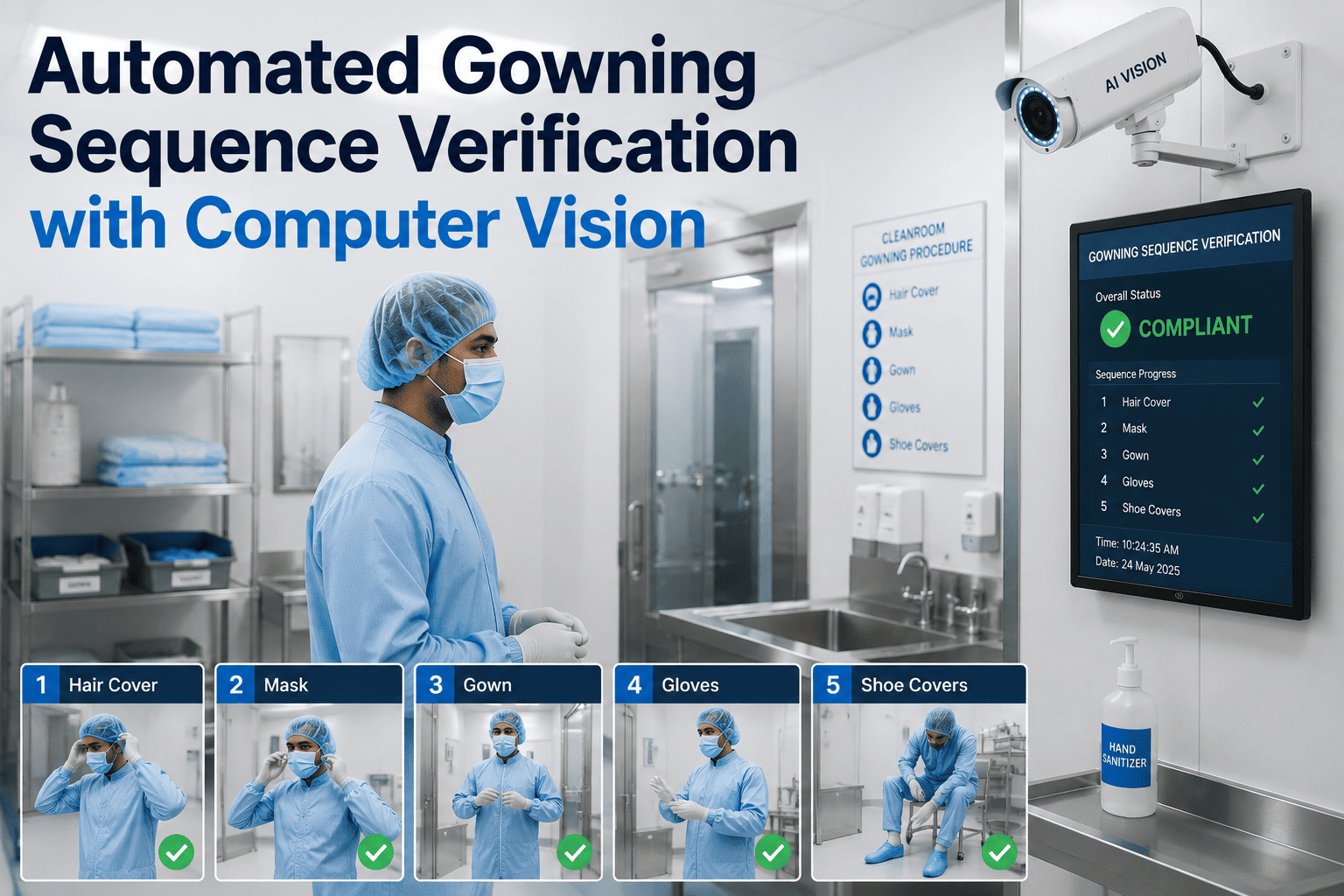
Camera Captures the Full Gowning Sequence
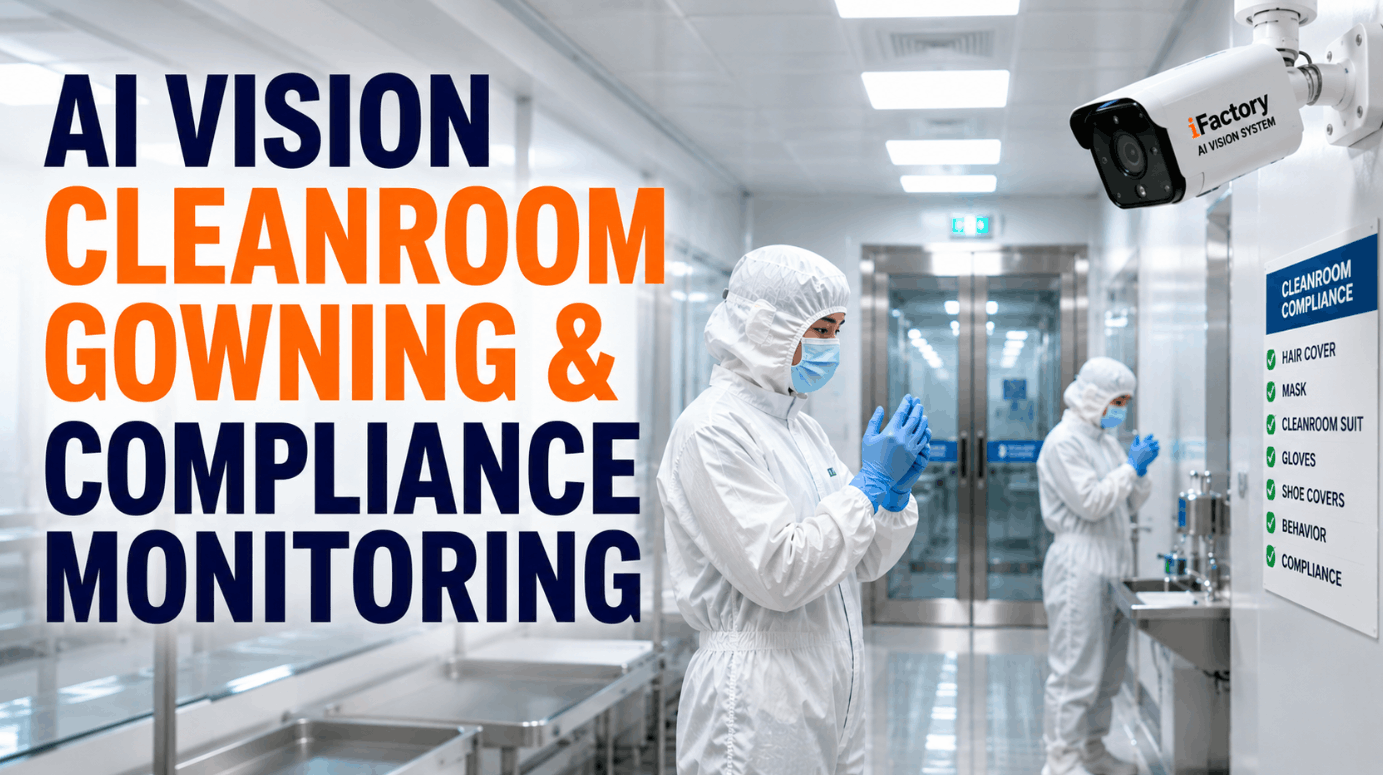
AI vision cameras positioned in the gowning room observe each garment being donned in order — bouffant, mask, coverall, boots, gloves — the same sequence your SOP already specifies, without requiring the operator to change their normal gowning routine.
02
Operator Identity Is Matched Automatically
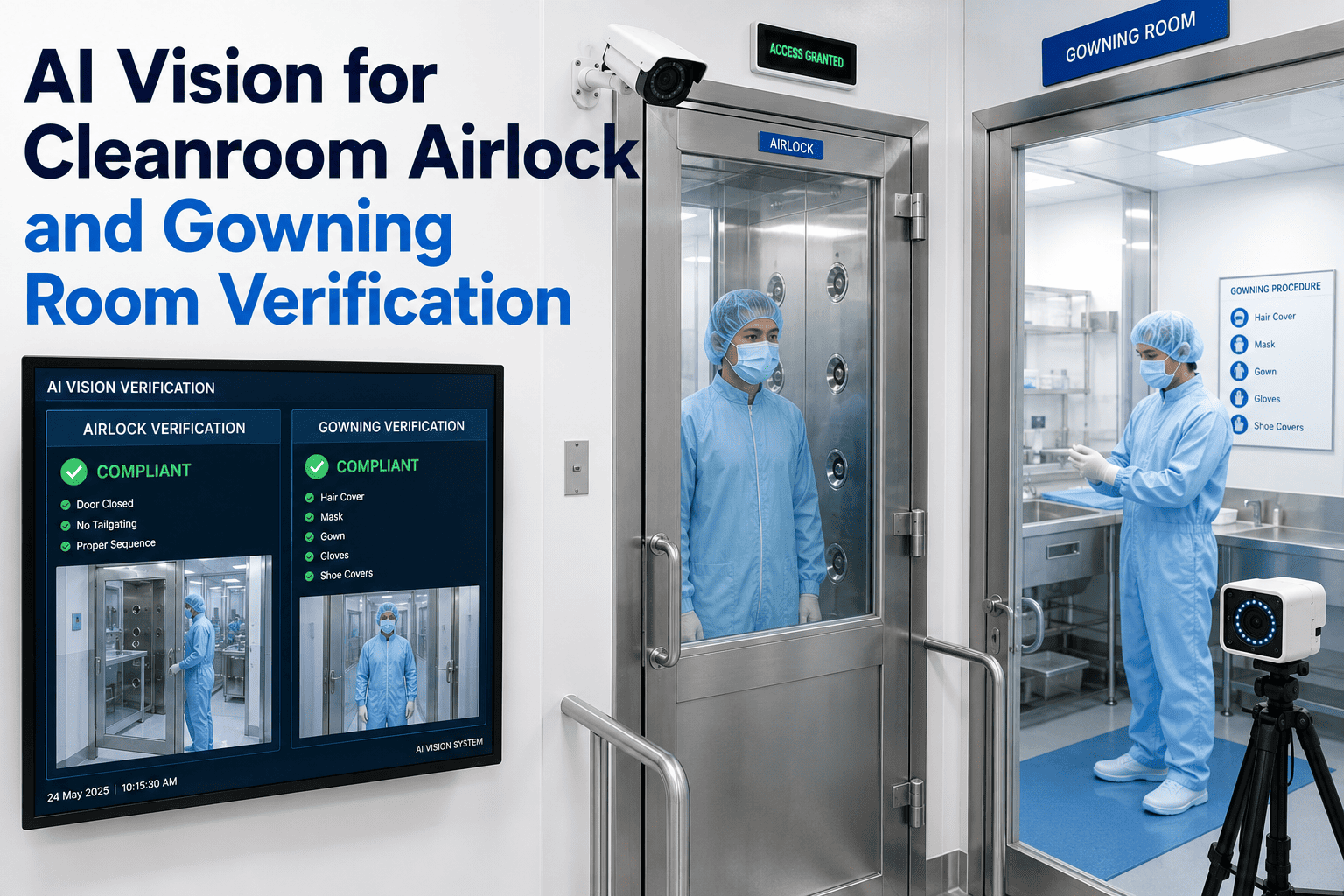
Badge credential at the airlock is cross-checked against the camera capture, so the record reflects who was actually gowning, not just whose badge was scanned.
03
Compliance Status Is Determined in Real Time
Each garment is checked against the required sequence and coverage — a gap at the wrist, an exposed hairline, a missing boot cover is flagged before the operator proceeds.
04
Record Is Written and Locked
Timestamp, personnel ID, pass or fail status, and photo evidence are written to a tamper-evident record the moment the event completes — no manual entry step exists for an error or omission to enter.
The Numbers Behind the Risk
What Gowning Documentation Gaps Actually Cost
None of these numbers are abstract for a QA director preparing for an inspection. They translate directly into how confidently a facility can answer a records request, and how much of an investigation ends up focused on documentation instead of the actual process being documented.
Top 5
Documentation and audit trail gaps rank among the most common 21 CFR Part 11 inspection findings
20–40%
Defect and deviation miss rate reported for manual visual checks under production conditions
Full Term
Audit trail retention required for as long as the electronic records they document
Zero
Tolerance for edited entries — records must be structurally non-editable, not just policy-restricted
On the Floor
A Gowning Gap Caught Before It Became a Batch Deviation
A sterile injectable facility had a documented gowning SOP that every operator signed off on during training, and a paper logbook at the gowning room entrance where a supervisor initialed each shift's compliance. During a routine review ahead of an anticipated inspection, the QA team could not produce evidence for three operators on a specific date — the logbook page had gaps, and no one could reconstruct with confidence whether gowning had actually been verified or simply assumed because no issue was reported. Nothing had gone wrong on the floor that day, but the absence of proof was itself the finding waiting to happen. After moving to camera-based gowning verification, the same facility could pull a filtered report for any operator, any shift, any date range, in under a minute — with photo evidence attached to every entry rather than an initial that only confirms someone was standing at the door.
The lesson that generalizes: in a GMP environment, an unrecorded event is functionally the same as an event that never happened, no matter how confident the team is that it did occur correctly. Documentation is not a formality layered on top of the real work — for an inspector, it is the only evidence the real work occurred at all, and the gap between "we're sure it happened" and "here is the record" is exactly where warning letters get written.
What Inspectors Actually Ask
The Questions a Paper System Struggles to Answer Quickly
During inspections, investigators are frequently asked to demonstrate a system that shows who performed a specific action, when it occurred, and whether the record was altered after approval. That framing matters — the question is rarely "does a gowning procedure exist." It's "prove this specific instance of it happened, and prove the proof itself is trustworthy." A paper logbook can usually answer the first half of that question. It almost never structurally supports the second half, because nothing prevents a page from being rewritten, backfilled, or lost between the event and the moment someone asks to see it.
On-Premise Edge Inference
Processing runs on NVIDIA hardware inside the facility, so gowning event data never has to leave the validated plant boundary to be evaluated — a direct fit for data integrity requirements under 21 CFR Part 11.
Existing Camera Compatibility
Where gowning room cameras or ONVIF-compatible hardware already exist for security or process monitoring, the AI compliance layer can be added without a hardware teardown.
Integrates With Access Control Logic
Gowning verification can tie directly into airlock interlock systems, holding inner doors locked until compliance is confirmed, so documentation and access control run off the same verified event.
Retraining and CAPA Evidence, Ready Made
When FDA cites a gowning lapse and expects documented evidence of retraining and requalification, a system-generated history of that operator's subsequent compliant gowning events is exactly the kind of proof inspectors look for.
Readiness Check
Signs Your Gowning Documentation Won't Survive an Audit
1Gowning compliance is confirmed by a supervisor's initials rather than a system-generated timestamp
2There is no photo or visual evidence attached to individual gowning events
3Pulling records for a specific operator on a specific date takes more than a few minutes
4Paper logs could theoretically be re-written or backfilled without anyone knowing
5Your last inspection cited a documentation or audit trail gap of any kind
If any of these sound familiar, a pilot on a single gowning room is usually enough to see how quickly a compliant audit trail forms and how much faster a records request gets answered when it's system-generated instead of assembled by hand. Most validation teams find the pilot itself doubles as useful evidence — a documented before-and-after comparison is exactly the kind of proof a quality steering committee wants before approving a wider rollout.
Measuring the Gap
What to Pull Before Your Next Inspection Readiness Review
| Question an Inspector Might Ask | Paper Log Answer Time | AI Vision Audit Trail Answer Time |
| Show gowning records for Operator X, last quarter |
Manual search across binders or shifts |
Filtered report in seconds |
| Prove this record was not altered after the fact |
Relies on procedural trust, not structural proof |
Tamper-evident by system design |
| Show photo evidence for a flagged gowning event |
Typically does not exist |
Attached automatically to the record |
| Demonstrate corrective action after a citation |
Signed retraining certificate only |
Ongoing compliant-event history for that operator |
Running through this exercise honestly, before an inspector does it for you, is usually what surfaces whether a documentation gap exists at all. Most QA teams already know intuitively which of these questions would take too long to answer — the value of writing it down is turning that instinct into a specific, fundable gap rather than a vague sense of risk that never quite makes it onto a budget request.
Common Questions
Gowning Documentation and 21 CFR Part 11, Explained
Does an AI-generated gowning record actually satisfy 21 CFR Part 11 requirements?
Section 11.10(e) requires audit trails to be secure, computer-generated, and automatically time-stamped, with no user able to modify an entry once recorded. A camera-based system that writes timestamp, personnel ID, compliance status, and photo evidence directly to a locked record at the moment the event occurs meets that structure by design, rather than relying on a person to accurately transcribe what happened after the fact.
Book a demo to see the record format your validation team would review.
What happens if a camera flags a gowning gap — does that stop the operator from proceeding?
In deployments tied into airlock interlock logic, the inner door stays locked until every garment passes visual verification, which prevents an improperly gowned operator from reaching the classified space at all. Where the system runs as documentation only, a flagged event is still logged with photo evidence and routed for supervisor review, so the gap is caught and recorded rather than silently missed.
Talk to support about which configuration fits your current airlock setup.
Do we need to replace our existing gowning room cameras to deploy this?
Not in most cases. Where ONVIF-compatible or RTSP-capable cameras are already installed for security or process monitoring, the AI compliance layer can typically be added on top of that existing hardware rather than requiring a full camera replacement, which keeps both cost and installation timeline down.
Contact our team with your current camera specifications to confirm compatibility.
How does this help if we're cited for a gowning lapse and need to show corrective action?
When a gowning finding requires documented evidence of retraining and requalification, a system-generated history of that specific operator's gowning events after the corrective action gives inspectors exactly the kind of verifiable, non-editable proof they look for — rather than a signed training certificate with no ongoing evidence the behavior actually changed on the floor.
How long does a pilot deployment typically take to validate on one gowning room?
Because most sites already have gowning room camera coverage and the SOP itself does not need to change, a scoped pilot on a single gowning room can usually be evaluated within a matter of weeks, running in parallel with existing paper documentation until performance is confirmed.
Book a scoping call to get a timeline specific to your facility and validation requirements.
Stop Reconstructing Compliance After the Fact
Get a Gowning Audit Trail That Answers an Inspector in Seconds
See how iFactory's AI vision cameras document every gowning event automatically, with photo evidence and a locked, 21 CFR Part 11 compliant record — no manual logbook required.