Eighteen months. Four cleanroom airlocks. Zero contamination events traced to gowning failure. That's not a marketing claim — it's the operating record of a sterile injectable manufacturer that replaced supervisor spot-checks with AI vision monitoring at every gowning transition point on its production floor. Gowning violations, which had been running at a rate high enough to keep the quality team occupied every single shift, dropped 92 percent within the first quarter of deployment and stayed there. This walks through what the facility looked like before, what changed, and how to book a demo to see whether the same result is realistic for your cleanroom.
Case Study · Cleanroom Safety
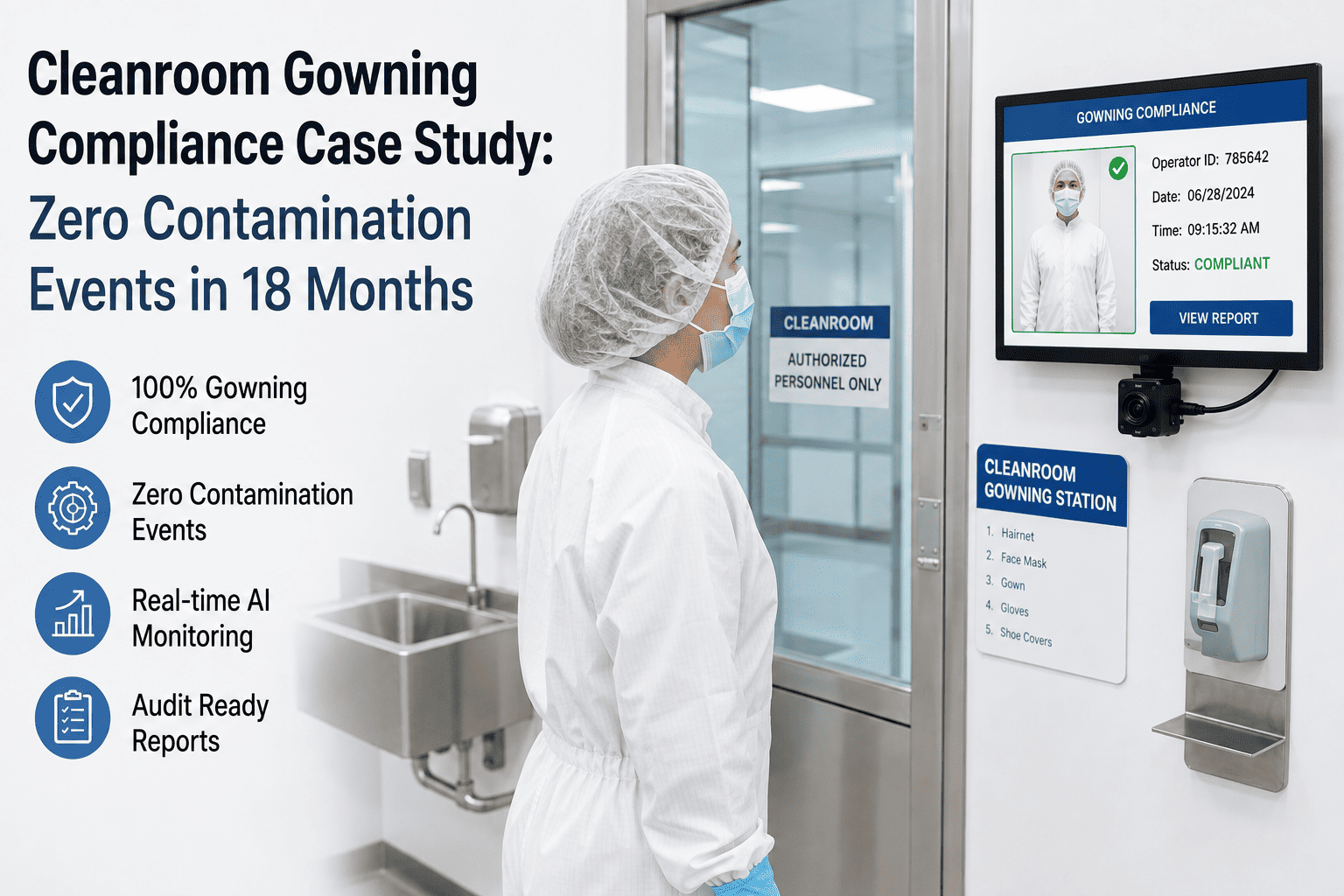
Cleanroom Gowning Compliance Case Study: Zero Contamination Events in 18 Months
A sterile injectable manufacturer deployed AI gowning monitoring across four cleanroom airlocks. Gowning violations dropped 92 percent in the first quarter — and stayed there for a year and a half.
18
Months, zero contamination events
92%
Reduction in gowning violations
4
Airlocks under continuous monitoring
100%
Of gowning events documented automatically
The Facility
Where This Deployment Happened
The details below are what defined the scope of this deployment and are worth reading before drawing conclusions for your own facility — the starting conditions here, particularly the reliance on spot-checks across multiple shifts, are what created the room for a 92 percent improvement in the first place.
Facility Type
Sterile injectable manufacturing, aseptic fill-finish
Classified Zones
ISO 5 filling suites behind ISO 7 gowning corridors
Airlocks Monitored
4 gowning and de-gowning transition points
Personnel Volume
Multiple shifts, rotating operator pool
Prior Monitoring Method
Supervisor spot-checks and paper gowning logs
Deployment
AI vision cameras integrated with airlock interlock logic
Before Deployment
What the Gowning Program Actually Looked Like
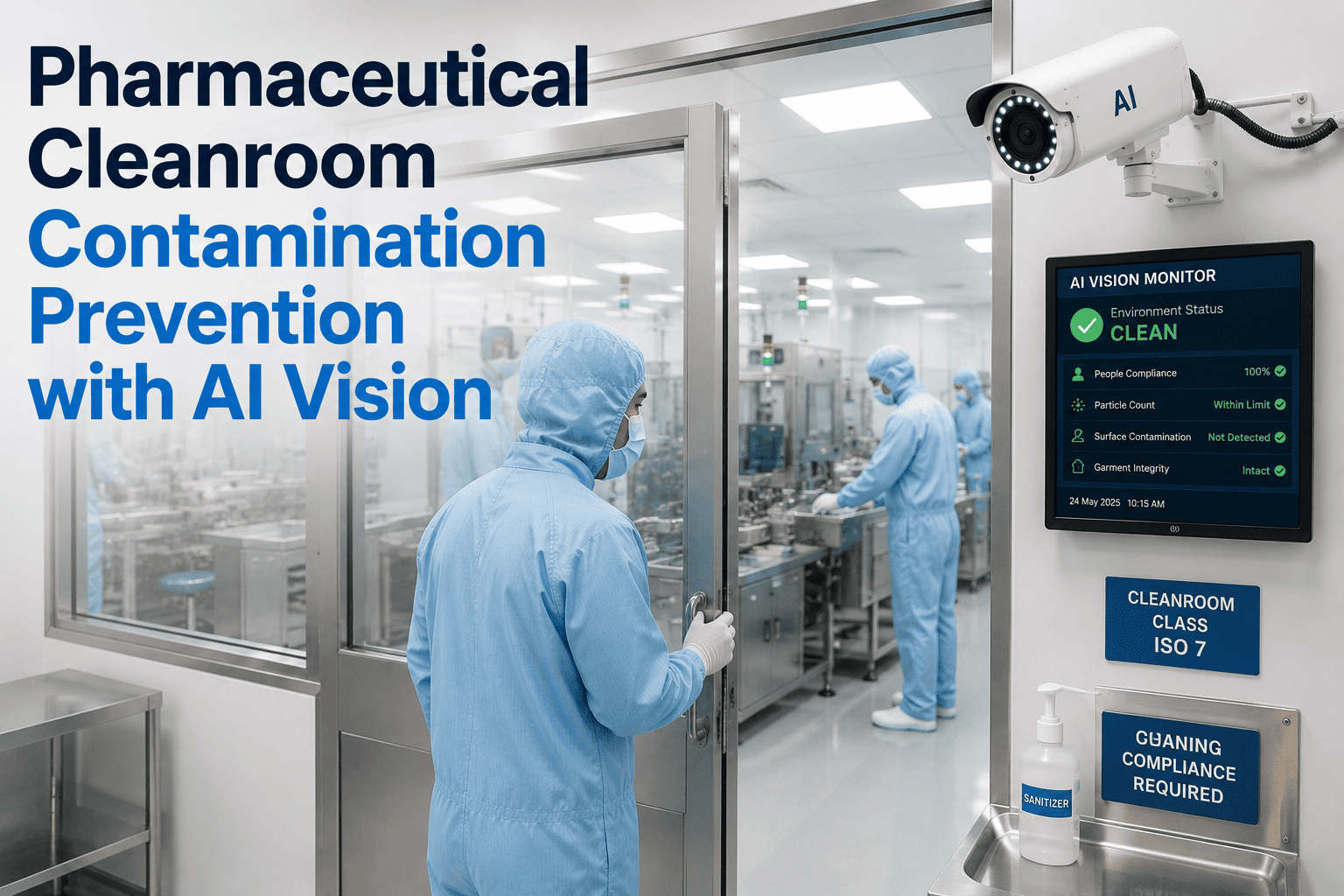
Personnel are the primary source of contamination risk in a cleanroom, shedding roughly 10 million particles per minute during normal movement — which is exactly why gowning technique matters more than almost any other single control point in a sterile facility. This site's gowning SOP was detailed and well documented on paper. The gap was in verification: a supervisor could not physically observe every gowning event across four airlocks and multiple shifts, so the program relied on spot-checks and operator self-discipline for most transitions.
That gap showed up as a steady background rate of gowning violations — a wrist gap, a hairline exposed at the bouffant edge, a boot cover not fully seated — most caught only when a supervisor happened to be present, or not caught until an environmental monitoring excursion prompted an investigation that traced back to a gowning inconsistency days or weeks earlier. Personnel and aseptic technique lapses, including improper gowning, are consistently among the most frequently cited contributors to environmental monitoring positives in ISO 5 and ISO 7 spaces industry-wide, and this facility's own internal data reflected that same pattern before the deployment.
The Verification Gap
Operator gowns without direct observation most shifts
Supervisor spot-checks cover a fraction of events
Minor gowning gaps go unflagged in real time
Issues surface later via EM excursion investigation
By the time a gap was found, the root cause was days old.
The Deployment
How the Rollout Actually Went, Month by Month
Month 1
Camera Installation and Parallel Run
AI vision cameras were installed at all four airlocks and run in parallel with the existing paper log, so every gowning event was captured by both systems for direct comparison before any process changed.
Month 2
Baseline Violation Rate Established
The parallel run surfaced a substantially higher true violation rate than the paper log had ever shown — confirming that spot-checks were missing most of the events that mattered.
Month 3
Interlock Integration Goes Live
Camera verification was tied into the airlock door interlock logic, holding the inner door locked until gowning was confirmed complete, moving the system from passive logging to active prevention.
Months 4–6
Violation Rate Drops 92 Percent
With every operator seeing real-time feedback at the interlock and every event logged automatically, the gowning violation rate fell 92 percent from the established baseline and held at that level through the end of the quarter.
Months 7–18
Zero Contamination Events Traced to Gowning
Across the following twelve months, environmental monitoring showed no contamination event traceable to a gowning failure — a result the facility had not achieved in any prior 18-month period under the paper-based program.
Behind the Numbers
What "AI Gowning Monitoring" Actually Meant on This Floor
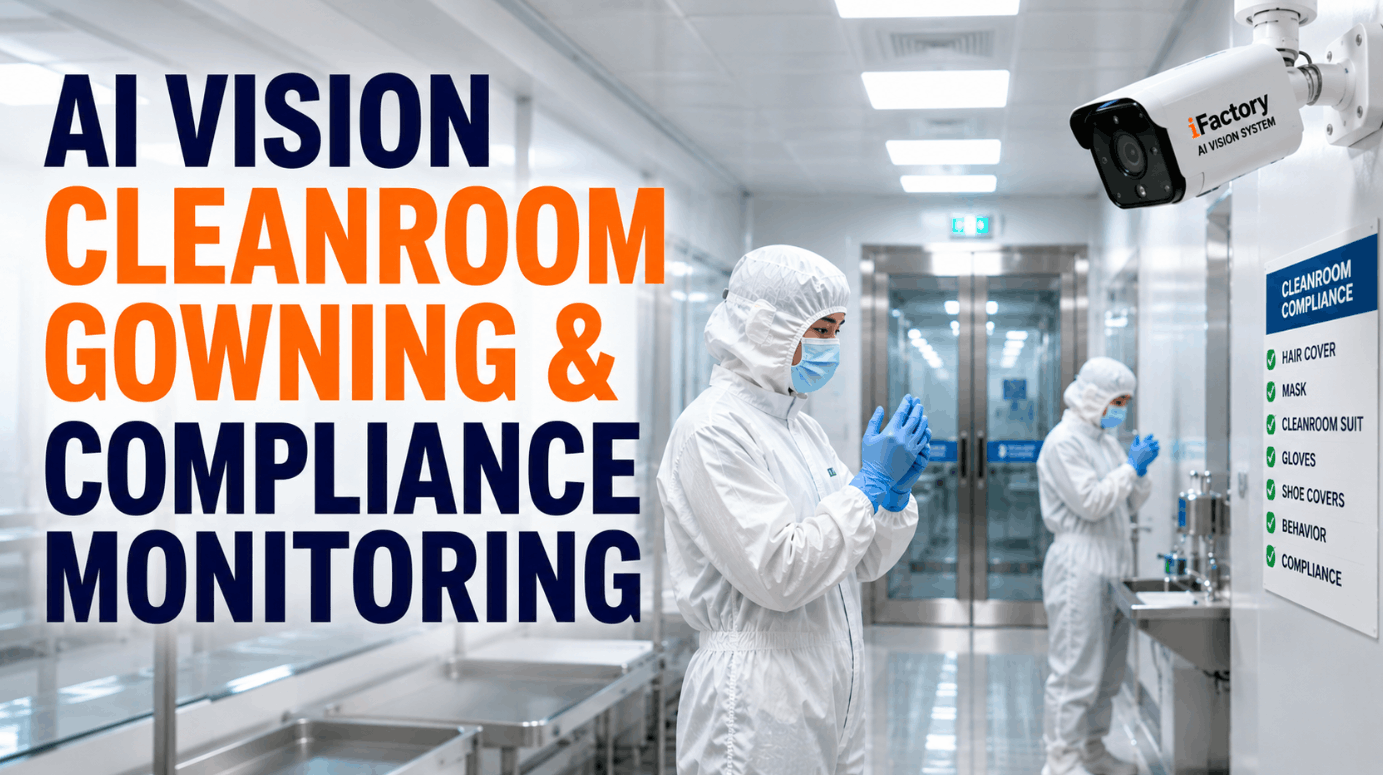
The 92 percent figure can sound abstract without understanding what the system was actually checking. At each airlock, cameras observed the full gowning sequence already defined in the facility's SOP — bouffant placement, mask seal, coverall closure, boot cover seating, and glove-to-sleeve overlap — and verified each step against that sequence in real time rather than relying on an operator's self-assessment or a supervisor's periodic glance. A gap at any point in that sequence generated an immediate flag, tied to a specific operator, a specific airlock, and a specific timestamp, with a photo captured as evidence.
Two design choices mattered more than the underlying detection accuracy in determining whether this program actually changed behavior. First, feedback happened at the point of gowning, not after the fact — an operator who missed a step found out immediately, while it was still fixable, rather than during a retrospective review days later. Second, every event was logged regardless of outcome, which meant the facility had a genuine baseline violation rate for the first time, rather than a rate distorted by which events happened to be observed.
See This Same Deployment Model Applied to Your Airlocks
A short walkthrough shows how continuous AI gowning verification would map onto your specific cleanroom layout and shift pattern.
Before and After
What Actually Changed at Each Airlock
| Measure | Before AI Vision | After AI Vision |
| Gowning events observed |
Fraction, via supervisor spot-check |
100%, every event at every airlock |
| Time to detect a gowning gap |
Hours to days, if caught at all |
Real time, before entry to classified space |
| Gowning violation rate |
Established baseline |
92% reduction within one quarter |
| Documentation format |
Paper log, supervisor initials |
Timestamped digital record with photo evidence |
| Contamination events tied to gowning |
Recurring, prior periods |
Zero across 18 consecutive months |
| Audit record retrieval |
Manual search through logbooks |
Filtered report by operator, date, or status |
Why It Worked
Three Reasons the Violation Rate Actually Held
A 92 percent drop in the first quarter is a meaningful result on its own, but the part that matters more to a facility evaluating this approach is that the rate held for the following fifteen months rather than drifting back up once the novelty wore off. Three specific design choices explain why the improvement was durable rather than temporary.
Coverage Was Total, Not Sampled
Every gowning event at every airlock was observed, removing the gap where most violations previously went unflagged simply because no one was watching that specific transition at that specific moment.
Feedback Was Immediate, Not Retrospective
Because verification was tied to the interlock itself, an operator learned about a gowning gap before entering the classified space, not days later during an excursion investigation that could no longer change the outcome.
The Record Removed Ambiguity
A timestamped, photo-backed record meant retraining conversations were grounded in a specific documented event rather than a general reminder, which made corrective action land differently with operators.
The Broader Context
Why a Result Like This Matters Beyond One Facility
This facility's result did not happen in a vacuum. It happened against a regulatory backdrop where documentation gaps and personnel lapses are drawing more scrutiny than they were even a few years ago, and where the financial exposure of getting contamination control wrong keeps climbing.
561
Form 483s issued to drug facilities in FY2024, up sharply from 349 in FY2020
180+
Pharmaceutical companies received warning letters in a single recent year
$10M–$100M
Typical cost range of a single pharmaceutical product recall
10M/min
Approximate particles shed by personnel during normal cleanroom movement
"
The paper log told us gowning was fine because nothing bad had been reported. What the camera data showed us was that we simply weren't watching most of it. Once every event had a record, the conversation with operators changed completely — it stopped being about trust and started being about a specific, documented moment they could see for themselves.
Facility Quality Assurance Director
Sterile Injectable Manufacturing Site
One Caught Event
What the System Flagged in Month Four
During the fourth month of deployment, the system flagged a recurring pattern with one operator — a small gap at the glove-to-sleeve interface that was not severe enough to trigger an immediate contamination concern but appeared across several consecutive shifts. Under the prior spot-check program, this pattern would almost certainly have gone unnoticed, since no single instance was dramatic enough to draw a supervisor's attention and the events were spread across different shifts. The photo-backed record made the pattern visible in a way a memory-based spot-check program never could, and targeted retraining on that specific technique closed the gap within a week.
That single caught pattern is a useful stand-in for what the 92 percent reduction actually represents. It is rarely one dramatic failure prevented — it is dozens of small, recurring technique gaps that a sampling-based program was structurally unable to see, each one closed before it had the chance to compound into an actual contamination event.
Is Your Facility Positioned for a Similar Result
Conditions That Made This Deployment Work
1Gowning compliance today relies primarily on spot-checks or self-reporting rather than continuous observation
2Environmental monitoring excursions have previously been traced back to gowning-related root causes
3Multiple shifts and a rotating operator pool make consistent supervisor coverage difficult
4Your gowning room airlocks already have or can accommodate camera coverage
5Leadership wants documented, quantifiable evidence of contamination control improvement, not just anecdotal confidence
This facility started with a parallel run rather than a full cutover, which is generally the fastest way to establish a credible before-and-after baseline without disrupting production during validation. Facilities considering a similar deployment typically find the parallel-run period itself generates enough data to justify the interlock integration decision on its own.
Putting the Result in Context
What Zero Contamination Events Actually Protected
| Exposure Avoided | Typical Range or Pattern |
| Pharmaceutical product recall |
10 million to 100 million dollars, depending on severity and scope |
| Warning letter and remediation |
Extended regulatory oversight, halted shipments, import alerts in severe cases |
| Batch rejection from a contamination excursion |
Full batch loss plus investigation and CAPA labor |
| 483 observation tied to personnel or gowning lapse |
One of the most frequently cited findings in sterile manufacturing inspections |
None of these outcomes occurred at this facility during the 18-month period reviewed here, which is precisely the point — a contamination-control program's success is measured by what does not happen, and that absence is difficult to see until it's framed against what the alternative typically costs. For a quality director building the case for investment, this is often the more persuasive framing than the violation-rate reduction alone, because it translates a compliance metric into the kind of financial exposure a board or executive sponsor actually weighs.
Common Questions
About This Deployment
Is a 92 percent violation reduction and zero contamination events a realistic outcome for other facilities?
The specific percentage depends on the facility's starting baseline — a site with a strong existing gowning program will see a smaller relative improvement than one relying heavily on spot-checks, simply because there is less gap to close. What generalizes across deployments is the underlying mechanism: continuous, camera-based verification catches a category of small technique gaps that sampling-based supervision structurally cannot see, which is why the improvement tends to be substantial regardless of starting point.
Book a demo to talk through what a realistic baseline and target would look like for your specific facility.
How long did the parallel run take before the facility trusted the system enough to tie it into the interlock?
This facility ran the camera system alongside the existing paper log for roughly two months before integrating it into the airlock interlock logic, which gave the quality team enough data to validate the system's accuracy against known events and build confidence before it started actively gating access. A shorter or longer parallel run may make sense depending on your validation requirements and how quickly your team wants directional data.
Talk to support about scoping a parallel run timeline for your site.
Did operators push back on being monitored this closely at every gowning event?
Initial concern is common, but the facility's experience was that the tone shifted once operators understood the system was there to catch technique gaps early rather than to penalize individuals after the fact. Because the interlock gave immediate feedback at the point of gowning rather than a delayed report days later, most operators described it as clarifying rather than punitive — they knew exactly where they stood before entering the classified space.
Does this replace the need for a documented gowning SOP or ongoing training program?
No — the SOP and training program remain the foundation, and the camera system verifies adherence to the sequence already defined in that SOP rather than replacing it. What changes is the facility's ability to confirm the SOP is actually being followed at scale, across every shift and every operator, instead of assuming compliance based on periodic spot-checks.
Contact our team to discuss how this integrates with your existing training and SOP structure.
What would a pilot deployment at our facility look like before committing to all our airlocks?
Most facilities start with a single airlock or gowning room running in parallel with existing documentation, which is enough to establish a true baseline violation rate and validate accuracy before expanding facility-wide. That scoped approach is what this facility used, and it kept the validation burden manageable while still generating real before-and-after data within a few months.
Book a scoping call to map out a pilot for your specific cleanroom layout.
Eighteen Months, Zero Contamination Events Tied to Gowning
See Whether This Result Is Realistic for Your Facility
Talk through your current gowning program, airlock layout, and violation history with the iFactory team to scope what a comparable deployment could look like on your floor.