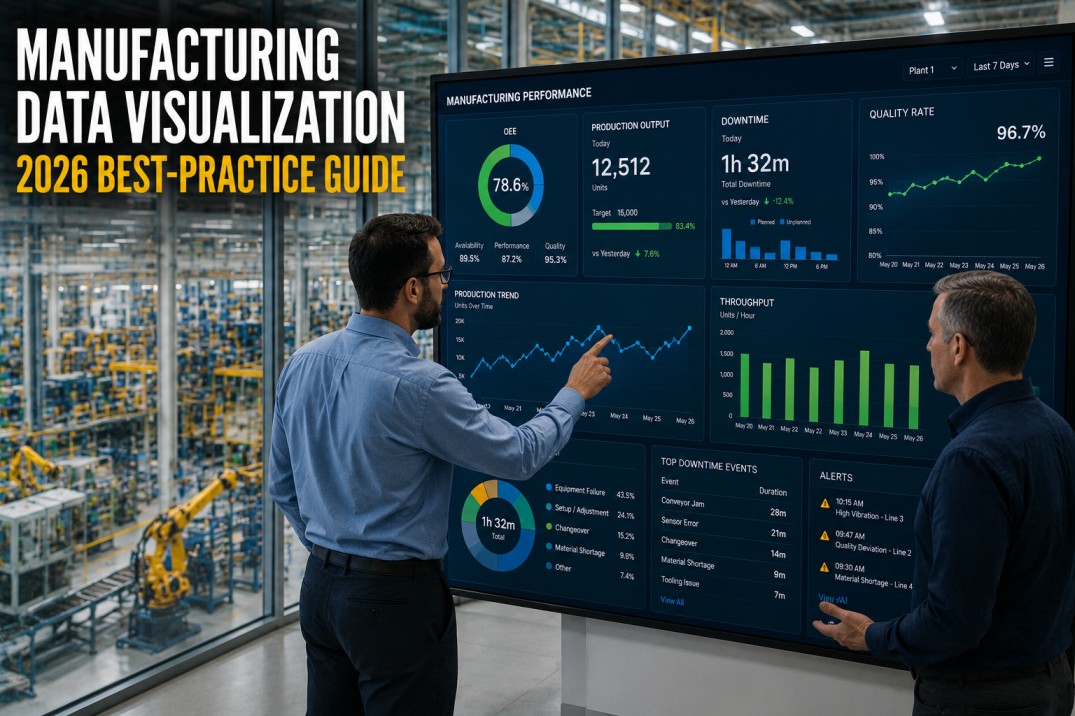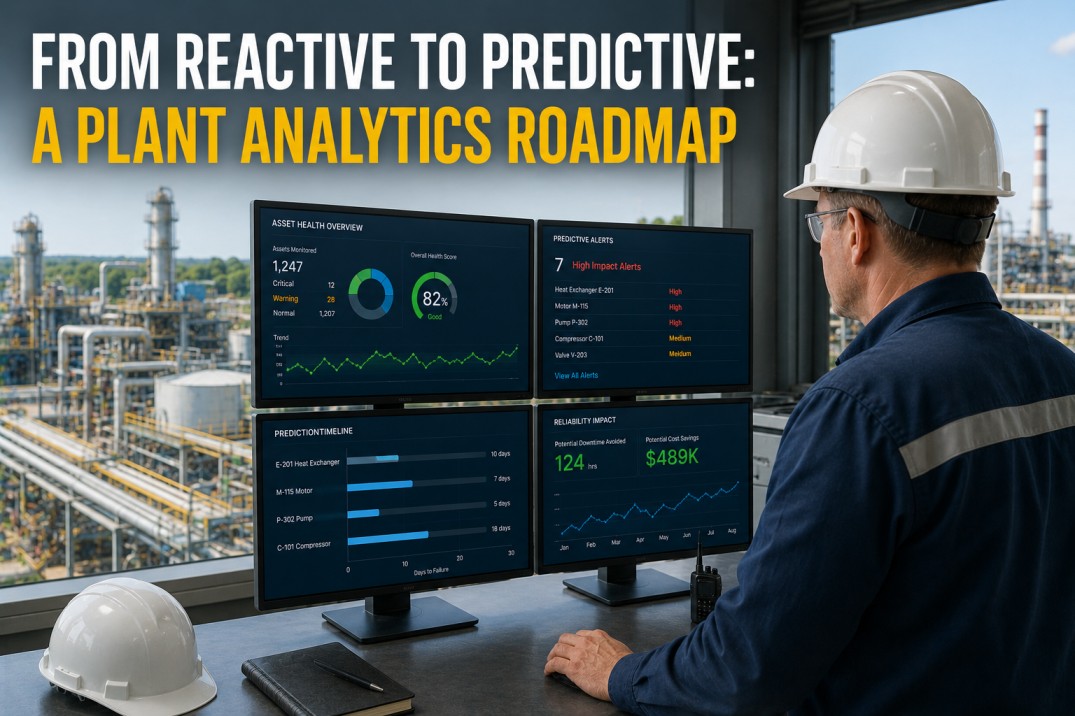
Most manufacturing plants in 2026 are stuck in a reactive analytics cycle. Data is collected passively — historians log OEE after each shift, quality reports land weekly, and downtime is analysed after the fact during morning stand-ups. The plant operates on rearview-mirror information. But a growing number of plants are breaking out of this cycle through a structured analytics transformation: a deliberate, phased roadmap from reactive reporting to predictive and prescriptive analytics. This page lays out a four-level maturity model — Reactive, Diagnostic, Predictive, Prescriptive — and the specific steps, investments, and capability shifts required to move from one level to the next. iFactory specialises in guiding manufacturers through this transformation, one plant at a time, and this roadmap reflects the patterns we see working across discrete and process manufacturing in 2026.
Start Your Journey
Move from Reactive Reports to Predictive Intelligence
Most plants operate on rearview-mirror data. iFactory helps you build a structured roadmap from reactive to predictive analytics — assessing your current maturity level, identifying quick-win capability gaps, and deploying a phased transformation that delivers measurable value at every stage. Start with a 30-minute analytics maturity assessment.
Plant Analytics Maturity: Your Starting Point
Before embarking on an analytics transformation, it is essential to measure where your plant stands today. The four metrics below represent the typical starting point for mid-size manufacturing plants — based on iFactory's benchmarks across 200+ plant assessments in 2025–2026. Use these as a reference to gauge your own baseline and the magnitude of the transformation ahead.
The Four-Level Analytics Maturity Staircase
Analytics maturity in manufacturing follows a predictable progression across four levels. Each level builds on the capabilities of the previous one, adding layers of analytical depth, data sophistication, and decision automation. The staircase diagram below shows how plants ascend from reactive reporting to prescriptive intelligence — and what each level looks like in practice on the plant floor.
Assess Your Plant
Where Does Your Plant Sit on the Analytics Maturity Staircase?
Most plants overestimate their maturity level. iFactory's analytics maturity assessment evaluates your current state across data infrastructure, analytics capabilities, team skills, and governance — then maps a phased roadmap to Level 3 and beyond in an 18-month horizon. The assessment takes 30 minutes and gives you a quantified baseline.
Six Dimensions of Analytics Readiness
Analytics maturity is not just about technology — it spans data infrastructure, tools and platforms, team skills, process maturity, governance, and organisational culture. The radar chart below compares a typical reactive plant (Level 1) against the target profile for a predictive plant (Level 3), across all six dimensions. The gap between the two polygons represents the capability uplift required — and the specific areas where investment will deliver the highest return on the journey from reactive to predictive.
How Each Capability Evolves Across Four Stages
The scrollable table below maps eight key manufacturing analytics capabilities across all four maturity levels. Each cell describes the specific state of that capability at the given stage — from manual spreadsheets at Level 1 to closed-loop AI-driven optimisation at Level 4. Use this as a diagnostic tool to identify where your plant is today and what the next level looks like for each capability.
| Capability | Level 1 — Reactive | Level 2 — Diagnostic | Level 3 — Predictive | Level 4 — Prescriptive |
|---|---|---|---|---|
| Data Collection | Manual shift logs, paper checklists | Semi-automated SCADA/MES historian | Real-time edge ingestion, all sources | Self-healing data pipelines, auto-validation |
| Data Storage | Excel files, local Access DBs | Centralised SQL warehouse | Data lakehouse with open formats | Federated fabric, multi-cloud + edge |
| Analysis Method | Manual calculations, basic charts | Dashboard drill-down, slice-and-dice | ML models, regression, clustering | Optimisation engines, causal AI |
| Reporting | Weekly static PDF reports | Self-service daily dashboards | Real-time KPI alerts, auto-narratives | Autonomous reports with recommendations |
| Quality Analytics | Defect counting after inspection | SPC charts, trend monitoring | Predictive quality drift detection | Closed-loop process adjustment |
| Maintenance Strategy | Run-to-failure, reactive repair | Calendar-based preventive maintenance | Condition-based PdM, RUL forecasts | Self-optimising maintenance scheduling |
| Decision Support | Gut feel, experience-based | Data-informed with drill-down context | Model-recommended with confidence | Automated decisions with human override |
| Governance | No formal governance | Basic naming, one data owner | Full catalog, RBAC, quality rules | Automated policy enforcement, audit trails |
Diagnose Your Gaps
Which Capabilities Are Holding Your Plant Back?
Every plant has a unique capability profile. Some excel at data collection but lack governance; others have strong teams but outdated tooling. iFactory's capability assessment maps your plant across all eight dimensions above, identifies the biggest gaps between current and next level, and prioritises the investments that will move you forward fastest.
Recommended Investment Mix at Each Maturity Stage
The allocation of budget across infrastructure, tools, people, and governance shifts significantly as a plant advances through the maturity levels. A reactive plant needs to spend heavily on foundational data infrastructure; a predictive plant invests more in ML tools and specialised talent. The donut charts below show the typical investment split at each level, based on iFactory's deployment data across 200+ plants.
Your 18-Month Analytics Transformation Timeline
The transformation from a reactive Level 1 plant to a predictive Level 3 plant typically takes 12–18 months. Reaching Level 4 prescriptive capabilities extends the horizon to 18–24 months. The phased timeline below shows the recommended sequence of activities, investment waves, and key milestones for a mid-size manufacturing plant. Every plant moves at its own pace — this timeline represents the most common pattern iFactory has observed across successful transformations.
ROI Builds at Every Stage — From Quick Wins to Compound Returns
One of the most common misconceptions about analytics transformation is that value only arrives at Level 3 or Level 4. In reality, measurable ROI starts at Level 1 — simply by replacing manual reports with automated dashboards. And each subsequent layer adds compounding returns. The four cards below show the typical ROI range at each maturity stage, how long it takes to realise, and where the value comes from.
Build Your Roadmap
Your Plant's Analytics Roadmap Starts Here
Every plant has a unique starting point, capability profile, and business context. The four-level roadmap framework above gives you the standard pattern — but your plant's path will be different. iFactory works with your team to build a customised analytics transformation roadmap: starting with a 30-minute maturity assessment, followed by a detailed gap analysis, investment plan, and phased implementation timeline tailored to your plant's data, people, and processes.
Frequently Asked Questions
How long does it take to move from Level 1 reactive to Level 3 predictive analytics?
For a typical mid-size manufacturing plant, the journey from Level 1 (reactive reporting) to Level 3 (predictive analytics) takes 12–18 months. The Foundation phase (months 1–6) focuses on building the data infrastructure — edge ingestion, data lakehouse, and real-time dashboards. The Diagnostic phase (months 5–10) adds drill-down analytics, SPC, and role-based self-service. The Predictive phase (months 9–15) deploys the first ML models for predictive maintenance, quality drift, and anomaly detection. Faster timelines are possible for plants with existing data infrastructure — or if the scope is limited to a single production line rather than an entire plant. iFactory's typical first deployment — running predictive models on one line — goes live within 12–16 weeks of project start.
Do I need a data science team to reach Level 3 predictive capabilities?
Not necessarily. At Level 2 (diagnostic), you can achieve significant value with no data science talent — just a BI-literate plant engineer or production manager who can build dashboards and interpret trends. At Level 3, the complexity depends on the use case. Many predictive models — anomaly detection on sensor data, regression-based quality prediction, threshold-based PdM — can be deployed using pre-built ML pipelines that do not require a dedicated data science team to operate. iFactory's platform includes a library of pre-trained manufacturing models that can be configured and deployed by plant engineers with basic analytics training. For advanced use cases — multi-sensor fusion, deep learning on spectra or images, causal inference — a dedicated data scientist or ML engineer is recommended, typically as a shared resource across 2–3 plants.
What is the biggest mistake plants make when trying to move from reactive to predictive?
The single biggest mistake is skipping Level 2 (diagnostic) and trying to jump directly from Level 1 to Level 3 predictive. Predictive models require clean, well-structured, time-series data with known quality characteristics — data that most Level 1 plants do not have. Without foundational data infrastructure and diagnostic analytics capabilities, predictive models produce unreliable results, eroding trust in analytics and slowing adoption. The second most common mistake is underinvesting in people and change management. Technology deployment without operator and supervisor training, dashboard adoption support, and governance processes consistently leads to shelf-ware — dashboards built but not used. The third is scope creep: trying to transform an entire plant at once instead of starting with a single line, proving value, then scaling.
How do I measure progress through the analytics maturity levels?
Progress through the maturity levels should be measured across five dimensions: (1) Data coverage — what percentage of production processes have real-time data flowing into the analytics platform; (2) User adoption — what percentage of operators, supervisors, engineers, and managers actively use dashboards and reports; (3) Decision latency — the average time between an event occurring on the plant floor and a decision being made based on analytics; (4) Model performance — for predictive levels, the precision, recall, and accuracy of deployed ML models; (5) Business impact — measurable improvements in OEE, scrap rate, downtime, energy consumption, or cost per unit. iFactory provides a maturity tracking dashboard that scores your plant across these five dimensions on a quarterly basis, producing a quantified maturity score and a prioritised list of next-step improvements to advance to the next level.
Can a single plant be at different maturity levels for different capabilities?
Yes — in fact, most plants are not uniformly at one maturity level. It is very common to see a plant with Level 3 data collection (real-time SCADA ingestion on key lines) but Level 1 governance (no data catalog, no ownership, no quality rules), or Level 2 dashboards with Level 1 maintenance strategy (run-to-failure). This is why the eight-dimension capability assessment in the progression table above is important: it reveals the uneven profile that most plants have, and helps prioritise which capability gaps to close first. iFactory's assessment methodology scores each of the eight capabilities independently and produces a radar chart showing the plant's unique maturity profile — making it easy to see where the plant is strong, where it is behind, and where the next investment dollar will have the greatest impact.
Start Today
From Reactive to Predictive — Your Plant's Roadmap is Ready
You now have the full framework: the four-level maturity model, the six-dimension capability radar, the eight-dimension progression table, the investment allocation guidance, the 18-month timeline, and the ROI projections at every stage. The next step is to apply this framework to your plant. iFactory's platform and team are purpose-built to guide manufacturing plants on this journey — from the first edge connector to the first predictive model to full prescriptive optimisation. Start with a 30-minute personalised assessment and roadmap session.