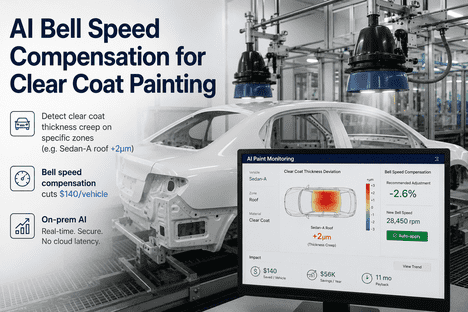
Two microns sounds like nothing. On the roof of one sedan model, painted thousands of times a month, two extra microns of clear coat is a slow, invisible leak of one of the most expensive materials in the shop. Clear coat goes on through high-speed rotary bell atomizers spinning anywhere from 10,000 to 90,000 rpm, and bell speed is one of the levers that sets how finely the paint atomizes and how thick the film lands. When a single zone starts creeping over target, no operator sees it — the car looks fine, the gloss looks fine, and the overspend just compounds. AI bell speed compensation catches that creep on the specific zone where it happens and trims the bell back to target, on-prem, before it turns into a five-figure annual bill.
iFactory AI Paint Control
AI Bell Speed Compensation for Clear Coat
Detect clear coat thickness creep on specific zones — like Sedan-A roof at +2μm — and compensate bell speed automatically to hold target film build, all on a single on-prem AI server.
+2μm
Sedan-A roof creep caught
How Two Microns Becomes Real Money
Clear coat is applied to a target film build, and every micron above that target is expensive material sprayed for no benefit. Because the overspend is microscopic and the finish still passes inspection, it hides — until you multiply it across every car, every shift, every month. The leak is silent precisely because nothing looks wrong.
Invisible
To the eye
A few microns over target still looks glossy and passes visual checks, so the overspend never triggers a reject or an alarm.
Zone
Specific
Creep shows up on one model and one panel — a roof, a hood — not the whole car, so shop-wide averages mask it entirely.
Costly
Material
Clear coat is among the most expensive coatings applied, so extra film build maps almost directly to wasted spend.
Volume
Multiplied
At line volumes, a small per-car overspend compounds into tens of thousands of dollars a year on a single zone.
Bell Speed Is the Lever
In a state-of-the-art paint shop, clear coat is laid down by electrostatic high-speed rotary bell atomizers. Bell rotational speed governs how the paint film tears into droplets at the bell edge and, together with flow and shaping air, where and how thick the film lands. Adjust the bell, and you move the film build. The problem has never been the lever — it's knowing exactly when and where to pull it.
10k-90k RPM Range
High-speed bells spin across a wide range; the operating speed shapes droplet size and film uniformity on the panel.
Speed Sets Atomization
Centrifugal force drives paint to the bell edge; rotational speed determines how finely that film breaks into droplets.
Film Build Follows
Atomization, flow, and shaping air together decide deposited thickness, so the bell is a direct handle on microns.
Per-Zone Control
Speed can be tuned for a specific model and panel, so compensation targets exactly the zone that drifted.
Want to see creep detection mapped to your own zones and bells? Book a demo and we'll walk a real thickness trend and the compensation it triggers.
From Thickness Creep to Auto-Compensation
The fix is a closed loop: measure the film, spot the drift on the specific zone, calculate the bell adjustment, and apply it — then confirm the thickness came back to target. iFactory runs that loop continuously so a creeping zone self-corrects instead of quietly overspending.
1
Measure Film Build
Thickness data is captured per zone and model, building a live picture of where each panel sits against target.
2
Detect Zone Creep
AI trends each zone and flags drift early — for example, Sedan-A roof reading +2μm over its setpoint.
3
Compute Bell Adjustment
The model calculates the bell speed change needed to bring that zone's film build back onto target.
4
Compensate & Confirm
The bell is trimmed and the next readings verify the zone returned to target — overspend stopped at the source.
The Economics, Made Concrete
The case for compensation is not abstract — it is a per-vehicle number that rolls up to an annual figure and a payback you can put in front of finance. This is what catching one creeping zone looks like on the books.
$140
Per vehicle
clear coat overspend recovered on the affected zone, per car
$56K
Per year
that per-car saving multiplied across annual production volume
11 mo
Payback
the recovered material cost pays back the system inside a year
+2μm
The trigger
a creep this small is all it takes to justify compensation
Want this modeled on your volumes and clear coat cost? Talk to our paint team and we'll build the per-vehicle and annual numbers for your zones.
On-Prem AI, Inside Your Firewall
Paint recipes, film-build setpoints, and process data are core manufacturing IP. The iFactory AI runs on a pre-configured edge server on-premise, with all processing inside your firewall and no external egress required to operate. The integration with paint-shop data is read-only by design, so there is no path from outside into your control systems — compensation recommendations stay local, and so does your data.
All Processing On-Site
Thickness trending and compensation run on the in-plant edge server; nothing about your paint process leaves the building.
Read-Only Integration
Connections to paint and quality data are strictly inbound — no external egress, no path into control systems from outside.
Real-Time Edge Decisions
Local edge inference trends zones and computes adjustments fast enough to act while the line keeps running.
Your Recipes Stay Yours
Film-build setpoints and recipe data are sensitive IP and remain on-prem, satisfying data residency by architecture.
What Bell Speed Compensation Delivers
Catching creep at the zone level converts directly into recovered material, steadier film build, and a payback that defends itself. These reflect what compensating a single drifting zone delivers on a high-volume clear coat line.
$140
Per-vehicle saving
overspend trimmed on the affected zone, car after car
On target
Film build held
zones kept at setpoint instead of quietly drifting over
Earlier
Creep caught
drift flagged before it compounds into annual waste
11mo
To payback
recovered clear coat pays the system back inside a year
Curious which of your zones are creeping right now? Talk to our paint team and benchmark your film-build data against AI compensation.
Frequently Asked Questions
How does AI detect creep on a specific zone like a roof?
It trends film-build thickness per zone and per model rather than relying on a shop-wide average. Because creep typically shows up on one panel of one model — a roof at +2μm over setpoint, for instance — zone-level trending is what surfaces it. A drift that small never triggers a visual reject, so without per-zone analytics it stays invisible while the overspend compounds.
Why adjust bell speed instead of something else?
Clear coat is applied by high-speed rotary bell atomizers, and bell rotational speed is a direct lever on how finely the paint atomizes and how thick the film lands. Together with flow and shaping air it sets the deposited film build, so trimming the bell on the affected zone moves that zone's thickness back to target without disturbing the rest of the car.
Where do the $140 and $56K numbers come from?
They illustrate a single creeping zone: roughly $140 of clear coat overspend recovered per vehicle on the affected zone, which multiplied across annual production volume rolls up to about $56K per year, paying the system back in around 11 months. The exact figures depend on your volumes and clear coat cost, which we model with you during a demo.
Does this touch our paint control systems or expose our recipes?
No. The AI runs on a pre-configured edge server on-premise with all processing inside your firewall, and the integration with paint-shop data is read-only — inbound only, with no external egress and no path into control systems from outside. Film-build setpoints and recipes are sensitive IP and stay local, so data residency is satisfied by the architecture itself.
How do we get started?
The fastest way to see fit is a demo on your own film-build data. We'll show zone-level creep detection, map the bell speed compensation it would trigger, and build the per-vehicle and annual savings numbers against your volumes and clear coat cost. Book a slot and bring one model and zone you suspect is drifting.
Stop Spraying Money Onto the Roof.
See Bell Speed Compensation on Your Line
Bring one model and zone you suspect is creeping. We'll show AI trending the film build, flagging the drift, computing the bell speed adjustment, and confirming the return to target — plus the per-vehicle and annual savings, all on an on-prem AI server inside your firewall.
On-prem
inside your firewall