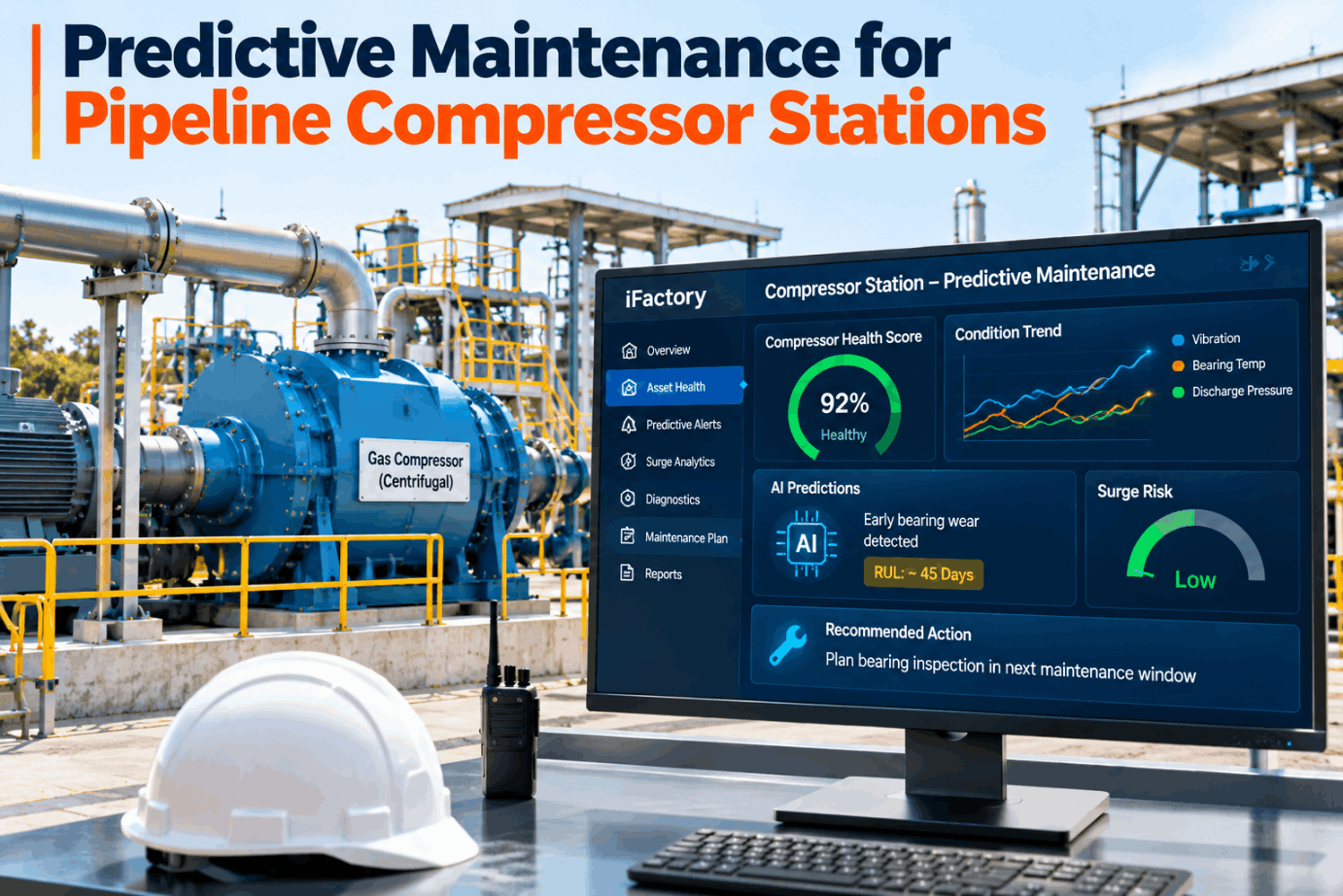
Predictive Maintenance for Pipeline Compressor Stations

By David Cook on November 3, 2026

predictive-maintenance-pipeline-compressor-stations

A transmission compressor station rarely fails all at once. A discharge valve starts to leak, a dry gas seal vents a little more each week or a turbine's exhaust spread widens, and the signs sit in separate systems until a unit trips. Predictive maintenance for pipeline compressor stations brings those signals together for each unit, so you can fix problems in a window you choose. See how it reads your own units in a 30-minute station review.

MIDSTREAM COMPRESSION · PREDICTIVE MAINTENANCE

Every Unit on One Health Board, Before a Trip Costs Firm Capacity

iFactory reads vibration, valve temperatures, PV curves, seal vents and surge margin for centrifugal, reciprocating and driver equipment. It scores each unit, explains what changed and suggests the earliest sensible window for the repair.

CS-07 · Station health2 of 3 running
Firm load needs two units · scores refreshed hourly
88
Unit ACentrifugal · GT driverRunning
63
Unit BRecip · 4 throwsRunning · flagged
91
Unit CRecip · standbyStart-tested
Unit BCyl 2 HE discharge valve · +14 °C vs peers
Illustrative values · valve change proposed for Saturday window
CENTRIFUGAL VS RECIPROCATING UNITS

Two Machine Families Behind One Station Rating

Mainline transmission stations often run centrifugal compressors driven by gas turbines or electric motors, while many storage sites, laterals and older stations rely on reciprocating units driven by gas engines or motors. The two families wear out in different ways and give different warning signs. API 617 (9th edition, 2022) covers axial and centrifugal compressors, and API 618 (6th edition, 2024) covers reciprocating compressors in gas service. Talk through your station's mix with our compression support team.

RECIPROCATING UNITS
  • Gas engine or electric motor driver
  • Positive displacement: capacity set by speed, clearance pockets and unloaders
  • Wear parts: valves, rings, rider bands, packing and crosshead
  • Key signals: valve cover temperature, PV curves, rod load and rod position
CENTRIFUGAL UNITS
  • Gas turbine or electric motor driver
  • Dynamic machine: flow and head follow speed and the performance map
  • Risk areas: dry gas seals, bearings, surge and the turbine hot section
  • Key signals: shaft vibration and position, seal vent flow, surge margin and exhaust spread
A note on ISO 13631

ISO 13631 is sometimes listed as a monitoring standard. It is actually the specification for packaged reciprocating gas compressors, so it matters when you buy or repackage a unit, not as a rulebook for condition monitoring.

COMPRESSOR STATION PREDICTIVE MAINTENANCE

Failure Modes Worth Watching on Each Unit

Most station trips trace back to a short list of components. The matrix pairs each one with the first signal that usually moves and the field check that confirms it. An AI flag is a reason to look, not a diagnosis, so every row ends with a human check. Walk your own failure history through this list in a failure mode session.

Component
Unit
How it degrades
Early signal
Field check
Suction and discharge valves
Recip
Broken plates or springs, fouled seats, leakage
Valve cover temperature above peer valves; PV curve shape
Ultrasonic listening, then valve inspection at a stop
Piston rings and rider bands
Recip
Wear lets gas bypass and the piston settle
Rod position trend; falling cylinder efficiency
Ring and band check at the next overhaul
Rod packing
Recip
Ring wear and rod scoring
Rising packing vent flow and case temperature
Vent flow measurement; rod surface check
Crosshead and pin
Recip
Bushing distress when rod load does not reverse enough
Calculated rod load and reversal; crosshead vibration
Bushing clearance check; oil sample
Dry gas seals
Centrifugal
Face damage, liquids or oil reaching the seal
Primary vent flow and pressure trend
Seal panel review; seal gas filter and dew point check
Journal and thrust bearings
Centrifugal
Wear, oil breakdown, misalignment
Shaft vibration, axial position, bearing metal temperature
Orbit and spectrum review; oil analysis
Surge
Centrifugal
Flow reversal at low flow or high head
Shrinking margin to the surge control line; recycle valve activity
Controller event log; performance map check
Combustion and hot section
GT driver
Nozzle faults, blade damage, compressor fouling
Exhaust temperature spread; heat rate drift
Borescope inspection; water wash results
COMPRESSOR VIBRATION ANALYSIS AND BEYOND

Six Signal Streams the Model Reads Together

Vibration is only one channel. API 670, the machinery protection standard most recently revised in 2025, covers shaft vibration, axial position, speed, piston rod position, overspeed and surge, plus critical temperatures. ISO 20816-8 sets vibration evaluation for reciprocating compressor systems, mainly to protect foundations and piping from fatigue, and leaves condition monitoring out of its scope. iFactory reads the protection rack, the recip analyzer and the controllers side by side. Check which tags you already have with our support team.

CentrifugalShaft vibration and positionProximity probe orbits, 1× and 2× trends and thrust position, read against speed and load.
RecipValve cover temperaturesEach valve compared with its peers on the same cylinder end, so ambient and load swings cancel out.
RecipPV curves and rod loadCrank-angle pressure traces show valve and ring losses; rod load and reversal are worked out every revolution.
CentrifugalDry gas seal vent flowPrimary vent flow and pressure trended against suction pressure and speed.
CentrifugalAnti-surge marginDistance from the surge control line and how often the recycle valve opens.
GT driverExhaust spreadSpread across exhaust thermocouples, plus heat rate, to catch combustion and hot section issues.
COMPRESSOR SURGE PREDICTION

Seeing Surge Margin Shrink Before the Recycle Valve Has To Act

The anti-surge controller protects the machine. It opens the recycle valve when the operating point nears the surge control line, and it should stay in charge. What it does not do is explain why margin has been shrinking for a week. iFactory trends margin against suction pressure, gas composition and speed, and flags slow drift from fouling, an off-design operating range or a faulty transmitter. See a margin trend replayed in a surge analytics demo.

Unit A · lowest daily surge marginIllustrative week
Mon19%0 recycle openings
Tue17%0 recycle openings
Wed15%1 recycle opening
Thu13%2 recycle openings
Fri12%3 recycle openings
TrendDown 7 points in 5 days
Check firstSuction transmitter and gas composition
OwnerStation reliability engineer

Margin definitions vary between controller makers. iFactory uses your controller's own definition rather than inventing a new one.

Know Which Unit Can Wait and Which Cannot

iFactory scores each unit, explains the score in plain words and suggests the earliest sensible window. Your reliability engineer still makes the call, with the evidence in front of them.

CS-07 · Station supervisor and iFactory
SupervisorCan Unit B run until the Saturday window?
iFactoryProbably. The Cyl 2 head-end discharge valve cover is 14 °C above its peers and the PV curve shows some recompression loss, but the gap has held steady for three days.
SupervisorWhat would change that?
iFactoryIf the gap passes your 20 °C alert setting or rod load reversal falls, start Unit C and take B off early. Two valve assemblies are on the shelf.
TARIFF COMMITMENT PROTECTION

Firm Service, Spare Units and an Honest Look at Commercial Risk

Interstate pipelines sell firm transportation under tariffs approved by FERC. Under FERC's reservation charge crediting policy, shippers generally receive full credits when primary firm service is not delivered for reasons other than force majeure, and routine maintenance is not treated as force majeure. So a forced outage that cuts firm service has a direct cost, and so does planned work that overruns. Predictive maintenance cannot promise a number, but it gives earlier notice and better choices. Review your own exposure with our operations support team.

Earlier noticeWarning ahead of many wear-related failures, though not sudden ones such as a broken valve plate with no prior trend.
Spare unit readinessStandby units start-tested and scored, so a swap is a plan rather than a hope.
Posted maintenanceWork grouped into windows you can post to shippers ahead of time, as your tariff requires.
Evidence trailAlerts, decisions and work orders linked for outage reviews and audits.
What we will not claim

There is no outage reduction percentage on this page. Results depend on your fleet, spares, staffing and how quickly alerts become work orders, so measure them on your own stations.

PLANNED OUTAGE WINDOW

From First Flag to a Clean Weekend Valve Change

When a fault grows slowly, the best fix is a planned one. This illustrative sequence shows how a valve alert becomes a short, planned outage instead of a trip on a cold morning. Real timing depends on your parts, crews and notice rules. Plan your own window rhythm with our reliability planners.

Day 0FlagDischarge valve cover 14 °C above peers; engineer reviews the PV curve.
Day 2ConfirmUltrasonic check on the valve cover agrees; work order raised.
Day 4PrepareValve kit staged, Unit C start-tested, window agreed with gas control.
Day 6NotifyGas control confirms capacity holds; notice posted only if firm capacity is affected.
Day 8Fix and verifyValve changed, then PV curve and temperatures checked against peers before release.
STATION RELIABILITY SOFTWARE INPUTS

The Data Sheet Each Unit Needs Before Go-Live

Good predictions start with clean, well-labelled data. Most stations already collect what is needed in a historian, a protection rack and a recip analyzer, so new sensors are usually the exception. The sheet below shows what we map for each unit. Ask our integration team for a blank copy.

Unit and typeUnit B · separable recip, 4 throws
DriverNatural gas engine with its own control panel
Protection tagsFrame and crosshead vibration, rod position per throw
Analyzer channelsCylinder pressure by crank angle, valve cover temperatures
Process dataSuction and discharge pressure and temperature, speed, flow
Gas qualityChromatograph feed for composition and specific gravity
Work historyCMMS orders and parts used over the last three years
Alert ownerStation reliability engineer, daily review
COST AND ROI WORKSHEET

Sizing the Exposure With Your Own Numbers

The value of compressor station predictive maintenance depends on spare capacity, contract terms and repair costs, so it has to be sized from your own records. Every input below is assumed, and each sum is shown so you can check it. Swap in real values during a worksheet session.

Firm volume not scheduled during a forced outage120,000 Dth/d, assumed
Reservation rate credited back$0.25 per Dth per day, assumed
Outage length2 days, assumed
Credit exposure120,000 × $0.25 × 2 = $60,000
Call-out and expedited parts premium$15,000, assumed
Exposure per forced outage$60,000 + $15,000 = $75,000

If a spare unit carries the load, curtailment and credits may be zero, and the case rests on repair cost and risk. Do not apply a reduction rate to this figure unless your own history supports one.

TURNKEY AI DEPLOYMENT

A Racked Server and Station Models, Shipped Ready

iFactory ships a pre-configured NVIDIA AI server racked and ready, with compressor and driver models pre-loaded and read-only links to your historian, protection system and controllers. You rack it, plug in power and Ethernet, and the AI is live. Nothing leaves site, because the server sits behind your station network controls. Ask our deployment team how it fits your network.

What's Included
  • Pre-configured NVIDIA AI server, racked and ready
  • Read-only connectors for historian, protection rack and recip analyzer
  • Unit models for centrifugal, reciprocating and GT driver equipment
  • Surge margin analytics using your controller's definition
  • Health board for each station and each unit
  • Alert routing to reliability staff and CMMS work requests
  • Remote support for models and hardware
Live in 6–12 weeks
Wk 1–4
Connect and Map

Tags mapped for each unit, data quality checked and failure history reviewed.

Wk 5–8
Baseline and Shadow

Models learn normal behaviour per unit and run silently while engineers review flags.

Wk 9–12
Go Live

Health board and alerts switched on, with outage-window planning in weekly reviews.

HOW iFACTORY FITS

Predictive Maintenance and Surge Analytics for Midstream Compression

iFactory adds an analytics layer beside your protection and control systems. It never trips, loads or unloads a unit by itself. Try it against your own historian data in a pilot planning call.

1
Scores every unit. Health scores for centrifugal, recip and driver equipment, explained in plain words.
2
Watches surge margin. Margin drift and recycle activity trended against operating conditions.
3
Plans the window. Alerts turned into kitted work orders timed for planned outages.
4
Keeps people in charge. Protection and anti-surge control stay in your existing systems.
1000+
Industrial clients running iFactory
99.9%
Platform uptime for round-the-clock stations
6-12 wks
From racked server to live unit scores
FREQUENTLY ASKED QUESTIONS

What Station Managers Ask About Compressor Predictive Maintenance

Does iFactory replace our machinery protection system or anti-surge controller?
No. Your API 670 protection system and anti-surge controller stay exactly as they are and keep their trip and recycle authority. iFactory reads their data, finds slow trends and explains them. It never sends a trip or changes a set point.
Which signals matter most on reciprocating units?
Valve cover temperatures compared across peers, PV curves from cylinder pressure, rod load and reversal, rod position and packing vent flow. Together they separate a leaking valve from worn rings or packing. You can see a recip diagnosis walked through on sample data.
Can AI predict surge on centrifugal compressors?
It can show that margin is shrinking and suggest why, which gives you time to act. Moment-to-moment protection stays with the anti-surge controller, which reacts far faster than any analytics layer. Treat the AI as an early warning measured in hours and days, not a replacement for the controller.
Will this cut our station outages by a set percentage?
We do not quote one. Results depend on fleet age, spares, staffing and how quickly alerts become work. What you can measure is how many failures were flagged before a trip and how many repairs moved into planned windows. Our support team can help set up those measures.
We run older integral engine-compressors. Can they be covered?
Usually, yes. Many older units already have a portable or online analyzer and basic vibration switches. We start with what exists and suggest a short list of added sensors only where a failure mode is blind. Book a 30-minute review with your unit list.
What does a first pilot look like?
Start with one station that has a mix of units and a known pain point, such as recurring valve failures or a seal that keeps alarming. Connect the historian, run the models silently for a few weeks and compare flags with what your technicians find. Then map out that pilot with our team.

Run Every Unit With a Clear Health Picture

Bring centrifugal, reciprocating and driver data into one station view, see surge margin drift early and move repairs into windows you choose. Delivered turnkey and live in 6 to 12 weeks.


Example station summary · CS-07
Units scored3 of 3, hourly
Open flags1 · Unit B discharge valve
Lowest surge marginUnit A, 12% this week
Next windowSaturday, 06:00–14:00
Valve kit staged · Unit C start-tested

Share This Story, Choose Your Platform!