An under-processed retort cycle doesn't look like a problem on the day it happens — the can seals fine, the case ships, and the only evidence is a calculated F0 value that quietly fell short of the scheduled process. For low-acid canned foods, the FDA's 12D standard requires a minimum F0 of 3 minutes at 121.1°C, calculated across the entire come-up, hold, and cooling profile — not just the time the retort sat at temperature. Get that calculation wrong, or lose visibility into a sensor drift mid-cycle, and the product moving to the warehouse carries a real Clostridium botulinum risk with no visible sign of failure. 21 CFR Part 113 exists precisely because this gap is invisible without rigorous, continuous monitoring tied directly to the scheduled process filed with FDA. iFactory's thermal processing platform connects retort temperature and pressure data straight into F0 calculation, deviation flagging, and process authority documentation — so cold-spot lethality is verified in real time, not reconstructed after the fact. Book a Demo.
F0 Value: What It Actually Measures and Why the Math Matters
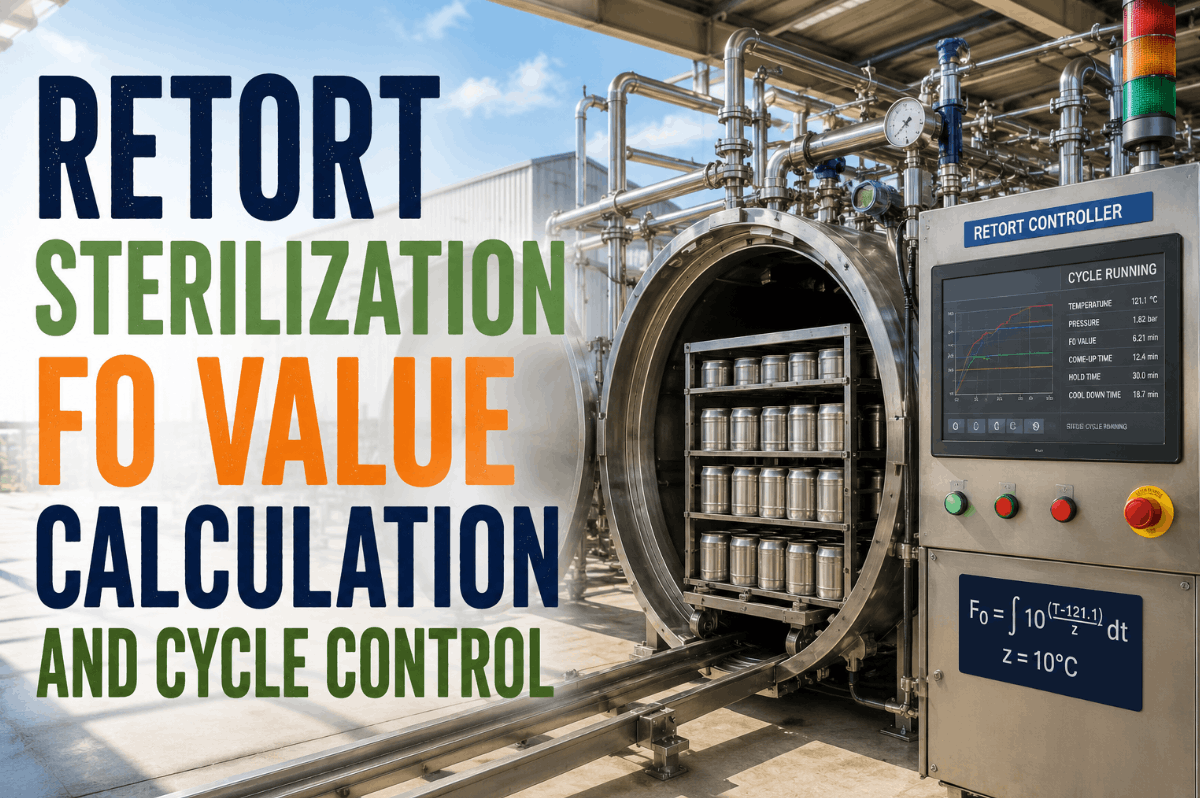
The F0 value is the total accumulated lethality of a thermal process, expressed as the equivalent number of minutes at the reference temperature of 121.1°C. It is not simply the hold time at retort temperature — it integrates lethality contributed during come-up time, the full hold period, and even part of the cooling phase, because heat continues killing spores as long as the product's cold spot is above a biologically significant temperature. The industry standard for low-acid canned foods is a minimum F0 of 3 minutes, which delivers a 12D reduction in Clostridium botulinum spores — a 99.9999999999% population reduction. The relationship between temperature and required time follows the z-value: because C. botulinum's z-value is 10°C, every 10°C increase in process temperature reduces the time needed to hit the same F0 by a factor of ten, which is the entire logic behind high-temperature-short-time processing.
What makes F0 calculation operationally difficult is that it depends on the temperature at the product's cold spot — the slowest-heating point inside the container — not the retort chamber temperature. A thick, chunky stew heats differently than a thin broth; a glass jar distributes heat differently than a metal can or retort pouch; and any unplanned variation in fill weight, headspace, or initial product temperature can shift the delivered F0 without the retort's own gauges showing anything unusual.
The Five Phases of a Retort Cycle Every F0 Calculation Must Account For
A scheduled process is built around the full cycle, not just the hold phase, and a deviation in any one of these five stages can shift the delivered F0 below the filed minimum even if the hold time and temperature look correct on the chart.
Initial Product Temperature
21 CFR 113 requires the initial temperature of container contents to be accurately determined and recorded before processing, since a colder-than-scheduled starting point extends the time needed to reach lethal temperature at the cold spot.
Come-Up Time
Come-up time is the elapsed period between steam introduction and the retort reaching its scheduled processing temperature. This phase contributes real lethality to the F0 total and must be tracked precisely, not assumed constant cycle to cycle.
Hold Time at Process Temperature
The core sterilization phase, where the retort is held at the scheduled temperature for the filed duration. Even brief temperature dips during this phase reduce instantaneous lethality and must be captured to calculate the true delivered F0.
Cooling Phase Lethality Carryover
The product's cold spot continues to receive lethal heat exposure for a period into the cooling phase, since internal temperature lags behind the retort's cooling water. This contribution is part of the total F0 and cannot be ignored in the calculation.
Critical Factor Verification
Headspace, fill weight, consistency, and container size are critical factors filed with the scheduled process — deviation in any of them changes the heat penetration profile even if the retort itself runs exactly on schedule. Book a Demo to see automated critical factor tracking.
Batch Retort vs. Continuous and Hydrostatic Systems: What Changes for F0 Control
The equipment configuration determines exactly which parameters 21 CFR 113 requires you to record, and the monitoring discipline that protects F0 delivery differs meaningfully across system types. Request a custom retort monitoring mapping.
| Retort Type | How Containers Move | Key Monitored Parameters | Primary F0 Risk |
|---|---|---|---|
| Batch Still Retort | Loaded in baskets/crates, processed as a fixed batch | Retort temperature, come-up time, vent schedule, bleeder operation | Uneven heat distribution across the load if venting is incomplete |
| Agitating Retort | Containers rotate or agitate during the cycle | Agitation speed, retort temperature, headspace, fill consistency | Agitation speed deviation directly changes heat penetration rate |
| Hydrostatic (Continuous) | Continuous chain conveyor through steam/water legs | Steam chamber temperature, water leg temperatures, chain speed | Chain speed drift changes residence time without an obvious alarm |
| Aseptic Processing | Product sterilized before aseptic fill into pre-sterilized containers | Holding tube outlet temperature, flow rate, retention time | Flow rate variance changes actual product retention time at lethal temperature |
What Happens When a Cycle Deviates from the Scheduled Process
21 CFR 113 is explicit about what must happen when a retort cycle fails to satisfy the minimum requirements of the filed scheduled process — and the obligation falls on the processor regardless of whether the deviation was caught in real time or discovered later in a records review.
Under 21 CFR 113, any process deviation — including emergencies like a jam or breakdown in a continuous agitating retort — must be recorded and made the subject of a separate deviation file. The affected product must then be evaluated by a process authority; unless that evaluation demonstrates the product received a thermal process sufficient to render it free of microorganisms of public health significance, the product must be fully reprocessed to commercial sterility or destroyed. There is no middle option, and there is no shortcut around the documentation. iFactory closes the practical gap here: continuous F0 calculation flags an under-target cycle the moment it's detected, automatically opens the deviation record, and routes the affected lot to hold status before it can reach the warehouse. Explore Deviation Management.
Core Capabilities: Real-Time F0 Tracking and Scheduled Process Compliance
iFactory is built to sit directly on top of your retort instrumentation, turning raw temperature and pressure data into a continuously verified lethality record rather than a chart someone reviews after the fact.
Live F0 Calculation Engine
Cold-spot temperature data streams continuously into the F0 integration calculation, giving operators a running lethality total throughout come-up, hold, and cooling — not a number reconstructed at end of cycle.
Scheduled Process Digital Library
Every filed scheduled process — by product, container size, and retort type — is stored digitally and checked automatically against the live cycle to confirm critical factors stay within filed limits.
Automated Deviation Flagging
If a cycle's calculated F0 falls short, or a critical factor like headspace or initial temperature drifts out of range, the affected lot is automatically flagged for process authority review before release.
Audit-Ready Records Package
Processing and production records required under 21 CFR 113.100 — retort temperature, come-up time, critical factor checks — are compiled automatically into one exportable, FDA-ready record set.
Where Retort Sterilization Programs Lose Control of F0
Most thermal processing incidents trace back to a small set of recurring gaps — not equipment failure, but a breakdown in the discipline of recording and reacting to the data the retort is already generating.
"We had chart recorders on every retort and thought our F0 calculations were solid because nothing ever looked wrong on the paper trace. After a heat penetration study revealed our come-up time was running longer than our validated schedule assumed, we realized we'd been under-calculating delivered F0 for months without a single visible deviation. Connecting our retort data to iFactory's live F0 engine gave us our first real confidence that every lot leaving the plant actually hit the lethality our process authority filed." — Plant Quality Manager, Regional Canned Foods Processor
Building a Defensible F0 Monitoring Program: The Deployment Path
Moving from chart-recorder review to real-time F0 verification is a structured rollout, not a single equipment swap. Schedule a thermal processing audit.
Scheduled Process Digitization
Every filed scheduled process and its critical factors are loaded into the platform, by product, container, and retort, establishing the baseline every live cycle is checked against.
Retort Instrumentation Connectivity
Temperature, pressure, and time data from existing retort recorders are connected into iFactory, capturing come-up, hold, and cooling phase readings continuously.
Live F0 Calculation Activation
The platform begins calculating running F0 totals in real time against each scheduled process, surfacing the delivered lethality value before the cycle even completes.
Deviation Routing and Hold Logic
Any cycle falling short of its filed F0 minimum automatically generates a deviation record and places the affected lot on hold pending process authority evaluation.
Audit-Ready Records Rollout
Processing and production records consolidate automatically into the format 21 CFR 113.100 requires, ready for FDA inspection or internal quality review on demand.
Frequently Asked Questions: F0 Value and Retort Cycle Control
What F0 value is required for low-acid canned foods?
The industry standard minimum is an F0 of 3 minutes at 121.1°C, delivering a 12D reduction in Clostridium botulinum spores per FDA guidance.
Does come-up time count toward the F0 calculation?
Yes — come-up time contributes real lethality and must be measured accurately each cycle rather than assumed constant from the original validation study.
What must happen if a retort cycle deviates from the scheduled process?
21 CFR 113 requires the deviation to be recorded and the affected product evaluated by a process authority; it must be fully reprocessed or destroyed unless proven commercially sterile.
How does iFactory calculate F0 in real time?
iFactory streams cold-spot temperature data continuously and integrates lethality through come-up, hold, and cooling phases, surfacing the running F0 total during the cycle.
Can the platform handle batch, agitating, and hydrostatic retorts differently?
Yes — each retort type's specific required parameters under 21 CFR 113.100 are configured individually, from agitation speed to hydrostatic water leg temperatures.