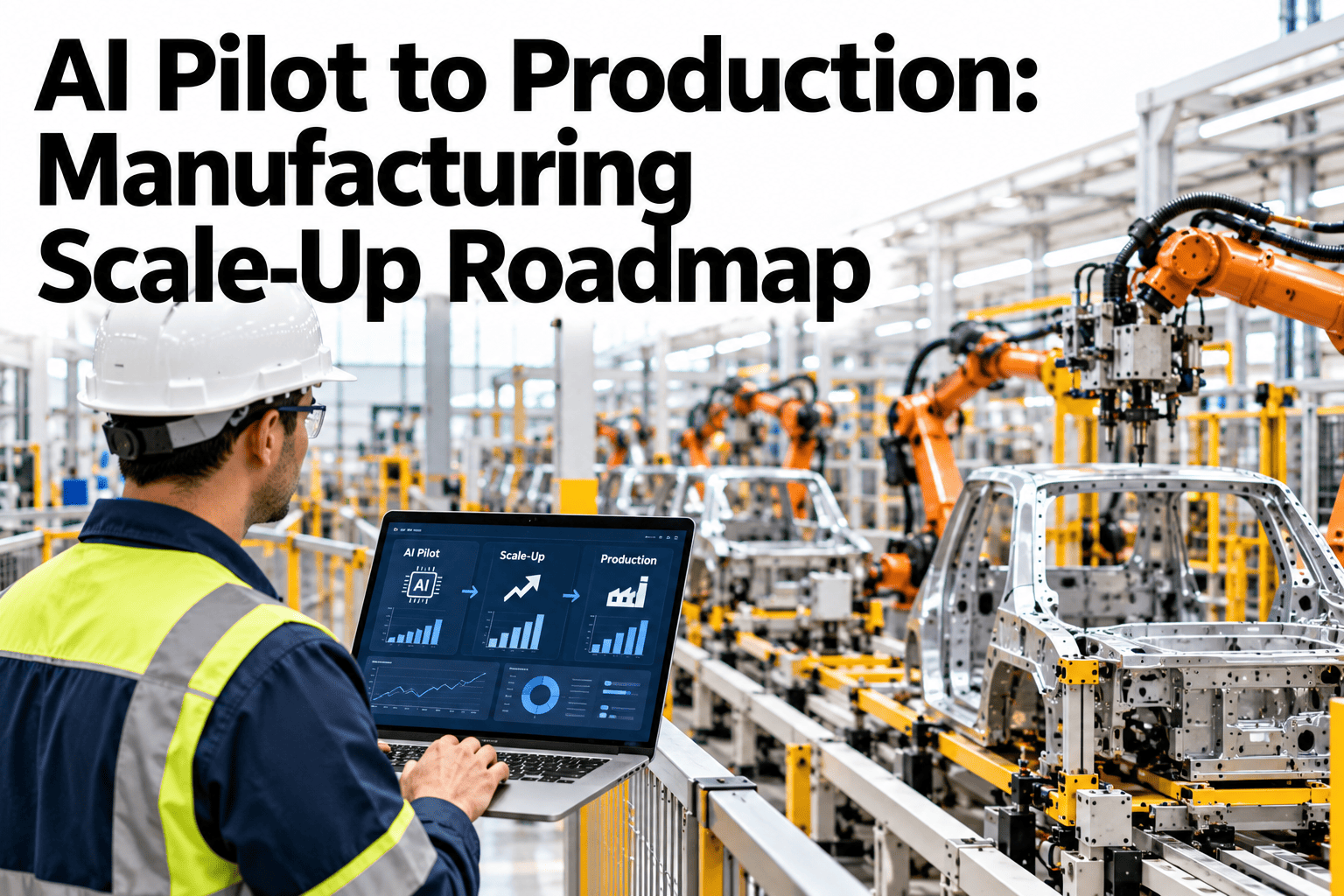
Most manufacturing AI pilots work. That is rarely the problem. The problem is what happens after the pilot succeeds, when a model that performed well on one line, with one engineer babysitting it, has to survive contact with a second shift, a third plant and a maintenance team that was never part of the original project. Scaling from pilot to production is a different exercise than building the pilot itself, with its own data, deployment and ownership questions. Plant and digital transformation leaders can map their own pilot against a production-ready checklist on iFactory AI before committing to a wider rollout.
A Successful Pilot Is Not a Production System Yet
iFactory AI maps the gap between a working pilot and a system that survives a second shift, a third line and a team that wasn't in the room for version one.
What Breaks Between Pilot and Production
A pilot's clean dataset rarely matches the messy, variable data a second line produces.
Pilots often run with an expert catching edge cases manually, a step production can't rely on.
Production usually spans more variation than the pilot's narrow scope covered.
Nobody is formally responsible for the model once the project team disbands.
A model that was accurate at launch degrades quietly without a process to catch it.
Pilots succeed on narrow, supervised conditions. Production demands the opposite.
A Production-Readiness Checklist
| Area | Pilot Stage | Production Requirement |
|---|---|---|
| Data | Curated, single source | Validated across lines, shifts and variation |
| Monitoring | Manual review by the project team | Automated drift and accuracy tracking |
| Ownership | The pilot's champion | A named operational owner after rollout |
| Failure handling | Engineer intervenes directly | A defined fallback when the model is uncertain |
| Scope | One line, one product | Validated against the full production range |
Score Your Own Pilot Against This Checklist
Bring your pilot's current state to a 30-minute session and see which gaps need closing before a wider rollout.
Four Stages, Not One Jump
Prove the concept on one line with close supervision.
Test against broader data and less hand-holding.
Add monitoring, fallback logic and named ownership.
Roll out to additional lines or plants with the same rigor.
A Composite Scenario: The Pilot That Stalled at One Line
Picture a defect-detection pilot that performs well for six months on Line 2, with the project engineer reviewing every flagged image personally. When the team tries to extend it to Line 5, accuracy drops and nobody owns the fix.
A structured scale-up plan, built before the pilot even starts, would have flagged the need for broader training data and a monitoring process before the second line went live, instead of discovering the gap mid-rollout.
Where iFactory AI Fits
Validates against real variation
Tests a model's performance across lines, shifts and product mix, not just the pilot's conditions.
Builds in monitoring
Tracks accuracy and drift automatically once a model goes live.
Defines the fallback
Sets a clear path for low-confidence cases instead of silent failure.
Assigns ownership
Hands the model to an operational owner, not just the original project team.
Expert Review
An industrial AI implementation consultant's perspective, reviewed for accuracy before publication: the single best predictor of whether a manufacturing AI pilot ever scales is whether anyone planned for scale before the pilot started. Projects that treat the pilot as a standalone proof of concept, with no plan for data breadth, ownership or monitoring, tend to stall exactly at the point of success. Reviewing the scale-up plan before launch, not after, is what separates the pilots that go somewhere.
Frequently Asked Questions
Why do successful pilots often fail to scale?
A pilot typically runs under favorable conditions: curated data, an engineer who catches edge cases manually, and a narrow scope of one line or one product. Production removes all three supports at once, so a model that looked production-ready may simply never have been tested against the conditions it now faces. See how your own pilot's conditions compare to full production in a short session.
How much additional data is needed to go from pilot to production?
It depends on how narrow the pilot's original scope was and how much variation exists across the lines, shifts and products the production system needs to cover. A pilot trained on one product variant will generally need meaningfully broader data before it can be trusted across the full product range. Ask for an assessment of the data gap between your pilot and full scope.
Who should own an AI system once it moves to production?
Ideally a named operational role, such as a reliability or quality lead, rather than the original project team, which often disbands or moves to the next initiative once the pilot succeeds. Without a named owner, model drift and edge cases tend to go unnoticed until they cause a visible problem. Explore how ownership should be structured for your rollout.
What happens when the model encounters something it wasn't trained on?
A production-ready system needs a defined fallback for low-confidence situations, whether that means flagging for human review, defaulting to a conservative action, or alerting a specific role. Without this, the model either makes a silent wrong call or stops functioning in a way nobody notices until downstream effects appear. Try a review of fallback logic appropriate for your use case.
How long does a realistic pilot-to-production timeline take?
Timelines vary widely based on how much data validation, monitoring infrastructure and organizational alignment are needed, and whether the rollout covers one additional line or an entire plant network. A phased approach, validating and hardening before each expansion, tends to be more reliable than an aggressive single jump. Join a session that scopes a realistic timeline for your own rollout.
Give Your Pilot a Real Path to Production
iFactory AI validates, hardens and scales manufacturing AI systems past the point where most pilots stall. Book a walkthrough on your own pilot.