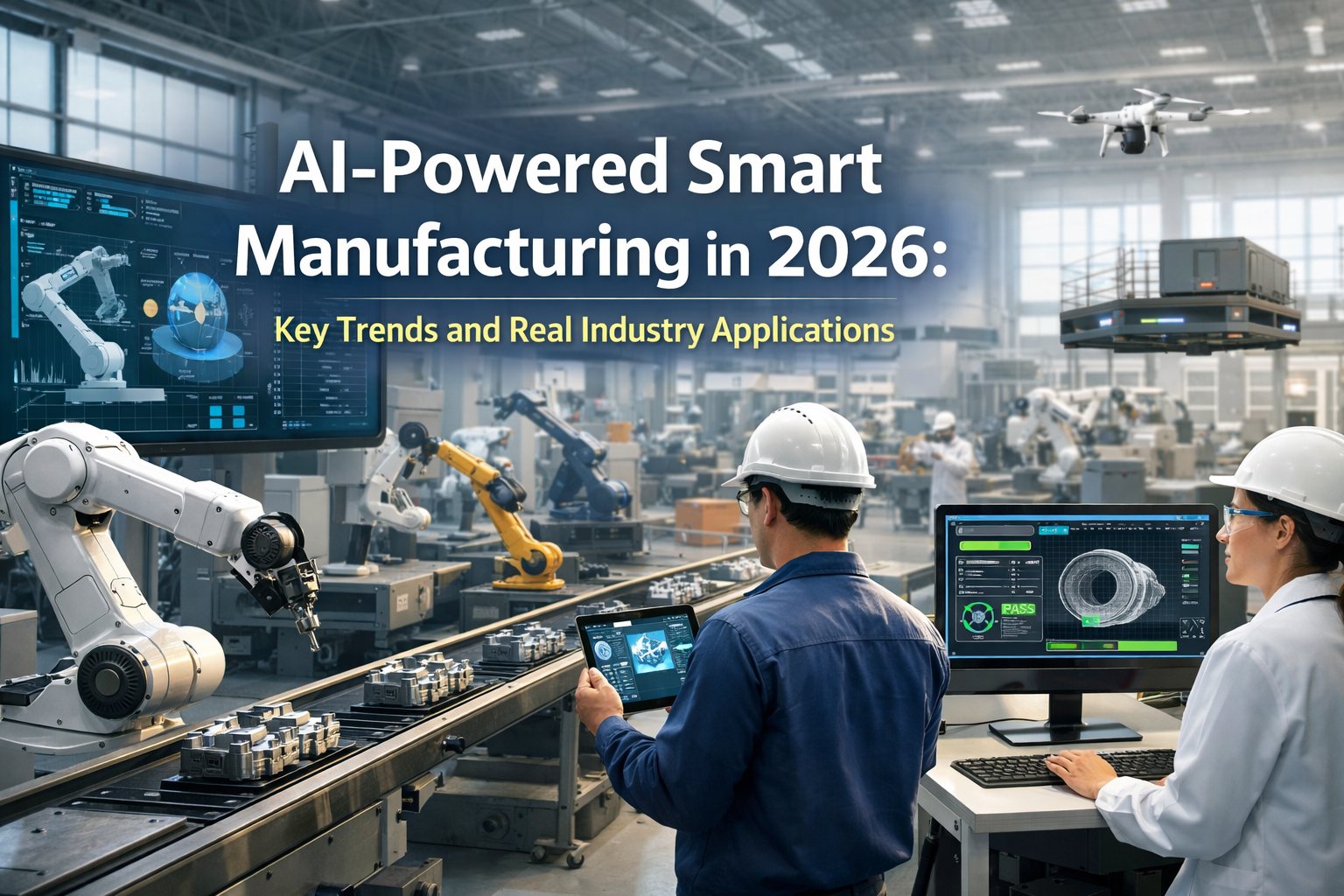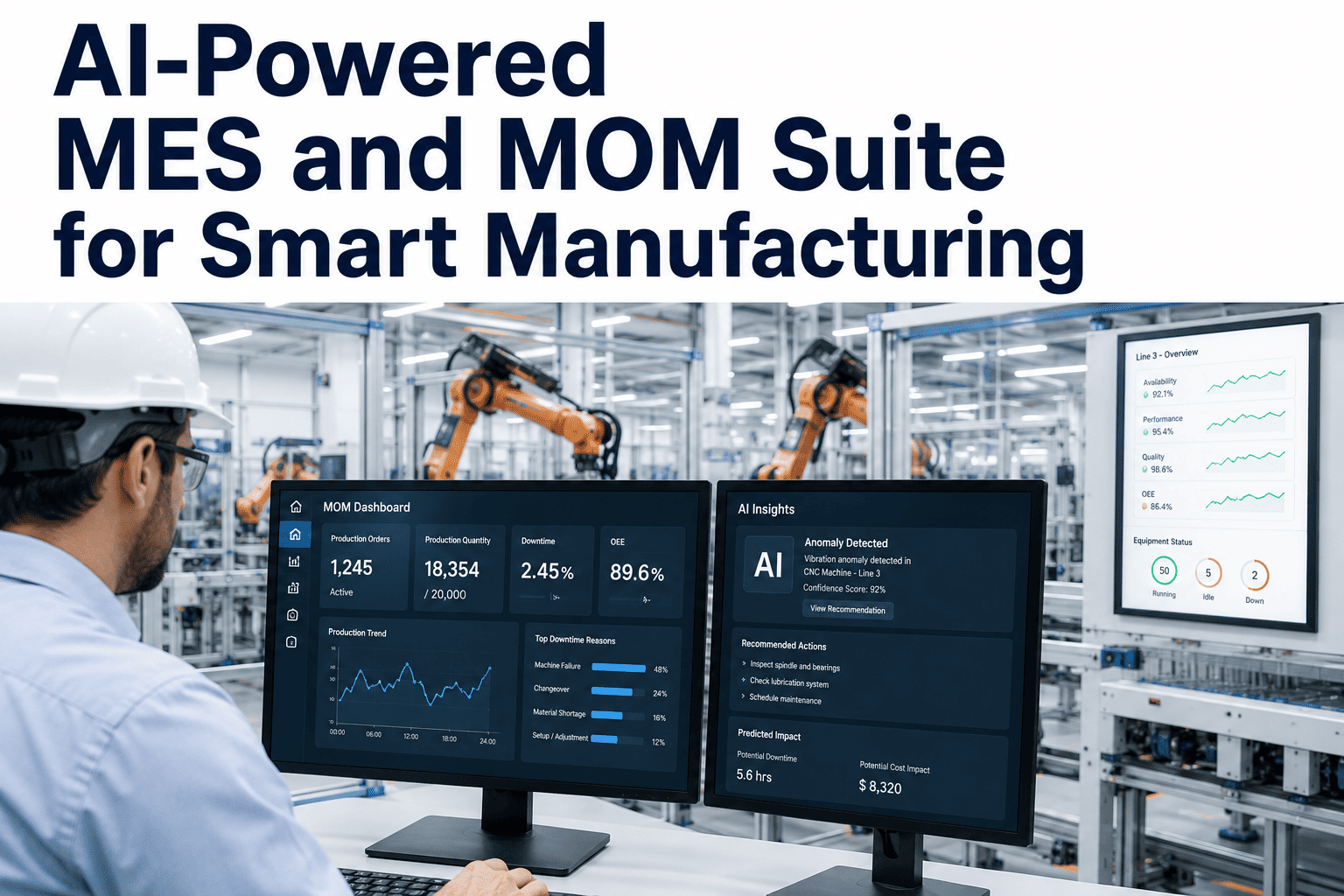
Most plants don't run on one system, they run on several: a scheduling spreadsheet, a separate quality database, a paper traveler for traceability, and a production tracking tool that doesn't talk to any of the others. Each piece does its job reasonably well in isolation, but the moment someone needs to trace a quality issue back to the specific shift, operator, and material lot involved, the gaps between systems turn a five-minute lookup into a multi-day investigation. An AI-powered MES and MOM suite brings scheduling, quality management, traceability, and real-time operations into one connected platform, so the answer to a traceability question is a query instead of a hunt across four different tools. A short session with our team can walk through what that consolidation looks like against your current system landscape.
Smart Factory Platform · MES / MOM Suite
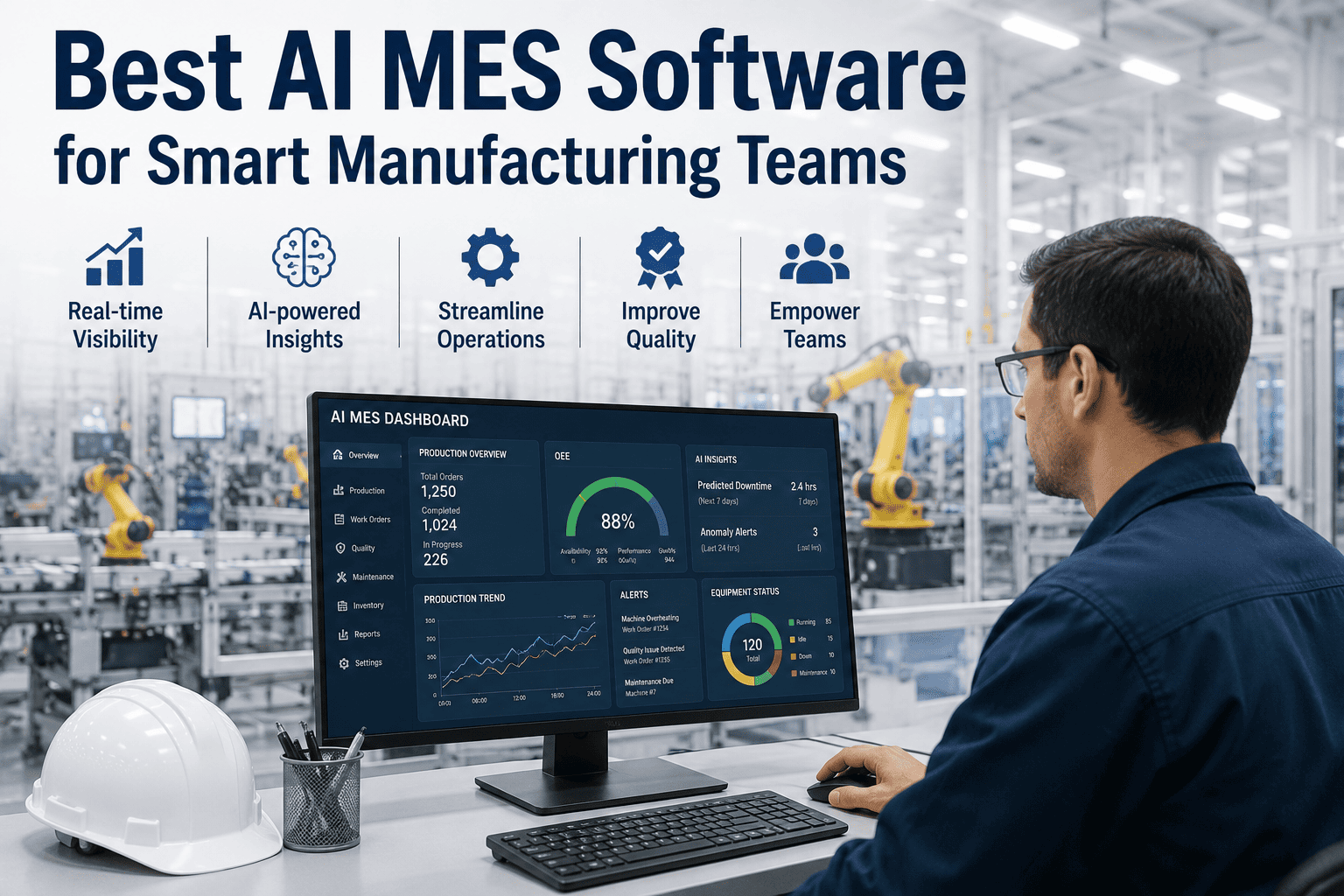
AI-Powered MES and MOM Suite for Smart Manufacturing
Production scheduling, quality management, traceability, and real-time operations unified in one platform, replacing the patchwork of spreadsheets and disconnected tools most plants still run on with a single connected source of truth.
1
connected platform instead of several disconnected tools
Real Time
production and quality visibility across the floor
Full
lot-level traceability from material to finished unit
The Fragmentation Problem
When Every System Owns a Piece of the Story, Nobody Owns the Whole Story
A production scheduling tool knows what's supposed to run and when. A quality database knows what passed and what didn't. A paper traveler or a separate traceability log knows which material lots went into which units. Each system was likely a reasonable choice at the time it was adopted, solving a specific problem for a specific team. The issue is that manufacturing questions rarely respect those boundaries. A customer complaint about a specific unit needs the schedule, the quality record, and the material lot all connected together, and when those three things live in three different systems that were never designed to talk to each other, someone on the quality team has to manually stitch the story back together, often under time pressure with a customer waiting on an answer.
What's Included
Four Core Modules Working From the Same Data
The value of a unified suite isn't any single module in isolation, it's that all four draw from and write to the same underlying data, so a change in one shows up correctly everywhere else instead of requiring a manual update across systems.
Production Scheduling
Plans and sequences work orders against real machine and labor capacity, adjusting automatically as actual production data comes in.
Quality Management
Captures inspection results, non-conformances, and corrective actions directly against the work order and material lot involved.
Traceability
Tracks every material lot and component from receiving through to the finished unit, genealogy included, without a manual paper trail.
Real-Time Operations
Shows live production status, downtime, and throughput across the floor in a single view instead of a shift-end summary.
See a Traceability Query Answered in Seconds, Not Days
Most plants have never seen what a full material-to-unit trace looks like when it doesn't require stitching together four separate systems by hand. A short session shows what that looks like for your process.
A Unit's Journey Through One System
From Scheduled Work Order to Traceable Finished Unit
Watching a single unit move through a unified MES shows why keeping everything connected matters more than any individual module's features.
Scheduled
Work order sequenced against real capacity and released to the floor with material lots reserved.
In Production
Real-time status tracks the unit through each station, logging cycle time and any stoppages automatically.
Inspected
Quality results attach directly to the unit and its material lots, flagging any non-conformance immediately.
Traceable
Complete genealogy from raw material to finished unit available in a single query, no manual reconstruction needed.
Applied Example
How a Supplier Material Issue Gets Contained in Hours Instead of Days
Consider a plant that receives notice from a raw material supplier that a specific lot shipped with a quality deviation, and needs to know immediately which finished units contain material from that lot. Under a fragmented system, this typically means someone pulling receiving records to find which work orders used the lot, then cross-referencing paper travelers or a separate production log to identify which specific units were built during those work orders, then checking a third system to confirm which of those units have already shipped. Each handoff between systems introduces delay and risk of human error in the matching. With a unified MES, the same question becomes a single traceability query: search the material lot number, and the system returns every work order, every unit, and every shipment status connected to that lot immediately, because the genealogy was captured automatically as the units moved through production rather than reconstructed after the fact from disconnected records.
Fragmented Systems vs Unified Suite
What Changes When Everything Draws From One Data Source
A fragmented system landscape and a unified suite can technically capture the same underlying data, but how easily that data can be connected and queried is where the practical difference actually shows up.
Fragmented Systems
Each tool holds its own piece of the story, requiring manual cross-referencing to answer any question spanning multiple areas.
Partial Integration
Some systems connect through periodic exports or manual syncs, reducing but not eliminating the lag and error risk.
Unified MES/MOM Suite
Scheduling, quality, traceability, and operations share one live data source, answering cross-functional questions instantly.
What's Actually at Stake
Where System Fragmentation Actually Costs a Manufacturer
The most visible cost of fragmentation shows up during exactly the moments a plant can least afford delay: a customer quality complaint, a supplier recall notice, or a regulatory audit, all of which demand a fast, accurate answer to a question that spans multiple disconnected systems. Beyond those acute moments, fragmentation carries a steady background cost in double-entry labor, since data captured in one system often needs to be manually re-entered or reconciled in another, consuming hours that never show up as a single line item but add up considerably across a year. There's also a decision-quality cost that's easy to underestimate: a scheduling decision made without live visibility into current quality and downtime data is a decision made on stale information, and stale information tends to produce schedules that look reasonable on paper but don't hold up against what's actually happening on the floor. Onboarding new staff carries an outsized cost in a fragmented environment too, since a new hire has to learn not just one system but the specific workarounds and manual handoffs that have grown up around stitching several disconnected tools together, institutional knowledge that rarely gets written down anywhere.
Most plants I've consulted with didn't set out to build a fragmented system landscape, it happened gradually, one tool adopted to solve one specific problem at a time, over years. Nobody sat down and decided traceability should live in a separate paper system from quality data, it just ended up that way because each system got adopted in isolation. The hard part of fixing it isn't technical anymore, the technology to unify these functions exists and works well. The hard part is committing to the migration, because untangling years of fragmented process takes real discipline even when everyone agrees the end state is better.
Solveig Marchetti-Okonkwo
Manufacturing Systems Consultant · 17 years implementing MES across discrete and process plants
Common Questions
AI-Powered MES and MOM Suite — Frequently Asked
These are the questions operations and IT leaders tend to ask first before consolidating onto a unified MES and MOM platform.
Do we have to migrate everything at once, or can this be phased?
Most implementations move in phases, typically starting with the module addressing the most acute pain point, whether that's traceability, quality, or scheduling, and expanding from there rather than requiring a single disruptive cutover across every function at once. This phased approach also lets a team validate the platform on a smaller scope before committing to a full rollout. Book a demo to discuss a phased rollout sequence for your plant.
Can this integrate with our existing ERP system?
Yes, the platform is designed to connect with common ERP systems rather than duplicate the business and financial data ERP already owns, focusing instead on the shop-floor execution layer that most ERP systems weren't built to handle in detail. That keeps a clear division of responsibility between the two systems instead of creating a new data conflict. Contact support to review integration options for your specific ERP.
How does traceability actually get captured without manual data entry?
Material lot and genealogy data gets captured automatically as units move through scheduled production steps, pulling from barcode or lot scans already part of the receiving and production process rather than requiring a separate manual logging step. This is what keeps the traceability record accurate, since it's built from the same actions operators are already performing rather than an additional task layered on top. Book a session to see the traceability capture workflow in detail.
What happens to our existing paper-based quality records?
Historical paper records can typically be digitized and imported as a reference archive, while all new quality data captures directly in the platform going forward, giving a plant a clean transition point without losing access to prior history. Many plants find the digitization process itself surfaces gaps in historical recordkeeping worth addressing anyway. Ask our team about migrating existing quality records.
How long does a typical MES implementation take?
Timeline depends heavily on scope and how many existing systems need to be integrated or replaced, with a single-module pilot often running considerably faster than a full multi-site rollout across scheduling, quality, and traceability at once. Starting with a focused pilot is usually the fastest way to get a realistic timeline for the full rollout. Book a call to scope a realistic timeline for your plant.
Stop Stitching Answers Together From Four Different Systems
iFactory unifies scheduling, quality management, traceability, and real-time operations into one connected platform, so the answer to a cross-functional question is a query instead of a multi-day investigation.