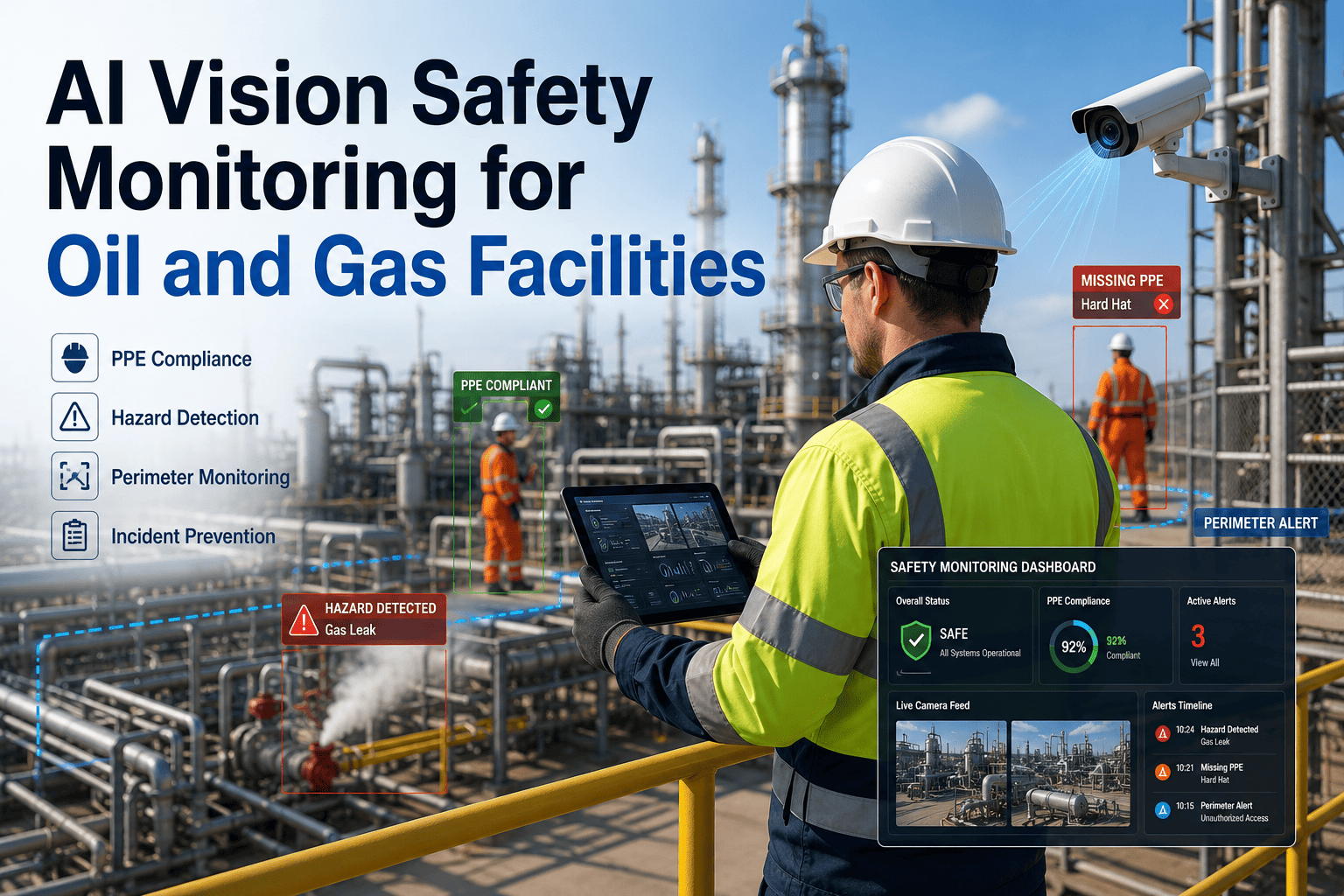
A refinery or offshore platform runs on hundreds of cameras already, but most of that footage is only ever reviewed after an incident, not before one. Manual safety audits and periodic walkthroughs simply cannot maintain consistent oversight across a fast-moving industrial site with explosive gases, rotating equipment, and constant personnel movement. Computer vision changes that equation by watching every zone continuously instead of during scheduled rounds, catching the missing hard hat or the unauthorized entry into a restricted zone the moment it happens — book a demo to see it running on your own camera feeds.
Oil & Gas · AI Vision Camera
AI Vision Safety Monitoring for Oil and Gas Facilities
Continuous computer vision monitoring for PPE compliance, restricted zone breaches, and proximity hazards — built on the cameras already installed at your site.
62%
Reported violation reduction within 30 days of deployment
24/7
Continuous coverage impossible through manual rounds alone
20%
Decline in safety-related incidents reported after AI deployment
What the System Watches For
Each detection category runs continuously in the background, sending an alert only when a genuine violation or hazard condition is confirmed.
PPE Compliance
Hard Hats, Vests & Gloves
Flags any worker entering a monitored zone without the required protective equipment for that specific area.
Zone Security
Restricted Area Breaches
Detects unauthorized entry into high-hazard zones such as tank farms, wellheads, and confined spaces.
Proximity Hazards
Equipment & Vehicle Proximity
Alerts when a worker moves within an unsafe distance of rotating equipment or moving vehicles on site.
Behavior Monitoring
Unsafe Acts
Identifies patterns such as bypassed guarding, unsafe lifting posture, or working at height without fall protection.
Coverage Across a Typical Facility
1
Tank farm and wellhead perimeter — restricted access and PPE checks for anyone crossing the boundary.
2
Process units and rotating equipment — proximity alerts around pumps, compressors, and turbines.
3
Loading and offloading bays — vehicle and personnel proximity during active transfer operations.
4
Confined space entry points — verification that entry permits and PPE requirements are being followed.
Fatigue, distraction, and shift pace all reduce human observation, but they never reduce the risk itself. A camera that never blinks catches what a rushed safety round on a large site inevitably misses.
What Facilities Report After Deployment
62%
Reduction in recorded PPE violations within the first 30 days of continuous AI monitoring going live.
Seconds
Time from a detected violation to a supervisor alert, replacing end-of-shift written reports.
20%
Decline in safety-related incidents reported by operators using AI-driven visual monitoring across production sites.
Manual Safety Rounds vs. Continuous AI Monitoring
| Factor | Manual Safety Rounds | AI Vision Monitoring |
|---|
| Coverage | Periodic, scheduled walkthroughs | Continuous, every zone, every shift |
| Alert speed | End-of-shift written report | Instant alert to supervisor device |
| Consistency | Varies by observer fatigue and pace | Same detection standard every time |
| Audit trail | Paper logs, hard to cross-reference | Timestamped video evidence per event |
Frequently Asked Questions
Do we need to install new cameras for AI vision monitoring to work?
In most cases the existing CCTV infrastructure already installed across the facility is sufficient, since the AI analysis runs on the video stream rather than requiring specialized hardware at each camera. A site assessment typically confirms camera placement and coverage gaps before deployment, and additional cameras are only recommended for zones with genuinely poor existing visibility.
Book a demo to review your current camera coverage against monitoring requirements.
How does the system avoid false alerts from normal work activity?
Detection zones and rules are configured per area based on the actual PPE and access requirements for that specific location, so a worker correctly wearing required gear in a low-risk zone does not trigger unnecessary alerts. The models are also trained to distinguish momentary occlusion, such as a worker briefly turning away from the camera, from a genuine sustained violation.
Contact support to discuss zone-specific rule configuration for your site.
Who receives the alerts when a violation is detected?
Alerts route to the safety officer or shift supervisor responsible for that zone, typically through a dashboard, mobile notification, or SMS depending on site preference, and can escalate automatically if not acknowledged within a defined window. This closes the loop between detection and actual corrective action rather than leaving violations to be discovered later in a report.
Book a demo to see the alert routing and escalation options.
Can this help with OSHA and ISO 45001 compliance reporting?
Yes, every detected event is logged with a timestamp and supporting video evidence, which significantly simplifies incident investigations and routine compliance reporting compared with reconstructing events from memory or incomplete paper logs. Facilities operating across multiple sites can also generate standardized reports for consistent regional compliance requirements.
Contact support for details on compliance reporting formats.
Does AI vision monitoring replace our safety officers?
No, it is designed to extend the reach of the safety team rather than replace it, providing continuous visibility across areas and shifts where manual presence is not practically feasible around the clock. Safety officers still make the judgment calls and lead corrective action, but they act on immediate, evidence-backed alerts instead of relying solely on periodic observation.
Book a demo to see how the system fits alongside your current safety team structure.
See What Your Cameras Have Been Missing
Continuous AI-powered PPE, zone, and proximity monitoring built on the camera infrastructure you already have installed.