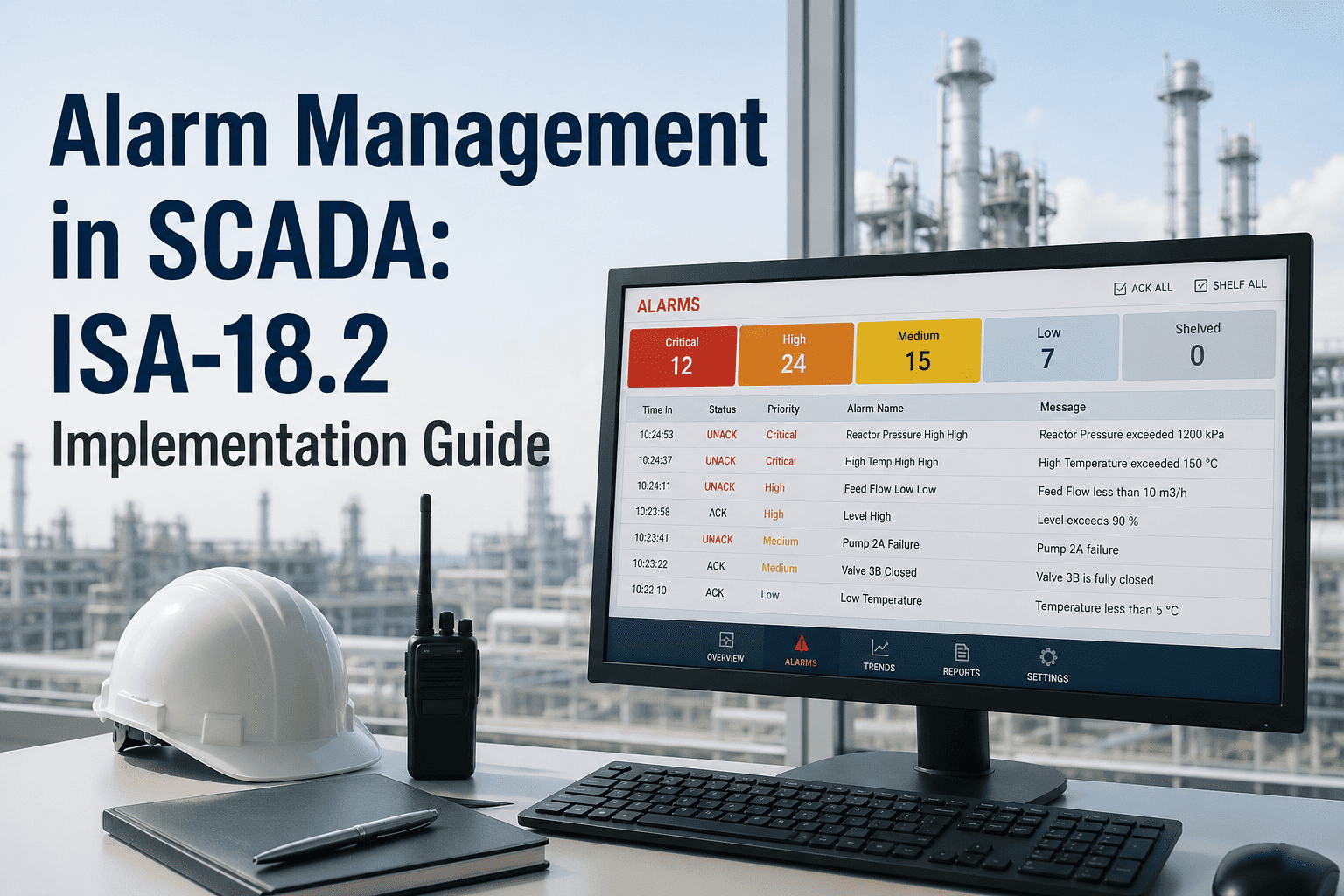
Every minute your SCADA system fires an unactionable alarm, your operators are one step closer to alarm fatigue — and your facility one step closer to an unplanned shutdown that costs $260,000 per hour or more. ISA-18.2 compliance is not a regulatory checkbox. It is the operational firewall between controlled production and catastrophic failure. Yet 78% of industrial facilities still run alarm systems designed in the 1990s, generating floods of low-priority noise that bury the one critical alert that matters. The cost of inaction is not theoretical: it is measured in unplanned downtime, HSE violations, and regulatory fines that dwarf the entire cost of a modern alarm rationalisation programme.
iFactory PLC/SCADA Integration
ISA-18.2 Alarm Management for SCADA: The Complete Implementation Guide
Reduce alarm floods by up to 80%, eliminate nuisance alerts, and protect your operators with a structured rationalisation programme built on ISA-18.2 standards and iFactory's SCADA integration intelligence.
80%
Alarm flood reduction with ISA-18.2 rationalisation
150+
Max annunciated alarms per operator per shift (ISA target)
6 wk
Typical Phase 1 rationalisation timeline
3–5×
ROI on alarm management programmes within 12 months
What Is ISA-18.2 and Why It Defines Modern Alarm Management
ISA-18.2 — the Management of Alarm Systems for the Process Industries standard — establishes a lifecycle framework for designing, implementing, and continuously improving industrial alarm systems. Adopted globally by refining, chemical, pharmaceutical, and food and beverage manufacturers, it defines how alarms should be rationalised, prioritised, and suppressed to ensure operators receive only actionable, meaningful alerts during abnormal process conditions.
The standard's core premise is straightforward: an alarm exists to notify an operator that a process deviation requires action within a defined response time. Any alert that does not meet this definition is not an alarm — it is noise. ISA-18.2 provides the vocabulary, metrics, and governance structure to systematically eliminate that noise from your SCADA environment.
≤1
Alarm per 10 minutes (ISA steady-state target)
≤10
Alarms in any 10-min peak period
≤5%
Chattering alarms as share of total alarm count
≤1%
Suppressed alarms at any given time
The Four Most Costly Alarm System Failure Modes
Before implementing ISA-18.2, operators must understand the specific failure patterns that erode alarm system effectiveness. Each has a measurable operational cost.
Alarm Flooding
Hundreds of simultaneous alarms during process upsets. Operators cannot triage fast enough, critical alerts are missed, and incidents escalate. The 2005 Texas City refinery explosion was preceded by multiple alarm flood conditions.
Chattering Alarms
Alarms that trigger and clear repeatedly within seconds due to process variability near setpoints. Each chatter event consumes operator attention and trains personnel to ignore entire alarm categories — including legitimate critical alerts.
Stale Alarms
Acknowledged alarms that remain active for hours or days without resolution. They normalise abnormal conditions, desensitise operators to alarm states, and mask early indicators of equipment deterioration that predictive analytics would otherwise surface.
Misconfigured Priorities
High-priority tags assigned to low-consequence conditions. When everything is critical, nothing is. Operators learn to ignore priority designations entirely, eliminating the triage hierarchy that ISA-18.2 is specifically designed to enforce.
ISA-18.2 Alarm Lifecycle: The Seven-Stage Framework
ISA-18.2 defines alarm management as a continuous lifecycle, not a one-time configuration exercise. Each stage feeds the next, creating a governance loop that systematically improves alarm system performance over time.
01
Philosophy
Define the alarm management principles, roles, responsibilities, and performance targets for your facility. Establishes what constitutes a valid alarm, priority definitions, and acceptable response times.
02
Identification
Systematically identify all potential alarm conditions across every PLC and SCADA node. iFactory's integration layer ingests alarm configuration data from OPC-UA, Modbus, and proprietary historian exports automatically.
03
Rationalisation
Review every alarm against the ISA definition: does it require operator action within a defined response time? Eliminate nuisance alarms. Reclassify priorities. Document consequences and required responses in the Master Alarm Database.
04
Basic Alarm Design
Configure deadbands, on/off delays, and suppression logic in SCADA to eliminate chattering. Apply state-based alarm suppression to prevent alarm floods during known process transitions such as startup, shutdown, and product changeover.
05
Advanced Alarm Design
Implement dynamic alarming, alarm shelving workflows, and consequence-based prioritisation. iFactory's AI layer correlates alarm patterns with asset health data to surface predictive alerts before threshold breaches occur.
06
Implementation
Deploy rationalised alarm configurations to SCADA without production disruption. iFactory's staged rollout methodology validates alarm performance against ISA KPIs before site-wide deployment, protecting operational continuity.
07
Monitoring and Benchmarking
Continuously track alarm rate, flood frequency, chattering counts, and stale alarm duration against ISA-18.2 KPIs. Monthly performance reports identify regression and drive the rationalisation cycle to repeat on the worst offenders.
Legacy Alarm Management vs. ISA-18.2 Optimised: The Operational Gap
The difference between an unreformed alarm system and an ISA-18.2 programme is not incremental. It is the difference between operators reacting to noise and operators managing processes. The table below maps the specific operational gaps that drive unplanned downtime, HSE risk, and maintenance cost in legacy environments.
| Dimension |
Legacy Friction |
ISA-18.2 Optimised |
| Alarm Volume |
300–2,000+ alarms per operator per shift |
≤150 annunciated alarms per shift (ISA target) |
| Priority Distribution |
60–80% of alarms tagged High or Critical |
≤5% Critical, ≤15% High, remainder Low/Advisory |
| Chattering Control |
No deadband or delay configuration; alarms fire on raw signal |
Deadbands, on-delays, and hysteresis eliminate repetitive triggers |
| Flood Management |
All alarms annunciate during upsets, overwhelming operators |
State-based suppression silences non-actionable alarms during transitions |
| Stale Alarm Tracking |
No systematic review; acknowledged alarms persist indefinitely |
Automated stale alarm escalation after defined response window |
| Operator Guidance |
Alarm fires with tag name and value only |
Master Alarm Database provides consequence, required action, and response time |
| Predictive Integration |
Alarms are reactive — process has already breached setpoint |
AI-generated predictive alerts fire 14–21 days before threshold breach |
| Performance Reporting |
No structured KPI tracking; issues discovered post-incident |
Monthly ISA-18.2 KPI dashboard with trend analysis and bad actor reports |
| Regulatory Compliance |
No audit trail; alarm philosophy undocumented |
Full Master Alarm Database, rationalisation records, and change history |
How iFactory's PLC/SCADA Integration Accelerates ISA-18.2 Implementation
Implementing ISA-18.2 from scratch is a multi-month engineering exercise when done manually. iFactory's PLC/SCADA integration layer compresses the rationalisation timeline by automating the most labour-intensive steps: alarm inventory extraction, bad actor identification, and performance benchmarking.
Automated Alarm Inventory
- Ingests alarm configuration from OPC-UA, Modbus TCP, and SCADA historian exports automatically
- Identifies chattering, stale, and flood-prone tags without manual log analysis
- Generates prioritised bad actor list ranked by alarm contribution percentage
- Delivers ISA-18.2 gap assessment in days, not weeks
AI-Enhanced Rationalisation
- Machine learning correlates alarm history with actual process events to validate consequence severity
- Recommends deadband and delay settings based on observed signal noise characteristics
- Flags alarms with no associated operator response in historical records for potential deletion
- Reduces manual rationalisation workload by up to 60% compared to traditional methods
Continuous KPI Monitoring
- Real-time ISA-18.2 performance dashboard tracks alarm rate, flood events, chattering counts, and stale alarms
- Monthly bad actor reports identify regressions and drive the next rationalisation cycle
- Automated alerts when facility KPIs breach ISA acceptable thresholds
- Audit-ready reporting for ISO 55000, OSHA PSM, and ESG documentation requirements
See how iFactory integrates with your SCADA system and delivers ISA-18.2 compliance.
Book a Demo
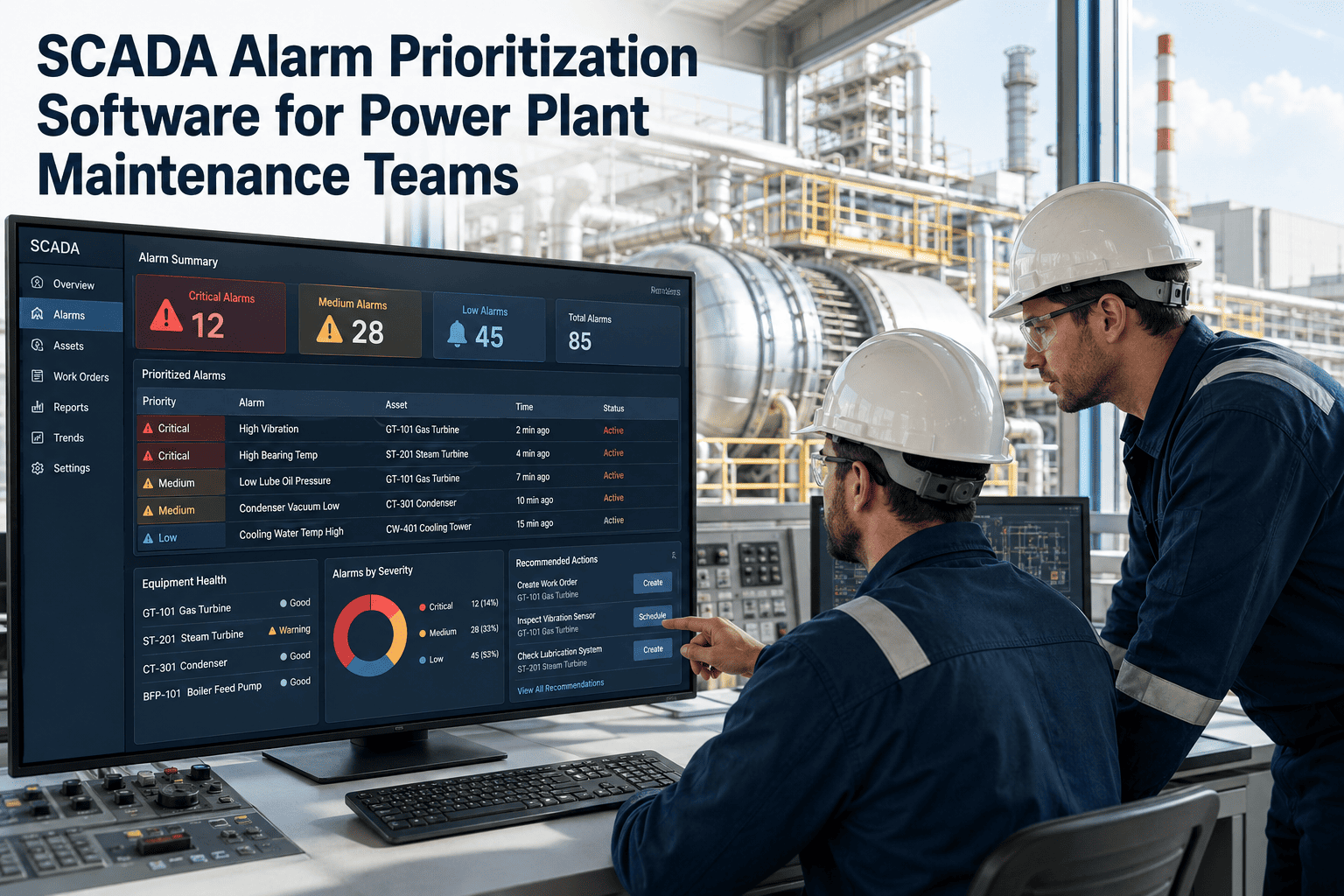
Alarm Priority Framework: The ISA-18.2 Three-Tier Model
One of the most common causes of alarm priority inflation is the absence of a documented consequence-based prioritisation model. ISA-18.2 recommends a tiered framework linked directly to the time available to respond and the consequences of failure to respond.
Critical / Priority 1
≤5% of total alarms
Response required within 5 minutes. Failure to respond results in potential personnel injury, major environmental release, or significant asset damage. Examples: high-high pressure on pressure vessels, motor winding temperature approaching thermal protection trip, emergency shutdown system deviation.
High / Priority 2
≤15% of total alarms
Response required within 10–15 minutes. Failure results in production loss, product quality deviation, or equipment damage requiring unplanned maintenance. Examples: pump bearing temperature trend, compressor discharge pressure deviation, tank level approaching overflow threshold.
Low / Advisory / Priority 3
≥80% of total alarms
Informational. Response within 60 minutes or next scheduled maintenance window. Does not require immediate operator intervention. Examples: filter differential pressure approaching cleaning threshold, minor process variable drift within acceptable range, utility consumption deviation advisory.
State-Based Alarm Suppression: Eliminating Startup and Shutdown Floods
The most frequent source of alarm floods in process facilities is not faulty equipment — it is valid alarms firing in inappropriate process states. During startup, shutdown, and product changeover, hundreds of process variables operate outside their steady-state operating envelopes. Without state-based suppression, every deviation generates an alarm, creating conditions that mirror a genuine process emergency when none exists.
ISA-18.2 mandates that alarm systems be aware of process state and suppress non-actionable alarms accordingly. iFactory's SCADA integration layer reads PLC state outputs via OPC-UA and automatically activates suppression sets defined for each operating mode. Operators receive only the alarms that are actionable given the current process state — eliminating the systematic flood condition that occurs in virtually every facility without this configuration.
Normal Production
Full alarm set active. All three priority tiers annunciated. ISA KPIs tracked against steady-state benchmarks.
Startup Mode
Low and advisory alarms suppressed. High and Critical remain active. Suppression automatically lifts when steady-state conditions achieved.
Planned Shutdown
Non-safety-critical alarms suppressed in sequence as equipment taken offline. Critical alarms remain active throughout.
Maintenance Mode
Equipment under maintenance tagged to shelve associated alarms. Shelving requires authorisation and is time-limited with automatic re-enablement.
Frequently Asked Questions: ISA-18.2 Implementation
How long does a full ISA-18.2 rationalisation programme take?
For a typical mid-size process facility with 2,000–5,000 alarm tags, a phased rationalisation programme takes 3–6 months. iFactory's automated alarm inventory and bad actor identification compress the analysis phase from 6–8 weeks to under 2 weeks. The critical path is the rationalisation workshop process itself, which requires maintenance, operations, and process engineering input for each alarm reviewed. Facilities using iFactory's AI-assisted rationalisation report completing the same scope 40–60% faster than traditional manual approaches.
Does ISA-18.2 compliance require changes to our existing SCADA system?
Not necessarily. Most rationalisation improvements — deadband configuration, priority reassignment, suppression logic, and shelving workflows — are implemented within existing SCADA platforms such as Wonderware, IgnitionSCADA, Aveva System Platform, and Rockwell FactoryTalk. iFactory integrates with all major SCADA platforms via OPC-UA and REST APIs without requiring platform replacement. The Master Alarm Database and KPI monitoring layer sit alongside your existing infrastructure.
What is the difference between alarm shelving and alarm suppression?
Suppression is automatic — driven by process state logic that disables alarms that are not actionable in a given operating mode. Shelving is manual — an operator or supervisor deliberately silences a specific alarm for a defined period, typically during planned maintenance or a known process abnormality. ISA-18.2 requires that both be tracked, time-limited, and auditable. iFactory's platform enforces shelving authorisation workflows and automatically restores shelved alarms at the defined expiry time, preventing alarms from being silenced indefinitely without review.
How do we handle alarms for assets already monitored by iFactory's predictive analytics?
Assets monitored by iFactory's AI engine benefit from two complementary alarm layers. SCADA threshold alarms continue to fire on real-time process variable breaches as required by ISA-18.2. Additionally, the predictive layer generates early warning alerts — typically 14–21 days before a threshold is reached — surfaced as advisory notifications rather than traditional SCADA alarms. This prevents predictive intelligence from contributing to alarm load while still ensuring operators receive actionable early warnings ahead of any critical condition.
Stop Managing Alarm Noise. Start Managing Your Process.
Your ISA-18.2 Compliance Programme Starts With a 30-Minute Alarm Audit
iFactory's engineers will analyse your current SCADA alarm performance against ISA-18.2 benchmarks, identify your top bad actors, and deliver a prioritised rationalisation roadmap — at no cost. Most facilities reduce alarm load by 60–80% within 90 days of implementation.
80%
Alarm flood reduction
3–5×
ROI within 12 months
100%
Audit-ready documentation