Every minute your factory floor runs on a mismatched or legacy industrial network, you are paying an invisible tax — in latency, in failed handshakes between PLCs and SCADA systems, and in unplanned downtime that no maintenance team can predict because the data never arrived in time. PROFINET, EtherNet/IP, and EtherCAT are not interchangeable choices. Selecting the wrong protocol for your topology is not a configuration error you fix later — it is an architectural decision that locks your operational ceiling for the next decade.
iFactory PLC/SCADA Integration Intelligence
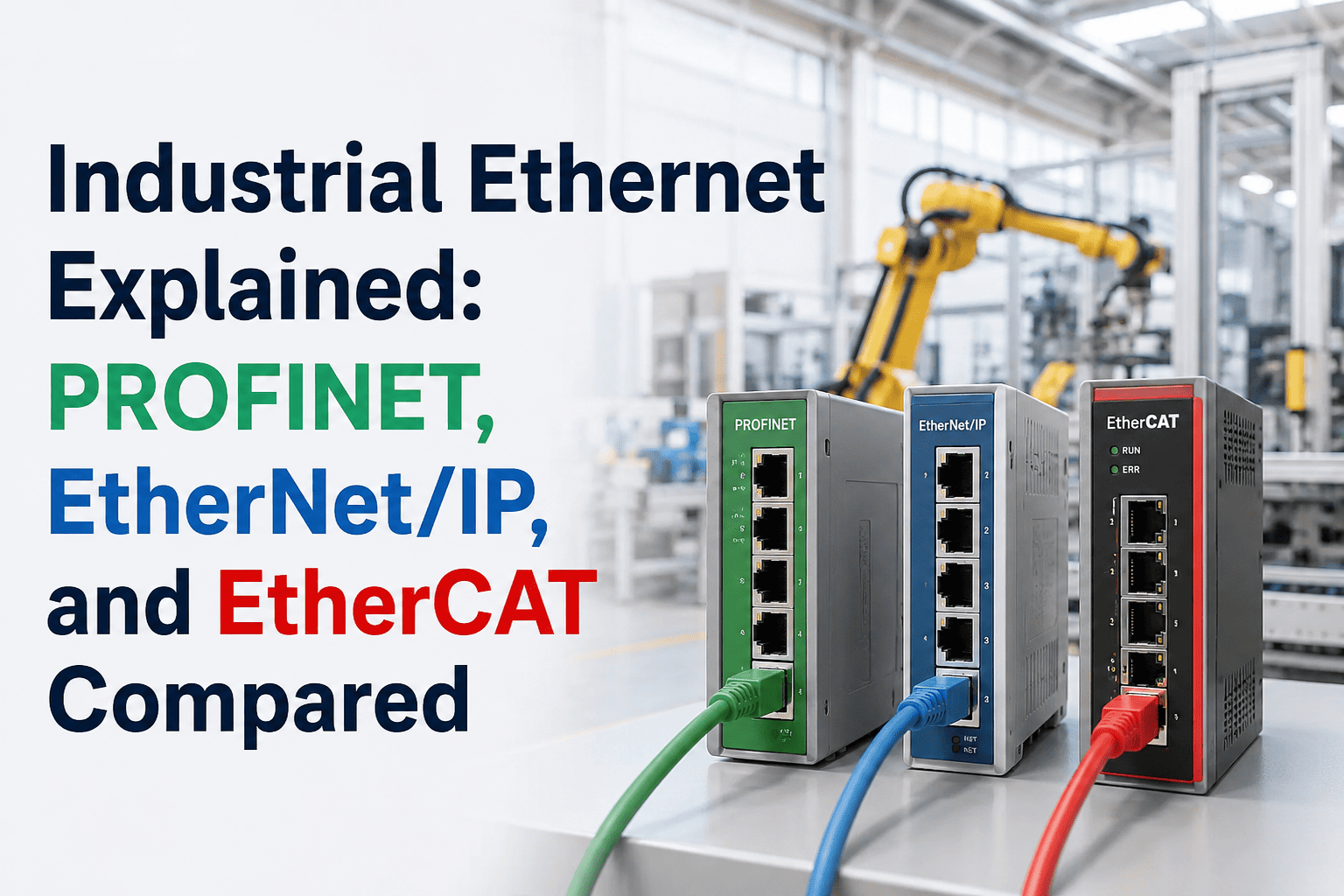
Industrial Ethernet Protocols: PROFINET, EtherNet/IP, and EtherCAT Compared
A practical selection guide for factory network architects — topology fit, determinism requirements, real-time performance, and integration with AI-powered digital twin platforms.
<1ms
EtherCAT cycle time for motion control
60%
Of new installations use Industrial Ethernet
3x
Faster diagnostics with protocol-native integration
TSN
The convergence layer unifying all three
Executive Summary
⚙
Protocol choice determines OEE ceiling
The protocol you select defines your maximum scan rate, diagnostic resolution, and how cleanly your PLC data reaches your SCADA historian and digital twin platform.
?
Determinism is the variable most teams underestimate
The gap between a 10ms jitter and a 100μs jitter is the difference between a functioning servo axis and a scrapped production run. Standard Ethernet provides neither guarantee.
?
Integration cost scales with protocol mismatch
Running PROFINET assets alongside EtherNet/IP controllers without a proper gateway multiplies engineering hours. Protocol-native iFactory integration eliminates this overhead entirely.
Understanding the Three Dominant Industrial Ethernet Protocols
What it is
Developed by Siemens and standardised under IEC 61158, PROFINET supports three channels: TCP/IP for configuration, RT for cyclic I/O at ~1ms, and IRT for motion-grade determinism down to 31.25μs.
Best for
- Siemens S7 PLC environments and TIA Portal ecosystems
- Process automation with moderate timing requirements
- Rich device diagnostics via GSDML device descriptions
- Multi-vendor environments requiring strong IEC compliance
Key limitation
IRT mode requires PROFINET-certified switches, increasing infrastructure cost significantly versus standard managed Ethernet hardware.
What it is
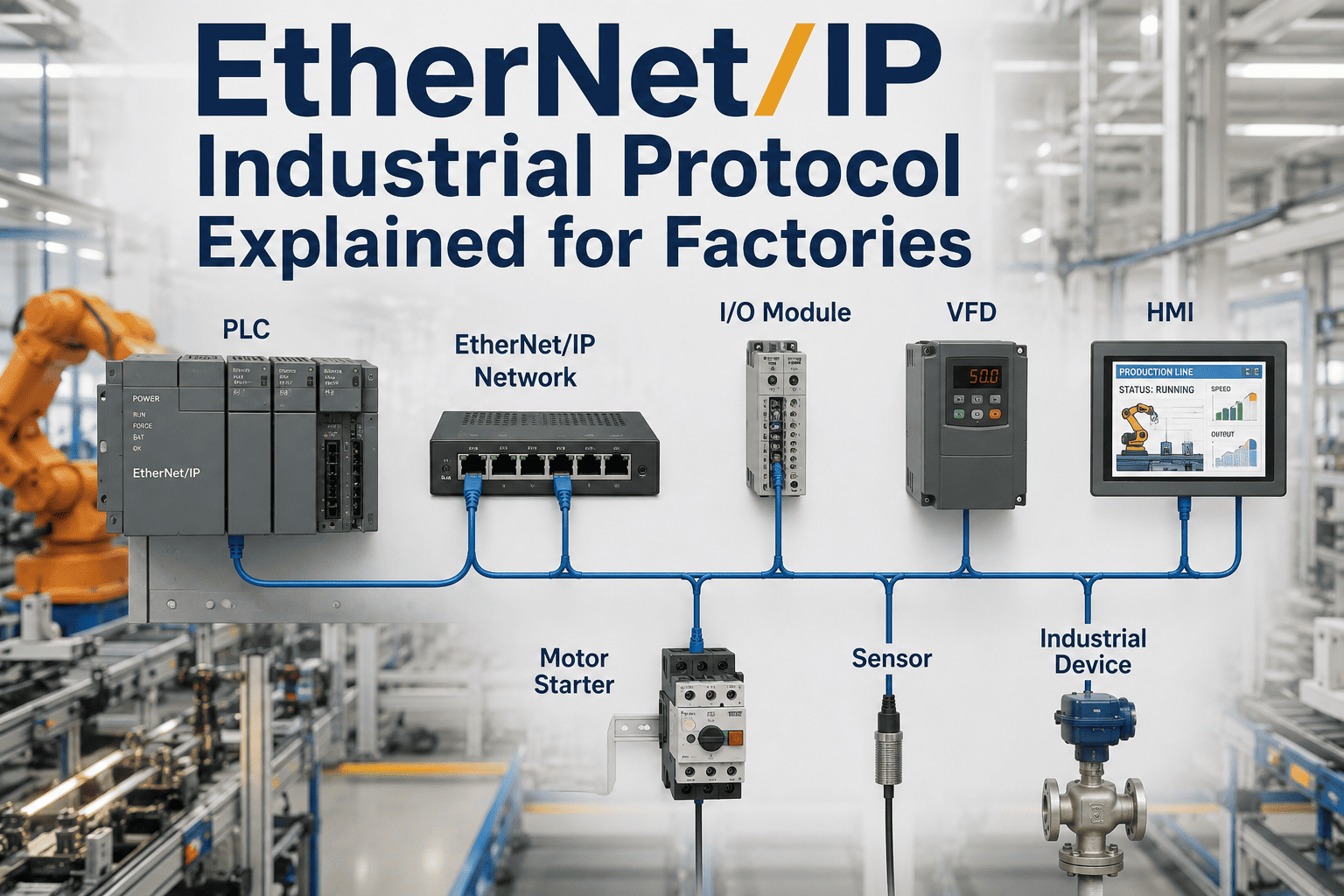
Built on the Common Industrial Protocol (CIP) and managed by ODVA, EtherNet/IP runs over unmodified Ethernet hardware using implicit messaging for real-time I/O at 1–10ms and explicit messaging for configuration.
Best for
- Rockwell Automation / Allen-Bradley PLC installations
- Discrete manufacturing, automotive assembly, and packaging lines
- Cost-sensitive environments using standard IT Ethernet switches
- Integration with existing CIP-based safety and motion networks
Key limitation
Lacks native isochronous timing without additional infrastructure. High-axis-count motion applications require supplementary solutions.
What it is
Developed by Beckhoff (IEC 61158), EtherCAT uses "processing on the fly" — a single frame traverses all slave nodes in sequence — achieving cycle times below 100μs with sub-microsecond jitter.
Best for
- High-speed motion control with 10+ coordinated servo axes
- Robotics, CNC machining, and semiconductor fabrication
- Applications where jitter directly causes product quality variance
- Beckhoff TwinCAT and PC-based control architectures
Key limitation
Mandatory line topology creates cabling constraints in brownfield facilities and requires careful segment planning from the outset.
iFactory integrates natively with PROFINET, EtherNet/IP, and EtherCAT — no protocol translation overhead, no data loss.
Book a Strategy SessionComparison Matrix: Protocol Selection by Use Case
| Criteria | PROFINET | EtherNet/IP | EtherCAT |
|---|
| Cycle Time | ~1ms (RT) / 31.25μs (IRT) | ~1–10ms | <100μs |
| Jitter | Moderate (RT) / <1μs (IRT) | Moderate | Sub-microsecond |
| Topology | Star, ring, tree | Star, tree | Line (mandatory) |
| Switch Requirement | Standard (RT) / Certified (IRT) | Standard managed | None (frame forwarding) |
| Primary PLC Vendor | Siemens, Phoenix Contact | Rockwell, Allen-Bradley | Beckhoff, any EtherCAT master |
| Motion Control Fit | Good (IRT mode) | Moderate | Excellent |
| Diagnostics Depth | Rich (GSDML) | Good (EDS files) | Good (ESI files) |
| TSN Roadmap | Active (CC-Link IE TSN) | Active (CIP Sync) | Active (EtherCAT G) |
| Brownfield Fit | High | High | Moderate (topology constraint) |
| Digital Twin Integration | OPC-UA via PROFINET gateway | OPC-UA / REST native | ADS / OPC-UA via TwinCAT |
Legacy Friction vs. Optimised Excellence
Legacy Friction
Protocol chosen by default — whatever the PLC vendor sold — not by application determinism requirement
Mixed-protocol environments with gateway bottlenecks introducing 50–200ms translation latency
SCADA historian polling at fixed intervals, missing transient fault signatures entirely
No OPC-UA bridge — digital twin platforms cannot ingest live PLC data without custom scripting
Network faults diagnosed reactively after production impact; root cause analysis takes hours
TSN migration deferred indefinitely — current protocol mix has no clear convergence path defined
Optimised Excellence
Protocol selected against determinism budget, topology constraints, and vendor ecosystem — documented decision
Protocol-native iFactory integration via OPC-UA, MQTT, and REST — zero translation overhead
Event-driven data ingestion capturing every anomaly at source scan rate, not historian poll rate
Live PLC data streams feeding AI digital twin models in real time — first predictive alerts in 4–6 weeks
Network health monitored proactively — jitter spikes and CRC errors surface before they cause downtime
TSN migration path defined and staged — IRT or CIP Sync assets identified for priority cutover
How Protocol-Native Integration Compounds ROI
?
Reduced Integration Overhead
Eliminating protocol gateway layers removes a primary source of data latency and maintenance cost. iFactory's native connectors reduce integration engineering hours by 60–80% versus custom middleware development.
⚡
Higher Data Fidelity for AI Models
Protocol-native ingestion at native scan rates gives AI models the signal resolution needed to detect early-stage bearing wear, insulation degradation, and torque anomalies — not just gross failures.
?
Faster Time to Predictive Value
Facilities with clean protocol-to-SCADA pipelines reach first anomaly detection alerts in 4–6 weeks. Gateway-heavy architectures spend 3–4 months resolving data quality issues before AI models can be trusted.
Looking Ahead
Time-Sensitive Networking (TSN): The Convergence Layer
IEEE 802.1 TSN standards are progressively adopted across all three industrial Ethernet ecosystems, providing deterministic communication over standard hardware — eliminating proprietary switches and enabling IT/OT convergence. PROFINET has incorporated TSN via CC-Link IE TSN. ODVA has defined CIP Sync over TSN for EtherNet/IP. Beckhoff is developing EtherCAT G with TSN bridging.
What TSN changes
- Deterministic timing on standard Ethernet hardware — no proprietary switches required
- IT and OT traffic on a shared physical network with bandwidth reservation guarantees
- Simplified multi-vendor interoperability across protocol families
What TSN does not change
- Application-layer protocol selection — CIP, PROFINET, and EtherCAT remain distinct
- The need for proper topology planning and device-level engineering expertise
- The requirement for PLC/SCADA integration skill at the application layer
Frequently Asked Questions
Can we run PROFINET and EtherNet/IP on the same network?
Technically yes — both run over standard Ethernet hardware. However, mixed environments require gateway devices that introduce latency and maintenance complexity. The cleaner path is OPC-UA as a common abstraction layer above both protocols, which iFactory supports natively without custom scripting.
Is EtherCAT overkill for a general manufacturing environment?
For most process and discrete manufacturing applications with cycle times above 5ms, EtherCAT's sub-100μs capability is genuine overkill — and its mandatory line topology creates unnecessary cabling constraints. Reserve EtherCAT for motion control segments; use PROFINET or EtherNet/IP for general I/O and supervisory layers.
How does protocol selection affect digital twin data quality?
Directly. Protocols with shorter cycle times and event-driven reporting provide higher-fidelity data streams for AI model training. iFactory ingests data at the native protocol rate, ensuring predictive models receive the signal resolution needed to detect early-stage failure signatures before they become downtime events.
Should we standardise on one protocol across a multi-site enterprise?
Standardisation reduces long-term engineering overhead significantly, but retrofitting established lines is expensive. Standardise for all new installations and use a protocol-agnostic platform like iFactory to unify existing heterogeneous environments under a common data model without requiring hardware replacement.
iFactory PLC/SCADA Integration
Your Protocol Infrastructure Is Already the Right Starting Point
iFactory connects natively to PROFINET, EtherNet/IP, and EtherCAT environments — delivering real-time asset data to AI digital twin models without gateway overhead, custom scripting, or protocol translation latency. Your first predictive alerts can be live in 4–6 weeks.
4–6wk
Time to first predictive alert
Zero
Gateway overhead with native integration
10–30x
ROI on digital twin investment