At 06:18 on a Friday morning at a BIW shop in a Tier 1 brake assembly plant, the incoming shift supervisor walked the line and found 47 vehicle bodies parked with a paint adhesion issue that had not appeared on any defect report. The outgoing supervisor had written a logbook entry — "RH side primer issue, spoke to paint shop" — at 03:40. The page had been turned. The line operator had gone home. The paint shop had not been told. The 47 bodies became three days of rework and an IATF non-conformance the plant could not satisfactorily root-cause to a specific shift or operator. Paper logbooks fail like this — quietly, structurally, and just often enough to matter. This page is for operators and team leaders who already know the symptom and want to see how an electronic shift logbook closes the gap.
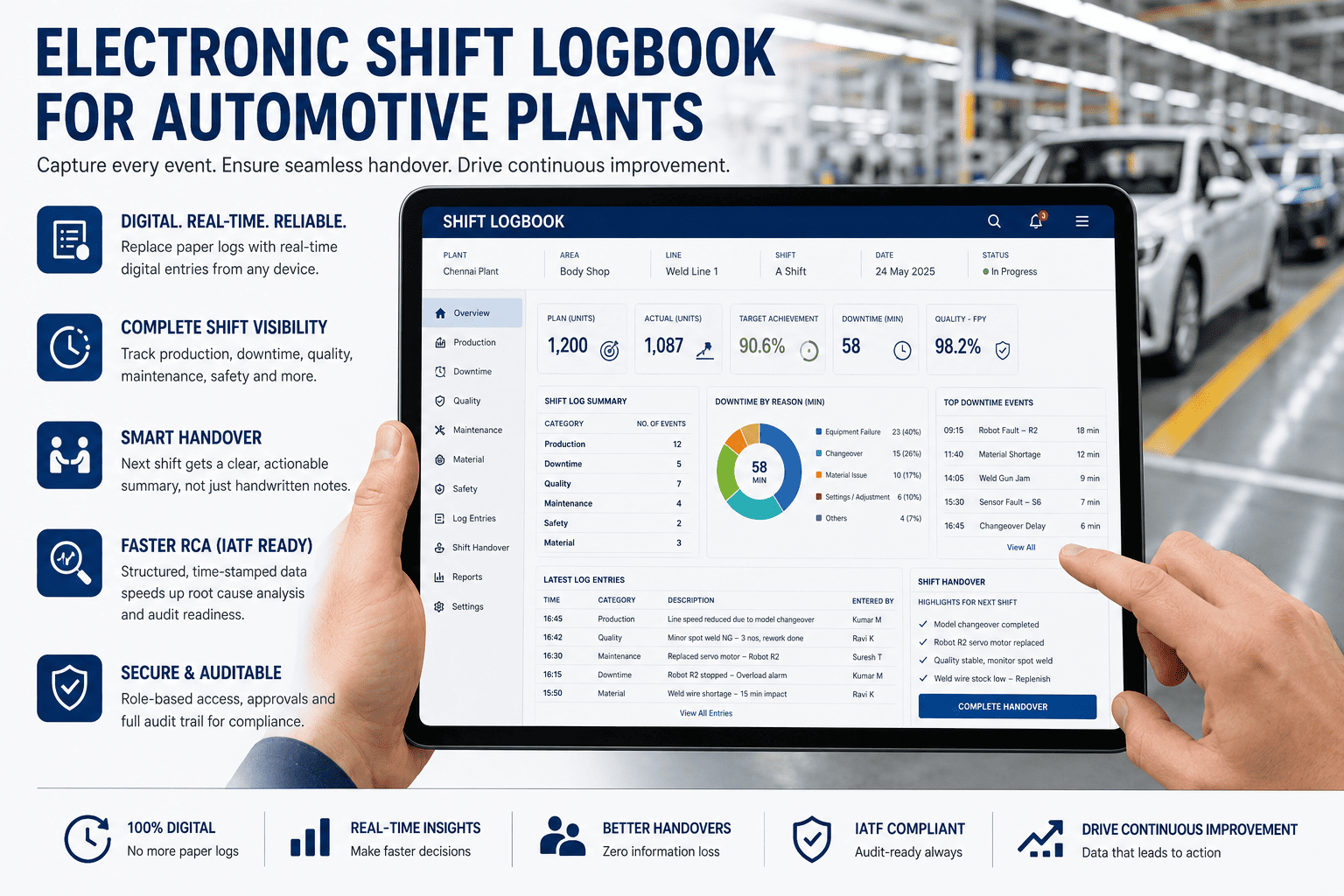
Electronic Shift Logbook for Automotive Plants — Every Event Captured, Every Handover Live
Paper logbooks capture roughly 38% of critical events on a typical automotive line. The rest disappears into operator memory and the back of a printed production sheet. An electronic shift logbook makes the handover live, the events searchable, and the IATF audit trail one click away.
Six Ways a Paper Shift Logbook Fails Your Plant
Paper logbooks fail in six recurring ways across automotive plants — body shops, paint, general assembly, powertrain, and Tier 1 component lines. The pattern is identical regardless of plant. Each failure mode costs the plant audit risk, root-cause time, and operator credibility.
Illegible handwriting under time pressure
The last 15 minutes of a shift always have the most events and the worst writing. Critical entries become unreadable. The next shift cannot interpret them, the IATF auditor cannot interpret them, and the original writer is at home.
One-line summaries lose all context
"Paint issue RH side" tells the next shift nothing they can act on. Which station, which model, which lot of primer, what corrective action was tried, who was notified — all of it lives in the writer's head, not the logbook.
No linkage to work orders or defect records
The shift entry references a defect; the defect references a CAPA; the CAPA references a maintenance work order. On paper, all four documents live in separate binders in separate locations and nobody finds all four during a root-cause investigation.
No search, no aggregation, no trend
"How many times did weld station 7 trip in the last 30 days?" is a 90-minute manual research task with paper logbooks. With a structured electronic logbook, it is a 5-second query. The trend is the leading indicator nobody is looking at.
Pages get torn, lost, or photocopied incorrectly
Paper logbooks have one copy of every page. The auditor wants page 47 of last March's logbook. Pages 46 and 48 are intact. Page 47 is missing, smudged, or under the cup of tea from the 03:00 break. The IATF observation writes itself.
Handovers happen verbally or not at all
The outgoing operator finishes at 06:00 sharp. The incoming operator arrives at 05:45 to gown up. The handover is two minutes in the corridor over coffee. Critical context — open issues, ongoing investigations, supplier holds — gets summarized into three sentences that lose 80% of the actual state.
Anatomy of a Digital Shift Handover — Outgoing, System, Incoming
A digital shift logbook is not a screen that replaces the paper book. It is a three-actor workflow — outgoing shift, system, incoming shift — where the system does the work the operators cannot. The diagram below shows what each side contributes, and what they get out.
What the operator records
- Quick-tap event entry with structured templates (no free-text fishing)
- Photo attachment from line-side tablet for any quality or damage event
- Auto-link to the MES production order and current job number
- Open issues acknowledged with required handover note
- Single supervisor sign-off at end of shift, electronically signed
What the platform does automatically
- Aggregates events by area, equipment, severity, and time
- Pulls in equipment downtime and quality data from MES / ANDON / QMS
- Generates the structured handover briefing — open items, KPIs, alerts
- Maintains immutable audit trail with electronic signatures
- Routes critical events to supervisors and maintenance in real time
What the operator sees on arrival
- Structured handover briefing on the line-side tablet at clock-in
- Open issues from previous two shifts with current status
- Equipment under temporary fix or operating restriction, with details
- Quality holds, supplier issues, and inventory anomalies
- Acknowledged-and-accepted sign-off before the line restarts
Twelve Event Categories Captured on an Automotive Line
A working electronic shift logbook captures every event class that affects the production line. Twelve categories cover the operating reality of a body shop, paint, GA, powertrain, or Tier 1 assembly line. Each event has a structured template — no free-text guessing about what to write.
Quality defects
Defect code, station, batch, photo evidence, IATF severity classification
Equipment downtime
Equipment ID, reason code, start and end timestamps, duration, action taken
Andon and line stops
Andon trigger station, escalation level, response time, resolution
Material and supplier issues
Lot number, supplier, defect type, hold status, MRB referral
Personnel changes
Operator substitutions, training status changes, qualification expiries
Safety and near-miss
Incident classification, location, severity, immediate action, follow-up owner
Maintenance interventions
Work order link, technician, root cause flag, temporary vs permanent fix
Rework and scrap
Unit count, rework station, reason code, disposition, cost impact
Tooling and changeover
Tool ID, changeover duration, validation result, next due cycle
Energy and utilities
Power dips, compressed air pressure events, cooling water deviations
KPI deviations
OEE drop, takt-time miss, FTQ deviation, automatic capture from MES
Instructions and approvals
Engineering deviation approvals, supplier holds, customer-driven changes
What an Actual Log Entry Looks Like
The structured template is what separates a useful electronic logbook from a digitised version of the paper book. Below is a real-shape log entry from a BIW welding line — the kind that takes the outgoing operator 90 seconds to file and gives the incoming operator and the IATF auditor everything they need.
Why this entry survives an IATF audit
Every required IATF element is present — equipment identification, batch traceability, operator qualification status, root-cause action, linked corrective work, photo evidence, and signed-and-witnessed sign-off. A paper logbook entry for the same event would typically read "WS-07 quality issue, rework done, see Mike." The auditor's next twenty questions would have no answers.
Clause-by-Clause Compliance Mapping
An electronic shift logbook addresses specific IATF 16949:2016 clauses that paper books struggle with. The table below maps the relevant clauses to the logbook capability that satisfies them — the language a quality manager presents to the auditor when the question comes up.
| IATF clause | Requirement | How the logbook satisfies it |
|---|---|---|
| 7.5.3 — Control of documented information | Documented information must be controlled, retrievable, and protected from unauthorised alteration | Immutable audit trail, role-based access, full version history, supervisor electronic sign-off |
| 8.5.2 — Identification and traceability | Outputs traceable through the production process, with documented identification | Every entry tied to production order, batch, operator, equipment, and shift |
| 9.1.1 — Monitoring, measurement, analysis | Determine what needs monitoring, methods, when, and how results are evaluated | Structured event capture with categorisation, search, and aggregation by equipment / line / shift |
| 10.2 — Nonconformity and corrective action | React to nonconformity, determine causes, implement corrective action, evaluate effectiveness | Logbook entries link to defect records, CAPAs, 8D investigations, and verification of effectiveness |
| 10.2.4 — Problem solving | Defined process for problem solving including root cause and mistake-proofing | Photo evidence, linked records across shifts, search across history enables 5-Why and 8D execution |
| 7.2 — Competence | Records of competence and qualification for personnel performing work affecting product quality | Operator qualification status auto-populated on every entry; expired qualifications flag at clock-in |
| 8.7.1.4 — Customer waiver | Records of product released under customer concession including expiry of authorisation | Customer waiver number and expiry captured as structured field; flags when waiver expires |
Get a paper-to-digital audit on one of your lines
We sit at a console for one full shift, capture every event in both paper and digital form, and deliver a side-by-side report showing the capture gap, the handover gap, and the audit-trail gap. No deployment commitment from the walk-through.
- One-shift parallel capture
- Capture-rate quantification
- IATF audit gap analysis
- Integration scoping with your MES / ANDON / QMS
- On-premise NVIDIA AI server, racked and ready
- Live in 6–12 weeks across multiple lines
Integration with the Rest of the Plant — Not Another Data Silo
The biggest mistake plants make when buying shift logbook software is treating it as a stand-alone application. A logbook disconnected from MES, ANDON, QMS, CMMS, and ERP is a new data silo. The architecture below shows how the logbook sits as a hub, not an island.
Electronic Shift Logbook
Hub of record for every shift eventMES
Production order, batch, station status, OEE pulled in automatically. Logbook entries reference the active job without manual typing.
ANDON
Every andon trigger creates a logbook event with timestamp, station, and escalation level. Response time auto-calculated.
QMS
Defect tickets, CAPAs, MRB records, and 8D investigations link bidirectionally with logbook entries.
CMMS
Work orders generated from logbook events flow into the maintenance backlog; completed work orders surface back on the logbook timeline.
ERP
Inventory holds, supplier lot data, and customer-waiver tracking link to the logbook for traceability across the order lifecycle.
HR / LMS
Operator qualification status and training records flow into every logbook entry; expired qualifications flag at clock-in.
Why on-premise matters for automotive
Manufacturing is the most-targeted industry for ransomware four years running. Shift logbook data — production schedules, supplier holds, equipment status — is competitively sensitive. An on-premise deployment with no cloud egress and no data sent off-site addresses both the cybersecurity exposure and the OEM-mandated data-residency requirements common across automotive Tier 1 contracts.
Case Study — Tier 1 Brake Assembly Plant, 18 Months
A Tier 1 supplier in northern India producing brake systems for three OEMs across two buildings — stamping, machining, sub-assembly, and final assembly. Pre-deployment plant had three shifts running across 22 lines, with a single shared paper logbook per line. Eighteen months after digital cutover, the metrics are below.
| Metric | Before (paper) | After 18 months (digital) | Change |
|---|---|---|---|
| Event capture rate | ~38% | 96% | +58 pts |
| Time to root-cause an incident | 14–28 days | 2–4 days | −85% |
| IATF audit preparation time | 3–4 weeks | 4 hours | −95% |
| Operator time at handover | 15–25 min/shift | 4–6 min/shift | −72% |
| Shift handover incidents per quarter | 9 | 1 | −89% |
| IATF audit findings related to records | 4 (last audit) | 0 (last two audits) | Eliminated |
| Documented duplicate data entry per shift | ~22 min/operator | 0 | Eliminated |
Where the largest gain actually came from
The biggest measurable improvement was not the audit preparation time — it was operator time recovered from duplicate data entry. Each operator across 22 lines and 3 shifts recovered roughly 22 minutes per shift previously spent re-entering data already captured upstream by MES, ANDON, or QMS. Across 66 operator-shifts per day, that is nearly 25 operator-hours of recovered productive time per day at the plant level.
Six-Phase Roadmap from Paper to Live Across the Plant
An electronic shift logbook rollout that respects operators succeeds. One that drops a new system on the line and asks operators to figure it out fails inside three months. The six phases below are calibrated for automotive plants in active production — no shutdown required at any phase.
Line Walk-down and Event Inventory Week 1–2
Walk each candidate line through one full shift. Inventory every event class actually logged. Map the existing paper templates. Identify where operators are filling out the same data multiple times across different forms.
Template and Integration Design Week 3–6
Configure event templates for each category and line. Design integrations to MES, ANDON, QMS, CMMS, and ERP. Map operator qualification records from HR / LMS. The goal is one place where every shift event is captured once.
Pilot Line Deployment Week 7–10
One line, all three shifts, running the electronic logbook in parallel with the paper logbook. Operators trained on the tablets. Supervisors trained on the dashboards. Daily reviews of what is being captured and what is being missed.
Parallel Run and Template Refinement Week 11–14
Four weeks of parallel paper-and-digital running on the pilot line. Templates refined based on operator feedback. Integration latencies tuned. IATF audit dress-rehearsal validates the audit trail and report exports.
Pilot Cutover and Plant-Wide Wave Week 15–22
Paper retired on the pilot line. Rolled out in waves to remaining lines, typically 4–6 lines per month. Each wave uses the refined template library and integration pattern from the pilot.
Continuous Improvement and Audit Cycle Month 6+
Quarterly review of event capture rates, handover completeness, and IATF audit findings. Template library evolves with new event categories. AI summarisation of handover briefings rolls out as the data baseline matures.
Electronic Shift Logbook — Operator and Team Lead Questions
Will operators actually use this, or will it become another ignored system?
The pilot phase exists to answer exactly this question. Operators use systems that save them time. If the digital logbook adds work, it dies; if it removes the 22 minutes per shift of duplicate data entry, operators become its strongest advocates within a month. Template design and integration are the deciding factors — get them right and adoption is not the problem.
How does this work on lines with older equipment and no PLC connectivity?
Most events are operator-recorded, not equipment-recorded — quality observations, andon triggers, handover notes, supplier issues. These work on any plant. For equipment-sourced events on legacy machines, tablet-based event capture by the operator covers the gap until the line is upgraded or a non-invasive sensor is added.
Is data stored on-premise, or in the cloud?
On-premise by default. The NVIDIA AI server holds the logbook database, integration drivers, and dashboards inside your plant network. No data leaves the perimeter. Critical for automotive customers with OEM-mandated data residency requirements and for plants concerned about ransomware exposure — manufacturing is the most-targeted industry for ransomware four years running.
How does it satisfy IATF 16949 audit requirements specifically?
The clause-by-clause mapping table above covers the main IATF requirements that paper logbooks struggle with — 7.5.3 document control, 8.5.2 traceability, 9.1.1 monitoring, 10.2 corrective action, 10.2.4 problem solving, 7.2 competence, and 8.7.1.4 customer waiver. Each clause has a documented logbook capability with audit trail. Most plants reduce IATF audit preparation from weeks to hours.
What happens during a network outage?
Line-side tablets buffer entries locally when the network is unavailable, then sync automatically when connectivity returns. The handover briefing screen has a cached version available offline. No event is ever lost to a network outage — this is a deliberate design choice for plants where line uptime is uncorrelated with IT uptime.
Do we need to buy NVIDIA AI servers separately?
No. The fully-loaded AI server is supplied pre-configured and pre-loaded with the logbook database, event templates, integration drivers, IATF report library, and dashboards. On-premise, no cloud, no egress. Rack it, connect power and Ethernet, and the system goes live. Tablets, cabling, integration with MES / ANDON / QMS, operator training, and 24×7 remote monitoring are all included.
What is the typical timeline from contract to first live line?
Live in 6–12 weeks for the pilot line. Three-phase delivery: weeks 1–4 — line walk-down, template design, hardware install. Weeks 5–8 — pilot deployment, operator training, parallel run begins. Weeks 9–12 — pilot cutover, first wave of plant-wide rollout. Full plant typically completes within 6–9 months on a 20-line site.
Every Event Captured. Every Handover Live. Every Audit One Click Away.
Hardware + software bundle. Pre-configured NVIDIA AI server, racked and ready, on-premise — no cloud, no data egress. Pre-loaded with automotive event templates, IATF 16949 audit trail, integration drivers for MES / ANDON / QMS / CMMS / ERP, and operator-friendly tablet interface. Live in 6–12 weeks. Trusted by 1000+ industrial clients with 99.9% uptime.