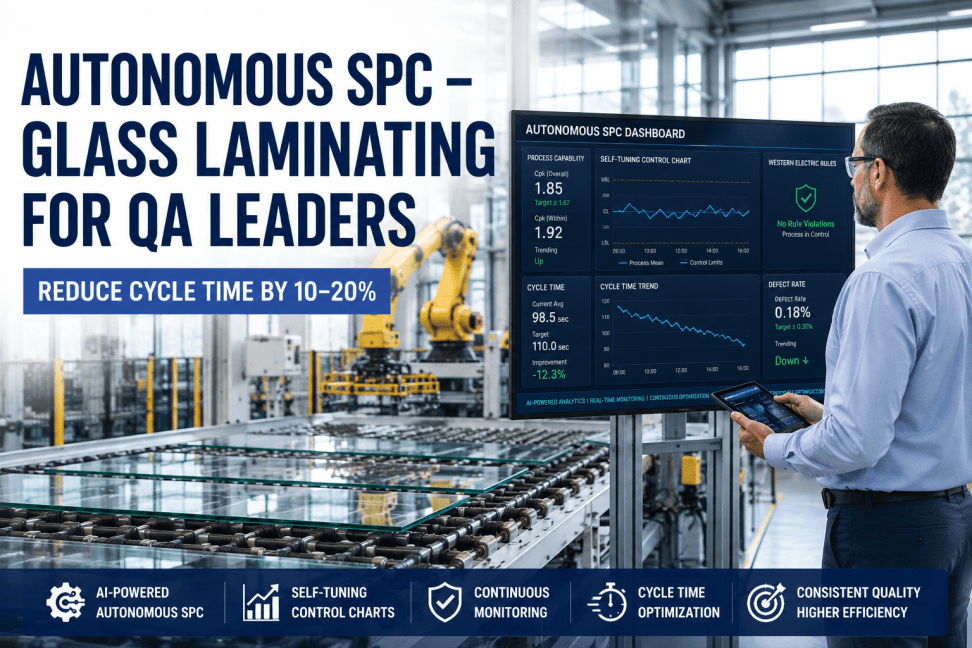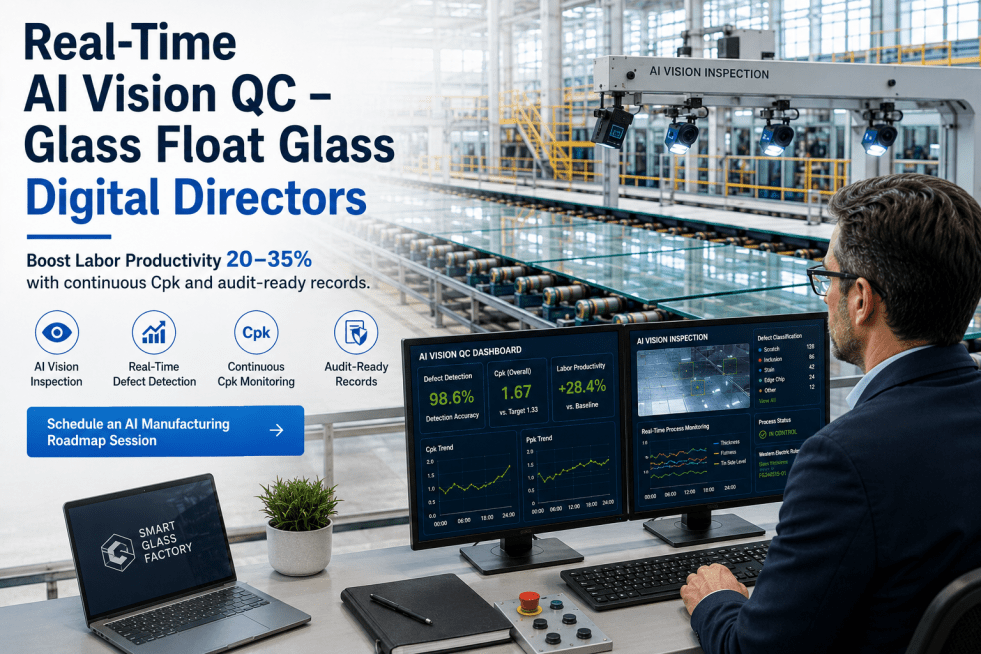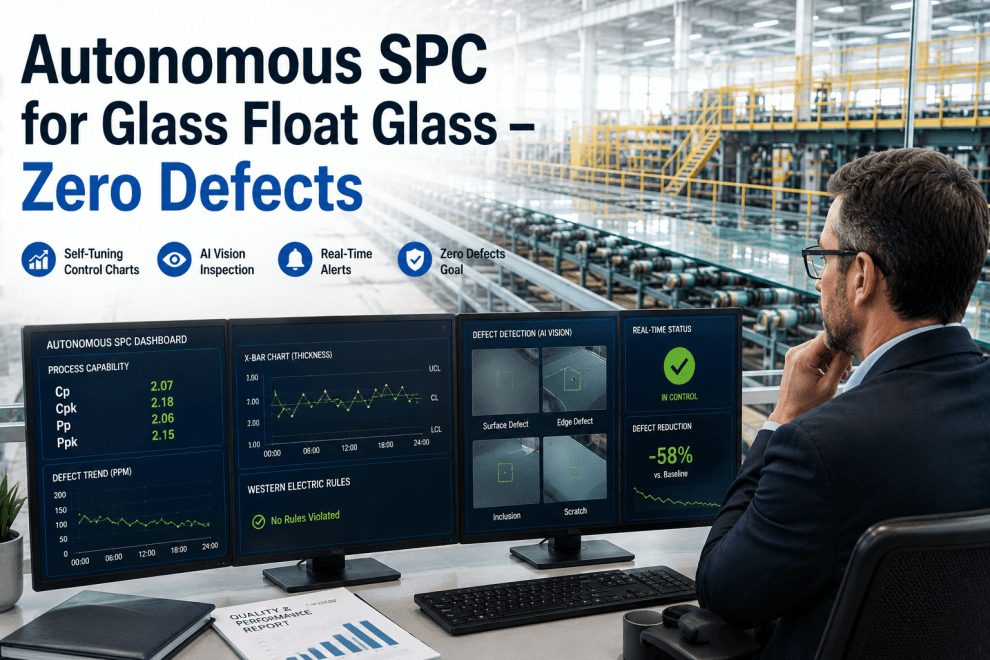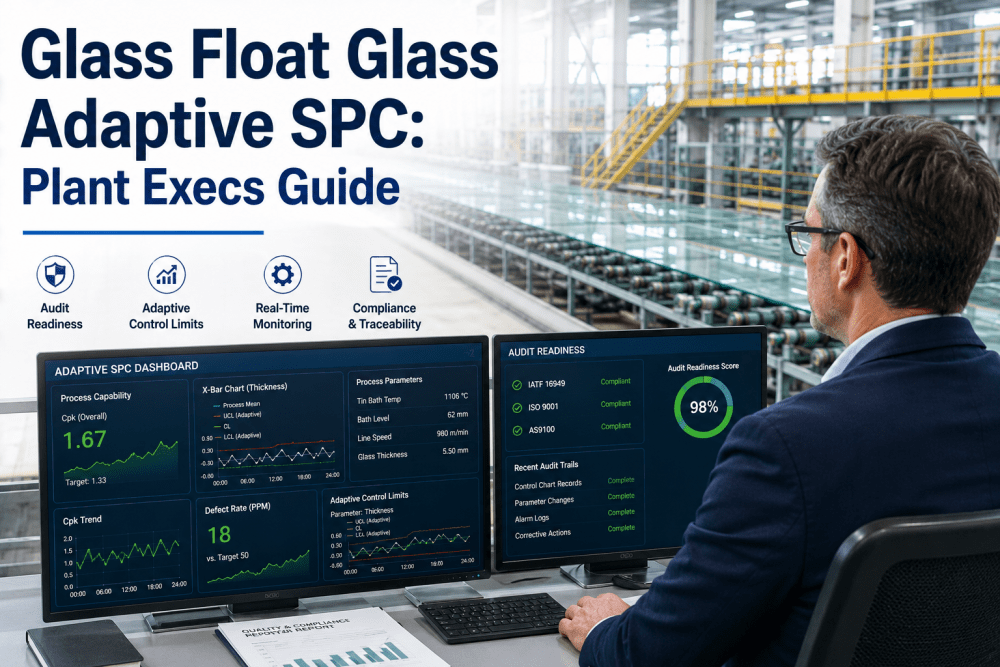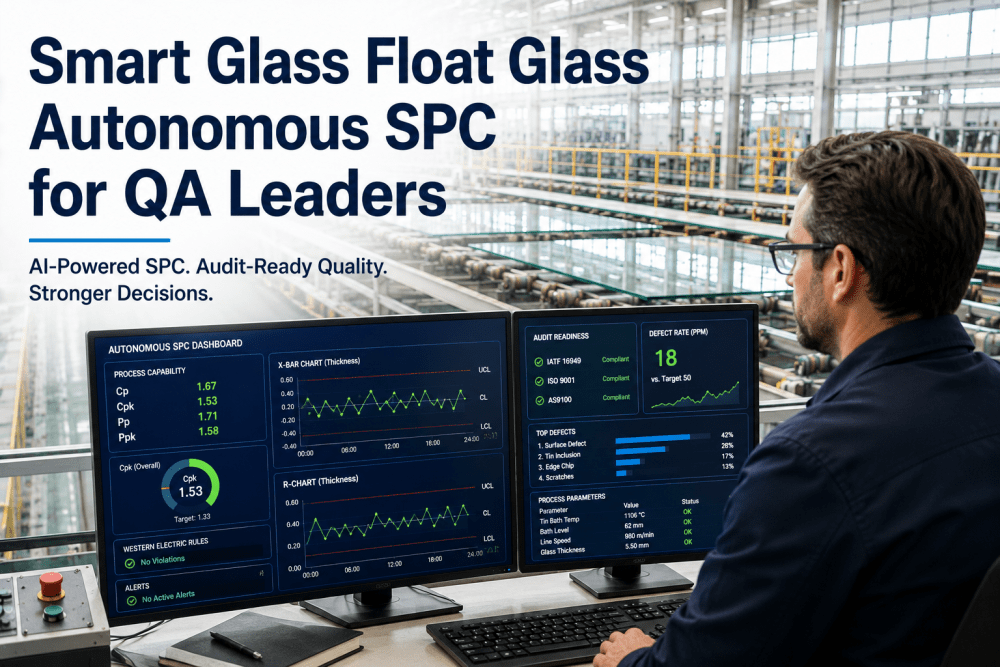
Autonomous statistical process control (SPC) for glass float glass operations represents a fundamental shift in how quality leaders maintain audit readiness across tin bath, annealing lehr, and cutting stations. Traditional SPC requires quality engineers to manually set control limits, monitor control charts, and investigate every out-of-control condition — consuming 18 to 24 hours per week per float line in routine statistical analysis. Autonomous SPC eliminates this manual overhead by deploying self-tuning control charts that continuously adjust to process variation, apply Western Electric rules automatically, and flag only statistically significant deviations for investigation. For quality leaders preparing for ISO 9001 or customer-specific audits, autonomous SPC provides continuous Cpk monitoring with complete traceability from raw material batch through finished glass inspection — transforming audit preparation from a quarterly scramble to a continuous state of readiness.
The Audit Readiness Challenge in Float Glass Quality Control
Quality leaders in float glass manufacturing face a persistent compliance challenge: maintaining audit-ready quality records across continuous production processes where control limits must account for raw material variation, tin bath temperature gradients, and annealing lehr drift. Traditional SPC implementations require quality engineers to review control charts manually, investigate every rule violation, and document corrective actions — a workflow that creates a backlog of uninvestigated signals during peak production periods. When an auditor requests historical process capability data for a specific production period, the quality team must reconstruct control limit calculations, verify rule applications, and manually compile supporting evidence. This reactive compliance model exposes operations to non-conformance findings, particularly around statistical technique selection and process change management. Book a Demo to see how autonomous SPC eliminates compliance gaps across your float glass lines.
How Autonomous SPC Ensures Audit-Ready Quality Records in Float Glass
Autonomous SPC transforms audit readiness by automating every statistical workflow that quality engineers currently perform manually. Instead of setting control limits once per batch or shift, the system continuously recalculates limits based on real-time process behavior — applying Western Electric rules, Nelson rules, and custom logic without human intervention. Every control chart, Cpk calculation, and rule violation is time-stamped, serial-number-correlated, and stored with full context for audit retrieval. When an auditor requests process capability data for a specific date range, the quality leader retrieves a complete, pre-validated report in seconds rather than days.
| Quality Capability | Traditional SPC | Autonomous SPC | Audit Readiness Impact |
|---|---|---|---|
| Control Limit Calculation | Manual, periodic (per batch or shift) | Continuous, self-tuning in real time | Eliminates stale limit compliance risk |
| Rule Violation Detection | Visual chart review with 4 to 8 hour delay | AI-classified within 200 milliseconds | Immediate signal-to-noise separation |
| Cpk Monitoring | End-of-shift calculation | Continuous per-station tracking | Real-time capability visibility |
| Investigation Documentation | Manual NCR and logbook entry | Auto-generated with root cause classification | Complete, audit-ready records |
| Historical Data Retrieval | Hours to days via manual compilation | Seconds via pre-indexed dashboards | Instant auditor response |
| Statistical Technique Compliance | Dependent on individual engineer knowledge | Standardized, validated, and logged | Consistent methodology across all lines |
| Quality Engineer Time Allocation | 60 to 70% on chart review and documentation | 80% on continuous improvement and RCA | Higher-value quality engineering work |
The comparison demonstrates that autonomous SPC does not eliminate the quality engineer's role — it reallocates their time from manual chart maintenance to high-value root cause analysis and process improvement. The system handles the statistical heavy lifting while the quality team focuses on the substantive quality work that drives real improvement.
Autonomous SPC Capabilities for Float Glass Quality Leaders
iFactory's Autonomous SPC platform delivers four integrated capabilities that together create a continuous audit readiness environment. Each capability addresses a specific compliance vulnerability in traditional SPC implementations.
Measured Results — Autonomous SPC Impact on Audit Readiness
The quality leader deployed the iFactory Autonomous SPC platform across three float glass lines producing architectural, automotive, and specialty glass grades. The following metrics represent the measured improvement from pre-deployment baseline to post-deployment steady state across 18 months of production data.
Beyond the headline metrics, the autonomous SPC deployment produced structural improvements in quality culture. Quality engineers reassigned from manual chart review to root cause analysis projects delivered a 14% reduction in glass thickness variation across the tin bath zone. The platform's self-tuning control limits eliminated the 31 false alarm investigations per month that had been consuming 18% of the quality team's capacity — allowing them to focus on the 8 to 10 statistically significant signals that required genuine investigation. Book a Demo to review the audit readiness assessment for your float glass operation.
Expert Perspective — Autonomous SPC Transforms Audit Readiness from a Periodic Event to a Continuous State
Conclusion — Autonomous SPC Changes Quality Compliance from a Reactive Burden to a Continuous Capability
What the quality leader lacked was not SPC knowledge or compliance commitment — every line had control charts, every shift performed chart review, and every non-conformance generated an NCR. The missing piece was a system that could apply consistent statistical methodology across all lines, automatically document every quality event, and retrieve audit evidence in seconds. Autonomous SPC closed this gap — delivering 87% reduction in audit findings, 93% faster evidence retrieval, and 65% reduction in manual chart maintenance. The system did not change the specification limits or the quality standards. It changed when and how quality leaders access the evidence needed to demonstrate compliance — from a reactive quarterly scramble to a continuous state of readiness. Book a Demo to review the autonomous SPC deployment plan for your float glass operation.
Frequently Asked Questions — Autonomous SPC for Float Glass Audit Readiness
What is autonomous SPC and how does it differ from traditional statistical process control in float glass manufacturing?
Autonomous SPC differs from traditional SPC in three fundamental ways. First, control limits self-tune continuously based on real-time process behavior rather than requiring manual recalculation at fixed intervals. Second, all Western Electric and Nelson rules are applied automatically with zero manual chart review — flagging only statistically significant deviations. Third, every quality event is automatically documented with full audit traceability. Traditional SPC depends on quality engineers to manually configure charts, review rules, and document investigations — creating compliance gaps during peak production periods.
How does autonomous SPC improve audit readiness for float glass quality leaders?
Autonomous SPC improves audit readiness by maintaining complete, consistent, and immediately retrievable quality records at all times. The platform automatically logs every control limit adjustment, Western Electric rule application, Cpk calculation, and investigation action — with timestamps, operator identification, and lot correlation. Quality leaders retrieve pre-validated process capability reports for any date range in seconds, eliminating the manual evidence compilation that typically consumes four to six weeks of pre-audit preparation time.
What Western Electric rules does autonomous SPC support and how are they applied?
The platform applies all eight Western Electric rules automatically: one point beyond zone A, two out of three points in zone A, four out of five points in zone B, eight consecutive points on one side of center, six consecutive points trending, fourteen alternating up and down, fifteen points in zone C above or below center, and eight points beyond zone C. Each rule violation is classified with a confidence score and root cause pattern assignment for structured investigation.
Does autonomous SPC require replacement of existing SPC or MES systems in float glass plants?
No. iFactory's Autonomous SPC platform integrates with existing MES, CMMS, and quality data collection systems through standard interfaces including REST API, OPC-UA, and MQTT. The platform connects to existing measurement equipment including thickness gauges, bow measurement systems, and edge inspection cameras without requiring hardware replacement. Deployment typically requires 8 to 12 weeks for a multi-line float glass facility.
What is the typical ROI timeline for autonomous SPC deployment in float glass operations?
Float glass operations deploying iFactory Autonomous SPC typically achieve full payback within 4 to 6 months, driven by three primary savings sources. First, elimination of manual chart review and investigation labor reduces quality engineering time allocated to SPC maintenance by 40 to 60 percent. Second, reduction in non-conformance findings and associated corrective action costs lowers compliance-related expenses. Third, the 4 to 6 week pre-audit preparation labor is eliminated through autonomous documentation and one-click report retrieval.