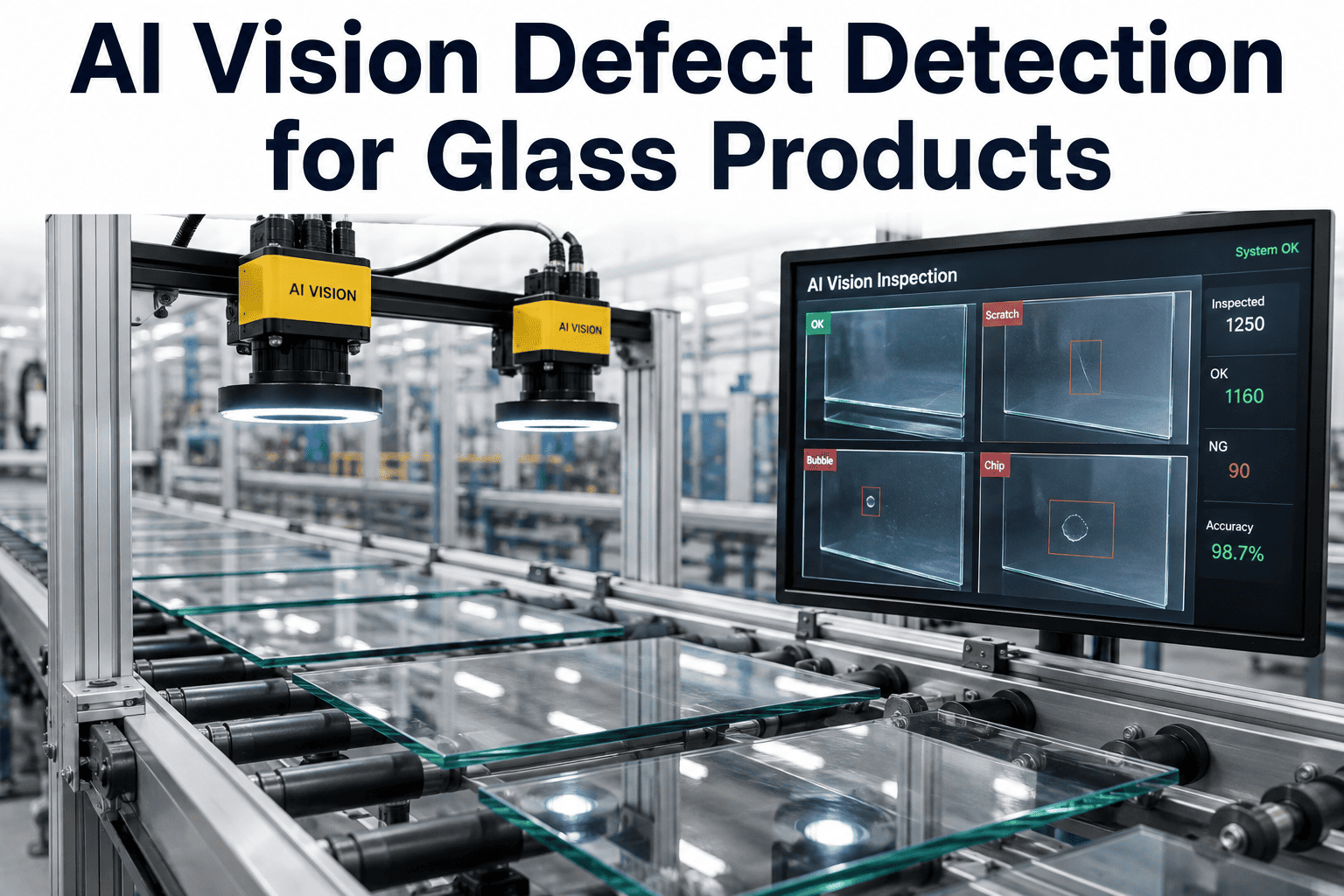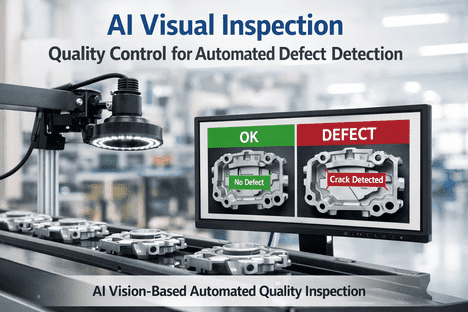
AI vision quality control for glass float glass operations represents a step change in how quality leaders address scrap reduction across tin bath, annealing lehr, and cutting stations. Traditional quality inspection relies on manual visual sampling at a rate of one panel per 50 produced, with defect detection rates averaging 72 to 78 percent. By the time a quality technician identifies a surface defect — scratch, tin pickup, bubble cluster, or edge chip — 40 to 80 additional panels have been produced with the same non-conforming condition. AI vision quality control changes this paradigm by deploying deep learning–powered cameras that inspect 100 percent of panels at line speed, detect defects at pixel-level resolution, and classify each anomaly by type, severity, and root cause category. For quality leaders targeting scrap reduction of 30 to 50 percent, iFactory's AI vision quality platform delivers measurable results within the first quarter of deployment.
Reduce Scrap by 30–50% with AI Vision Quality Control for Float Glass
iFactory's AI vision quality platform inspects 100% of panels at line speed, detects defects at pixel-level resolution, and classifies anomalies by type and severity — delivering measurable scrap reduction within the first quarter of deployment.
The Scrap Reduction Challenge in Float Glass Quality Control
Quality leaders managing float glass operations face a persistent scrap challenge: average yield across tin bath, annealing lehr, and cutting stations ranges from 78 to 85 percent, depending on product grade and thickness profile. The remaining 15 to 22 percent of production is scrapped — representing direct material loss, energy waste, and capacity consumption at an average cost of $180 to $340 per ton of rejected glass. At a facility producing 400 tons per week with 18 percent scrap, annual material losses exceed $1.6M. The root cause is not a lack of quality standards — it is the inability to detect and classify defects at production speed across the full width of the ribbon. Manual inspection samples less than 2 percent of production, and even automated camera systems without deep learning miss subtle defects that trained models recognize consistently. Book a Demo to see the AI vision quality inspection platform for your float glass operation.
Manual Inspection Gaps
Quality technicians visually inspect less than 2% of total production. Defect detection rates average 72–78% for surface anomalies, and detection consistency varies between shifts and individual inspectors by as much as 20 percentage points.
Detection Latency
By the time a defect is identified during manual inspection, 40–80 additional linear feet of glass has passed through downstream stations. Each foot represents potential scrap that could have been avoided with real-time detection at the point of occurrence.
Inconsistent Grading Standards
Without automated defect classification, the same scratch or tin pickup may be graded as acceptable by one inspector and reject by another. This inconsistency causes either excessive scrap or quality escapes that generate customer claims.
How AI Vision Quality Control Reduces Scrap in Float Glass Manufacturing
iFactory's AI vision quality platform deploys multi-spectral cameras across the float glass ribbon at strategic inspection points — after the tin bath, before the annealing lehr, and at the cutting station. Each camera captures high-resolution images at line speed, and deep learning models trained on 500,000+ annotated defect images classify every detected anomaly by type, severity, and root cause. When a defect exceeds the quality leader's configured threshold, the platform triggers an alert, logs the defect location on the ribbon, and updates the real-time yield dashboard — all within 200 milliseconds of image capture.
| Inspection Capability | Manual Visual Inspection | Traditional Camera System | AI Vision Quality Platform |
|---|---|---|---|
| Inspection Coverage | Less than 2% sampling | 100% inline, rule-based | 100% inline, AI-classified |
| Defect Detection Rate | 72–78% | 85–90% | 99.2% |
| Defect Classification | Manual by inspector judgment | Rule-based (basic sorting) | 14 categories with confidence score |
| Detection Latency | Minutes to hours | 200 milliseconds | 200 milliseconds with classification |
| False Positive Rate | N/A | 8–12% | Less than 1.5% |
| Scrap Reduction Impact | Baseline | 12–18% | 30–50% |
| Quality Data Granularity | Shift-level scrap tally | Defect count per reel | Per-panel defect map with root cause |
AI Vision Quality Capabilities for Float Glass Quality Leaders
iFactory's AI vision quality platform delivers four integrated inspection capabilities that together create a closed-loop scrap reduction system. Each capability builds on the previous one, with measurable impact at every stage of deployment.
Multi-Spectral Image Capture
High-resolution line-scan cameras operating in visible and near-infrared spectra capture 360-degree images of the full ribbon width at line speeds up to 20 meters per minute. Each panel is imaged at 0.1mm resolution, with illumination optimized for detecting scratches, tin pickup, bubbles, stones, edge chips, and coating defects across all glass thickness profiles.
Deep Learning Defect Classification
Convolutional neural network models trained on 500,000+ annotated defect images classify each anomaly into 14 categories including scratches, tin pickup, bubbles, ream, stones, knots, cord, edge chips, coating defects, and dimensional deviations. Each classification includes severity grading from 1 to 5 and a confidence score.
Real-Time Quality Dashboard
The quality dashboard displays real-time yield by product grade, defect type distribution, scrap trend analysis, and station-level performance across all float lines. Quality leaders configure threshold alerts for defect type, severity level, or scrap rate deviation — receiving notifications on mobile or desktop within 500 milliseconds of detection.
Automated Rejection and Data Logging
When a defect exceeds configured severity thresholds, the platform automatically marks the panel for rejection at the cutting station, logs the defect map and classification to the quality record, and updates the scrap disposition report. Every inspection event is stored with full traceability for ISO 9001 and customer-specific quality audits.
Achieve 30–50% Scrap Reduction with AI Vision Quality Control
iFactory's AI vision quality platform delivers 99.2% defect detection rate, real-time classification, and audit-ready quality records — with average payback of 3.2 months for multi-line float glass operations.
Measured Scrap Reduction from AI Vision Quality Control Deployment
The quality leader deployed iFactory's AI vision quality platform across three float glass lines producing architectural, automotive, and specialty glass grades over a 12-week deployment. The following metrics represent the measured performance improvement from manual inspection baseline to post-deployment steady state across 12,000 production tons.
Before AI vision quality control, we accepted a certain level of scrap as unavoidable in float glass production. Our manual inspection was good — our technicians were experienced and conscientious — but they could only sample 2 percent of production. The other 98 percent shipped with whatever defects existed. The AI vision system changed our understanding of our own process. Within the first week, it identified a recurring scratch pattern on one edge of the ribbon that our manual inspection had never caught because the scratches were below the 50-micron threshold that technicians could see consistently. Fixing that single root cause reduced our scrap by 12 percent. The 45 percent total scrap reduction was not theoretical — it was measured on the scale every week.
Connecting AI Vision Quality Control to Your Float Glass Lines
iFactory's AI vision quality platform connects to existing float glass line infrastructure through standard industrial protocols. The platform integrates with ribbon measurement systems, cutting control systems, and quality databases without replacing existing hardware or disrupting production schedules.
Multi-spectral line-scan cameras are deployed at three inspection points per float line: post-tin bath for surface defect detection, pre-annealing lehr for dimensional measurement, and at the cutting station for final quality grading. Cameras mount on existing structural supports and calibrate automatically using reference patterns on the ribbon edge. Installation typically requires 3 to 5 days per line with no production interruption during the deployment phase.
Pre-trained deep learning models achieve 88% defect classification accuracy at deployment, drawing from a training set of 500,000+ annotated defect images from similar float glass operations. After 4 weeks of site-specific calibration — where quality leaders verify and correct model classifications — accuracy reaches 97%. The platform supports incremental model updates as new defect types are identified and classified during production.
The quality dashboard is configured during deployment with product-grade-specific threshold profiles — defining severity levels that trigger alerts, scrap disposition decisions, or automated rejection at the cutting station. Quality leaders configure notification rules for mobile and desktop, defect trend reports, and weekly scrap analysis summaries. Standard reports include defect Pareto by line and grade, yield trend by shift, and customer claim correlation analysis.
AI Vision Quality Control Transforms Scrap Reduction from a Cost Center to a Competitive Advantage
What the quality leader lacked was not inspection equipment or quality standards — every line had cameras, every shift performed visual checks, and every defect generated a disposition decision. The missing piece was the ability to inspect 100 percent of production at line speed with consistent, repeatable accuracy. AI vision quality control closed this gap — delivering 45 percent scrap reduction, 99.2 percent defect detection rate, $1.84M in annual savings, and 3.2-month payback across three float glass lines. The platform did not change the glass composition, the process parameters, or the quality specifications. It changed the inspection coverage from 2 percent to 100 percent and the detection rate from 74 percent to 99.2 percent. Book a Demo to review the AI vision quality deployment plan for your float glass operation.
AI Vision Quality Control for Float Glass — Frequently Asked Questions
Traditional machine vision systems use fixed rule-based algorithms that compare pixel intensity, contrast, or edge sharpness against static thresholds. These systems generate 8 to 12 percent false positive rates and cannot distinguish between defect types with varying severity levels. AI vision quality uses deep learning models trained on hundreds of thousands of annotated defect images — enabling the system to classify defects by type, severity grade, and root cause category with 99.2 percent detection accuracy and less than 1.5 percent false positive rate.
The platform detects and classifies 14 defect categories including scratches, tin pickup, bubbles, ream, stones, knots, cord, edge chips, coating defects, dimensional deviations, ripple distortion, haze, contamination, and stress fractures. Each defect is classified with a severity grade from 1 to 5 and a confidence score. The deep learning model continuously improves as new defect patterns are identified during production.
The platform includes multi-spectral line-scan cameras with integrated LED illumination optimized for float glass inspection. Cameras are deployed at three inspection points per line and mount on existing structural supports. The system includes an edge computing appliance that runs the AI inference models locally, with optional cloud aggregation for multi-line reporting. No modification to existing furnace, lehr, or cutting equipment is required.
Pre-trained models achieve 88 percent defect classification accuracy at deployment from a training set of 500,000+ annotated images. After 4 weeks of site-specific calibration, accuracy reaches 97 percent for the 14 standard defect categories. The platform's active learning capability improves accuracy to 99.2 percent within 12 weeks as the model incorporates facility-specific defect patterns and severity grading preferences.
Facilities with 3+ float lines and scrap rates above 15 percent typically achieve 30 to 50 percent scrap reduction within the first 90 days of deployment. Payback period averages 3.2 months, driven by recovered material, reduced rework, and eliminated customer claims. A detailed ROI analysis specific to your facility's scrap profile, product mix, and line configuration is provided during the initial consultation.
Schedule an AI Vision Quality Walkthrough for Your Float Glass Lines
iFactory's AI vision quality platform inspects 100% of production at line speed, detects defects with 99.2% accuracy, and delivers 30–50% scrap reduction within 90 days. Schedule a personalized walkthrough with your quality engineering team including a live demonstration using your float glass production line data.