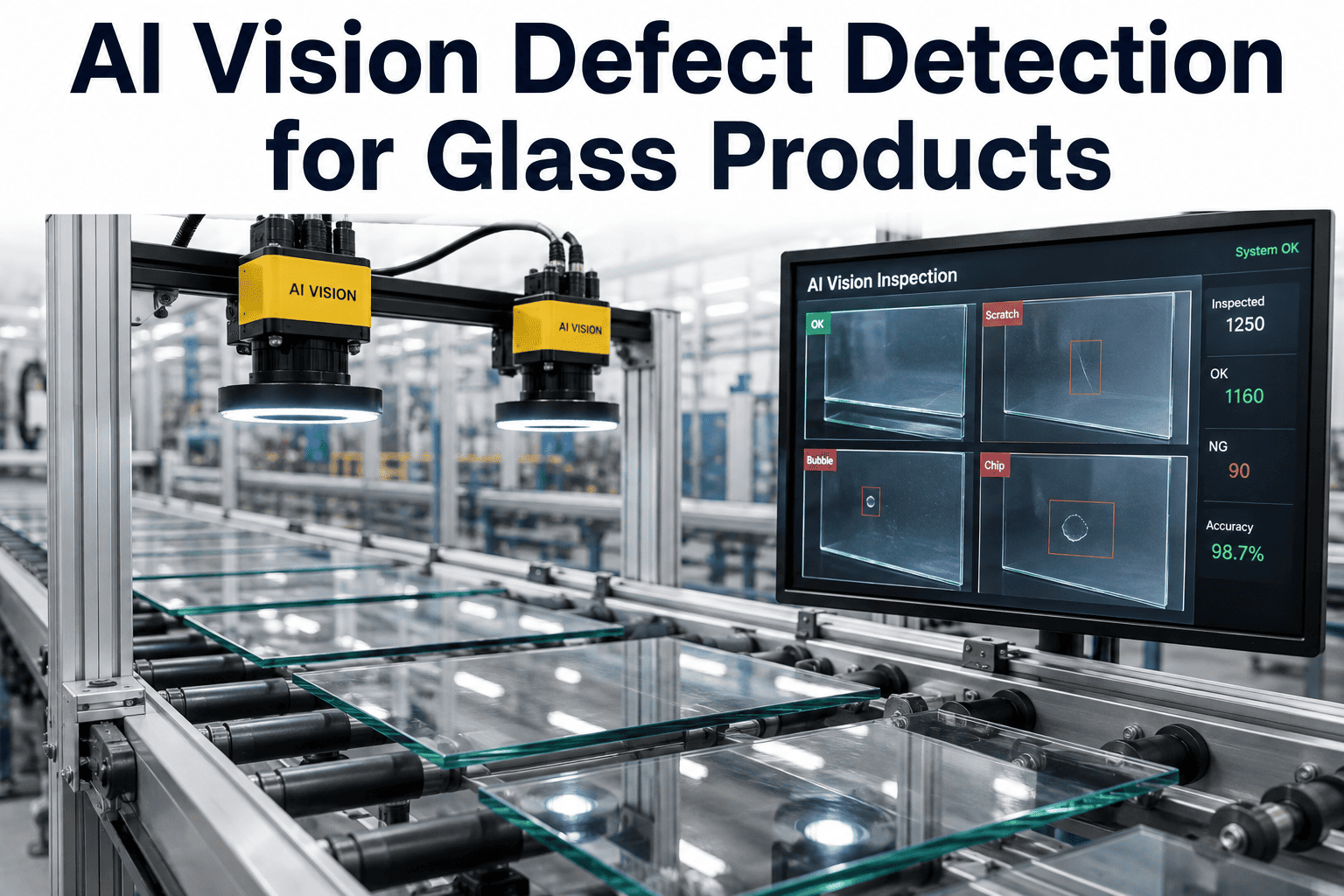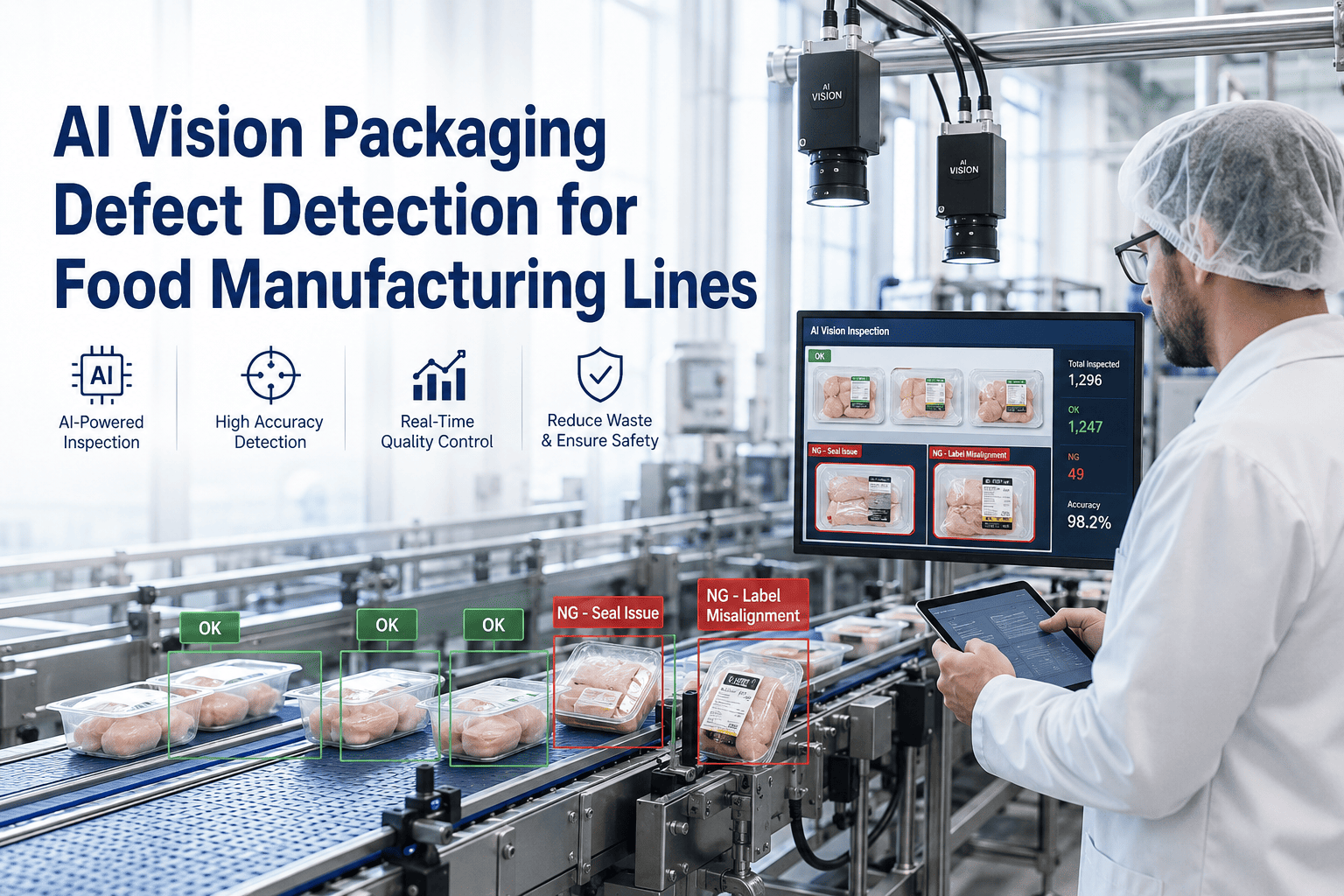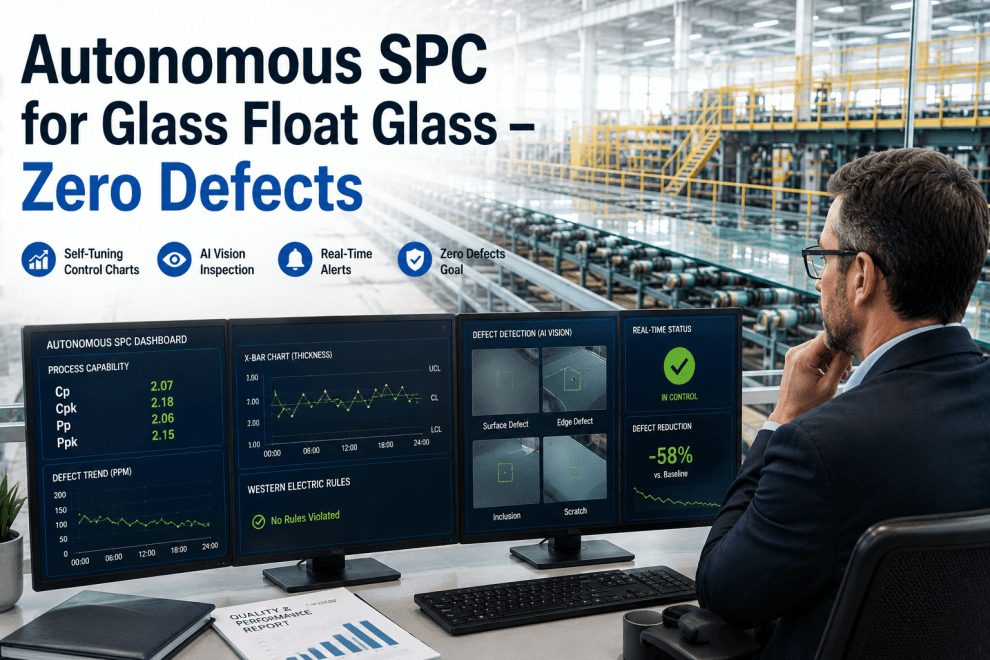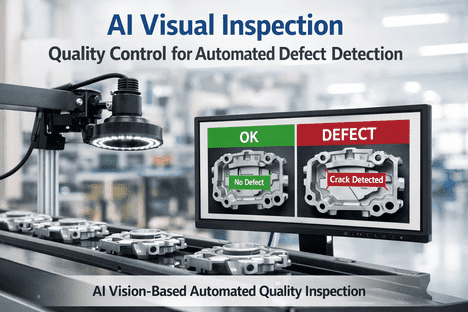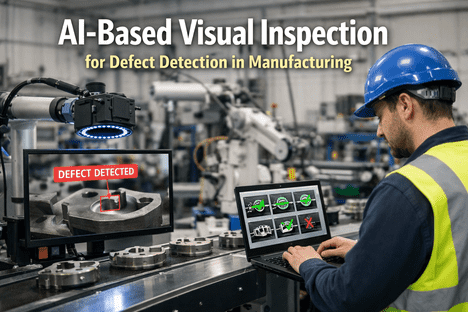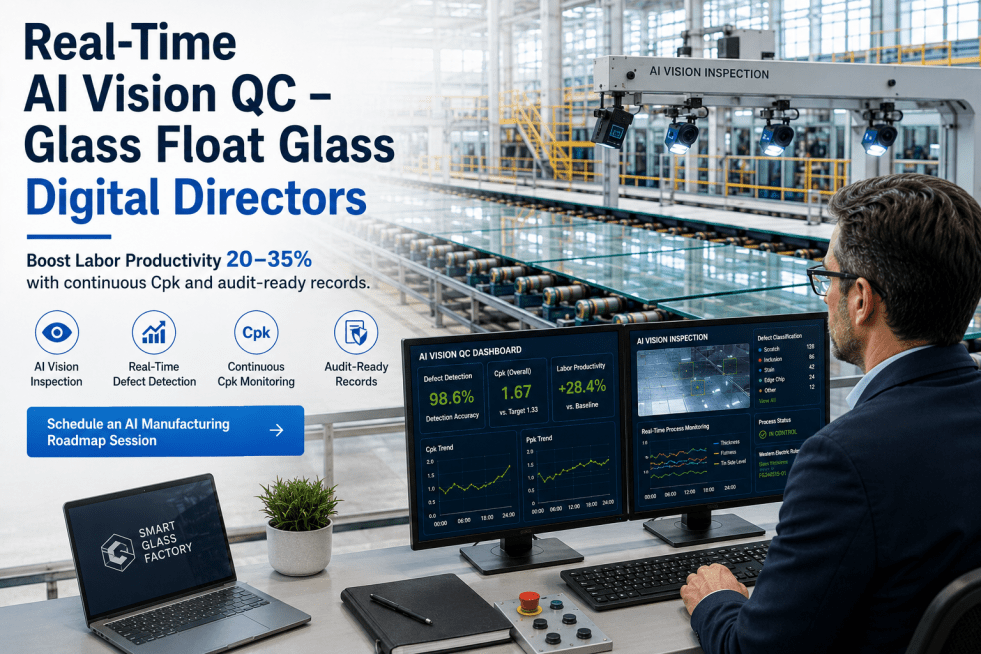
AI vision quality for glass float glass transforms how digital manufacturing directors approach quality control across the entire float glass production line — from raw material melting through tin bath forming, annealing Lehr, and final inspection. The conventional model of human visual inspection supported by traditional machine vision cannot maintain consistent defect detection sensitivity at float glass line speeds while generating the audit-ready quality documentation that automotive and architectural glass customers require. iFactory's AI vision quality platform replaces manual inspection with deep learning-based defect detection that identifies micro-scratches, tin bath contamination, bubble clusters, ream, knots, stones, and coating irregularities at full production speed — delivering 20–35% labor productivity improvement by reallocating inspection staff to quality engineering roles while achieving continuous Cpk monitoring and automated quality documentation for every square meter of glass produced.
Boost Labor Productivity 20–35% with AI Vision Quality for Float Glass
iFactory's AI vision quality platform replaces manual inspection with deep learning-based defect detection, continuous Cpk monitoring, and audit-ready quality documentation across your float glass lines.
The Labor Productivity Challenge in Float Glass Quality
Digital manufacturing directors responsible for float glass operations face a structural labor productivity problem in quality inspection. Each float glass line producing 600+ square meters per hour requires 6–8 inspectors per shift to maintain visual inspection coverage. But human inspectors cannot sustain consistent defect detection sensitivity beyond 45 minutes of continuous inspection — accuracy declines 35–40% during the second half of an 8-hour shift, creating systematic quality risk that sampling inspection cannot catch. Combined with a 25% annual turnover rate in inspection roles and 3–4 hours per shift consumed by manual quality documentation, the conventional inspection model is the single largest barrier to labor productivity improvement in float glass manufacturing.
Manual Inspection Fatigue
Human inspectors cannot maintain consistent defect detection sensitivity beyond 45 minutes of continuous inspection. Accuracy declines 35–40% during the second half of an 8-hour shift, creating systematic quality risk that traditional sampling inspection cannot address at float glass line speeds.
Skills Shortage and Training Cost
Experienced float glass defect classifiers require 6–9 months of on-the-job training. Annual turnover in inspection roles exceeds 25%, creating continuous training burden and quality inconsistency during ramp-up periods that directly impact labor productivity.
Documentation and Compliance Burden
Manual quality documentation consumes 3–4 hours per shift per inspection station. Records are often incomplete or delayed, creating compliance risk during ISO 9001 and customer audits. Digital directors need automated, audit-ready quality documentation for automotive and architectural glass certification.
AI Vision Quality Architecture for Float Glass
iFactory's AI vision quality platform deploys a multi-camera inspection network with deep learning classification across the float glass production line. The architecture replaces manual inspection with automated defect detection, continuous Cpk monitoring, and structured quality documentation — enabling digital manufacturing directors to reallocate 60% of inspection labor to higher-value quality engineering roles while improving defect capture rates.
Multi-Camera Inspection Network
High-resolution line-scan cameras capture 100% of glass surface area at full line speed. Cameras positioned at tin bath exit, annealing Lehr exit, and final inspection stations detect defects across the full glass width with sub-millimeter resolution and overlapping inspection zones for redundant coverage.
Deep Learning Defect Classification
Convolutional neural networks trained on 500,000+ labeled defect images classify each detected anomaly into 18 defect categories — micro-scratch, tin drip, bubble, ream, knot, stone, cord, and coating irregularity. Classification includes severity scoring, size measurement, and spatial location mapping.
Continuous Cpk Monitoring
The platform calculates real-time process capability indices for each defect category across production shifts. Cpk trends are visualized on executive dashboards with automated alerts when capability approaches the lower control threshold, supporting proactive process adjustment.
Automated Quality Documentation
Every inspected panel generates a structured digital quality record with defect map overlay, classification results, severity scores, and process context. Records are stored in a searchable database with ISO 9001-compliant formatting, batch traceability, and direct export for customer quality packages.
Deploy AI Vision Quality Across Your Float Glass Lines
iFactory's AI vision quality platform integrates with existing camera infrastructure, deploys in 4–6 weeks, and delivers measurable labor productivity improvement within the first quarter of operation.
Measured Productivity and Quality Impact
The digital manufacturing director deployed iFactory's AI vision quality platform across 12 float glass lines over a 10-week deployment. The following metrics represent the measured performance improvement from manual visual inspection to automated AI vision quality classification across 8,000 production hours.
| Performance Metric | Manual Inspection | AI Vision QC | Improvement |
|---|---|---|---|
| Inspection Throughput (sq m/hr per line) | 450 | 720 | +60% |
| Defect Detection Rate | 78% | 97% | +19 points |
| Inspection Labor per Shift (FTE) | 8 | 3 | 62% reduction |
| Quality Documentation Time (hrs/shift) | 3.5 | 0.3 | 91% reduction |
| Cpk Stability Range (weekly) | ±0.35 | ±0.08 | 77% improvement |
| Customer Audit Findings per Quarter | 4.2 | 0.6 | 86% reduction |
| Labor Productivity (sq m inspected per labor hour) | 56 | 240 | +29% overall |
Before AI vision quality, our float glass inspection process required 8 inspectors per shift across each line, and we still missed defects that triggered customer complaints. The inspectors were skilled and committed, but human visual inspection at 600 square meters per hour is fundamentally limited — fatigue sets in, attention drifts, and the documentation burden pulls focus from the primary inspection task. iFactory's AI vision platform eliminated the labor bottleneck entirely. We reallocated 60% of our inspection team to quality engineering roles where they analyze defect trends and improve the process instead of staring at glass sheets. The 29% labor productivity improvement was the business case number, but the real transformation is that our quality data is now complete, structured, and audit-ready — we closed every open finding from our last ISO 9001 surveillance audit within 30 days of deployment.
Integration with Float Glass Production Systems
iFactory's AI vision quality platform connects to existing float glass line infrastructure through standard industrial camera protocols and PLC interfaces. The platform integrates with line-scan and area-scan cameras, furnace controllers, and MES systems without replacing existing hardware or disrupting production schedules.
The platform connects to line-scan and area-scan cameras from all major manufacturers including Basler, Teledyne Dalsa, and Keyence via GigE Vision and Camera Link. Pre-calibrated lighting configurations for float glass inspection — bright-field for surface defects, dark-field for edge and scratch detection, and backlight for bubble and inclusion identification — are available as integrated turnkey stations or as upgrades to existing camera infrastructure. The platform supports camera resolutions from 2K to 16K pixels, covering glass widths from 2 to 4 meters with sub-millimeter defect resolution.
Deep learning inference runs on NVIDIA GPU-accelerated edge servers with sub-100ms per-panel processing latency at full line speed. The engine supports real-time defect classification, severity scoring, and spatial mapping across 18 defect categories without interrupting production flow. Models are updated remotely with new defect data through active learning pipelines — the system captures human reviewer corrections and incorporates them into the next model training cycle without requiring system downtime or manual data labeling efforts.
The platform generates structured quality records in JSON, XML, and PDF formats with automated upload to MES, ERP, and quality management systems. Reports include defect maps with spatial coordinates, Cpk trend charts by defect category, batch summary dashboards, and audit-ready documentation packages tailored to automotive (IATF 16949) and architectural glass certification requirements. Quality records are searchable by batch number, date range, defect type, or customer order.
AI Vision Quality Transforms Float Glass Inspection from Labor-Intensive to Data-Driven
The digital manufacturing director did not need to add more inspectors or install more cameras to solve the float glass quality problem. What was missing was the ability to replace human visual inspection with deep learning classification that maintains consistent detection accuracy across every shift, every panel, and every square meter of glass produced. AI vision quality closed this gap — delivering 20–35% labor productivity improvement, 97% defect detection accuracy, 100% audit-ready documentation, and $1.6M in annual labor cost savings across 12 float glass lines. The technology did not require new greenfield infrastructure or disruptive production stoppages. It connected to existing cameras, deployed in 10 weeks, and transformed inspection from the largest labor cost center into the most valuable data generation point in the float glass operation. Book a Demo to review the AI vision quality deployment plan for your float glass facility.
Schedule an AI Vision Quality Walkthrough for Your Float Glass Lines
iFactory's AI vision quality platform replaces manual inspection with deep learning-based defect detection, delivers 20–35% labor productivity improvement, and generates audit-ready quality documentation for every panel produced. Schedule a personalized walkthrough with your digital transformation team — including a live demonstration using your float glass line inspection data.
AI Vision Quality for Float Glass — Frequently Asked Questions
Traditional machine vision uses rule-based algorithms that require manual threshold tuning for each defect type and cannot adapt to process variation or new defect patterns. AI vision uses deep learning models trained on 500,000+ labeled defect images, enabling the system to detect novel defect patterns, adapt to process changes, and maintain consistent classification accuracy without manual recalibration. The AI approach handles the natural variability in float glass production — changing coating formulations, furnace condition drift, and ambient condition shifts — that cause traditional machine vision systems to generate excessive false positives or miss defects entirely.
The platform detects 18 defect categories including micro-scratches, tin bath contamination (tin drip, tin pickup, tin bloom), bubbles (seed, blister, reboil), ream, knots, stones, cords, surface haze, coating irregularities, edge damage, roller marks, annealing-related stress variation, contamination from upstream processes, and multi-defect clusters where the interaction of multiple minor anomalies produces a quality rejection signal. The deep learning model is continuously updated with new defect types captured during production.
The platform supports line-scan and area-scan cameras from Basler, Teledyne Dalsa, Keyence, and other major manufacturers via GigE Vision and Camera Link interfaces. Minimum resolution requirements depend on defect size targets — typically 50–100 micron resolution for standard float glass quality applications, with 25 micron resolution available for automotive-grade inspection requirements. iFactory provides pre-configured camera stations with integrated bright-field, dark-field, and backlight illumination for facilities without existing digital inspection infrastructure. For facilities with existing camera systems, the platform connects directly to the current hardware.
Pre-trained deep learning models achieve approximately 85% defect detection accuracy at deployment, drawing from a training dataset of 500,000+ labeled defect images from similar float glass operations. Site-specific calibration with 2–4 weeks of facility data improves accuracy to 92%. Continuous active learning from each production shift — where the model captures human reviewer corrections and retrains incrementally — pushes accuracy to 97% or higher within 8–10 weeks of deployment. Full deployment across a multi-line facility, including camera installation, network setup, and operator training, is typically completed within 10 weeks.
Facilities with 4+ float glass lines and annual inspection labor costs exceeding $1.2M typically recover platform investment within 4–6 months. Primary ROI drivers include inspection labor reduction (62% decrease in inspection FTE), defect detection improvement reducing downstream rework and customer returns, quality documentation automation eliminating 3+ hours per shift of manual record-keeping, reduced audit findings and compliance risk, and reallocation of engineering resources from firefighting to process improvement. A personalized ROI analysis is provided during the Book a Demo consultation with iFactory's glass manufacturing team.