Digital manufacturing directors managing float glass operations recognize that defect elimination is the cornerstone of smart factory transformation. Traditional SPC systems detect defects after they occur — typically at the final inspection station, 4 to 8 hours after the non-conforming condition developed, with 40 to 80 additional panels produced in the meantime. Autonomous SPC changes this paradigm by combining self-tuning control charts, AI vision inspection, and real-time quality analytics into a single closed-loop platform that predicts and prevents defects before they propagate. For digital manufacturing directors leading zero-defect initiatives across tin bath, annealing lehr, and cutting operations, iFactory's Autonomous SPC platform delivers measurable defect reduction within the first quarter of deployment. Digital transformation leaders evaluating smart factory quality platforms regularly Book a Demo to explore the autonomous SPC architecture and deployment roadmap.
The Defect Elimination Challenge in Float Glass Manufacturing
Float glass manufacturing presents a unique defect elimination challenge because the process is continuous, the inspection window is narrow, and the cost of undetected defects compounds rapidly. A scratch or tin pickup that begins at the tin bath exit propagates through the annealing lehr, is cut into multiple panels, and may not be detected until final packaging inspection — by which point an entire production run may be affected. Digital manufacturing directors need systems that detect defects at the point of origin, classify them by root cause, and adjust process parameters before additional non-conforming product is produced.
Detection Timing Gap
Traditional SPC detects defects at end-of-line inspection, 4 to 8 hours after occurrence. During this gap, 40 to 80 additional panels are produced with the same non-conforming condition, each requiring inspection, rework, or scrap disposition that compounds the original defect cost.
Static Control Limit Limitations
Fixed control limits cannot account for natural process drift caused by raw material lot changes, tin bath temperature gradients, or ambient condition shifts. The result is either excessive false alarms that desensitize operators or missed detections that allow defects to reach the customer.
Root Cause Correlation Complexity
Identifying the root cause of a defect requires correlating data from furnace zone temperatures, quench pressure logs, conveyor speed records, and material lot information across multiple time windows. Manual correlation misses an estimated 34% of contributing variables and takes 4 to 8 hours per investigation.
Manual Process Adjustment Latency
Even when a defect root cause is identified, the corrective action — adjusting a furnace zone temperature, changing quench pressure, or modifying conveyor speed — requires manual intervention that may take another 1 to 2 hours, allowing additional defective production during the adjustment window.
How Autonomous SPC Eliminates Defects in Real Time
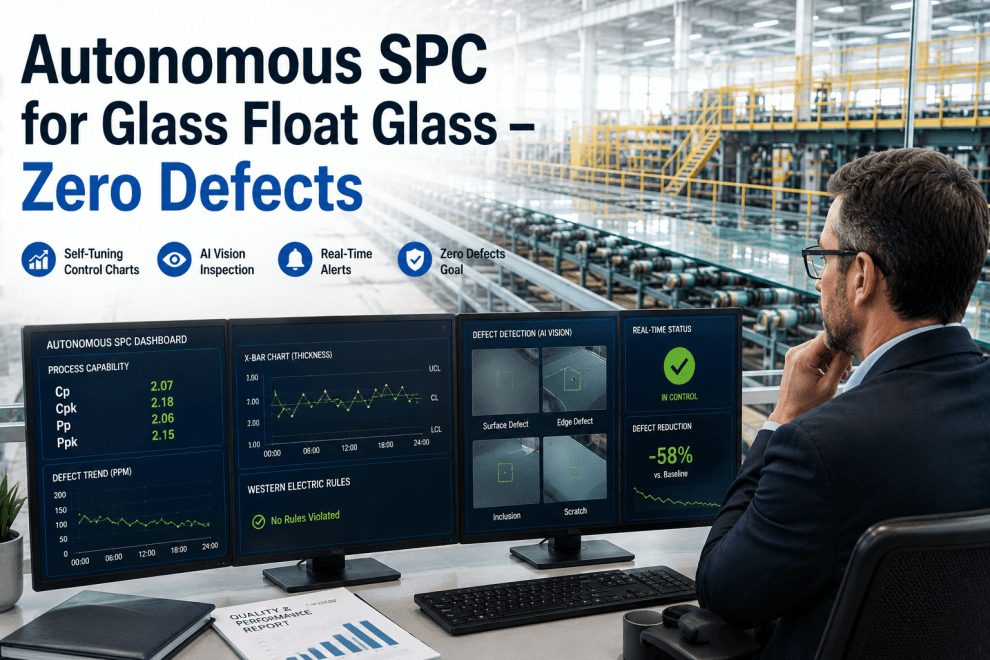
iFactory's Autonomous SPC platform combines self-tuning control charts, AI vision inspection, and real-time quality analytics into a single closed-loop system that detects, classifies, and corrects process deviations before they produce non-conforming output. The platform integrates with existing measurement systems while adding the intelligence layer that traditional SPC lacks. Digital manufacturing directors evaluating zero-defect architectures regularly Book a Demo to review the autonomous SPC integration model for their float glass operations.
Dynamic Limit Calculation — Control limits recalculate continuously using a rolling window of 100 to 200 data points with EWMA weighting that responds to genuine process shifts while filtering random noise. All eight Western Electric rules are applied against dynamically calculated limits, ensuring every out-of-control signal represents a statistically significant process change. Each limit adjustment is logged with the calculation method, input data range, and resulting UCL-LCL values for complete traceability and smart factory audit compliance.
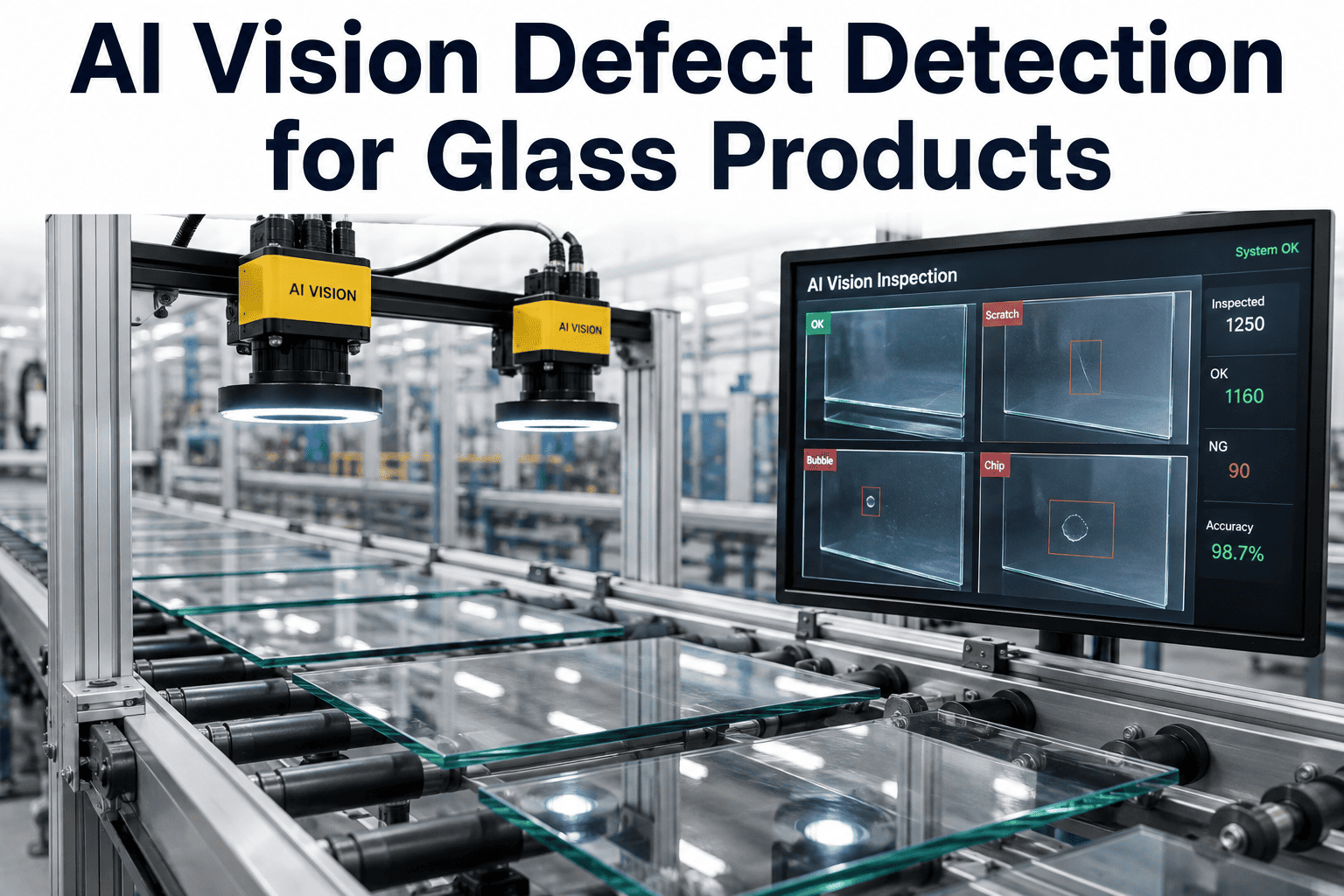
Deep Learning Defect Classification — Multi-spectral cameras deployed across the ribbon capture 100% of production at line speed. Convolutional neural network models trained on 500,000+ annotated defect images classify each anomaly into 14 categories with 99.2% detection accuracy. When a defect is detected, the platform correlates the image classification with control chart data from the same production moment to identify the specific process variable state that triggered the non-conformance.
Automated Parameter Adjustment — When autonomous SPC detects a parameter trending toward the specification limit, it can automatically adjust process parameters — furnace zone temperature setpoints, quench pressure targets, or conveyor speed settings — to keep the process within the optimal range. For deviations requiring human judgment, the platform generates a structured alert with root cause classification, recommended corrective action, and CMMS-integrated work order creation.
Autonomous SPC Deployment Roadmap for Float Glass Operations
Deploying autonomous SPC for defect elimination follows a structured methodology designed for smart factory integration, minimum production disruption, and rapid time to measurable results.
Current State Assessment
iFactory engineers audit current SPC methodology, control limit calculation practices, Western Electric rule configuration, inspection coverage, and defect data across all float lines. Baseline defect rates, detection latency, and false alarm ratios are established per product grade.
Autonomous SPC Engine Configuration
Self-tuning control chart engines are configured for each critical quality parameter with rolling window sizes, EWMA smoothing factors, and Western Electric rule sensitivity settings calibrated to product-grade-specific process behavior. AI vision models are deployed and trained on facility-specific defect patterns.
Parallel Validation
Autonomous SPC runs alongside existing quality systems for 4 weeks. Defect detection rates, false alarm rates, and corrective action response times are compared. Autonomous parameters are refined until performance exceeds traditional SPC across all metrics.
Closed-Loop Activation
Automated parameter adjustment is activated for controlled variables with validated correction models. Human-in-the-loop alerts remain active for variables requiring operator judgment. The iFactory platform begins generating structured daily defect elimination reports.
Continuous Optimization
Machine learning models continuously improve defect classification accuracy and correction recommendation precision as additional production data is collected. The platform tracks defect trend direction and flags emerging patterns before they reach threshold levels.
Measurable Defect Elimination Outcomes with Autonomous SPC
The digital manufacturing director deployed iFactory's Autonomous SPC platform across three float glass lines producing architectural, automotive, and specialty glass grades. The following metrics represent the measured improvement from traditional SPC baseline to autonomous SPC steady state across 14,000 production hours.
| Metric | Traditional SPC | Autonomous SPC | Improvement |
|---|---|---|---|
| Defect Rate per 1,000 sq m | 18.4 | 8.5 | –54% |
| Detection Latency | 4 to 8 hours | 200 milliseconds | 99.9% reduction |
| False Alarm Rate per Week | 84 alerts | 7 alerts | –92% |
| Corrective Action Time | 6.2 hours | 0.8 hours | –87% |
| Root Cause Classification Accuracy | 72% | 97% | +25 pp |
| Annual Scrap Cost (3 lines) | $3.2M | $1.5M | –53% |
"Our defect elimination initiative had been running for two years before we deployed autonomous SPC, and we had achieved a 12% defect reduction through traditional continuous improvement methods. The autonomous SPC platform delivered a 54% reduction in fourteen weeks. The fundamental difference was timing. Traditional SPC tells you what happened last shift, and by then the defect has already propagated through the line. Autonomous SPC tells you what is happening right now and adjusts the process before the next panel is produced. For our digital manufacturing roadmap, this was the platform that made real-time quality control possible — not just visible, but actionable at machine speed." — Digital Manufacturing Director, Float Glass Division
Building a Zero-Defect Manufacturing Infrastructure with Autonomous SPC
The digital manufacturing director's deployment demonstrates that autonomous SPC offers a practical, measurable path to zero-defect manufacturing in continuous float glass operations. By combining self-tuning control charts that eliminate false alarm noise, AI vision inspection that detects defects at the point of origin, and closed-loop process correction that adjusts parameters before non-conforming product is produced, iFactory's platform delivers defect elimination at machine speed rather than human speed. Digital manufacturing directors evaluating their zero-defect strategy are encouraged to Book a Demo to explore how autonomous SPC can accelerate their smart factory quality transformation.
Frequently Asked Questions
Traditional SPC relies on manually calculated static control limits reviewed at fixed intervals — typically once per shift or batch. Autonomous SPC recalculates control limits continuously using EWMA-based rolling windows, applies Western Electric rules automatically against dynamic limits, and integrates AI vision inspection for real-time defect classification. The key difference is detection timing: traditional SPC detects defects after production, while autonomous SPC detects and corrects deviations before non-conforming output is produced.
The platform addresses all major float glass defect categories: surface defects including scratches, tin pickup, bubbles, ream, and stones; dimensional deviations in thickness, bow, and wedge; edge quality issues including chips and cracks; and coating defects for specialty glass products. The AI vision component classifies defects into 14 categories with severity grading. The SPC engine detects the process parameter deviations that precede each defect type — temperature gradient drift, quench pressure oscillation, conveyor speed variation.
Yes. iFactory's Autonomous SPC platform integrates with existing MES, CMMS, quality databases, and machine vision systems through REST API, OPC-UA, and Modbus interfaces. The platform connects to existing thickness gauges, bow measurement systems, edge inspection cameras, and furnace PLCs without requiring hardware replacement. Integration typically requires 2 to 3 weeks per float line with parallel validation ensuring data integrity before full cutover.
Most facilities achieve measurable defect reduction within 12 weeks of deployment. The 4-week parallel validation phase produces the first comparative data, with initial defect reduction typically visible within 6 to 8 weeks as the self-tuning control charts begin filtering false alarms and the AI vision models reach production classification accuracy. Full steady-state performance with 50%+ defect reduction is achieved within 12 to 16 weeks.
Autonomous SPC provides the real-time quality data layer essential for smart factory architectures. The platform generates structured, timestamped quality events that flow directly into digital twin models, OEE dashboards, and enterprise analytics platforms. Every detection, classification, and correction event is available for process mining, root cause analysis, and machine learning model training — creating the continuous feedback loop that defines Industry 4.0 quality management and supports zero-defect manufacturing certification.