A rolling mill operator at a 320,000 tpa aluminum plant in Odisha described the moment in 2025 when his SAP MII dashboard told him a coil was within spec, while the line camera at the exit was already flagging surface bands his SPC system had not learned to recognise. The MII platform was doing exactly what it was designed for in 2008 — pulling tag data, computing OEE, presenting dashboards. It was not designed to learn the visual signature of a new defect mode, retrain on it, and push the model back to the line within the same shift. That is a different kind of system. With SAP MII mainstream maintenance ending December 31, 2027 and extended support sunsetting in 2030, every aluminum manufacturer is making the same evaluation — what comes next, and is the next platform allowed to be different. This page is the operations-grade comparison between the legacy SAP MII approach and the iFactory AI-native platform for aluminum SPC, vision, and shop-floor intelligence.
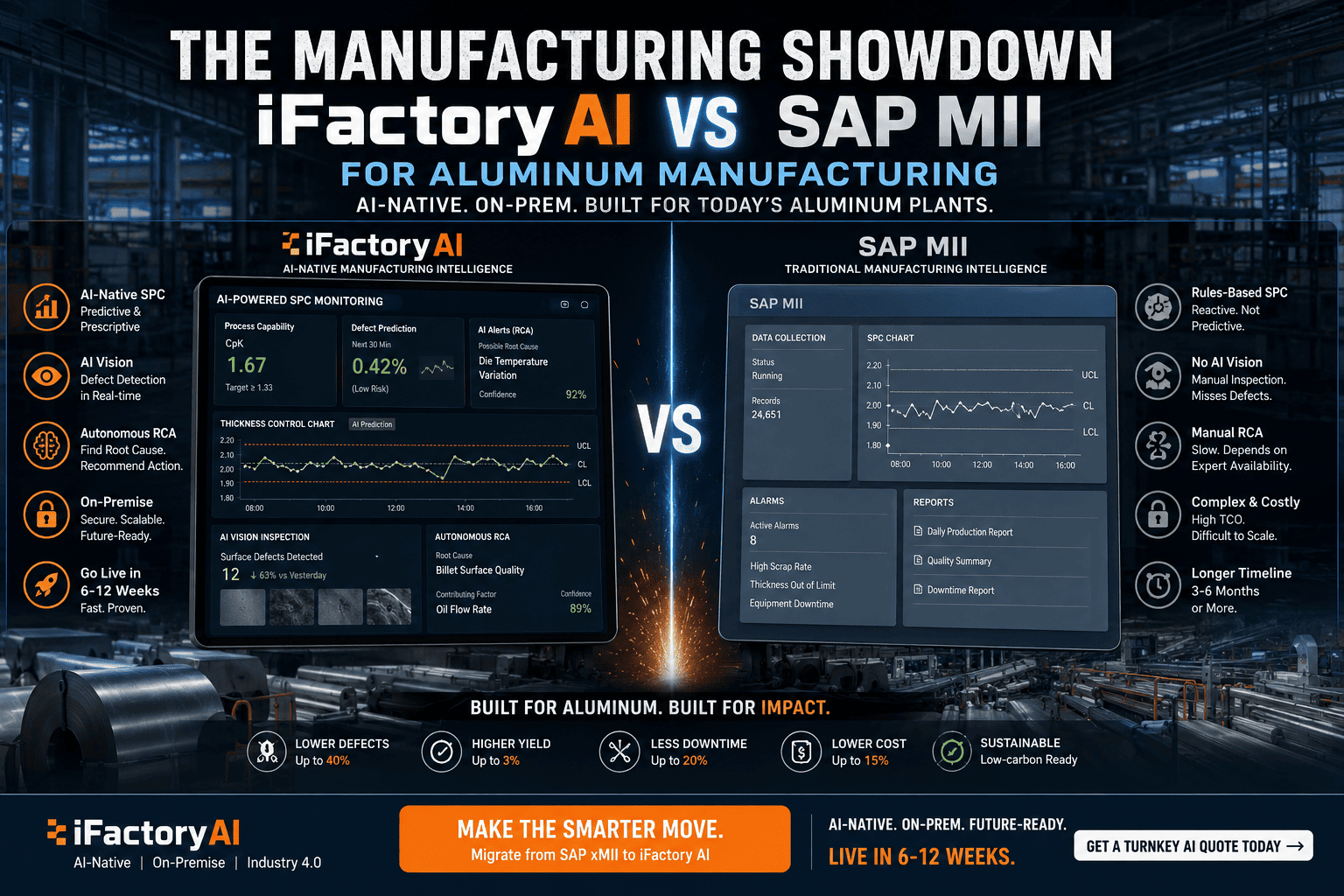
iFactory AI vs SAP MII — The Manufacturing Showdown for Aluminum Plants Facing the 2027 Cliff
SAP MII served aluminum manufacturers honestly for nearly two decades. Its end-of-life timeline now forces a strategic choice — migrate to SAP Digital Manufacturing, stay on extended support, or rethink the architecture entirely. For aluminum operators dealing with surface defects, alloy chemistry drift, and process variability that demand AI-native capabilities, the third option deserves serious evaluation.
What SAP Has Actually Announced — And Why It Matters for Aluminum Specifically
Before evaluating any alternative platform, the facts of SAP's announcement matter. The summary below is what SAP has publicly confirmed. None of it is speculation or competitive positioning.
Mainstream support ends 31 December 2027
SAP MII mainstream maintenance officially ends on this date, confirmed publicly by SAP. After this point, no new features, no functional enhancements, no architectural updates.
Extended support to 31 December 2030
Extended maintenance is available at premium pricing until the end of 2030. This is a runway for migration, not a continuation of the product roadmap.
No "MII 2.0" is coming
SAP has confirmed there will be no successor version of MII. The recommended forward path is SAP Digital Manufacturing (DM), which is a cloud-native architecture requiring rebuild rather than upgrade.
SAP MII 15.5 runs on Java/NetWeaver AS Java 7.5
The current architecture was designed for the data volumes and processing patterns of the early 2000s. Sensor density, real-time analytics, and AI workloads of modern aluminum plants push it well beyond its original design envelope.
Migration timelines: 12–36 months
Industry analysts consistently report 12 to 36 month migration windows. The dominant variable is the volume of custom BLS transactions, xMII queries, and PCo integration points that must be rebuilt — not a one-to-one port.
Specialist consulting capacity is tightening
Reports from 2025 indicate SAP specialist rates have risen approximately 20% since 2023, with projections of 30–50% further increases by 2026–27 as remaining migration volume compresses into a shrinking window.
Why this is an inflection moment for aluminum specifically
Aluminum manufacturing has changed materially since SAP MII was designed. Surface defect detection now uses computer vision at line speed. Alloy chemistry control requires predictive SPC with multi-variable correlation. Operator decision-support runs on natural-language assistants. None of these were considerations in 2005. Migrating SAP MII to the same architectural pattern carries the legacy into the next decade. Replacing it with an AI-native platform lets you choose what 2030-era aluminum manufacturing actually needs.
SAP MII vs iFactory AI — Feature-by-Feature Comparison
The comparison below is the honest one. SAP MII has real strengths — particularly in ERP integration and enterprise-wide deployment patterns. iFactory AI has different strengths — particularly in AI-native processing, deployment speed, and the modern UX shop-floor operators actually use. Pick the comparison row that matters most to your aluminum plant's specific situation.
| Capability | SAP MII (Classic, 15.x) | iFactory AI (2026) |
|---|---|---|
| Core architecture | Java / NetWeaver AS Java 7.5 — designed early 2000s | AI-native, modern microservices, on-premise or cloud |
| Support timeline | Mainstream ends Dec 2027; extended to Dec 2030 | Active roadmap, continuous releases, no EOL announced |
| SPC capability | Classical SPC with Western Electric rules, manual configuration | Predictive SPC with ML-driven rule selection, autonomous threshold tuning |
| Vision AI / surface defect detection | Third-party vision systems integrated via PCo connectors | Native vision AI with pre-trained aluminum defect models |
| Operator decision support | Dashboards and alerts; investigation is operator-led | Natural-language AI assistant with root-cause guidance |
| Autonomous RCA (root-cause analysis) | Not native; custom BLS logic typically required | Native autonomous RCA with linked process variables |
| ERP integration | Tight integration with SAP ECC and S/4HANA | Open APIs for S/4HANA, Oracle, custom ERPs |
| Shop-floor connectivity | SAP PCo connectors to PLCs, OPC, historians | OPC-UA, MQTT, Modbus, vendor-specific drivers — all native |
| Deployment time (greenfield) | 6–18 months typical for a meaningful production deployment | 6–12 weeks turnkey, including hardware |
| Deployment effort (custom logic) | BLS transactions, xMII queries — significant developer effort | Configuration-driven; aluminum-specific templates pre-loaded |
| Hardware approach | Bring-your-own infrastructure; SAP licenses separate | Pre-configured NVIDIA AI server, racked and ready — turnkey |
| Updates & releases | Major version upgrades; no functional updates since 2020-ish | Continuous releases; model retraining on plant data |
| Operator UX | Web-based, originally desktop-optimised | Modern web + tablet, designed for line-side use |
| Total cost of ownership | SAP licenses + custom development + specialist consulting | Turnkey bundle — hardware, software, integration, training included |
| Specialist availability | SAP MII consultant rates rising 20–50% through 2027 | iFactory team retained through deployment and beyond |
Where SAP MII still wins fair and square
If your aluminum operation runs deeply embedded SAP ECC or S/4HANA workflows, your batch records, quality holds, and production orders all flow through SAP — and the SAP DM path is the lowest-disruption migration path on the table. The comparison above is not "iFactory AI for everyone" — it is the case for the subset of aluminum operations where AI capability and deployment speed outweigh the architectural pull of staying inside the SAP ecosystem. Most plants we work with are running iFactory AI alongside SAP S/4HANA, not instead of it.
Bolt-On AI vs AI-Native — Why the Architectural Difference Matters in Aluminum
The phrase "AI-enabled platform" appears in every manufacturing software brochure written since 2023. The difference between "AI bolted onto a dashboard layer" and "AI sitting at the core of the data path" is not marketing — it determines whether the system can do what aluminum manufacturers actually need it to do at line speed.
AI as a Bolt-On Layer
AI models live outside the core stack — typically separate vendor solutions, integrated via APIs. Training, inference, and model updates happen out of band. Latency to operator is seconds to minutes.
AI as the Core Layer
AI models run on the same NVIDIA appliance that connects to the shop floor. Vision inference at line speed (under 100 ms). SPC predictions on every sample. Model retraining on plant-specific data without external dependencies.
Five Aluminum-Specific Scenarios — What Each Platform Does
Generic platform comparison is interesting; aluminum-specific comparison is operational. The five scenarios below cover the highest-value aluminum manufacturing use cases — surface defect detection in rolling and extrusion, alloy chemistry SPC, smelter current efficiency, casthouse temperature control, and operator AI guidance.
Surface Defect Detection — Rolling & Extrusion
What it requires: Computer vision at line speed (1.5–3.0 m/s) recognising oxide bands, scratches, edge cracks, roll marks, pickup, die lines — and learning new defect modes as they appear.
Alloy Chemistry SPC — Casthouse
What it requires: Real-time SPC on Mg, Si, Fe, Cu and trace elements with predictive flagging before a heat goes out of spec, plus correlation to upstream raw material lots.
Smelter Current Efficiency & Anode Effects
What it requires: Real-time monitoring of pot voltage, alumina feeding, anode effects, and current efficiency, with cross-pot pattern detection to identify deteriorating cells early.
Casthouse Temperature & Solidification Control
What it requires: Real-time temperature control across holding furnace, transfer launders, DC caster mould — with prediction of porosity, shrinkage, and hot tearing risk per slab.
Operator AI Assistant — Shop Floor Decision Support
What it requires: Natural-language interface where an operator can ask "why did slab 7423 fail dimensional check?" and receive a sourced answer drawing from process data, prior incidents, and SOPs.
Get a SAP MII to iFactory AI migration assessment
We walk down your aluminum line, inventory your existing MII custom logic (BLS transactions, xMII queries, PCo connections), and deliver a migration roadmap with timeline, parallel-run plan, and TCO comparison against the SAP DM path. No commitment beyond the assessment.
- MII custom logic inventory
- Co-existence and parallel-run plan
- Aluminum AI use-case prioritisation
- TCO comparison: SAP DM path vs iFactory AI
- On-premise NVIDIA AI server, racked and ready
- Live in 6–12 weeks, with S/4HANA integration intact
From SAP MII to iFactory AI — A Phased Path Without Production Disruption
The biggest single migration risk is treating it as a cutover event. The phased pattern below — inventory, parallel run, gradual replacement, MII decommissioning — keeps production running throughout. No aluminum line should ever go dark for a platform migration.
MII Custom Logic Inventory
Catalogue every BLS transaction, xMII query, PCo connection point, and custom dashboard. This is the single most important input before any migration commitment — it determines whether the timeline is 6 months or 18.
Weeks 1–4 · No production impactiFactory AI Parallel Deployment
iFactory AI appliance installed on-premise, connected to the same data sources that feed MII. Both systems running in parallel — MII continues to serve production, iFactory begins building baseline.
Weeks 5–10 · Co-existence beginsUse-Case Migration Wave 1 — High-Value AI
Migrate the use cases where AI native capability matters most — surface defect vision, predictive SPC, operator AI assistant. MII continues to handle classical reporting and ERP integration unchanged.
Month 3–6 · Quick AI wins liveUse-Case Migration Wave 2 — SPC and Dashboards
Replace MII SPC charts, KPI engines, and operator dashboards with iFactory equivalents. Existing custom BLS logic rebuilt as iFactory configuration. Operators trained on the new UX.
Month 7–10 · Operational handoverS/4HANA Integration Continuity
iFactory AI integrates with S/4HANA via open APIs — production orders, batch records, quality holds, and material traceability continue to flow. MII is no longer the ERP-shop floor bridge by end of this phase.
Month 9–11 · ERP continuity verifiedMII Decommissioning
Once iFactory AI is serving 100% of the operational workload and S/4HANA integration is verified, MII is taken out of service. Most plants complete this step 12–14 months from contract — well within the 2027 mainstream-support deadline.
Month 12–14 · Full migration completeWhat stays the same after migration
S/4HANA stays. Your batch records, material masters, work orders, and quality data continue to flow through SAP's ERP layer — iFactory AI integrates via open APIs and message buses. Your operators keep the workflows they know, in a modern UX. Your existing PLC and historian investments stay. The migration replaces the integration layer, not the entire stack.
Case Study — 320,000 tpa Aluminum Rolling Plant, 11-Month Migration
A mid-size aluminum rolling and finishing plant in eastern India running SAP MII since 2014. 4 hot rolling lines, 6 cold mills, 2 anodising lines, finishing, slitting, packaging. Migration to iFactory AI completed in 11 months, fully overlapping with continued production. The audited 18-month outcome:
| Metric | Before (SAP MII) | After 18 months (iFactory AI) | Change |
|---|---|---|---|
| Surface defect escape rate | 0.47% (lagging indicator only) | 0.18% (real-time vision) | −62% |
| Time to detect a new defect class | 14–30 days (manual) | 24 hours (operator-labelled retrain) | Near-eliminated |
| Alloy chemistry out-of-spec heats per month | 4.2 average | 0.7 average | −83% |
| Operator time spent investigating alarms | ~22 min per shift per console | ~6 min per shift per console | −73% |
| SAP MII custom-logic maintenance hours/month | ~340 hours | 0 (system decommissioned) | Eliminated |
| S/4HANA integration continuity | Via SAP PCo / MII bridge | Via iFactory open APIs to S/4HANA | Maintained |
| Production hours lost to migration | — | 0 (parallel-run pattern) | — |
| Total migration cost vs SAP DM path estimate | — | ~58% of estimated SAP DM cost | −42% |
The board conversation that approved the migration
The plant director did not present this as a SAP MII replacement. The pitch was: "Our defect escape rate is 0.47%. We have no path on the existing platform to bring it under 0.25%. AI-native vision and SPC can. The platform change is the means; defect reduction is the end." The board approved on operational benefit, not on the EOL timeline. The 2027 deadline was a constraint, not the rationale.
Six-Phase Implementation Roadmap for an Aluminum Plant
The roadmap below applies whether you are migrating from SAP MII or starting fresh. Aluminum-specific templates ship with the platform — surface defect models, alloy chemistry SPC, smelter pot signatures — so the deployment time is spent on plant-specific configuration, not building from scratch.
Plant Walk-down and Use-Case Prioritisation Week 1–3
Walk every stage from smelter or remelt to finished coil. Inventory existing data sources, PLCs, vision systems, and SAP MII custom logic if present. Prioritise the AI use cases by expected operational impact.
iFactory AI Appliance Install Week 4–6
Pre-configured NVIDIA AI server arrives racked. Power, Ethernet, and existing data-source connections established. Surface defect cameras and additional sensors installed where required.
Baseline Collection and Model Calibration Week 7–10
Pre-trained aluminum defect and SPC models calibrate against plant-specific data. Operator-labelled samples used to fine-tune for site conditions. Initial models live in advisory mode.
Pilot Line Cutover and Operator Training Week 11–14
First production line cuts over to iFactory AI as primary. SAP MII continues to operate as backup if present. Operators trained on the new UX and the AI assistant interface.
Plant-Wide Wave Rollout Month 4–9
Remaining lines cut over in waves. S/4HANA integration verified at each stage. Defect models refined per line family. Operator AI assistant trained on plant-specific SOPs and incident history.
SAP MII Decommissioning and Continuous Improvement Month 10–14
If migrating from SAP MII, decommission once iFactory AI is serving 100% of operational workload. Quarterly model retraining cycle established. Use cases expanded based on plant-driven priorities.
Migration and Comparison — Common Questions
If we stay with SAP, we move to SAP DM. Why consider iFactory AI instead?
SAP DM is the most natural path for plants where SAP ERP is the centre of gravity and the operational priority is staying inside the SAP ecosystem. iFactory AI is the alternative for plants where AI-native capability — vision, predictive SPC, autonomous RCA, operator AI assistant — is the operational priority and you want those capabilities at deployment, not after a multi-quarter custom build on top of DM. The choice depends on which constraint dominates your situation.
Will we lose our S/4HANA integration if we move off SAP MII?
No. iFactory AI integrates with S/4HANA via open APIs — production orders, batch records, quality holds, material traceability all continue to flow. The MII layer's role as the ERP-to-shop floor bridge is replaced by iFactory's API integration. Your ERP investment is preserved.
How does iFactory AI handle our existing PLC and historian investments?
Standard. iFactory connects to PLCs via OPC-UA, MQTT, Modbus, and vendor-specific drivers — Siemens, Rockwell, Honeywell, ABB. Existing OSIsoft PI, Aveva, GE Proficy historians integrate via their standard APIs. No PLC replacement required; no historian migration required.
What happens to our 340 hours per month of SAP MII custom-logic maintenance?
Most of that effort disappears. iFactory AI is configuration-driven where MII required developer-led BLS transactions. The aluminum-specific templates ship with the platform. The few cases where genuine custom logic is required typically need 5–10% of the equivalent MII development effort because the underlying primitives are higher-level.
Can iFactory AI deal with the SAP MII deadline pressure if we are still on SAP ECC?
Yes. iFactory AI integrates with SAP ECC, S/4HANA, Oracle, and most major ERP platforms. The migration off MII can be decoupled from the ECC-to-S/4HANA migration if your priorities require it. We have customers running iFactory AI on ECC plants targeting an S/4HANA migration in 2027–28.
Do we need to buy NVIDIA AI servers separately?
No. The fully-loaded AI server is supplied pre-configured and pre-loaded with the aluminum-specific AI templates, predictive SPC engines, vision models, operator AI assistant, S/4HANA integration drivers, and dashboards. On-premise deployment — no cloud, no data egress, no DCS modification. Rack it, connect power and Ethernet, and the system goes live. Cabling, integration, operator training, and 24×7 remote monitoring are all included.
What is the typical timeline from contract to first AI capability live?
Live in 6–12 weeks for the pilot line. Three-phase delivery: weeks 1–4 — walk-down and prioritisation. Weeks 5–8 — appliance install, baseline collection, S/4HANA integration. Weeks 9–12 — pilot cutover and operator training. Plant-wide rollout typically completes within 10–14 months including MII decommissioning where applicable.
The 2027 Deadline Is a Constraint. The Operational Opportunity Is the Reason to Move.
Hardware + software bundle. Pre-configured NVIDIA AI server, racked and ready, on-premise — no cloud, no data egress. Pre-loaded with aluminum-specific predictive SPC, native vision AI for surface defects, operator AI assistant, S/4HANA integration drivers, and migration tooling for SAP MII custom logic. Cabling, integration, validation, operator training, and 24×7 remote monitoring all included. Live in 6–12 weeks. Trusted by 1000+ industrial clients with 99.9% uptime.