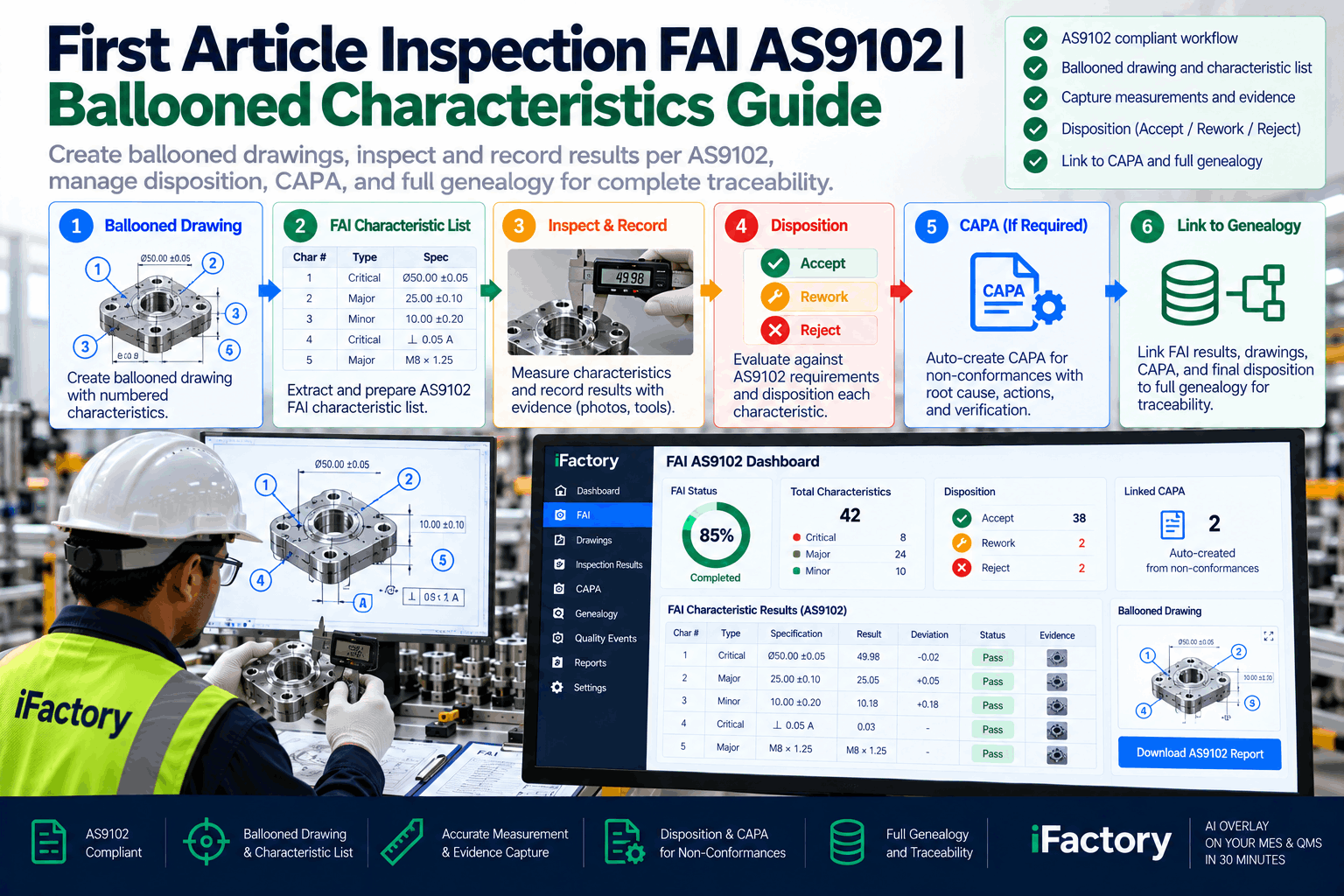
7:42 a.m. on the shop floor, a quality engineer is waiting on the last FAIR signature while the shipping cutoff clock is already running. If that first article is not released before the 10:00 a.m. pickup window, the part stays on hold, the revision mismatch stays open, and the order risks slipping another day. That is why teams need a tighter way to connect the ballooned characteristic, the hold, and the release decision before OOC lag becomes a shipment delay. iFactory AI supports the closed-loop path from ballooned characteristic through quarantine, CAPA, verification, and genealogy so first article inspection FAI AS9102 stays controlled from the first measured characteristic to the final release record. Walk through a 30-minute FAI demo.
First Article Inspection is a release gate, not a paperwork exercise. See how ballooned characteristics, quarantine, CAPA, and genealogy connect into one auditable release decision.
At a Glance
Why This Refresh Matters Now
First Article Inspection is often treated like a paperwork exercise, but in practice it is a release gate. If the build is inspected against the wrong revision, the result is not just a documentation error — it can create hold lag, reinspection, and a scramble to prove what changed, when it changed, and which records still apply.
That is why the modern FAI discussion is shifting away from disconnected PDFs and spreadsheets. The real question is not just whether AS9102 was completed. It is whether the process can stay closed loop when a characteristic fails.
Closed-loop control matters because quality does not end at measurement. A missed requirement should trigger a signal, a hold, a corrective workflow, a verification step, and a traceable release decision. When those pieces are separated across email, travelers, and manual updates, the result is slow containment and weak genealogy. iFactory AI supports that operational layer, connecting ballooned characteristics, inspection events, hold decisions, CAPA, and release control without asking quality to reconcile everything by hand.
Ballooned Characteristics: The Backbone of a Clean FAIR
A ballooned drawing assigns a unique identifier to every required characteristic. Each balloon should map directly to a FAIR line item and to the measured result captured on the shop floor or in inspection. When one balloon fails, the whole chain of accountability activates.
A strong ballooning process ensures every dimensional requirement is uniquely numbered, general notes and callouts are included alongside dimensions, tolerances remain exactly as written, special characteristics are identified clearly, and every measurement can be traced back to the source drawing line. The common failure is not creating a ballooned drawing — it is keeping that drawing synchronized with the inspection plan, current revision, and result record as changes happen.
The Three AS9102 Form Concepts That Matter Most
Many teams talk about AS9102 as the three forms, but the real value is in what each one proves. Each form controls a different layer of accountability, and each one becomes weak if the layer below it is not synchronized to the current revision.
Form 3 is where many programs struggle. If the characteristics are not aligned to the current revision, the FAIR becomes harder to trust. If the result data is scattered, release slows down. If a failed point is not tied to genealogy, containment becomes weak — and that is exactly where a shipment gate can turn into a late night.
A Simple Workflow Example: Balloon to Hold to Genealogy to Release
A hole diameter balloons on the drawing, the measured result comes in OOC, the lot is placed on hold, the genealogy record ties the suspect part back to machine, tool, operator, and revision, and release is blocked until the corrected result is verified. That single chain is what keeps a nonconformance from becoming a shipment mistake.
The first article reads 0.2508 — out of spec. Here is how the closed loop plays out from that single OOC result:
That sequence is the reasoning backbone behind closed-loop FAI. It is not enough to know that the part failed. You need to know what failed, what was affected, what was contained, what was corrected, and what proves it is safe to release.
When FAI Is Triggered
A full or partial FAI is typically needed when a controlled change could affect fit, form, or function. The operating rule is simple: if the controlled process changed, the proof of conformity may need to be renewed. A missed trigger can create a shipment hold at the worst possible moment, and revision drift, where the team is inspecting against an outdated definition while production has already moved on.
See how iFactory AI moves a suspect characteristic through hold, CAPA, genealogy, and verified release — without spreadsheet reconciliation.
Reject-to-Release Decision Tree
When a ballooned characteristic fails during FAI, the right response is not to leave the issue in a spreadsheet and hope it gets reviewed later. The right response is to convert the failure into a controlled workflow event with a clear decision path — and the decision path itself has to be visible to quality, production, and engineering at the same time.
The Closed-Loop SPC Path
A practical FAI process should not end at the report. It should feed a closed-loop SPC path — seven steps that separate recording a miss from actively controlling its impact:
Why Genealogy Matters in FAI
Genealogy is the traceable history of the part or assembly. Without it, a FAIR can look complete while still being difficult to defend. With it, the team can isolate impact faster and make better release decisions, especially when shipment holds are time-sensitive. The quicker the genealogy is preserved, the faster the team can contain the issue without widening the disruption.
At minimum, FAI genealogy should answer six questions: which raw material lot was used, which supplier certification supported it, which machine and tool and program built it, which inspection device and calibration status applied, which operator or inspector recorded the result, and which related serials or lots are affected by the failure. Miss one and containment becomes weak.
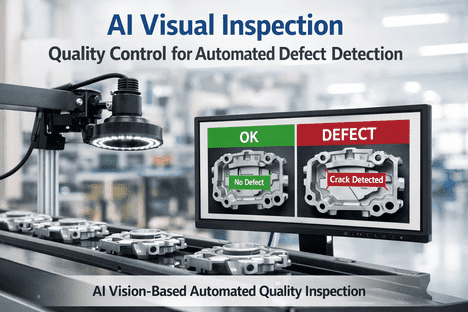
Where AI Visual Inspection Fits — and Where It Does Not
Vendor-reported market activity continues to show interest in AI inspection and industrial vision. The useful signal is not the marketing headline itself — it is the pattern: AI is being used to support inspection consistency, anomaly detection, and faster feedback loops. That matters, but the boundary matters more.
- Support measurement capture
- Support anomaly detection
- Standardize repetitive inspection tasks
- Accelerate data collection
- Reduce manual handling burden
- AS9102 FAI requirements
- PPAP evidence
- Engineering disposition
- Material certification review
- Approval authority
So the right positioning is clear: AI can assist the inspection workflow, but it does not own the release decision. That boundary is what keeps closed-loop control honest and audit-defensible.
How iFactory Fits Beside MES and QMS
iFactory AI is positioned as an operational quality layer that connects inspection events to action. It supports the handoff between inspection, containment, and release without forcing your MES or QMS to carry every step alone. That matters when your quality process spans multiple systems — the layer beside the systems of record is where hold lag actually lives.
Map ballooned characteristics to inspection records so Form 3 stays synchronized with the current drawing revision.
When a characteristic fails, the affected part and linked WIP move to quarantine — downstream use is blocked immediately.
Machine, tool, program, operator, gauge, calibration status — all connected to the suspect record before release is considered.
Best Practices for Aerospace and Precision Teams
A strong FAI process reduces the number of surprises that reach a shipment gate. The eight practices below are the ones aerospace and precision teams typically converge on after enough late-night containment calls to know what actually holds up in an audit.
Frequently Asked Questions
No. FAI and PPAP are different systems, though both prove process readiness. FAI is common in aerospace and focuses on verifying the first production build against engineering requirements. PPAP is more common in automotive and supplier approval workflows.
A ballooned characteristic is useful when it maps one drawing requirement to one controlled measurement. If the numbering, revision, or tolerance does not match the source drawing, the FAIR becomes hard to trust and audits get expensive fast.
Hold logic prevents suspect product from moving downstream before the issue is understood. It is the bridge between detecting a failure and proving the corrected part is safe to release — the difference between a documented miss and a controlled disposition.
No. AI can assist with capture and anomaly detection, but AS9102 still governs the first article reporting structure. Human approval and controlled disposition remain required — the boundary is what makes AI-assisted inspection defensible.
At minimum: part identity, revision, lot or serial traceability, machine, tool, operator, inspection device, and the related nonconformance or corrective action record. Anything less and containment stays fragile.
When ballooned characteristics, hold logic, CAPA, verification, and genealogy are connected, the team moves faster without losing traceability. That is the shift from static FAIR completion to closed-loop release control.