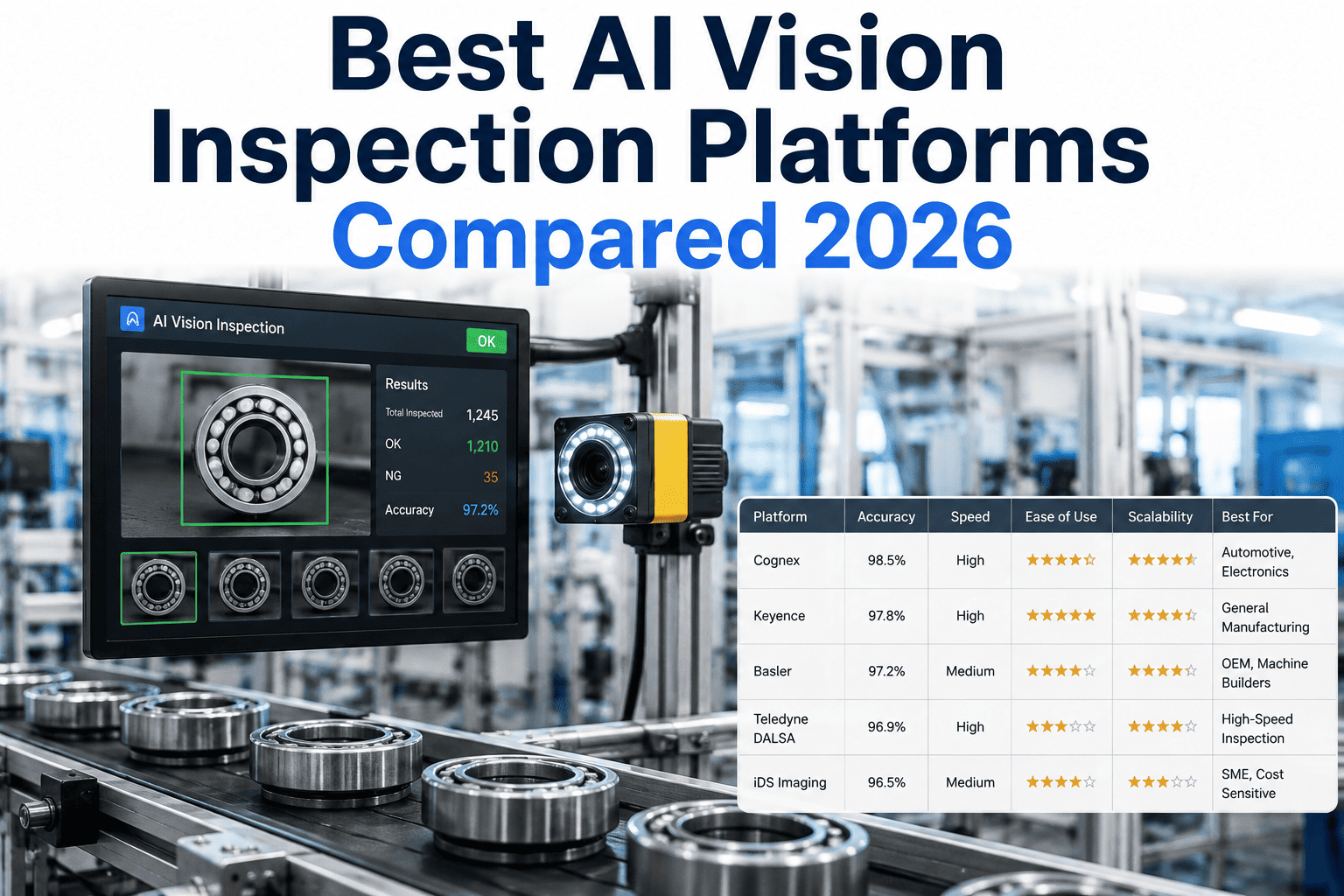
Best AI Vision Inspection Platforms Compared 2026

By James Smith on August 26, 2026

best-ai-vision-inspection-platforms-compared-2026

Every vendor pitch in AI vision inspection sounds identical from the outside, 99% accuracy, fast deployment, seamless integration, and a demo reel that never quite matches your actual production line. The AI-based machine vision market has grown fast enough that the shortlist now includes forty-year-old hardware giants sitting next to two-year-old cloud-native startups, and picking the wrong one does not just waste a budget cycle, it locks a plant into years of custom model training and an integrator's phone number for every line change. This comparison exists to cut through that noise before you talk to ifactory support about your own line.

2026 Buyer's Guide

Compare AI Vision Inspection Platforms on What Actually Matters

Accuracy, training workflow, edge deployment, camera support, CMMS integration, industry fit, and true total cost of ownership, laid out side by side.

Why This Shortlist Got So Crowded, So Fast

The AI-based machine vision market has expanded rapidly in the last two years, pulling in everything from established industrial hardware manufacturers retrofitting legacy vision systems with deep learning, to venture-backed startups selling cloud-first annotation and training platforms, to specialized manufacturing vendors building the entire stack from camera to CMMS. Every one of them will show you a demo that catches every defect on their sample video. None of that tells you what will happen on your line, with your lighting, your part geometry, and your existing PLC infrastructure.

The procurement mistake that costs the most time is treating this as a single category with a single winner. A pharmaceutical packaging line evaluating seal integrity has almost nothing in common, procurement-wise, with an automotive stamping plant evaluating surface defect detection, yet both frequently end up looking at the same generic top-ten list. The right comparison starts with your deployment constraints, not the vendor's marketing copy.

$24B → $91B
Projected AI vision market growth, 2025 to 2032
A market this size attracts every kind of vendor, from hardware legacy players to cloud-native startups.
~80%
Share of AI inference now running at the edge
Cloud round-trip latency is increasingly disqualifying for real-time line inspection.
4 Weeks
Operating standard for pilot-to-production go-live
Anything longer usually signals a heavier integration project than advertised.
7 Criteria
That actually separate platforms in practice
Accuracy claims alone tell you almost nothing about deployment reality.

The Seven Criteria That Decide the Outcome

Cut through the marketing and evaluate every vendor on the same seven dimensions. A platform that scores well on accuracy but poorly on training workflow will cost you months in data science time you did not budget for. A platform with excellent edge deployment but no CMMS integration leaves your maintenance and quality teams working from disconnected systems.

Detection Accuracy

Training Workflow Speed

Edge Deployment Capability

Camera & Hardware Support

CMMS & MES Integration

Industry-Specific Fit

True Total Cost of Ownership

Not sure how to weight these for your specific line? Talk to our team and we will help you build an evaluation scorecard before your next vendor call.

Skip the Demo Reel

See Detection Performance on Your Own Parts

Bring your own defect samples to the call. A platform is only as good as what it catches on your actual product, not a curated video.

Four Platform Archetypes, and Who Each One Actually Fits

Nearly every vendor in this market falls into one of four broad archetypes, and knowing which one you are looking at before the sales call saves an enormous amount of evaluation time.

ArchetypeBest FitTypical Weakness
Hardware-First LegacyPlants replacing an existing rule-based systemSlow retraining, requires vision engineers
Cloud-Native AnnotationTeams building custom models with in-house data scienceLatency and recurring cloud fees at production scale
Edge-Native SpecialistFirst vision deployment, fast time-to-valueNarrower defect category range out of the box
Industrial Platform with CMMS LoopPlants wanting inspection tied to maintenance workflowHigher upfront setup for full integration

Evaluation Checklist Before Any Vendor Demo

Walk into every vendor conversation with the same list of questions, asked in the same order, so the answers are actually comparable across vendors instead of shaped by whatever each sales team wants to emphasize.

How many sample images does training actually require?
Tens of images signals an edge-native, fast-deploy architecture; hundreds or thousands signals a heavier data science lift on your side.
Does inference run locally or does it require a cloud round trip?
Local inference under roughly 50 milliseconds is the standard for real-time line-speed decisions without network dependency.
What does a single-line pilot to production go-live timeline look like?
Four weeks is the current operating standard; anything measured in quarters usually means a heavier integration project.
Does the platform connect to your existing PLC, MES, and CMMS?
A vision-only platform with no workflow integration creates a second disconnected system your quality team has to check manually.
What is the true total cost, including retraining and integrator fees?
Ask specifically about per-image cloud fees, integrator day rates for line changes, and retraining costs for new product introductions.

The First-Deployment Recommendation Most Plants Land On

For a plant running its first AI vision deployment, edge-native and industrial platforms with a built-in CMMS loop consistently outperform the hardware-first and cloud-only lanes on time-to-value. They train on tens of images instead of hundreds, run inference locally with no recurring cloud fees, and can be piloted on a single line in weeks rather than quarters. Plants that already run a mature in-house data science function evaluating a fully custom model pipeline are the exception where a cloud-native annotation platform can make more sense, since the flexibility trade-off is worth it when the team building the models is already on staff.

7
Criteria to score every vendor against
4
Platform archetypes to identify before the call
4 Weeks
Reasonable pilot-to-production benchmark
Own Parts
The only test data that actually matters

Frequently Asked Questions

How many vendors should realistically be on a shortlist before demos start?
Three to five vendors spanning at least two different archetypes is usually enough to see real contrast without spending months on a comparison cycle that produces diminishing insight. Comparing five hardware-first legacy vendors against each other tells you less than comparing one hardware-first, one edge-native, and one industrial platform against the same evaluation criteria. Talk to our team about where iFactory fits relative to your current shortlist.
Is accuracy percentage alone a reliable way to compare vendors?
No, an accuracy number without the testing conditions behind it is close to meaningless, since a 99% figure measured on a curated demo dataset says nothing about performance on your actual production variation, lighting, and defect distribution. The only accuracy number worth trusting is one measured on your own samples under your own production conditions. Book a demo and bring your own defect samples for a real accuracy test.
What is the biggest hidden cost that shortlists tend to miss?
Retraining cost for new product introductions is the most commonly underestimated line item, since a platform that requires a system integrator every time a new SKU or product variant is introduced accumulates cost far beyond the initial license or hardware price. Ask every vendor directly how retraining works and who performs it before signing anything. Reach out to our team to see how retraining works without requiring a specialist AI engineer on staff.
Does edge deployment always outperform a cloud-based platform?
For real-time line-speed inspection decisions, yes in nearly every practical case, since a cloud round trip introduces latency that a fast-moving line cannot tolerate and creates a network dependency that a factory floor should not have to rely on for a pass or fail decision. Cloud-based platforms can still make sense for offline analytics and trend reporting layered on top of edge inference. Book a walkthrough to see how edge and cloud roles split in a typical iFactory deployment.
How long should a fair pilot actually run before making a purchase decision?
A pilot with clear, written acceptance criteria agreed before it starts, typically running two to four weeks on a single line, gives enough production variation to judge real performance without dragging procurement into a multi-quarter evaluation. Any vendor unwilling to commit to written acceptance criteria before the pilot begins is a signal worth taking seriously. Contact our team to scope a pilot with acceptance criteria built into the agreement.
Compare on Your Own Line, Not a Demo Reel

Test iFactory Against Your Actual Shortlist

Bring your evaluation criteria and your own defect samples. We will show exactly where iFactory fits against the platforms already on your shortlist.


4 Weeks
Pilot standard
7
Evaluation criteria
Edge
Native inference
CMMS
Loop included

Share This Story, Choose Your Platform!