Every FSMA inspection that ends in a 483 observation or a BRC non-conformance has the same root cause: a paper-based HACCP program that was never designed to survive the pace of modern food manufacturing. Your Critical Control Points exist on paper. Your corrective action logs live in binders no auditor can search in real time. And when a temperature excursion happens at 2 AM, the only record is whatever your overnight supervisor remembered to write down before the shift ended. The cost is not hypothetical — FDA enforcement actions against food manufacturers with inadequate HACCP documentation averaged $4.8 million per incident in civil penalties, recalls, and lost contracts in 2023. The question is no longer whether to digitize your HACCP program. It is how fast you can do it before your next audit cycle begins.
iFactory Quality Management
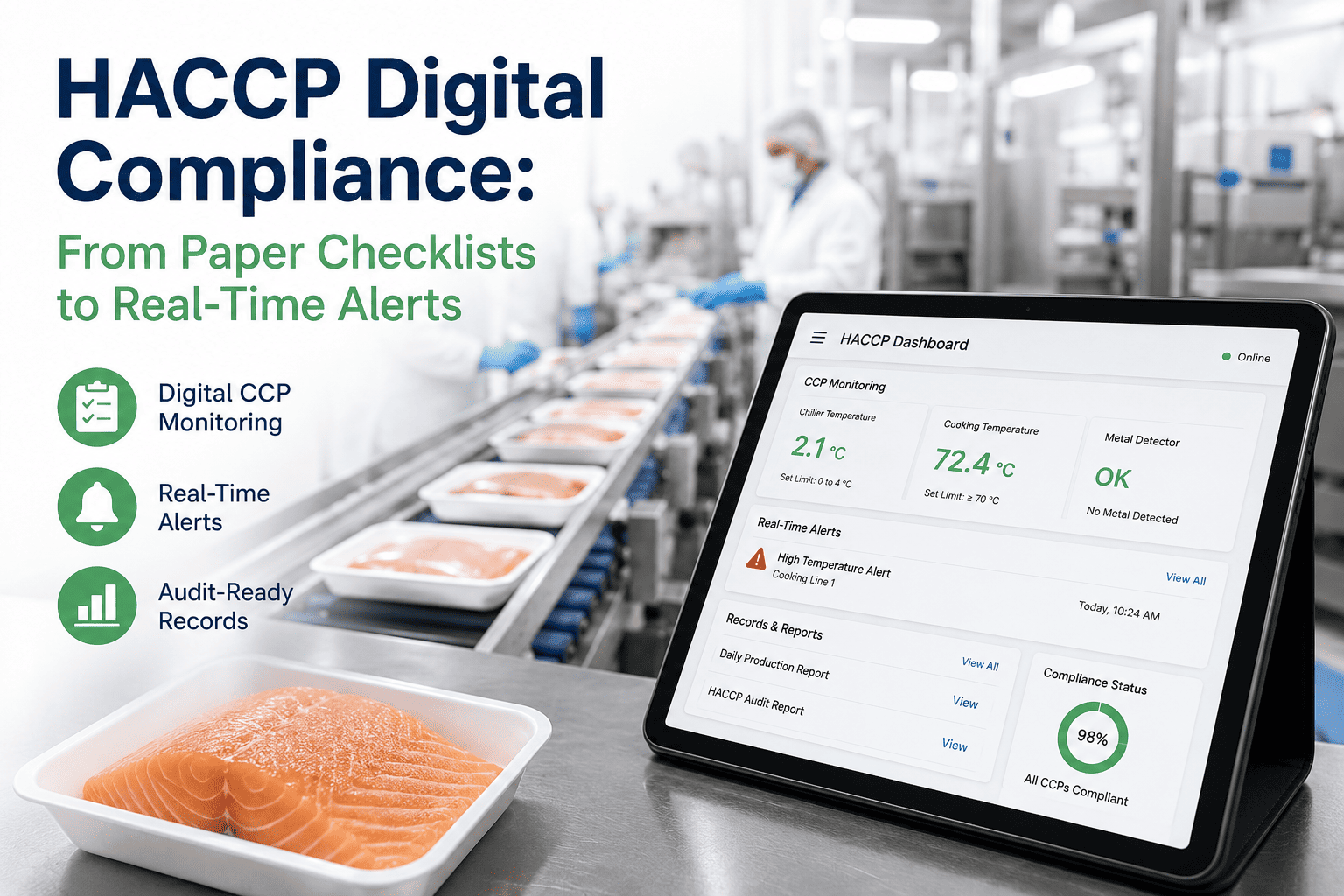
HACCP Digital Compliance: From Paper Checklists to Real-Time Alerts
How food and beverage manufacturers are replacing manual CCP monitoring with automated sensor alerts, audit-ready digital records, and real-time corrective action workflows — built for FSMA, BRC, and SQF auditors.
4.8M
Avg. FDA enforcement cost per HACCP failure
78%
Of BRC non-conformances trace to monitoring gaps
6 wk
Time to full digital CCP coverage
100%
Audit-ready records, always current
The Hidden Cost of Paper-Based HACCP Programs
Manual HACCP monitoring was designed for a slower era of food manufacturing. Today's production lines run continuous shifts, handle dozens of CCPs simultaneously, and face auditors who arrive with digital tools and expect digital evidence. The gap between what paper programs deliver and what modern compliance demands is where most manufacturers are losing money — quietly, consistently, and at scale.
⚠
Monitoring Gaps at Shift Change
Paper CCP logs depend entirely on operator discipline at handoff. Studies show 23% of manual temperature records contain transcription errors or missed intervals — exactly the evidence an FDA investigator will find.
?
Corrective Actions Without Timestamps
When a CCP deviation is identified on paper, the corrective action record is created after the fact. Auditors cannot verify response time, root cause analysis quality, or whether product on hold was actually quarantined.
?
Traceability Reconstruction Takes Days
When a customer complaint or regulatory inquiry arrives, paper-based programs require days of manual record reconstruction. Digital programs answer traceability queries in minutes — the difference between a manageable event and a recall.
?
Audit Preparation Consumes Weeks
BRC and SQF pre-audit preparation in paper environments typically consumes 80–120 person-hours of record compilation, gap analysis, and documentation review. Digital programs reduce this to a dashboard review and a report export.
What Digital HACCP Compliance Actually Looks Like
Digitizing a HACCP program is not about replacing paper with PDFs. It means connecting your Critical Control Points to automated sensor monitoring, building real-time alert logic that mirrors your HACCP plan limits, and creating an unbroken chain of timestamped digital evidence from raw material receipt through finished product release. Here is what each layer delivers.
01
Automated CCP Monitoring
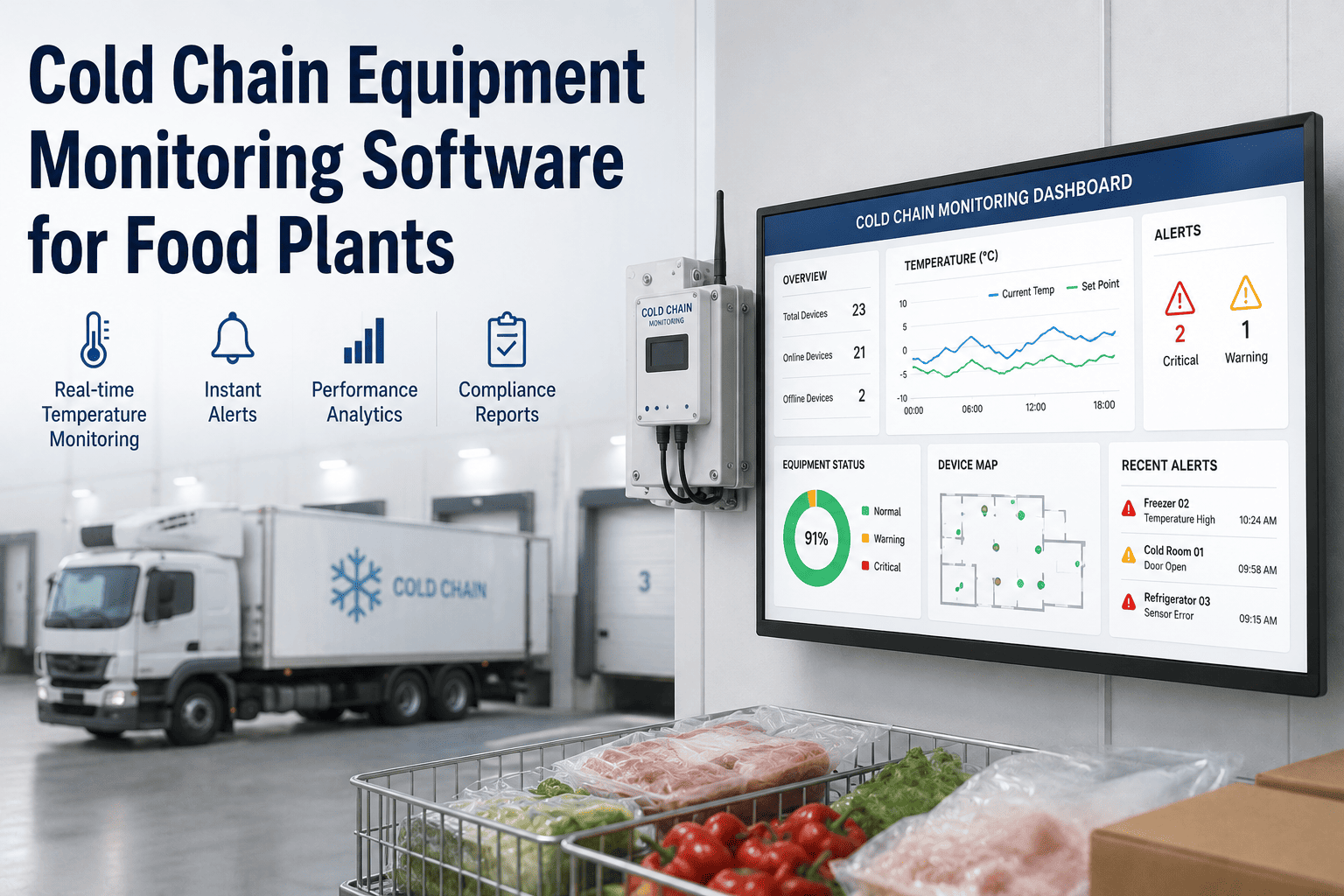
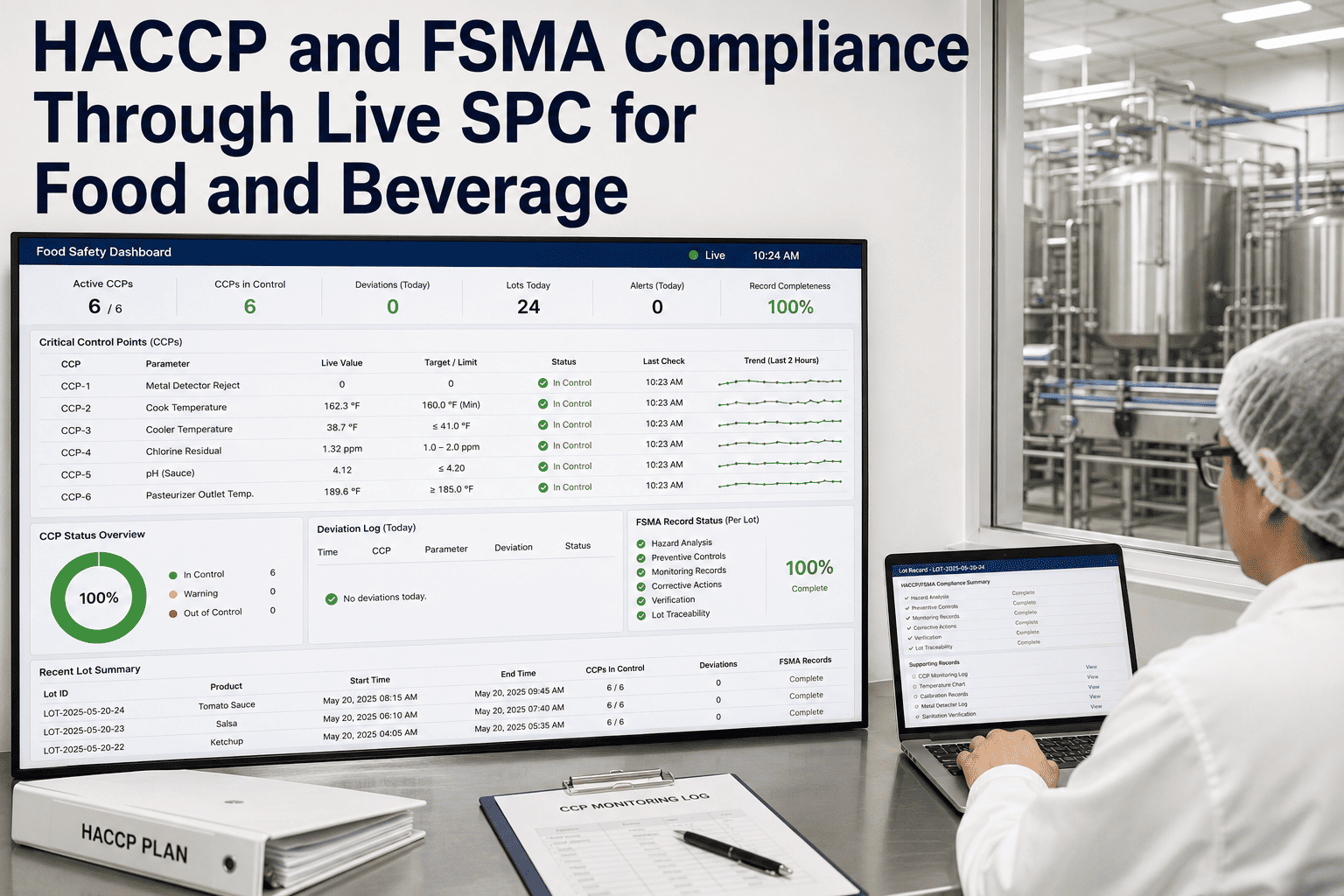
Continuous sensor data replaces scheduled manual checks. Temperature, pH, metal detection status, and pressure readings are captured at configured intervals — typically every 30 seconds to 5 minutes — and logged automatically against your HACCP plan parameters. No operator entry required. No transcription errors possible.
02
Real-Time Critical Limit Alerts
When a sensor reading approaches or breaches a Critical Limit, the platform triggers immediate alerts — to line supervisors, quality managers, and plant directors simultaneously. Alert logic mirrors your approved HACCP plan exactly, including upper and lower limits, hold time requirements, and severity classifications.
03
Structured Corrective Action Workflows
Deviations trigger guided corrective action workflows that capture every required HACCP element: deviation identification, immediate corrective action, root cause analysis, verification that the process is back in control, and product disposition decision. Every step is timestamped and signed with user credentials — creating the exact evidence chain auditors require.
04
Digital HACCP Records and Audit Export
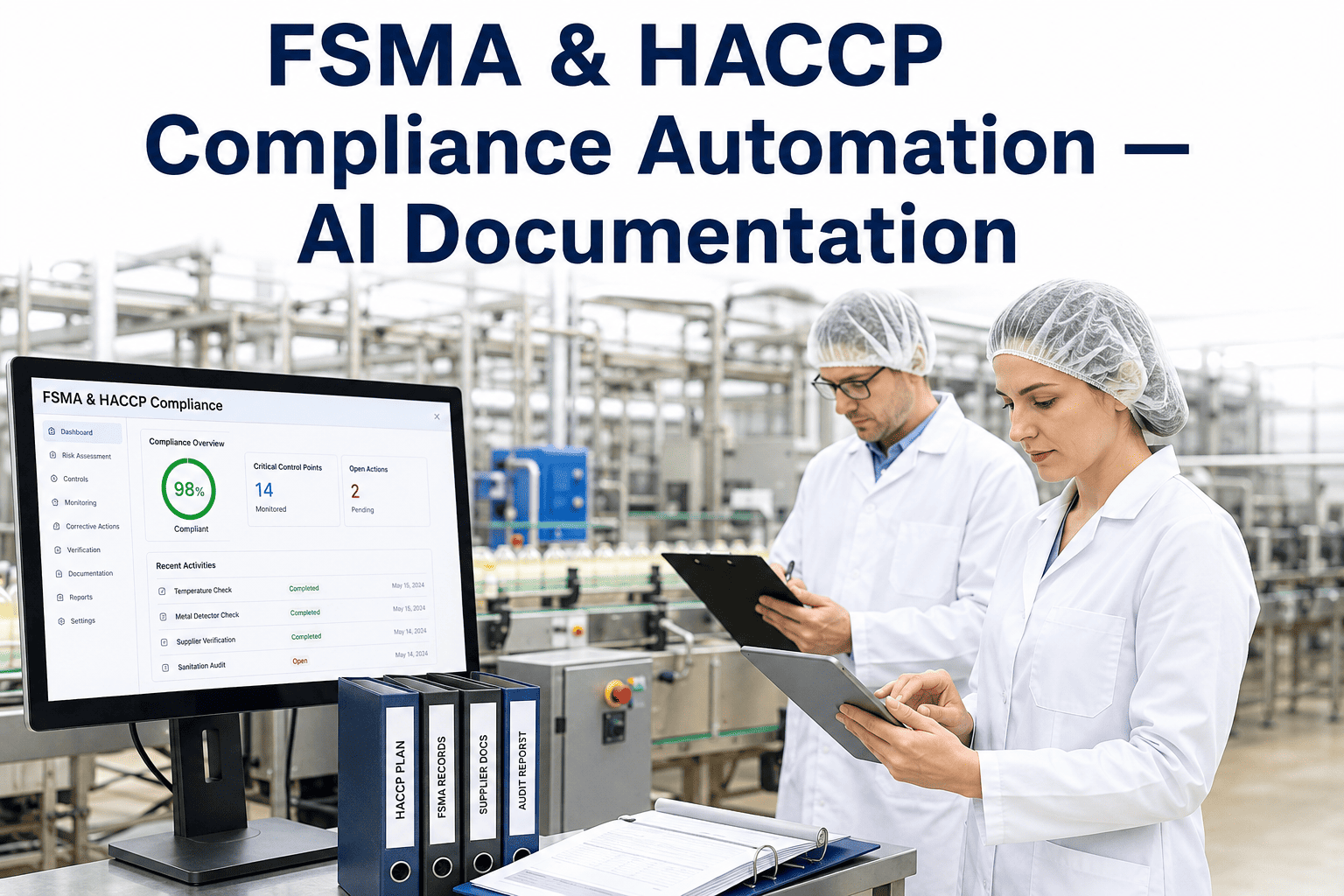
All CCP monitoring records, corrective actions, verification activities, and validation documents are stored in searchable, tamper-evident digital format. Auditors can be given read-only access to export exactly the records they require — by date range, CCP, product, or deviation type — in formats accepted by FDA, GFSI, BRC, and SQF schemes.
Legacy Friction vs. Optimized Excellence: The HACCP Compliance Comparison
The performance gap between paper-based and digital HACCP programs is measurable at every stage of the food safety management cycle. This matrix shows what your quality team is dealing with today — and what a digitized program delivers instead.
| Compliance Activity |
Legacy Paper Program |
iFactory Digital HACCP |
| CCP Monitoring Frequency |
Every 2–4 hours, operator-dependent |
Continuous, every 30 sec–5 min, automated |
| Critical Limit Breach Detection |
Discovered at next manual check (hours later) |
Real-time alert within seconds of excursion |
| Corrective Action Documentation |
Handwritten, often completed retrospectively |
Timestamped digital workflow, triggered automatically |
| Audit Record Retrieval |
Days of manual compilation from binders |
Filtered export in minutes, auditor-ready format |
| Traceability Query Response |
2–5 business days for full trace |
Complete lot trace in under 4 minutes |
| Pre-Audit Preparation Time |
80–120 person-hours per audit cycle |
Dashboard review and export — under 4 hours |
| Verification Activity Records |
Separate binders, prone to version mismatch |
Linked to CCP records, auto-verified on schedule |
| Multi-Site HACCP Consistency |
Inconsistent — each facility self-manages |
Standardized plans deployed across all sites centrally |
| Regulatory Inspection Readiness |
Reactive — preparation begins when inspection announced |
Always current — every record audit-ready in real time |
Three Ways Digital HACCP Delivers Measurable Business Impact
?
Risk Mitigation at Scale
- Eliminate CCP monitoring gaps that expose you to FDA 483 observations
- Automated deviation capture removes human error from your compliance chain
- Tamper-evident digital records withstand third-party and regulatory scrutiny
- FSMA Preventive Controls documentation generated automatically from monitoring data
Up to 94% reduction in audit non-conformances
⚙
Operational Efficiency Gains
- Recover 80–120 person-hours per audit cycle previously spent on record compilation
- Reduce quality team overtime during inspection preparation by 60–70%
- Automated HACCP reporting eliminates manual data entry across all CCPs
- Single platform for HACCP, GMP, and supplier verification records
$120–280K annual QA labor cost reduction
?
Revenue and Growth Protection
- Pass BRC, SQF, and FSMA audits with higher grades and fewer findings
- Meet retailer and foodservice buyer GFSI certification requirements faster
- Respond to customer HACCP verification requests in hours, not days
- Protect brand equity by eliminating preventable recall scenarios
Average recall prevention value: $8–35M per incident
See iFactory HACCP in Action
Live demo: real-time CCP monitoring, automated corrective action workflows, and one-click audit export — configured for your food safety scheme.
Book a Demo
FSMA, BRC, and SQF: How Digital HACCP Meets Every Scheme Requirement
Different food safety schemes share the same underlying HACCP framework but differ in documentation specificity, verification frequency requirements, and audit evidence expectations. iFactory's digital HACCP module is pre-configured with scheme-specific record templates and reporting formats.
FSMA Preventive Controls
- Process preventive control monitoring records — automated and continuous
- Corrective action records linked to specific lot and date codes
- Verification activity scheduling and completion tracking
- Recall plan testing documentation and distribution list management
BRC Food Safety Standard
- Section 2 HACCP records meeting Issue 9 documentation requirements
- CCP monitoring records with supervisor countersignature workflow
- Internal audit scheduling and finding closure tracking
- Supplier approval and monitoring records integrated with HACCP
SQF Food Safety Code
- SQF Element 2.4 HACCP food safety plan documentation
- Monitoring procedure records with configurable frequency enforcement
- Validation and verification records with sign-off workflow
- Management review meeting documentation and trend reporting
Implementation Timeline: HACCP Digitization in Six Weeks
Unlike ERP implementations that take quarters to configure, HACCP digitization follows a structured six-week deployment that mirrors your existing HACCP plan rather than requiring you to rebuild it. Each milestone delivers a working compliance capability, not a work-in-progress.
Week 1–2
HACCP Plan Import and CCP Configuration
Your existing HACCP plan — critical limits, monitoring procedures, corrective actions — is imported into the platform. Sensor connections are established via OPC-UA, MQTT, or direct instrument integration. Each CCP is configured with exact limit parameters from your approved plan.
Week 3
Alert Logic and Corrective Action Workflow Build
Monitoring alert thresholds are configured with escalation paths — line supervisor, QA manager, plant director. Corrective action workflows are built to match your HACCP plan procedures, with required fields enforced at each step to ensure regulatory completeness.
Week 4
Team Training and Parallel Run
Quality managers, line supervisors, and operators complete role-based training — typically 2–4 hours per role. The digital system runs in parallel with existing paper records for one week to validate accuracy and build team confidence before full transition.
Week 5–6
Go-Live and Audit Readiness Validation
Paper records are retired. Digital monitoring goes live as the system of record. A simulated internal audit is conducted using the platform's export tools to confirm all scheme-required records are captured correctly before the next scheduled external audit.
Frequently Asked Questions
Will our existing HACCP plan need to be rewritten for the digital platform?
No. iFactory imports your approved HACCP plan as the configuration basis for the digital system. Critical limits, monitoring frequencies, corrective action procedures, and verification activities are mirrored exactly. If your plan requires regulatory updates, those can be made during implementation — but digitization itself does not require plan revision.
What happens if sensor connectivity is lost — do we lose monitoring records?
The platform operates with local edge caching that retains up to 72 hours of sensor data during connectivity interruptions. On reconnection, all cached records sync to the cloud with original timestamps intact. Alert logic continues operating locally during outages, and the system automatically notifies quality staff of any connectivity gap in the record chain.
How do FDA or third-party auditors access our digital HACCP records?
Auditors are given a time-limited, read-only access token that allows them to query and export records within a specific date range and scope. Records can also be exported to signed PDF packages that meet FDA 21 CFR Part 11 electronic records requirements. No auditor needs to navigate your internal systems — they receive exactly the records they request in the format they require.
Can the platform handle multiple HACCP plans across different product lines?
Yes — the platform supports multiple concurrent HACCP plans, each with independent CCP configurations, monitoring parameters, and corrective action workflows. Product changeover triggers the appropriate plan automatically based on your production schedule. All plans are managed from a single quality management dashboard with plan-level reporting.
Ready to Pass Your Next HACCP Audit Without the Panic?
Digital CCP Monitoring. Real-Time Alerts. Audit-Ready Records — Always.
iFactory's Quality Management module deploys in six weeks, integrates with your existing HACCP plan, and gives your quality team a compliance program that performs whether it is 2 PM or 2 AM.
6 wk
To full digital CCP coverage
94%
Reduction in audit non-conformances
100%
Audit-ready records at all times
4 min
Full lot traceability query