Every day your production floor runs without intelligent robotics integration, a competitor is capturing the throughput, precision, and margin you are leaving behind. In 2026, industrial robotics is no longer a capital expenditure reserved for automotive giants — it is the operating baseline for any manufacturer serious about survival. The question is not whether to deploy cobots, AMRs, or 6-axis arms. The question is whether your current approach is optimised to extract full value from each platform — or whether fragmented, unconnected robot deployments are quietly bleeding efficiency from every shift.
iFactory Robotics AI Intelligence
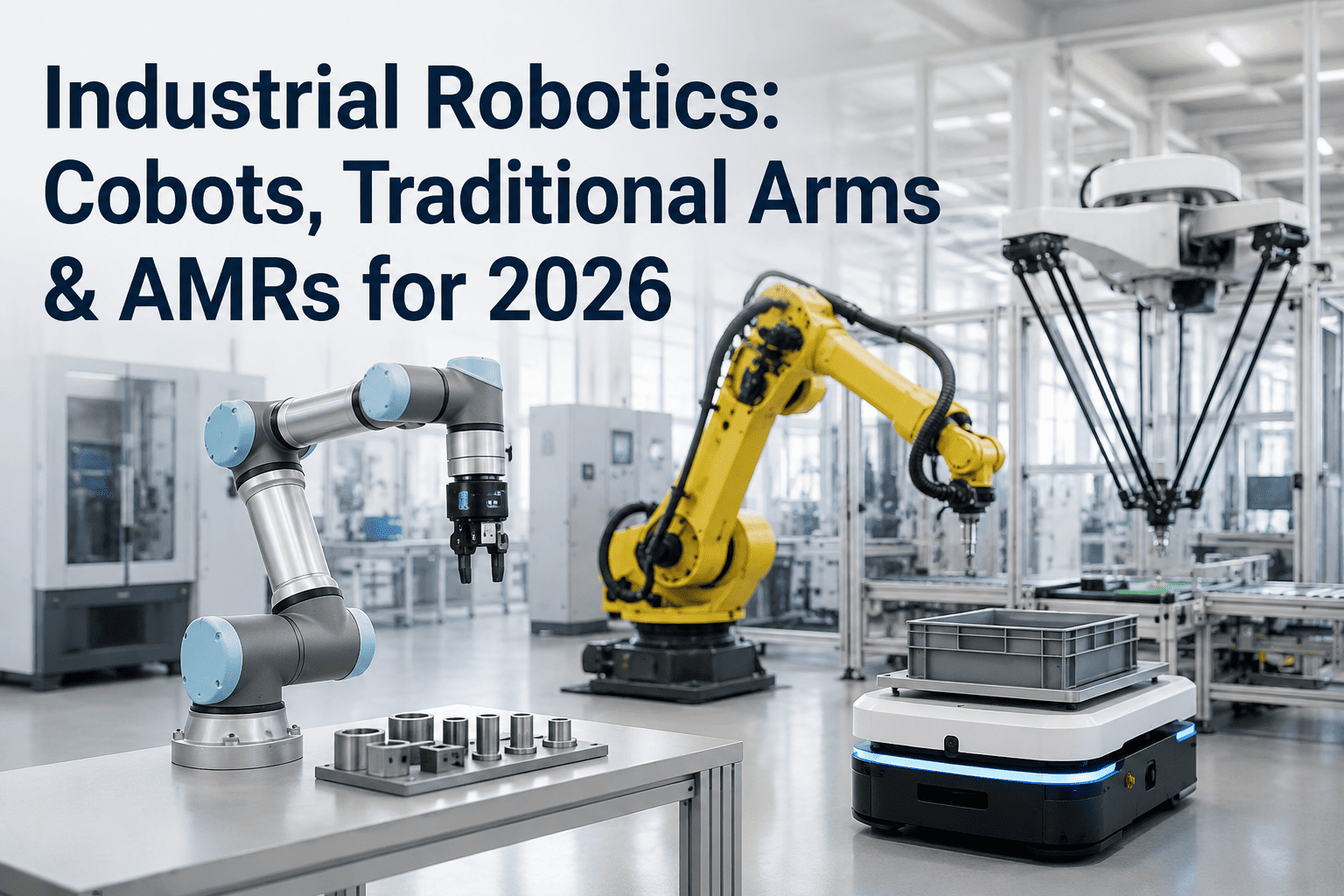
Industrial Robotics in 2026: Cobots, Traditional Arms & AMRs Explained
A complete guide to every major industrial robot type — use cases, payload ranges, safety considerations, and the ROI framework decision-makers need to justify investment with confidence.
$23B+
Global cobot market projected by 2030
68%
Of manufacturers deploying AMRs by 2026
18mo
Average ROI payback on cobot deployments
3.5x
Throughput increase with AI-guided robot fleets
The Four Primary Robot Architectures Reshaping Manufacturing
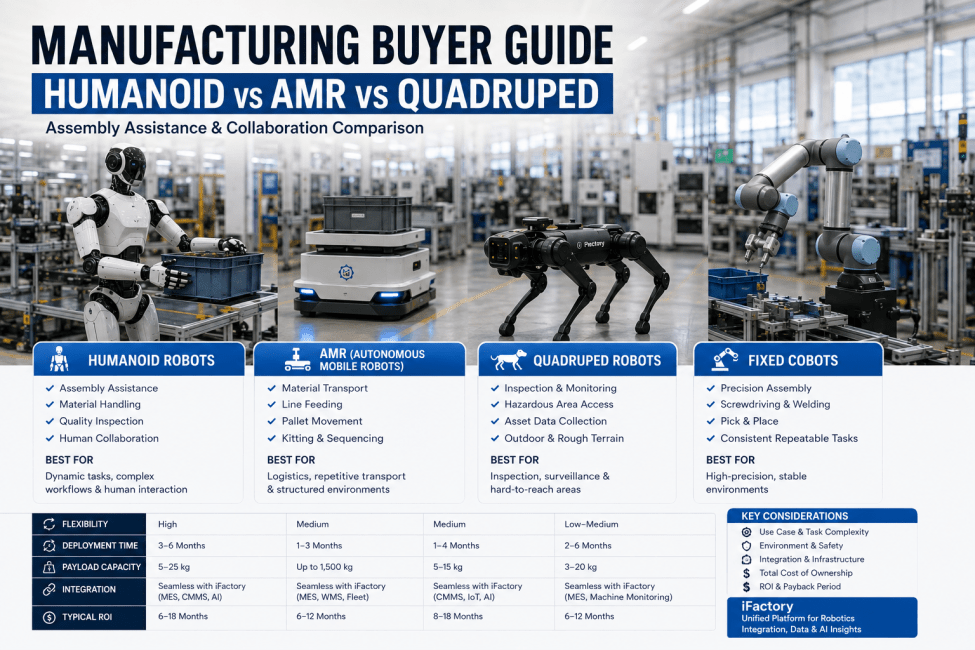
Industrial robotics in 2026 spans four distinct hardware categories, each solving a different operational problem. Understanding where each platform delivers maximum value — and where it underperforms — is the foundation of any serious robotics strategy.
Cobots
Collaborative Robots
- Payload range: 3–35 kg
- Works alongside human operators safely
- Rapid redeployment — no cage required
- Ideal for assembly, inspection, packaging
- Programming via hand-guiding or tablet
ROI window: 12–24 months
6-Axis Arms
Traditional Industrial Arms
- Payload range: 3–2,300 kg
- High-speed, high-repeatability (<0.02 mm)
- Welding, heavy assembly, press tending
- Fixed installation, safety fencing required
- Long lifecycle — 80,000+ operating hours
ROI window: 18–36 months
AMRs
Autonomous Mobile Robots
- Payload range: 100–1,500 kg
- Self-navigating via LiDAR and vision
- Material transport, kitting, replenishment
- No fixed tracks or infrastructure changes
- Fleet-scalable from 5 to 500+ units
ROI window: 12–20 months
Delta Robots
High-Speed Parallel Robots
- Payload range: 0.5–15 kg
- Cycle times under 0.3 seconds
- Pick-and-place, food sorting, pharma
- Ceiling-mounted, compact footprint
- Precision vision-guided picking
ROI window: 8–18 months
Legacy Friction vs. Optimised Excellence: The Manufacturing Gap in 2026
The most dangerous position in modern manufacturing is not failing to deploy robots — it is deploying them without the intelligence layer that transforms hardware into competitive advantage. The table below quantifies the operational gap between fragmented legacy robotics and an AI-integrated robotics platform.
| Operational Dimension |
Legacy Friction — Old Way |
Optimised Excellence — New Way |
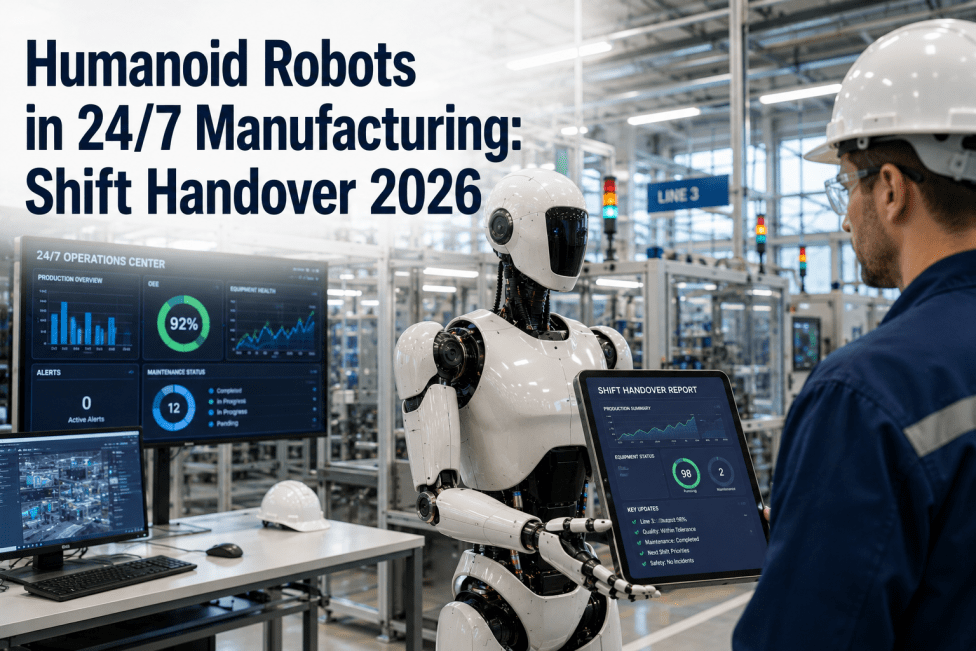
| Robot Uptime Visibility |
Manual shift logs, lagging reports, no real-time OEE data |
Live OEE dashboards per robot, instant downtime root-cause flags |
| Maintenance Approach |
Calendar-based PM schedules regardless of actual wear state |
AI-predicted RUL per joint and servo — maintenance only when needed |
| Fleet Coordination |
AMRs, cobots, and arms managed in separate siloed systems |
Unified fleet intelligence — cross-platform task orchestration |
| Failure Response |
Operators detect faults after stoppage — reactive repair cycle |
Anomaly detection 14–21 days before failure — zero surprise downtime |
| Energy Optimisation |
Fixed motion programs, no energy profiling per task |
AI trajectory optimisation reduces robot energy spend 12–18% |
| Safety Compliance |
Manual audit documentation, periodic inspections |
Continuous ISO 10218 monitoring with auto-generated compliance logs |
| ROI Measurement |
Spreadsheet estimates, no live cost-per-unit tracking |
Real-time TCO, cost-per-unit, and payback period per robot |
| Changeover Speed |
2–4 hour manual reprogramming for product variants |
AI-assisted recipe switching — under 15 minutes per changeover |
Where Each Robot Type Wins: Industry-by-Industry Deployment Map
No single robot architecture dominates every manufacturing context. The table below maps optimal deployment scenarios by industry vertical to help operations leaders build a right-sized, right-typed robotics fleet from day one.
Automotive & Tier 1
6-Axis Arm Welding, body assembly, press tending at 2,000+ kg payloads
AMR Line-side kitting, part replenishment across multi-acre facilities
Cobot Quality inspection, torque assembly, trim installation beside workers
Food & Beverage
Delta High-speed pick-and-place, portioning, and vision-guided sorting
Cobot Hygienic packaging, palletising, label inspection in washdown zones
AMR Cold-chain material movement, WIP transport, end-of-line staging
Electronics & Semiconductor
Cobot PCB assembly, solder inspection, micro-screwdriving at <1 mm precision
Delta Sub-3-gram component placement at 150+ picks per minute
AMR Cleanroom wafer transport, cassette handling, inter-bay logistics
Pharmaceuticals & MedTech
Cobot Vial filling, blister packaging, serialisation — FDA 21 CFR Part 11 compliant
Delta Sterile tablet sorting, capsule orientation, vision-based defect rejection
AMR Regulated material transport with full chain-of-custody logging
The Three Business Outcomes That Justify Every Robotics Investment
Workflow Velocity
AI-orchestrated robot fleets eliminate the task handoff latency that siloed deployments create. Cross-platform scheduling means cobots, AMRs, and arms execute as a single coordinated production system — not three separate islands.
- Changeover time reduced 60–80%
- Cycle time variance eliminated
- Shift-to-shift output consistency at 98%+
Overhead Reduction
Predictive maintenance on robot joints, servo drives, and end-effectors eliminates the unplanned downtime that makes robotics deployments underperform their original business case. Every maintenance event becomes scheduled, budgeted, and brief.
- Unplanned downtime reduced 35–55%
- Spare parts inventory optimised 40%
- Maintenance labour hours cut by half
Output Growth
When robot performance data feeds directly into production planning, capacity decisions become data-backed rather than gut-driven. Throughput optimisation models identify which lines have hidden capacity — and exactly how to unlock it.
- OEE improvements of 15–25 percentage points
- Hidden capacity revealed in 8–12 weeks
- Annual output increase of 20–40% without CapEx
iFactory Robotics AI Platform
Ready to unify your robot fleet under one intelligent platform?
Our engineers will map your current robot deployment against the iFactory Robotics AI framework and identify your highest-value optimisation opportunities — at no cost.
Request a Performance Audit
Safety Architecture: What Separates Compliant Deployments from Liability Exposure
Industrial robotics safety in 2026 is governed by ISO 10218-1/2 for traditional arms, ISO/TS 15066 for cobot collaborative workspaces, and IEC 62443 for connected robot network security. Non-compliant deployments carry regulatory penalties — but more immediately, they carry the operational risk of unplanned shutdowns triggered by safety audit failures.
Cobot Safety Zones
- Power and force limiting (PFL) via torque sensing
- Speed and separation monitoring (SSM) — dynamic zones
- Hand-guiding mode with deadman switch
- AI contact detection stops in under 100 ms
AMR Navigation Safety
- 360° LiDAR with 8-metre obstacle detection range
- Pedestrian intent prediction via onboard vision AI
- Emergency stop response under 0.3 seconds
- Geofenced zones enforced via fleet management system
Compliance Automation
- Auto-generated ISO 10218 inspection records
- OSHA incident log population from sensor events
- Continuous cybersecurity monitoring per IEC 62443
- ESG energy and safety reporting from twin data
Frequently Asked Questions: Industrial Robotics in 2026
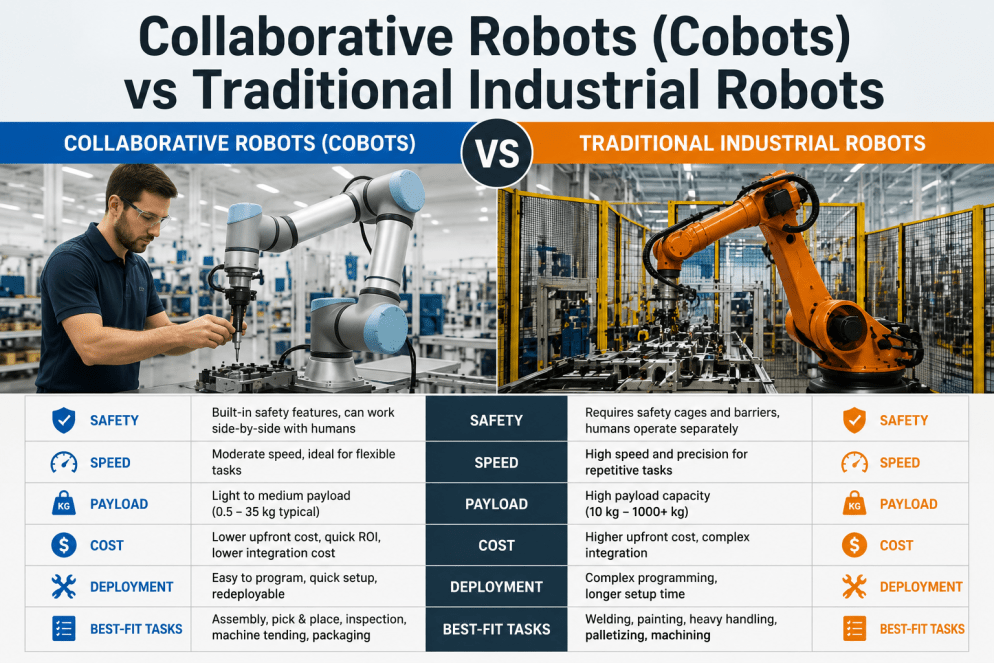
What is the difference between a cobot and a traditional industrial robot arm?
Traditional 6-axis arms prioritise speed and payload over human proximity — they require physical safety guarding and are optimised for high-volume, fixed-path operations. Cobots are engineered from the ground up for shared workspaces: they use torque sensors at every joint to detect and limit contact force, enabling them to work directly alongside operators without caging. The tradeoff is payload and speed — cobots top out around 35 kg and operate at lower velocities than their industrial counterparts.
When does an AMR make more sense than a traditional conveyor or AGV?
AMRs outperform conveyors and AGVs in any environment with variable routing, frequent layout changes, or shared human traffic. AGVs require fixed magnetic tape or track infrastructure — every route change is a physical project. AMRs use LiDAR-based SLAM mapping and can be rerouted via software in minutes. For facilities running multiple product families or managing seasonal demand shifts, AMR fleets provide material handling flexibility that fixed infrastructure cannot match.
How does iFactory's Robotics AI platform connect to existing robot hardware?
iFactory connects via OPC-UA, MQTT, and manufacturer-specific SDKs to robots from all major vendors including FANUC, KUKA, ABB, Universal Robots, and Boston Dynamics. The platform ingests joint health data, cycle counts, energy consumption, and alarm histories in real time — without requiring proprietary hardware replacements. Most deployments achieve full data connectivity within two to four weeks of engagement.
What ROI metrics should we track for a robotics deployment?
The five financial metrics most predictive of robotics ROI are: cost per unit produced (robot versus manual baseline), unplanned downtime hours and associated lost revenue, maintenance spend per robot per year, changeover time and associated OEE impact, and energy cost per production cycle. iFactory's Robotics AI platform tracks all five in real time and generates monthly financial summaries formatted for board-level reporting.
Start Smarter. Scale Faster.
Your Robotics Fleet Deserves an Intelligence Layer
iFactory's Robotics AI platform connects to every major robot vendor, unifies your fleet into a single performance view, and applies predictive AI to eliminate unplanned downtime — from first pilot to enterprise scale.
4–6wk
Time to first robot intelligence insights
35%
Average reduction in robot downtime
$1.8M
Average first-year savings on 50-robot fleet
10-30x
Return on platform investment
.png)