Every FDA warning letter costs an average of $14.6 million in remediation, lost production, and reputational damage — yet 68% of pharmaceutical manufacturers are still running MES and CMMS platforms that were never designed for 21 CFR Part 11 compliance. The gap between what your software does and what your next audit requires is not a technology problem. It is a strategic liability that compounds with every production cycle, every undocumented change, every unsigned electronic record sitting outside a validated audit trail.
iFactory Compliance Intelligence
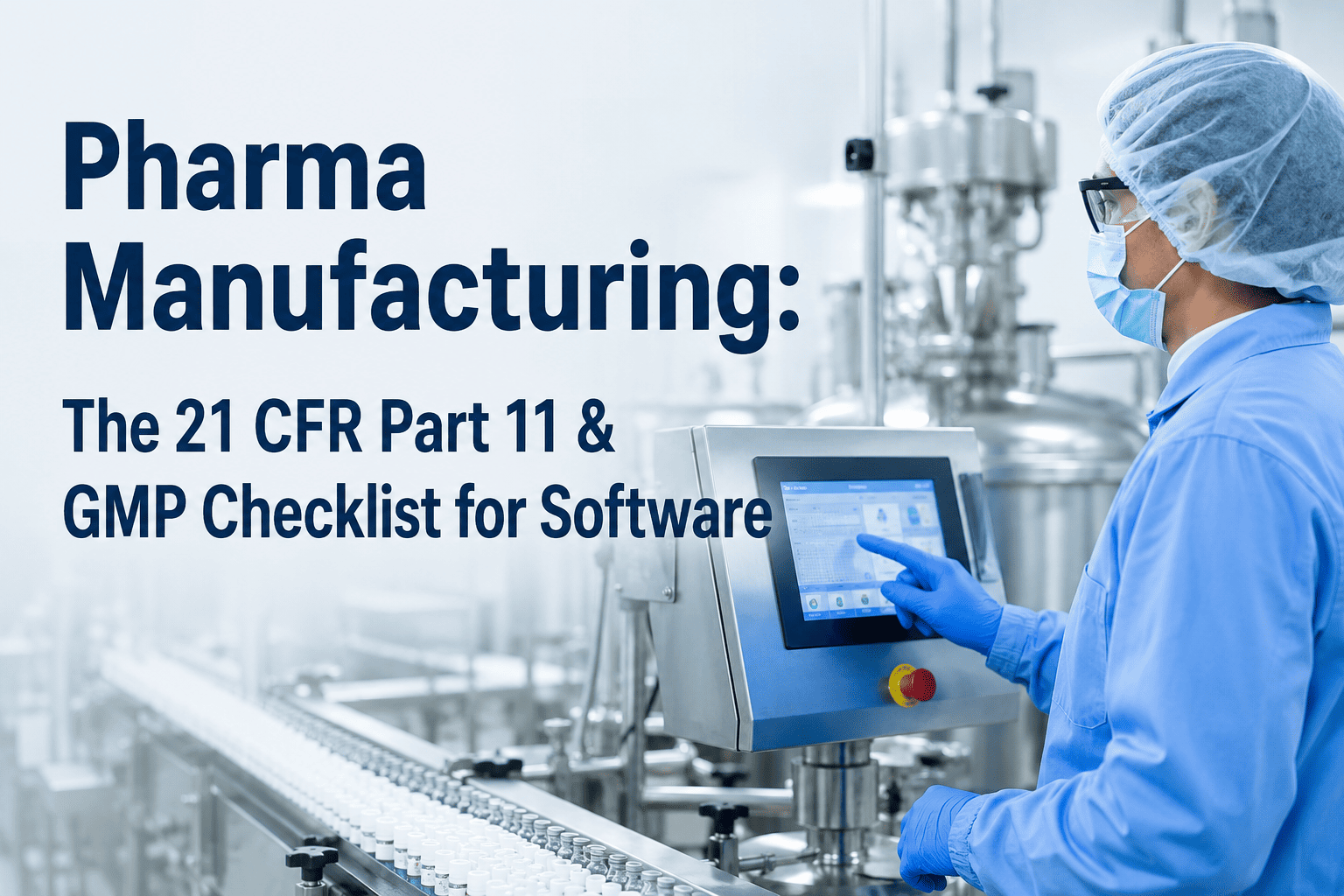
21 CFR Part 11 & GMP Software Checklist for Pharma Manufacturing
What your MES and CMMS must deliver to pass FDA audits — e-signatures, audit trails, data integrity, and ALCOA+ compliance across every workflow.
$14.6M
Average cost of an FDA warning letter
68%
Of pharma manufacturers using non-compliant platforms
100%
Audit trail coverage required under 21 CFR Part 11
4–8wk
Typical gap-to-compliance with iFactory MES
What 21 CFR Part 11 Actually Requires — and Where Most Platforms Fall Short
21 CFR Part 11 governs the use of electronic records and electronic signatures in FDA-regulated manufacturing. Compliance is not optional, and the FDA's interpretation has grown considerably stricter since the rule's original 1997 publication. Most legacy MES and CMMS platforms were architected before modern data integrity requirements crystallised — meaning they fail on fundamental controls that auditors now consider baseline expectations.
Core 21 CFR Part 11 Requirements Checklist
✓
Electronic Signatures (§11.50–11.70)
Each signature must be linked to the signatory's unique identity. Cannot be transferred, copied, or shared. Must include printed name, date/time, and meaning of signature.
✓
Audit Trail (§11.10(e))
Computer-generated, time-stamped records capturing who created, modified, or deleted data — and what the original value was. Audit trails must be retained for the life of the record.
✓
Access Controls (§11.10(d))
System access limited to authorised individuals. Password policies, session timeouts, and role-based permissions enforced at the platform level, not solely at the network level.
✓
Record Integrity (§11.10(a))
Electronic records must be accurate, reliable, and readily retrievable throughout the retention period. Data must be protected against alteration or destruction.
✓
System Validation (§11.10(a))
Systems must be validated for accuracy, reliability, and consistent performance. Validation documentation must include IQ, OQ, and PQ protocols with recorded outcomes.
✓
Operational System Checks (§11.10(f))
Sequence checks to enforce the order of steps and events where required, preventing out-of-order execution in batch records and GMP workflows.
ALCOA+ Framework: The FDA's Data Integrity Standard
The FDA, EMA, and WHO have converged on the ALCOA+ framework as the global benchmark for pharmaceutical data integrity. Every electronic record created by your MES or CMMS is evaluated against these nine attributes during an inspection. Failure to meet any single attribute across any production record is grounds for a data integrity observation — and repeated observations lead to warning letters, consent decrees, or import alerts.
A
Attributable
Every record entry traceable to the individual who created it, with timestamp and user ID permanently attached.
L
Legible
Records permanently readable throughout their retention period, with no degradation of digital format over time.
C
Contemporaneous
Data recorded at the time the activity occurs. System timestamps must be accurate and synchronised to a validated time source.
O
Original
The first capture of data, or a certified true copy. Systems must preserve original values and flag any subsequent modifications.
A
Accurate
Data truthfully reflects the activity, process, or measurement it documents, with no manual transcription errors or rounding without justification.
+
Complete, Consistent, Enduring, Available
Full records with no missing entries, uniform formatting, lifetime retention, and retrieval capability throughout the record's life cycle.
Legacy Friction vs. Optimised Excellence: The Compliance Gap
The operational and financial consequences of non-compliant software become visible only during an audit — which is precisely the worst moment to discover them. The comparison below reflects real-world observations from FDA inspection outcomes across pharmaceutical manufacturing sites.
| Compliance Area |
Legacy Friction (Old Way) |
Optimised Excellence (iFactory) |
| Electronic Signatures |
Shared login credentials. Signatures applied by batch at end of shift. No meaning-of-signature field. Easily repudiated. |
Individual biometric or PIN-based e-signatures. Applied in real time at point of action. Meaning, timestamp, and user ID locked to each record entry. |
| Audit Trail |
Manual change logs in spreadsheets. Incomplete entries. No original value capture. Easy to alter without detection. |
Automated, tamper-evident audit trail. Every field change captures old value, new value, timestamp, and operator ID. Cannot be disabled or edited. |
| Batch Records |
Paper-based or hybrid records. Manual transcription errors. Version control inconsistencies. Physical storage with retrieval delays. |
Electronic batch records (eBR) generated automatically from MES workflow execution. Instant retrieval. Version-controlled master batch records with change history. |
| Deviations & CAPAs |
Tracked in separate systems. No linkage to production records. CAPA effectiveness unverified. Recurring deviations missed. |
Integrated deviation management linked to batch and equipment records. CAPA workflows with effectiveness checks. Trend analysis flags repeat occurrences automatically. |
| Equipment Qualification |
IQ/OQ/PQ in disconnected documents. Calibration records in separate CMMS. No automated equipment status in MES. |
Qualification status embedded in MES. Equipment blocked from use if calibration or PM is overdue. Qualification records linked directly to production records. |
| Audit Readiness |
3–5 days of manual record compilation per audit. High risk of incomplete packages. Costly consultant engagement. |
One-click audit packages. All records retrievable by batch, date, operator, or equipment. Inspection-ready within hours, not days. |
How iFactory MES Workflow Delivers GMP Compliance by Design
Compliance should not be a layer bolted onto manufacturing software as an afterthought. iFactory's MES Workflow embeds 21 CFR Part 11 and GMP controls into the execution layer of every production process — making compliant behaviour the default, not the exception.
Workflow Integrity
Enforced step sequencing prevents out-of-order execution
Mandatory e-signature gates at critical process checkpoints
Operator prompts with SOPs embedded at point of use
Automated batch record generation from workflow completion
Overhead Reduction
Eliminates paper-based batch record compilation (saves 8–12 hrs per batch)
Audit packages generated on demand — no manual assembly
Automated CAPA tracking removes spreadsheet maintenance burden
Integrated calibration prevents duplicate record-keeping across CMMS and MES
Output & Growth
Faster batch release through electronic record completeness verification
Right-first-time rates improve with embedded SOP guidance
New product introductions accelerated with validated master batch templates
Multi-site rollout enabled by centralised compliance configuration
Frequently Asked Questions: 21 CFR Part 11 and GMP Software
Does our CMMS need to be 21 CFR Part 11 compliant, or just our MES?
Both. Any system that creates or modifies electronic records used to support batch disposition decisions — including maintenance records, calibration records, and equipment qualification documentation — falls within the scope of 21 CFR Part 11. A non-compliant CMMS creates data integrity gaps that auditors actively probe, particularly around equipment status and preventive maintenance execution records linked to production batches.
What is the difference between a validated system and a compliant system?
Validation confirms that a system performs as intended under defined conditions, documented through IQ, OQ, and PQ protocols. Compliance means the system's design and operation satisfy regulatory requirements. A system can be validated but still non-compliant if its architecture lacks required controls (e.g., no audit trail). iFactory provides both: a pre-validated platform with vendor-supplied validation documentation packages, and built-in compliance controls that meet 21 CFR Part 11 and EU Annex 11 requirements by design.
How long does it take to remediate a non-compliant MES platform with iFactory?
Most pharmaceutical manufacturers achieve full 21 CFR Part 11 compliance within 4–8 weeks of iFactory MES deployment, depending on the number of production lines and the complexity of existing master batch record libraries. The phased onboarding approach starts with highest-risk processes first, ensuring audit exposure is reduced from week one rather than waiting for a full-facility cutover.
Can iFactory integrate with our existing QMS and ERP without breaking validated state?
Yes. iFactory connects to SAP, Oracle, Veeva, and major QMS platforms via validated API integrations. All interface qualification documentation is provided as part of the deployment package, maintaining the validated state of both the MES and the connected systems. Data flows are unidirectional where required by data integrity principles, with full audit trail coverage on all cross-system record transfers.
Compliance Without Compromise
Your Next FDA Audit Starts Today — Are Your Systems Ready?
iFactory's pharmaceutical MES Workflow delivers 21 CFR Part 11 compliance, ALCOA+ data integrity, and GMP-aligned electronic batch records out of the box. Book a strategy session and receive a personalised compliance gap report for your facility.
4–8wk
Time to full compliance
Zero
Manual audit trail maintenance
100%
eBR coverage from day one
EU Annex 11
Also supported alongside FDA