Connecting a manufacturing plant to an AI platform creates network paths that did not previously exist. Some of those paths are necessary and expected — the AI server reading PLC data to build models. Others emerge unintentionally — remote access credentials that are too broad, edge devices with default passwords, model weights stored without access control. Industrial AI cybersecurity is not a topic that most manufacturing operations managers were trained on, but it is a subject that OT security specialists, IT security teams, and increasingly, cyber insurers, are asking about with more specificity each year. The question is not whether a connected factory is exposed to cyber risk — all connected systems are. The question is whether the exposure has been assessed, documented, and reduced to a manageable level through specific controls. This checklist addresses that assessment. iFactory AI, an on-premise AI platform for industrial manufacturing, is designed with security controls built into its architecture — not added as an afterthought. Teams preparing for a cybersecurity review of their AI deployment can review iFactory AI's security architecture with the technical team.
Industrial AI Cybersecurity Checklist: Access Control, Network Segmentation, Edge Devices, and AI Governance
A structured checklist for assessing the cybersecurity posture of a connected factory AI deployment — covering access control, network segmentation, data security, edge devices, model protection, remote access, and AI governance.
Why Industrial AI Introduces New Cybersecurity Challenges
Traditional OT cybersecurity focussed on protecting the control network from intrusion — keeping IT and OT separated, limiting remote access, and ensuring PLCs and DCS systems could not be reached from outside the plant. Industrial AI changes this threat model because the AI system must have read access to OT data to function, which creates authorised pathways into the OT network that did not previously exist. Each of these pathways, if poorly controlled, becomes a potential attack vector.
Section 1: Access Control Checklist
Access control is the first and most important security domain. Most industrial AI security incidents involve compromised credentials or excessive user permissions rather than sophisticated technical exploits.
Section 2: Network Segmentation Checklist
Network segmentation ensures that the AI platform can access the OT data it needs while limiting what can be reached from the AI server in the event of compromise. The principle is least-privilege connectivity — the AI server can reach the historian and PLCs it monitors, and nothing else.
Review Your Connected Factory AI Security Against This Checklist
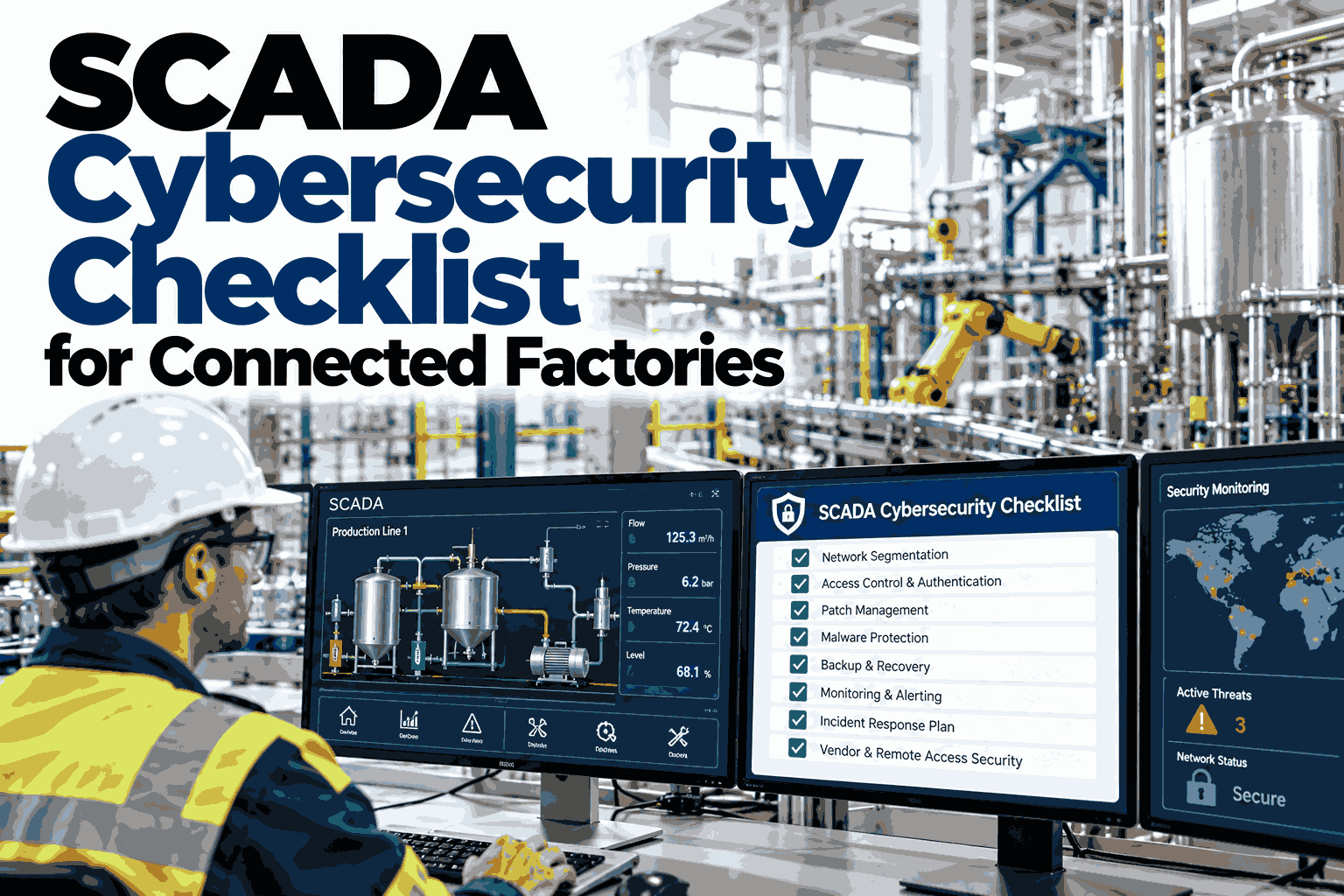
iFactory AI's technical team will walk through the full 7-domain security checklist against your deployment configuration and identify any gaps before they become vulnerabilities.
Section 3: Edge Device and AI Model Security Checklist
Edge devices — IoT sensors, vibration monitors, protocol gateways, and smart cameras — are frequently the weakest security link in an industrial AI deployment because they have embedded firmware, limited update mechanisms, and are often forgotten after installation.
Section 4: Remote Access and AI Governance Checklist
Remote access for vendor support, model updates, and remote monitoring is a necessary but high-risk element of any connected AI deployment. AI governance — the policies, audit trails, and human oversight controls — determines whether the AI system operates within its intended scope.
Frequently Asked Questions
What cybersecurity frameworks apply to industrial AI in a connected factory?
The most relevant frameworks are NIST Cybersecurity Framework (CSF 2.0, 2024), IEC 62443 (OT cybersecurity standard for industrial automation), and NCSC's Cyber Essentials (for UK-based manufacturers). IEC 62443 is the most specific to OT environments and addresses the IT/OT segmentation, access control, and remote access requirements that are most relevant to an industrial AI deployment. iFactory AI's security architecture is designed to support compliance with IEC 62443 security levels 2 and 3. Review the IEC 62443 alignment for your iFactory AI deployment.
Is an on-premise AI deployment more secure than a cloud-based AI platform?
On-premise deployment eliminates certain cloud-specific risks — OT data does not transit the public internet, there are no cloud provider credentials to compromise, and the system can be fully air-gapped from public networks if required. However, on-premise systems introduce local security responsibilities that cloud providers manage in a SaaS model: physical server security, local network security, patch management, and backup. Neither model is inherently more secure — the security outcome depends on how well the specific configuration is managed. For plants with strong local IT/OT security capability and data sovereignty requirements, on-premise is typically the stronger choice. Ask the security team for a comparison of on-premise vs cloud risk profiles for your environment.
How should we handle cybersecurity incidents involving the AI platform?
An industrial AI security incident should follow the same OT incident response procedure as any other OT security event — isolate the affected system, preserve evidence, notify the relevant internal teams (OT security, IT security, plant management), and restore from a known good state. The specific addition for an AI platform incident is model integrity verification after restoration — confirming that model files, training data, and configuration have not been modified during the incident. iFactory AI's incident response documentation covers these AI-specific steps as an addendum to the standard OT IR procedure. Review the AI-specific incident response procedure in a security planning session.
How often should the cybersecurity checklist be reviewed for a live AI deployment?
The full checklist should be reviewed annually as part of a formal OT security audit, and partially reviewed whenever a significant change occurs — adding new edge devices, changing network architecture, onboarding a new vendor remote access connection, or deploying a new AI model. Edge device firmware status should be reviewed monthly against vendor security bulletins. Access control recertification should happen at least annually and whenever an employee with AI platform access leaves the organisation. Ask about iFactory AI's security review and update schedule for deployed systems.
What is adversarial AI risk in an industrial manufacturing context?
Adversarial AI risk in manufacturing refers to the possibility that deliberately manipulated sensor data could cause an AI model to produce incorrect predictions — for example, feeding false vibration readings to a predictive maintenance model to suppress a failure alert, or manipulating quality sensor data to pass defective product. While this risk is lower in most manufacturing environments than in AI systems with direct financial or reputational output, it is real in high-value production environments. iFactory AI's model input validation layer flags sensor readings that fall outside statistically plausible ranges before they are fed to models, reducing exposure to both adversarial manipulation and sensor malfunction. Review the input validation and anomaly detection configuration for your deployment.
Deploy Connected Factory AI With Security Built In, Not Bolted On
iFactory AI's on-premise architecture is designed for OT security — IT/OT segmentation, role-based access, read-only OT connectivity, and audit-ready governance, configured before go-live.