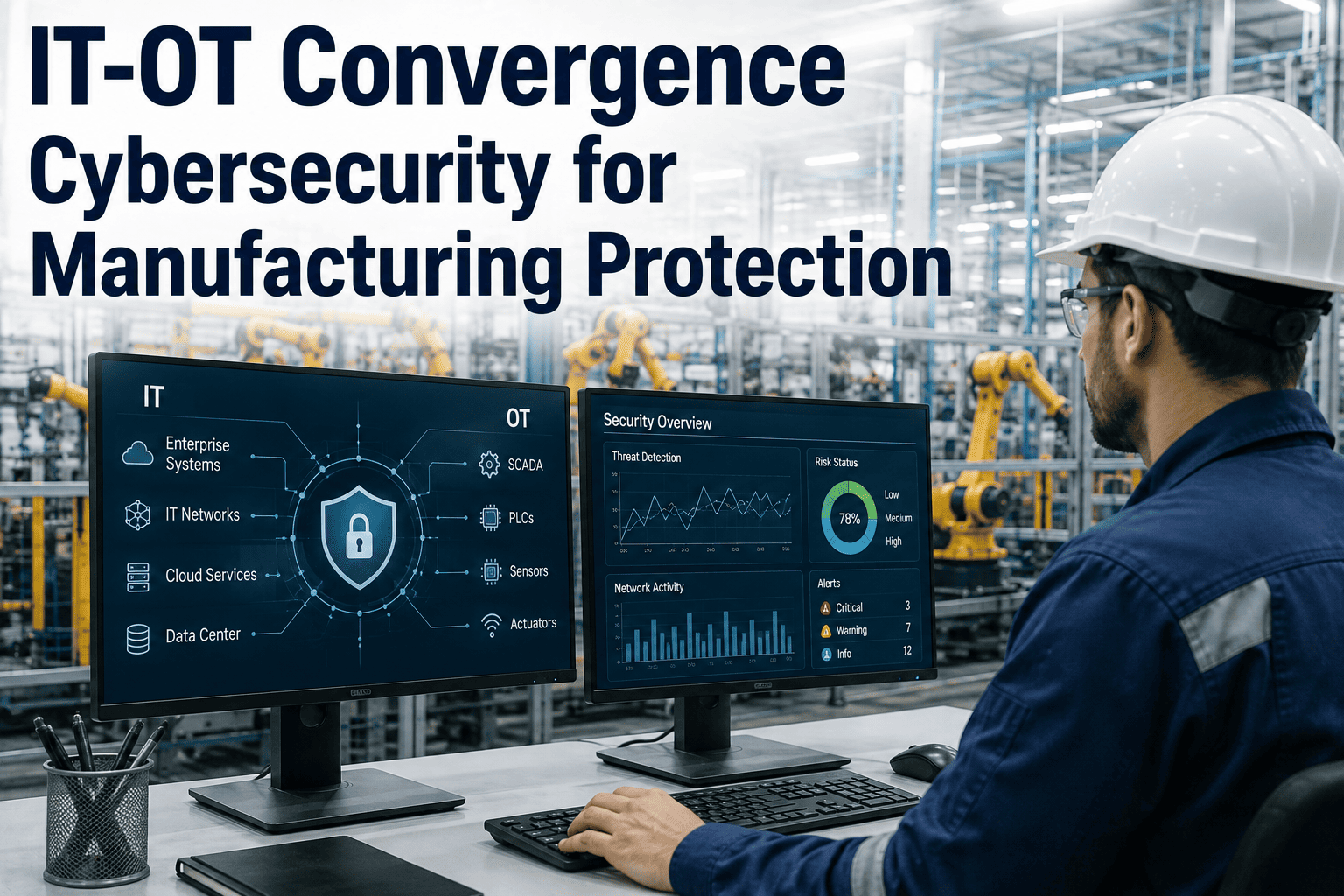
Manufacturing has been the #1 most cyberattacked industry for four consecutive years. In 2025, ransomware attacks against manufacturers surged 45% — with 1,156 recorded incidents and an average breach cost of $8.7 million. In Q1 2026 alone, manufacturing accounted for 29% of all global ransomware targets. Your factory isn't just a production facility — it's a high-value target operating with legacy PLCs that haven't been patched since 2018, SCADA systems connected to networks they were never designed for, and an IT/OT convergence that created attack surfaces nobody planned for. The threat isn't theoretical. It's happening right now — and the manufacturers who survive it are the ones building defense architectures today.
AI-Native Digital Transformation for Smart Manufacturing
Join iFactory's expert-led session covering how AI-native architecture — including sovereign data processing, IEC 62443-aligned security, and zero-trust OT design — protects smart factories while enabling real-time intelligence.
The convergence of IT and OT has created an attack surface that didn't exist a decade ago. Legacy PLCs speaking Modbus and PROFINET — protocols designed in the 1990s with zero authentication — are now connected to enterprise networks, cloud platforms, and AI systems. 65% of manufacturing APIs still use legacy protocols with no built-in security. 40% of OT security incidents cause operational disruption. And the ransomware groups targeting factories — Qilin, Akira, Safepay — are growing more sophisticated, more numerous (134 active groups in 2025, up 30%), and more aggressive. The question isn't whether your factory will be targeted. It's whether your architecture is ready when it happens.
The Manufacturing Threat Landscape: What the 2025–2026 Data Shows
The numbers tell a clear story: manufacturing is under sustained, escalating assault — and traditional IT security approaches aren't enough for OT environments. Here's the threat landscape backed by data from IBM, KELA, Bitsight, SANS, and NordStellar:
The critical insight: Organizations that refused to pay achieved 97% data recovery from backups, compared to only 46% for those who paid. Paying the ransom correlates with an 80% re-attack rate. The defense is architecture — not negotiation.
Why Factories Are Uniquely Vulnerable: The 5 Structural Weaknesses
Manufacturing's cybersecurity problem isn't a lack of firewalls — it's structural. The convergence of IT and OT created attack surfaces that traditional security tools were never designed to protect:
iFactory runs on-premise with zero external data transmission. Your maintenance data, asset histories, and AI models never leave your network. See how iFactory's sovereign architecture protects your factory →
The Defense Architecture: IEC 62443 + Zero Trust for OT
Protecting a factory requires a fundamentally different approach than protecting an office network. IEC 62443 — the international standard for industrial automation cybersecurity — provides the framework, and zero-trust principles provide the enforcement model. Here's how they combine:
Key principle: In manufacturing cybersecurity, the goal isn't to prevent every intrusion — it's to ensure that when (not if) an attacker gets in, they can't reach production systems. Network segmentation, zero-trust access, and sovereign data processing create the architectural barriers that contain threats before they become shutdowns.
How iFactory Protects Your Factory by Design
iFactory is architected for manufacturing environments where data sovereignty, operational continuity, and IEC 62443 alignment are non-negotiable. Here's how security is built into every layer:
- On-premise deployment — zero data leaves your network
- Edge AI inference locally — no cloud API dependencies
- Role-based access control with full audit trails
- Encrypted data at rest and in transit
- IEC 62443 zone-compatible network architecture
- Operational data transmitted to third-party cloud servers
- AI models trained on your data by external vendors
- Internet outage = loss of CMMS access during critical events
- Vendor data breaches expose your maintenance intelligence
- Compliance complexity with cross-border data regulations
iFactory: AI-Powered CMMS Built for Sovereign Manufacturing
Your maintenance data is your competitive intelligence. iFactory keeps it where it belongs — inside your network, under your control, protected by architecture designed for the most targeted industry on earth. See the sovereign difference in 30 minutes.
The 5-Step Cybersecurity Roadmap for Manufacturers
You don't need a $10 million security overhaul. The most effective approach targets the highest-risk vectors first and builds layered defenses incrementally. Here's the proven sequence:
You can't protect what you can't see. Map every PLC, HMI, SCADA system, and network connection. iFactory's asset management creates a complete digital inventory of every device on your floor — the foundation for every security decision that follows.
Separate IT and OT into defined security zones with monitored conduits between them. No flat network paths from corporate email to production controllers. This single step prevents 70%+ of lateral movement attacks.
Deploy iFactory as your on-premise CMMS with edge AI. All maintenance data, predictive models, and work order systems run inside your network. Eliminate cloud data exfiltration risk while gaining full AI-powered maintenance intelligence.
Deploy AI-powered OT network monitoring that detects protocol violations, unauthorized PLC commands, and behavioral anomalies in real time. Integrate alerts with iFactory for automated incident documentation and response tracking.
Implement air-gapped, immutable backups of all critical systems — PLC configurations, SCADA programs, CMMS databases, and production recipes. Test recovery quarterly. Organizations with tested backups achieve 97% data recovery without paying ransom.
Frequently Asked Questions
Three factors combine: high revenue potential makes manufacturers willing to pay ransoms to restore production, legacy OT systems have underdeveloped security frameworks with unpatched vulnerabilities, and the convergence of IT/OT creates attack surfaces that traditional security tools weren't designed to protect. Unlike banks or tech companies, most manufacturers lack dedicated cybersecurity teams and operate equipment that can't be easily patched without production shutdowns.
IEC 62443 is the international standard series for cybersecurity in industrial automation and control systems. It provides a framework for securing IACS from design to operation — defining security zones, conduit requirements, and security levels for each component. Unlike IT-focused standards like ISO 27001, IEC 62443 specifically addresses the unique constraints of OT environments: systems that can't be easily patched, protocols without authentication, and equipment that must operate 24/7.
iFactory supports on-premise deployment where all maintenance data, asset histories, AI models, and work orders remain inside your network perimeter. Edge AI inference runs locally — no operational data is transmitted to cloud APIs. Access is controlled through role-based permissions with full audit trails. The architecture aligns with IEC 62443 zone concepts, sitting within the MES/CMMS layer with defined, monitored connections to both the shop floor and enterprise systems.
The data strongly argues against it. Organizations that refused to pay achieved 97% data recovery from backups, compared to only 46% for those who paid. Paying correlates with an 80% re-attack rate — attackers know you'll pay again. The defense is investment in immutable backups, network segmentation, and incident response plans — not negotiation budgets. The average ransom payment ($115K median) is a fraction of the average breach cost ($8.7M), making prevention dramatically more cost-effective than response.
The highest-impact steps — asset inventory, network segmentation planning, and deploying iFactory as a sovereign CMMS — can begin within weeks. Network segmentation implementation typically takes 2–4 months for critical zones. Full IEC 62443 alignment is a 6–12 month journey. But the first step — knowing what's on your network and deploying sovereign operational tools — delivers immediate risk reduction. Book a demo and we'll map your current exposure together.
Your Factory Is a Target. Your Architecture Is Your Defense.
Every month without sovereign data processing, network segmentation, and AI-powered OT monitoring is a month of exposure to the 134+ active ransomware groups targeting manufacturers right now. iFactory gives you the operational intelligence you need — with the security architecture the #1 targeted industry demands.