In January 2026, CISA issued high-priority advisories for critical vulnerabilities in Siemens SIMATIC S7-1200 CPUs — controllers embedded in thousands of manufacturing plants worldwide. That same quarter, the Waterfall Threat Report revealed that nation-state attacks on critical infrastructure had doubled year-over-year, even as ransomware incidents temporarily slowed. The message is unmistakable: the factory floor is now a frontline. The air gap that once protected operational technology from cyber threats has evaporated. Every sensor, PLC, HMI and SCADA system connected to your network is a potential entry point — and 88% of firms in North Asia alone reported at least one OT incident in the last twelve months. Traditional IT security tools were not built for industrial environments where a misapplied patch can halt a production line and a firewall reset can shut down a furnace. AI-powered industrial cybersecurity solves this by understanding both the cyber threat landscape and the operational context — detecting attacks without disrupting the processes it protects.
AI-Powered Defense
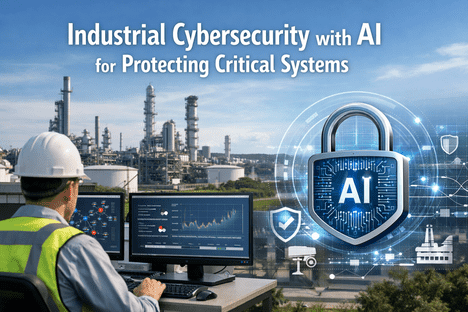
Industrial Cybersecurity with AI for Protecting Critical Systems
Detect OT threats in real time, defend SCADA and ICS networks, and maintain production uptime — without disrupting the operations you are protecting.
$90.8B
Industrial cybersecurity market in 2025, growing at 9.6% CAGR
88%
Of industrial firms reported at least one OT cyber incident last year
111K
OT devices with known exploitable vulnerabilities found in 2025 audit
75%
Of large manufacturers deploying AI-enabled OT cyber defense by 2030
Sources: Mordor Intelligence · Claroty · Telstra International · IDC Manufacturing FutureScape
Why Industrial Systems Are Under Siege
Manufacturing commands 64.6% of the industrial cybersecurity market for one reason: it is the most attacked sector. The convergence of IT and OT networks, the explosion of IIoT devices, and the persistence of legacy systems running unsupported firmware have created an attack surface that expands faster than most security teams can monitor. Attackers know that a ransomware payload on a production line inflicts operational damage that companies will pay to stop — and they are tailoring attack tools specifically for industrial protocols.
64.6%
Manufacturing's share of industrial cybersecurity spending — the most targeted sector globally
IT/OT Convergence
More than half of OT assets are now directly addressable on IT networks — creating lateral movement paths that never existed in air-gapped plants. Every connection is a potential attack vector.
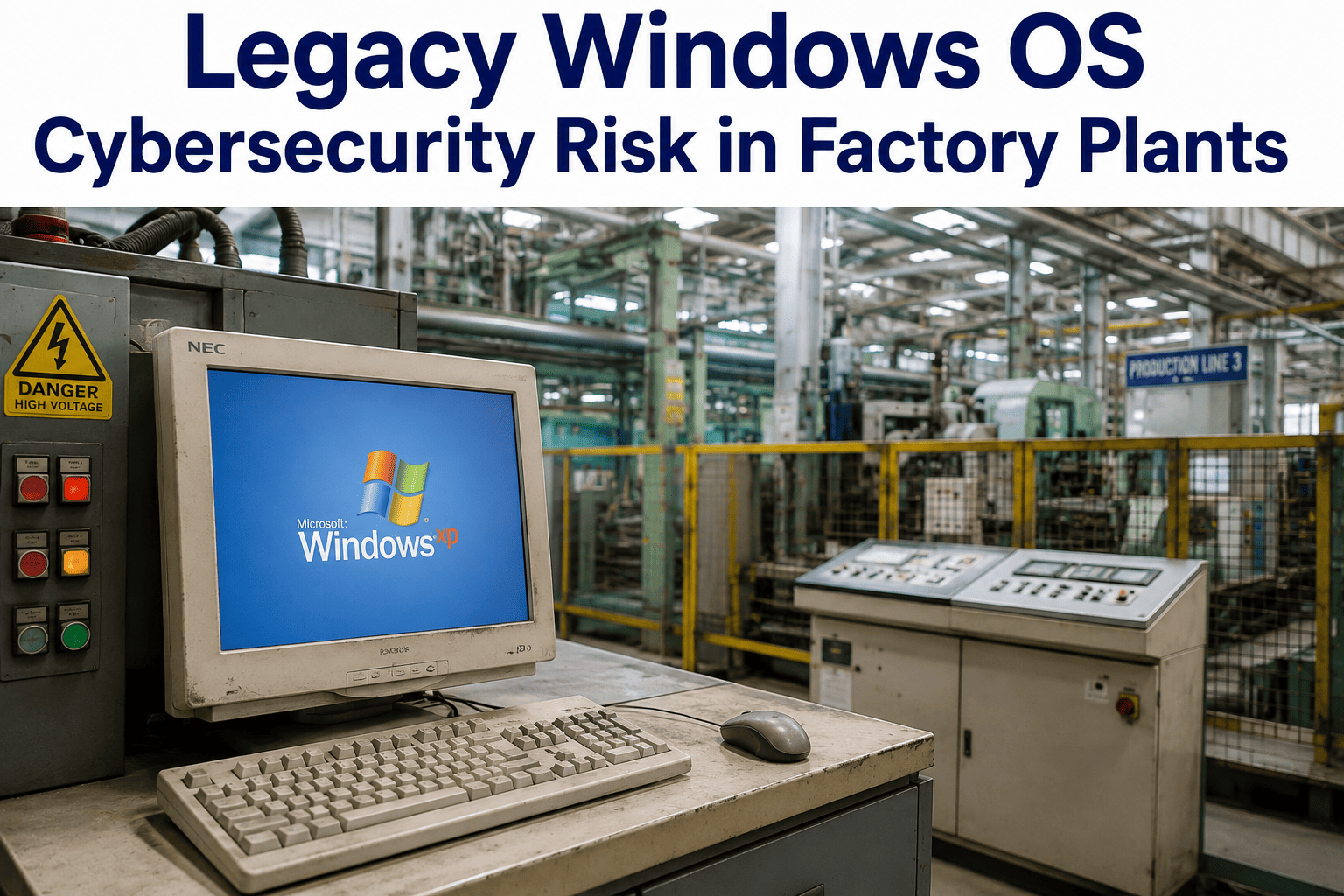
Legacy Vulnerability
Industrial assets remain active for 15 to 20 years — long past vendor patch commitments. Claroty's 2025 audit found 111,000 OT devices with known exploitable vulnerabilities, 68% linked to ransomware toolchains.
Tailored Ransomware
Groups like Medusa now customize payloads for industrial protocols, exploiting legacy equipment and weak network segmentation to maximize operational disruption and ransom pressure.
Nation-State Escalation
Nation-state attacks on critical infrastructure doubled in 2025. Power grids, water systems, and manufacturing are strategic targets — not just financial ones.
Skills Shortage
72% of organizations report staffing challenges in OT security. The expertise gap between IT security teams and OT engineers leaves industrial networks in a governance blind spot.
IT Security vs. OT Security: Why Traditional Tools Fail on the Factory Floor
The fundamental difference between IT and OT environments is consequence. In IT, a security incident means data loss. In OT, a security incident can mean physical damage, safety hazards, environmental releases, and production shutdowns costing millions per hour. Security tools designed for office networks create unacceptable risks when applied to industrial control systems.
Priority
Confidentiality first
Availability and safety first
Downtime Tolerance
Minutes to hours acceptable
Zero — any stop costs production
Patching
Automatic, frequent updates
45% delay patches due to production risk
Asset Lifespan
3–5 year refresh cycles
15–20 years, often beyond vendor support
Protocols
TCP/IP, HTTP, standard encryption
Modbus, DNP3, OPC — often unencrypted
Failure Impact
Data breach, financial loss
Physical damage, safety incidents, environmental release
How AI Defends Industrial Systems
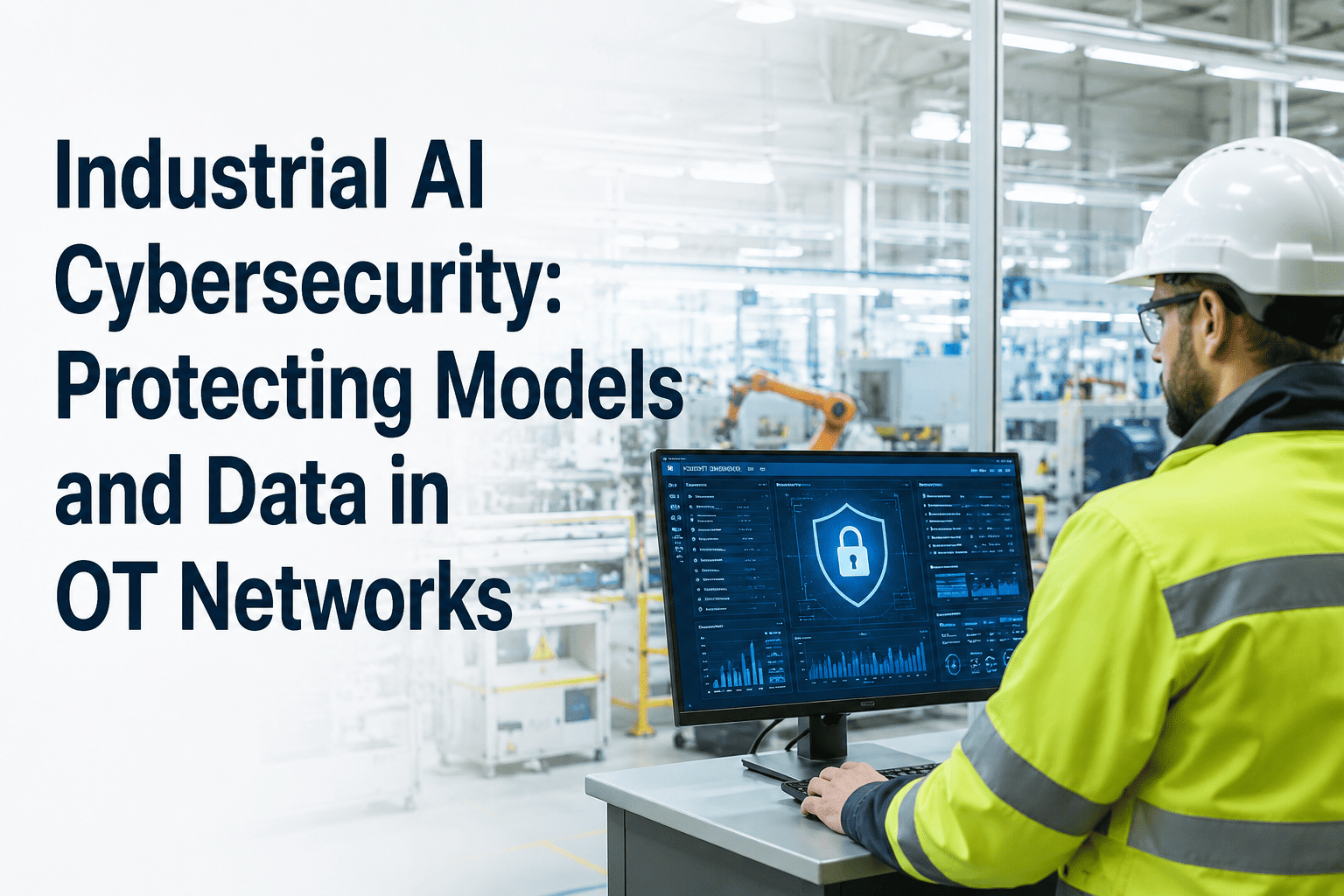
AI-powered industrial cybersecurity works by understanding both network behavior and physical process behavior — detecting threats that traditional signature-based tools miss because they manifest as subtle operational anomalies, not recognizable malware signatures.
01
OT Network Behavioral Analysis
AI maps every device, connection, and communication pattern across your OT network — building a dynamic baseline of normal behavior. Any deviation — new device appearing, unusual protocol usage, unexpected data flows — triggers an immediate alert without disrupting operations.
02
Process Anomaly Correlation
Unlike IT-only tools, AI correlates network anomalies with physical process data — temperature, pressure, flow rates, motor speeds. A command that looks legitimate on the network but would cause an unsafe process condition is flagged as a potential attack, not a routine instruction.
03
Zero-Trust Asset Verification
AI validates every user, device, and data flow across converged IT/OT networks — preventing lateral movement from a compromised IT system into production-critical OT zones. Each session is authenticated dynamically, even in environments without network connectivity.
04
Vulnerability Prioritization
Not all vulnerabilities are equal. AI scores each vulnerability by exploitability, asset criticality, and blast radius — so your team remediates the 68% linked to active ransomware toolchains first, instead of drowning in a list of 111,000 findings.
05
Automated Incident Response
When a threat is confirmed, AI initiates containment actions in milliseconds — isolating compromised segments, blocking malicious traffic, and alerting response teams — while maintaining safe operating conditions on unaffected production zones.
06
Predictive Threat Intelligence
AI forecasts vulnerabilities before they are exploited — analyzing firmware versions, patch status, configuration drift, and threat intelligence feeds to identify which assets are most likely to be targeted next and recommend proactive hardening actions.
Need a security posture assessment for your OT environment? Book a free industrial security review.
The Regulatory Landscape: Compliance Is No Longer Optional
Governments worldwide are enforcing stricter cybersecurity standards for industrial operators. Non-compliance now carries direct financial penalties, operational restrictions, and board-level liability. AI-driven security platforms automate the compliance evidence collection that manual processes cannot sustain.
IEC 62443
Global
The international standard for industrial automation and control system security. Defines security levels, zone architecture, and lifecycle requirements for manufacturers and asset owners.
NIS 2 Directive
European Union
Expanded scope covers manufacturing, energy, transport, and digital infrastructure. Mandates risk management, incident reporting within 24 hours, and board-level accountability for cybersecurity.
CISA ICS Advisories
United States
Continuous high-priority vulnerability advisories for industrial control systems. CISA allocated over $91 million in 2025 for infrastructure cybersecurity resilience programs.
NIST CSF 2.0
United States
Updated framework emphasizing governance, supply chain risk, and continuous improvement. Widely adopted as baseline for manufacturing cybersecurity programs.
CRA (Cyber Resilience Act)
European Union
Requires manufacturers of products with digital elements to meet mandatory cybersecurity requirements throughout the product lifecycle — including connected industrial equipment.
Industries Where AI Cybersecurity Is Mission-Critical
Power & Energy
Grid disruptions affect millions. AI monitors SCADA systems, substation controllers, and distributed energy resources — detecting intrusions that target power generation and distribution infrastructure.
Oil, Gas & Chemicals
Process safety systems are literal lifelines. AI defends DCS, safety instrumented systems, and pipeline control networks against attacks designed to cause physical damage or environmental releases.
Manufacturing
The most targeted industrial sector. AI secures robotic controllers, CNC machines, PLCs, and MES systems — preventing ransomware from encrypting production-critical assets and halting output.
Water & Wastewater
Attacks on treatment chemicals can threaten public health. AI monitors process control systems for unauthorized command changes that could alter chemical dosing or bypass treatment stages.
Transportation
Rail, port, and logistics operations depend on networked control systems. AI detects anomalous traffic patterns, unauthorized access attempts, and firmware tampering across distributed infrastructure.
The Investment Is Accelerating
AI in cybersecurity reached $29.6 billion in 2025 and is projected to hit $167.8 billion by 2035 at an 18.9% CAGR. The OT security market alone will grow from $22.6 billion in 2026 to $40.5 billion by 2033. Meanwhile, 73% of global manufacturers now rely on managed security partners to fill the OT expertise gap. The cost of inaction — measured in ransomware payments, production losses, regulatory penalties, and reputational damage — now far exceeds the cost of AI-powered protection.
$167.8B
AI cybersecurity market by 2035
73%
Of manufacturers using managed OT security partners
Deploy AI Industrial Cybersecurity in 8 Weeks
Week 1–2
OT Asset Discovery & Network Mapping
Passive network discovery identifies every connected OT device — PLCs, HMIs, RTUs, sensors, switches — without sending traffic that could disrupt operations. Build a complete asset inventory with firmware versions, communication patterns, and vulnerability status.
Week 3–4
Behavioral Baseline & Threat Modeling
AI learns normal network behavior and process patterns for every asset and communication path. Simultaneously, threat models are built based on your specific architecture, vulnerability profile, and industry threat intelligence.
Week 5–6
Detection Activation & Response Playbooks
Activate AI-driven threat detection with classified alerts and severity scoring. Configure automated response playbooks — network segment isolation, traffic blocking, escalation routing — tailored to your operational constraints and safety requirements.
Week 7–8
Compliance Mapping & Continuous Monitoring
Map detection and response capabilities to IEC 62443, NIS 2, NIST CSF, and your industry-specific frameworks. Activate continuous monitoring dashboards with compliance evidence automation. Begin ongoing threat intelligence integration.
Ready to secure your OT environment without disrupting production? Schedule your free industrial security assessment.
Frequently Asked Questions
What is industrial cybersecurity and why is AI needed?
Industrial cybersecurity protects operational technology systems — PLCs, SCADA, DCS, HMIs, and IIoT devices — from cyber threats that could disrupt production, damage equipment, or cause safety incidents. AI is needed because traditional signature-based security tools cannot detect novel attacks on industrial protocols, and the volume of OT network traffic exceeds human monitoring capacity. AI learns normal behavior for each asset and flags deviations in real time.
Book a demo to see AI OT security in action.
How is OT cybersecurity different from IT cybersecurity?
OT environments prioritize availability and safety over confidentiality. Industrial assets run for 15 to 20 years on unsupported firmware, use proprietary unencrypted protocols like Modbus and DNP3, and cannot tolerate patching-related downtime. A security tool that restarts a PLC or blocks a SCADA command could cause physical damage. AI-powered OT security monitors passively and detects threats without disrupting the processes it protects.
What regulations require industrial cybersecurity compliance?
Key frameworks include IEC 62443 (global industrial control system security standard), NIS 2 Directive (EU — mandatory for manufacturing, energy, and transport), NIST CSF 2.0 (U.S. baseline framework), CISA ICS advisories (U.S. vulnerability management), and the EU Cyber Resilience Act for connected industrial products. Non-compliance carries direct financial penalties and board-level liability.
Can AI cybersecurity be deployed without disrupting production?
Yes. AI OT security uses passive network monitoring — it observes traffic without injecting packets or altering network behavior. Asset discovery, behavioral baselining, and threat detection all operate without sending any traffic that could interfere with industrial control systems. Automated response actions are configured with operational safety constraints to prevent security measures from causing process disruptions.
Schedule a demo to see passive OT monitoring.
How does AI detect threats that traditional security tools miss?
Traditional tools rely on known threat signatures — they catch recognized malware but miss novel attacks. AI learns the unique behavioral baseline of every OT device and network path, detecting anomalies that indicate an attack even when the specific malware has never been seen before. AI also correlates network anomalies with physical process data — flagging commands that are technically valid but operationally dangerous.
The Air Gap Is Gone. Your Defense Must Evolve.
Every Connected Sensor Is a Potential Entry Point. AI Makes Every One a Monitored Checkpoint.
iFactory deploys AI-powered OT cybersecurity alongside your existing industrial infrastructure — providing real-time threat detection, automated response, and compliance reporting without disrupting the operations it protects.
Passive
Monitoring — zero disruption to running operations
8 Weeks
From deployment to full OT threat detection
IEC 62443
NIS 2, NIST CSF compliance mapping built in
24/7
Continuous AI-driven monitoring across all OT assets