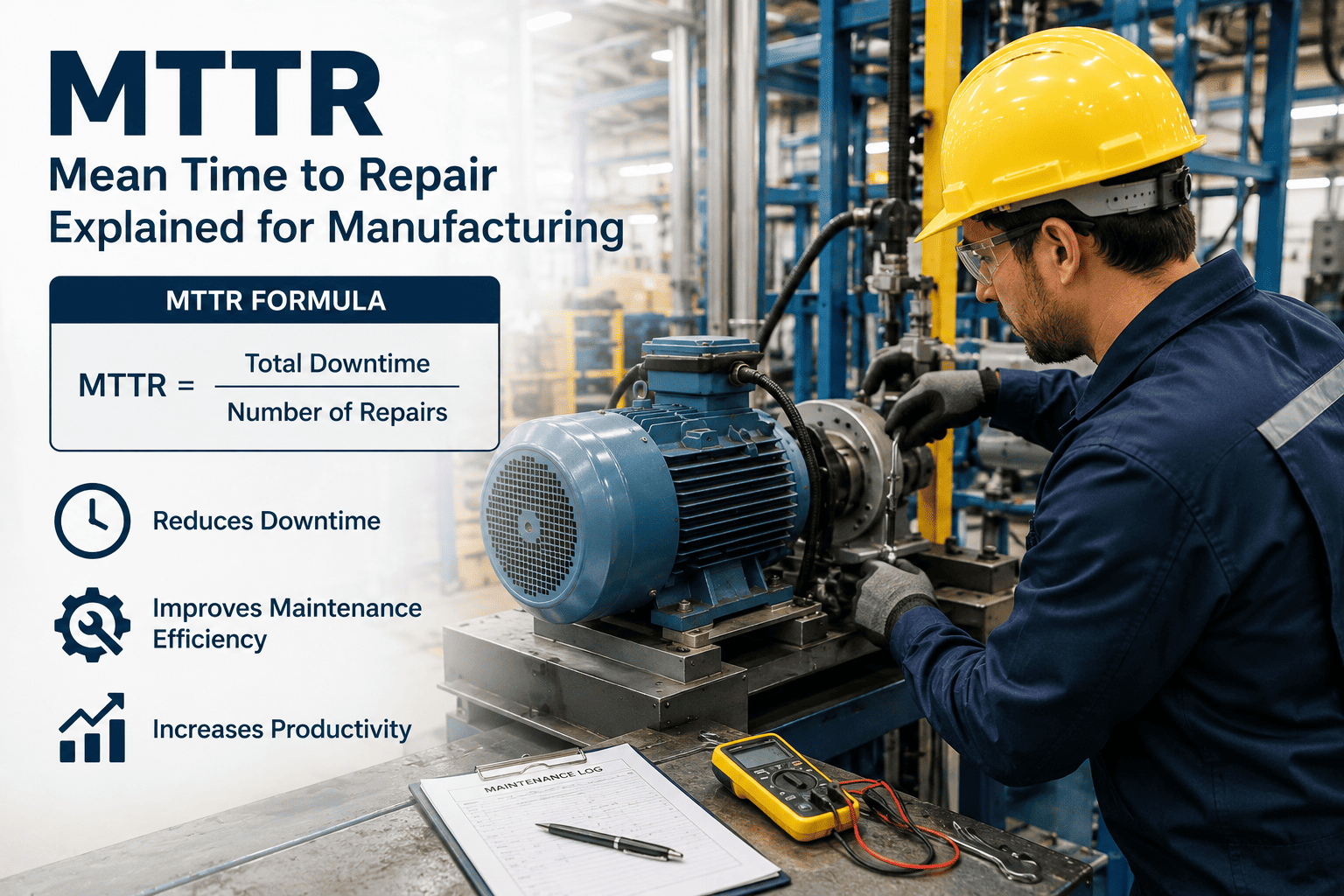
When a critical machine goes down, the clock that matters most to production isn't how often it fails — it's how long it stays down once it has. Mean Time To Repair captures that second number, and it's often the more actionable one, because unlike failure frequency, which can take months of reliability work to shift, repair speed usually has several fast, low-cost improvements sitting untouched: a missing spare, a diagnostic step nobody standardized, a procedure that lives only in one technician's head. A working session with our team can walk through where your own repair time is going before deciding what to fix first.
MTTR Reduction Strategies for Faster Manufacturing Repair
Every minute of repair time breaks down into diagnosis, preparation, and the actual repair itself — and most plants can cut meaningful time from the first two without touching the technical skill of the repair at all.
Where Repair Time Actually Goes
Breaking Down a Repair Into Its Three Phases
A four-hour repair rarely spends all four hours on the actual technical fix. Separating the phases is what reveals which minutes are recoverable without adding technical training or new tooling at all.
Diagnosis
Identifying what actually failed — often the largest, most variable phase, and the one most affected by tribal knowledge gaps.
→
Preparation
Locating the right spare part, tool, or documentation before the physical repair can begin.
→
Execution
The physical repair or replacement itself, plus verification and restart.
Phase One
Cutting Diagnostic Time Without Adding Technician Headcount
Diagnosis is usually the single largest and most variable phase of a repair, because it depends heavily on which technician responds and what they happen to remember about that specific machine's failure history. A technician who has fixed the exact same failure mode before might diagnose it in five minutes; a different technician facing it for the first time might spend forty-five minutes working through possibilities the first technician would have ruled out immediately. Standardizing that knowledge — documented failure signatures, common fault trees for each critical asset, and searchable repair history tied to the specific machine and symptom — turns diagnosis from a function of individual experience into something any technician on shift can move through quickly, regardless of who happens to be on call when the failure occurs.
Find Out Which Repair Phase Is Actually Costing You Time
A short session breaks down recent repair events into diagnosis, preparation, and execution time, so you know exactly where to focus first.
Phase Two
Spare Parts Readiness Strategies by Impact
| Strategy | Addresses | Typical Impact on MTTR |
|---|---|---|
| Kitted spare parts by failure mode | Time searching the parts room mid-repair | High |
| Critical spares stocked on-site | Waiting on supplier lead time | Very high, for stocked items |
| Labeled, organized parts storage | General search time across all repairs | Moderate, cumulative |
| Pre-staged tool carts by asset type | Time gathering tools before starting | Moderate |
Phase Three
Standard Repair Procedures Reduce Variation, Not Just Time
A documented standard repair procedure for a known failure mode does more than shave minutes off the execution phase — it reduces the variation between technicians, which matters just as much as the average time itself. A repair that takes forty-five minutes for one technician and two hours for another isn't a technician skill problem so much as a documentation gap, and closing that gap benefits every future repair of that failure mode regardless of who's on shift when it happens. Building these procedures doesn't require starting from scratch: the fastest, most reliable source is usually the plant's own best-performing technician's actual method, captured in detail and turned into a repeatable reference rather than left as knowledge only that one person carries.
Turn Your Best Technician's Knowledge Into a Repeatable Procedure
Capture the fastest, most reliable repair method for your most common failure modes, so repair speed doesn't depend on who's on shift.
Where to Start
Prioritizing MTTR Improvements by Effort and Impact
Low Effort, High Impact
Kitting spares for the top five most frequent failure modes; documenting the diagnostic steps your best technician already uses.
Higher Effort, High Impact
Building searchable repair history tied to specific assets and failure symptoms across the full maintenance team.
Ongoing Investment
Cross-training technicians across asset types so repair speed doesn't depend on one specialist being on shift.
The fastest MTTR win I've seen repeatedly isn't a new tool or a training program — it's simply kitting the spare parts for the five failure modes that happen most often. Most plants already know what those five failures are; they just haven't pre-staged the parts for them, so every one of those repairs starts with a walk to the parts room and a search that a five-minute kitting project would have eliminated entirely.
Salomé Nakagawa-Brennan
Maintenance & Reliability Improvement Lead · 13 years in industrial repair operations
Frequently Asked
MTTR Reduction — Common Questions
What's a realistic MTTR target to aim for?
There's no universal target, since it depends heavily on equipment complexity and failure type — a better approach is tracking each asset's own MTTR trend and setting a target based on its own historical best, similar to how demonstrated capacity works for utilization. Book a review to set a realistic target from your own repair history.
Does reducing MTTR mean rushing repairs and risking quality?
No — the improvements that reduce MTTR most reliably target diagnosis and preparation time, not the technical repair itself, so a well-executed MTTR program actually improves repair consistency by standardizing procedures rather than encouraging technicians to work faster or skip steps.
How do we know which failure modes to prioritize for spare kitting?
Start with whichever failure modes occur most frequently and cause the most cumulative downtime, since these usually offer the fastest and most visible payback for the kitting effort. Ask our team to help identify your own top failure modes from existing maintenance records.
How is MTTR different from downtime duration reported to production?
MTTR specifically measures repair time from when work begins to when the asset is verified functional again, while total downtime reported to production often includes additional time waiting for a technician to respond, so the two numbers answer related but distinct questions. Book a session to clarify how these two metrics connect in your current reporting.
Can standard repair procedures work across a unionized or multi-shift maintenance team?
Yes — standard procedures tend to be well received across shift and union structures precisely because they capture the fastest, safest method already used by an experienced technician rather than imposing an outside standard, making the knowledge available to everyone instead of just whoever happens to be on shift. Contact support to discuss rollout across a multi-shift team.
Cut Repair Time Without Adding Headcount or New Tools
iFactory helps maintenance teams find where diagnosis, preparation, and execution time is actually going — so the fastest MTTR wins get found first.